
The Hands Behind Civilization: Why Carpenter Tools Remain the Foundation of the Global Furniture Industry Ecosystem
Deep Analysis of Carpentry Tools, Woodworking Culture, Furniture Manufacturing, Craftsmanship Skills & the Future of the Global Woodworking Economy
By The Furniture Times | Global Woodworking Intelligence Report | Global Woodworking & Machinery Desk | May 2026
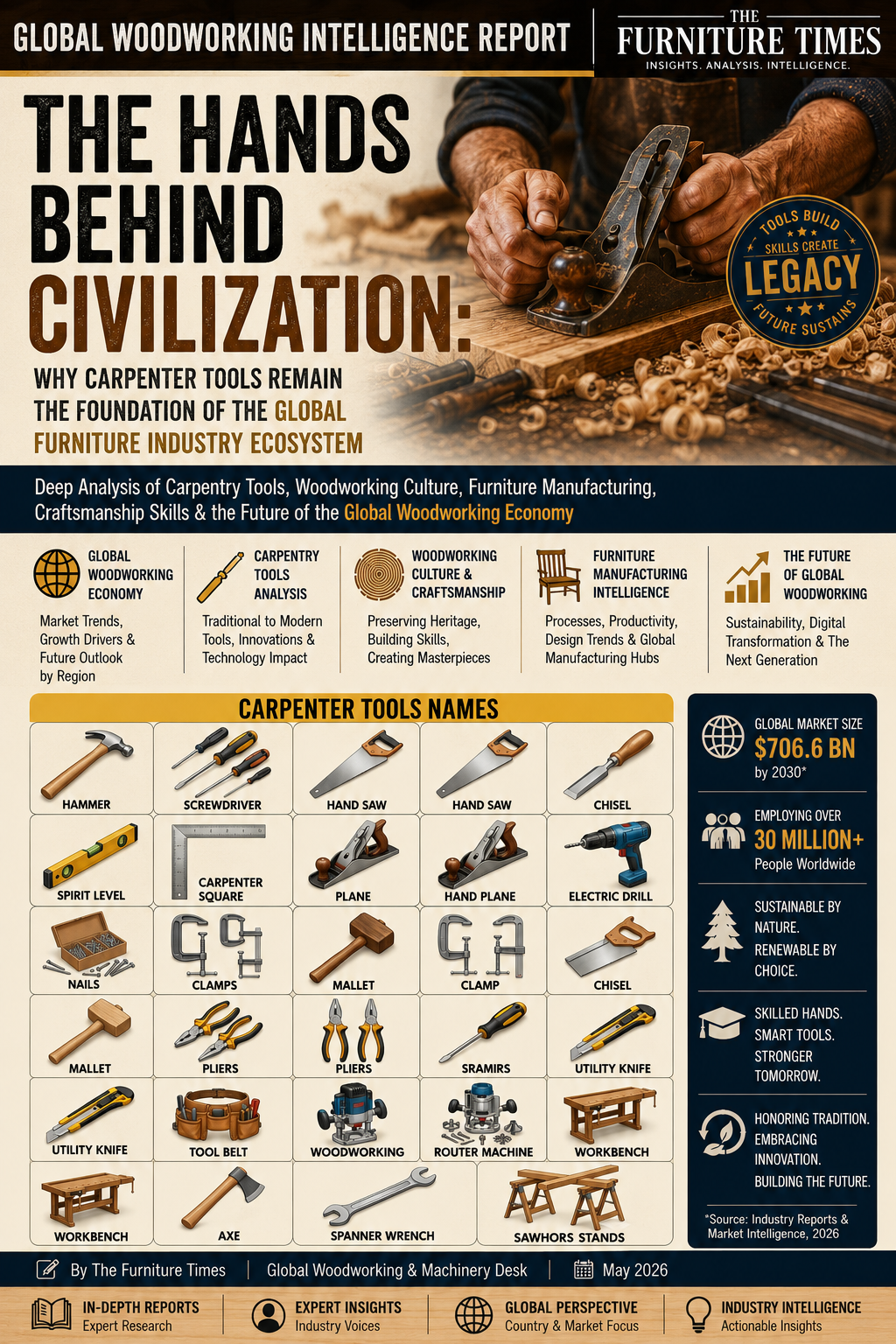
The image may appear simple at first glance.
A collection of carpenter tools:
hammers
screwdrivers
saws
chisels
drills
planes
clamps
routers
workbenches
But behind these tools exists:
the foundation of the entire furniture industry ecosystem.
Because before:
luxury furniture
modern interiors
CNC automation
AI-driven manufacturing
billion-dollar furniture exports
there was:
craftsmanship.
And craftsmanship began with tools.
Carpenter Tools Built the Furniture Industry
Every furniture product in the world begins with:
tools.
Before a chair exists,
before a cabinet is assembled,
before a luxury bed enters a showroom,
there is always:
measurement
cutting
shaping
joining
finishing
The image symbolizes:
the roots of furniture civilization.
These tools represent:
human skill
industrial evolution
technical precision
craftsmanship heritage
Without carpentry tools,
the furniture industry itself could never exist.
The Furniture Industry Still Depends on Human Hands
Even in the era of:
AI
CNC systems
robotics
smart factories
the furniture industry still fundamentally depends on:
skilled craftsmanship.
The tools shown in the image symbolize the continuing importance of:
carpenters
woodworkers
joinery specialists
craftsmen
installers
prototype makers
Machines accelerate production.
But craftsmanship still defines:
quality.
The Hammer: The Symbol of Construction & Creation
The hammer remains one of humanity’s oldest and most important tools.
Inside the furniture ecosystem, the hammer represents:
structure
assembly
force
precision
craftsmanship discipline
It symbolizes:
the beginning of physical creation.
Even in highly automated factories, manual assembly remains essential in many areas of:
upholstery
detailing
finishing
installation
Saws & Cutting Tools: Where Furniture Begins
The hand saw symbolizes:
transformation.
Raw timber becomes furniture through cutting.
This represents the first major stage in furniture production:
sizing
shaping
material preparation
Modern factories may use:
panel saws
beam saws
CNC cutting systems
but the philosophy remains unchanged:
precision defines quality.
Chisels & Planes Represent Craftsmanship Culture
The chisel and hand plane symbolize:
refinement.
These tools represent the artistic side of woodworking:
shaping edges
smoothing surfaces
refining details
perfecting joints
They symbolize patience.
Furniture craftsmanship has always depended on:
careful detail
disciplined workmanship
emotional connection to materials
This remains true even in 2026.
Measuring Tools Reflect the Rise of Precision Manufacturing
The carpenter square and spirit level symbolize:
accuracy.
Modern furniture manufacturing increasingly depends on:
engineering precision
dimensional control
production consistency
Poor measurements create:
instability
waste
poor fitting
structural weakness
This is why precision tools remain central to:
industrial quality systems.
Clamps Represent Structural Discipline
The clamp is one of the most underestimated tools in woodworking.
But symbolically,
it represents:
control and stability.
Furniture manufacturing depends heavily on:
pressure balance
alignment
structural consistency
Clamps help ensure:
glue bonding accuracy
joint stability
production precision
In many ways, clamps symbolize:
discipline inside craftsmanship.
Electric Drills & Routers Reflect Industrial Evolution
The image also highlights the evolution from:
traditional craftsmanship → industrial efficiency.
Modern tools like:
drills
routers
woodworking machines
represent:
productivity
scalability
precision engineering
industrial modernization
The global furniture industry increasingly combines:
manual craftsmanship
with:
advanced machinery ecosystems.
The Workbench Is the Heart of Woodworking
The workbench shown in the image symbolizes:
the workshop itself.
Historically, the workbench was:
the learning center
the creativity station
the craftsmanship laboratory
Furniture innovation often begins at:
the workbench.
Even billion-dollar furniture ideas begin with:
sketches
prototypes
measurements
material testing
The Global Woodworking Industry Is Massive
The image indirectly reflects the enormous scale of:
the woodworking ecosystem.
Globally, woodworking supports:
furniture manufacturing
cabinetry
construction interiors
hospitality projects
custom interiors
luxury residential markets
The woodworking machinery and carpentry ecosystem supports:
millions of jobs globally.
The Skills Crisis Facing the Furniture Industry
One of the biggest global challenges today:
declining skilled craftsmanship.
Many younger generations increasingly move toward:
digital careers
technology industries
office-based work
while traditional woodworking skills gradually decline.
This creates serious concern for:
furniture factories
custom furniture workshops
interior industries
artisan businesses
The image reminds the industry that:
craftsmanship must be preserved.
Why Carpenter Skills Still Matter in the AI Era
Artificial Intelligence can:
generate designs
optimize layouts
automate planning
But craftsmanship still requires:
touch
judgment
material understanding
human intuition
Wood behaves differently based on:
grain
humidity
density
finishing methods
This is why carpentry remains:
both science and art.
Furniture Manufacturing Is Becoming Hybrid
The future furniture industry increasingly combines:
traditional tools
digital systems
smart manufacturing
CNC automation
AI optimization
The future factory is becoming:
hybrid craftsmanship infrastructure.
The Emotional Value of Tools
The image also carries emotional meaning.
For many craftsmen, tools represent:
identity
dignity
livelihood
legacy
generational knowledge
A carpenter’s tools are not merely equipment.
They are:
extensions of craftsmanship itself.
Why the Furniture Industry Must Respect Its Roots
Modern furniture brands increasingly focus on:
technology
scale
automation
digital transformation
But this image reminds the industry of something important:
The furniture industry was built by human hands before machines.
The future industry must continue respecting:
craftsmanship culture
woodworking knowledge
skilled labour ecosystems
because these remain:
the soul of furniture manufacturing.
TFT Editor’s Philosophical Insight
The image teaches a powerful lesson:
Every luxury furniture product begins with simple tools and skilled human effort.
Behind every:
chair
table
cabinet
bed
sofa
exists:
measurement
cutting
shaping
patience
craftsmanship discipline
The furniture industry is not only manufacturing.
It is:
applied human intelligence through material creation.
Final Thought
The carpenter tools shown in the image may appear ordinary.
But collectively,
they represent:
the foundation of the global furniture ecosystem.
Without these tools:
there is no woodworking
no craftsmanship
no furniture factories
no interior design industry
no hospitality furniture
no luxury living environments
The tools symbolize:
industrial evolution
craftsmanship heritage
human creativity
economic infrastructure
And perhaps most importantly:
they symbolize the human hands behind civilization itself.
Closing Insight
“Long before AI, automation, and smart factories existed, humanity built comfort, shelter, and beauty with simple tools, disciplined craftsmanship, and patient human hands. The furniture industry still carries that legacy today.”
