
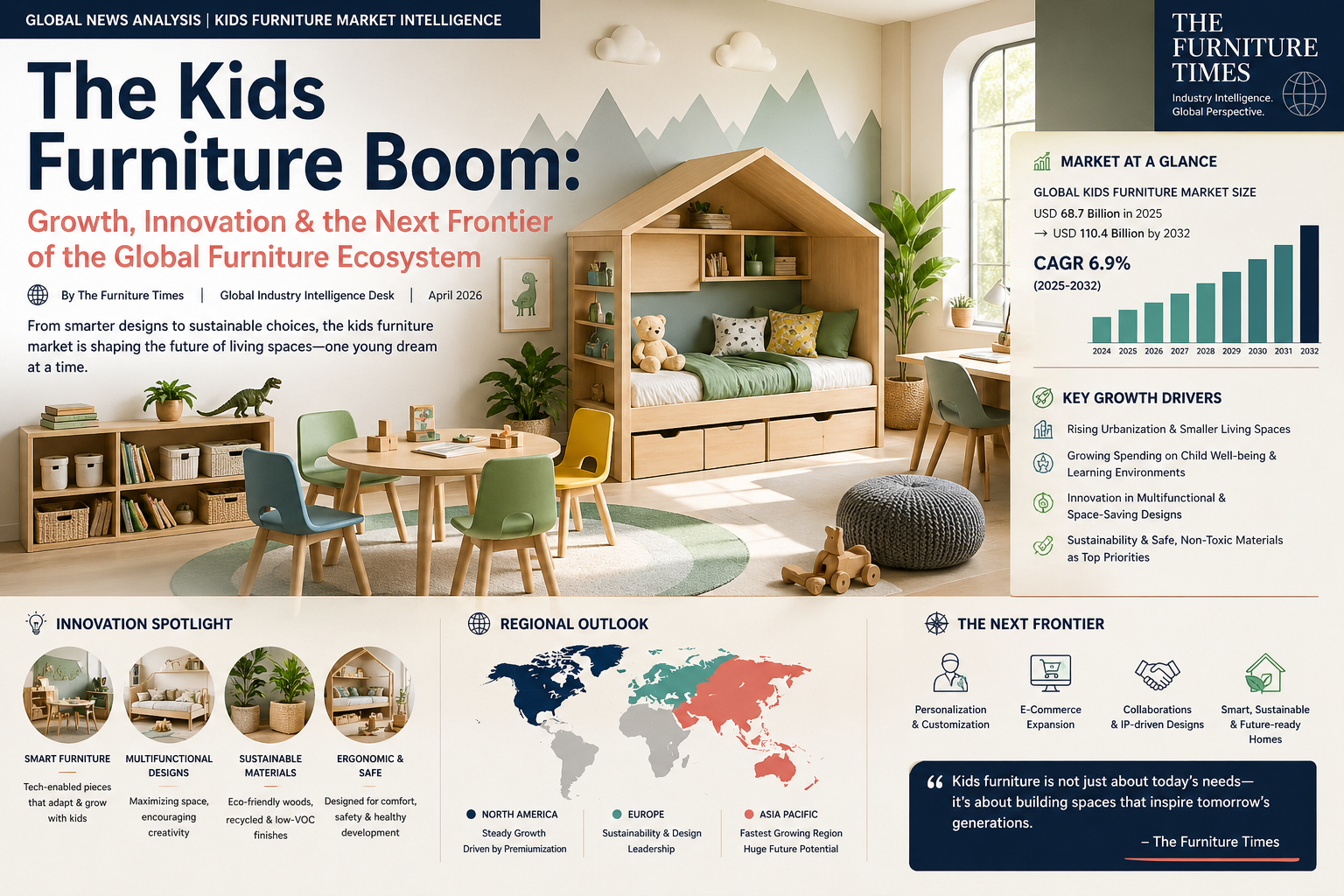
The Kids Furniture Boom: Growth, Innovation & the Next Frontier of the Global Furniture Ecosystem
Global News Analysis | Kids Furniture Market Intelligence
By The Furniture Times | Global Industry Intelligence Desk | April 2026
Introduction: A High-Growth Segment Reshaping the Industry
The global kids furniture market is rapidly emerging as one of the most dynamic and innovation-driven segments within the broader furniture ecosystem.
Recent research shows the market reaching approximately $91.88 billion in 2026, with projections to grow to nearly $177.68 billion by 2030, reflecting an exceptional ~17–18% CAGR.
This positions kids furniture not as a niche category—but as a major growth engine shaping the future of furniture design, retail, and digital discovery.
The Big Growth Drivers
1. Rising Global Demand for Child-Centric Living
The modern home is evolving—and children are at the center of this transformation.
Key drivers include:
- Increasing urban households with children
- Rising disposable incomes
- Growing focus on child comfort, learning, and safety
Parents are no longer buying basic furniture—they are investing in:
- Ergonomic study desks
- Creative play furniture
- Multi-functional beds and storage
This shift is turning kids furniture into a lifestyle-driven category, not just a necessity.
2. Multifunctional & Space-Saving Design Explosion
One of the strongest trends shaping the market:
Furniture that grows with the child
Examples include:
- Convertible cribs → toddler beds → study units
- Storage-integrated beds
- Foldable or modular furniture
Urbanization and smaller living spaces are accelerating demand for compact, adaptable furniture solutions.
3. E-Commerce Is Accelerating Market Access
The rise of online furniture sales is transforming how parents buy kids furniture:
- Easier product comparison
- Access to global brands
- Increased customization options
Digital channels are now one of the fastest-growing distribution segments, expanding the reach of manufacturers globally.
4. Safety & Sustainability Becoming Core Requirements
Parents today are more informed and selective.
Demand is increasing for:
- Non-toxic materials
- Rounded-edge safety designs
- FSC-certified wood
- Eco-friendly finishes
Safety is no longer optional—it is a purchase decision driver.
Market Structure: Where Growth Is Happening
Regional Highlights
- North America → largest market (premium spending, safety standards)
- Europe → sustainability-driven demand
- Asia-Pacific → fastest growth (urbanization + rising middle class)
Product Segments
- Beds, cribs, and cots dominate the market
- Storage furniture is one of the fastest-growing sub-segments
- Study desks and chairs are gaining importance due to hybrid learning trends
The Hidden Challenges
Despite strong growth, the kid’s furniture segment faces critical challenges:
1. Intense Competition
Thousands of global suppliers offering similar products → price pressure.
2. High Cost of Safety Compliance
Certified materials and safety standards increase production costs.
3. Demand Fragmentation
Different age groups require different designs → complex product development.
4. Digital Discovery Gap
Even with high demand, buyers still struggle to:
- Find the right suppliers
- Compare products globally
- Verify safety and certifications
The Real Problem: Discovery & Trust in a Growing Market
Here is the deeper issue:
The kid’s furniture market is growing—but the ecosystem is still unstructured.
- Parents struggle to find trusted brands
- Retailers struggle to source reliable suppliers
- Manufacturers struggle to gain global visibility
- Safety claims are difficult to verify
This brings us to the Search Bottom Line of Kids Furniture.
TFT Deep Analysis: From Growth to Intelligence
The kid’s furniture market is evolving across three stages:
Stage 1: Growth
Driven by population, lifestyle, and income
Stage 2: Visibility
Brands competing to be found online
Stage 3: Intelligence (Next Phase)
Buyers need:
- Verified products
- Safety assurance
- Smart recommendations
- Fast decision-making
Strategic Solution: What the Industry Must Do
1. Build Category-Specific Visibility
Businesses must clearly position themselves:
- Kids bedroom furniture manufacturers
- Nursery furniture suppliers
- Study desk and ergonomic chair specialists
- Montessori furniture providers
Without clear categorization → lost visibility
2. Focus on Safety Certification Transparency
Manufacturers should display:
- Material certifications
- Safety compliance standards
- Age-specific suitability
This builds trust and speeds up buying decisions.
3. Invest in Digital Product Experience
The future of kids furniture buying will depend on:
- 3D product visualization
- Room simulation tools
- Online customization
4. Strengthen Global Discovery Infrastructure
This is the biggest gap.
The industry needs:
- Structured supplier databases
- Verified listings
- Category-based search systems
- Global buyer-supplier matching
Role of FISE: The Missing Layer
The kids furniture segment highlights a major global issue:
There is no dedicated search engine for structured furniture discovery.
Furniture Industry Search Engine (FISE) can solve this by enabling:
- Global kids furniture supplier listings
- Category-based discovery (nursery, study, storage)
- Verified safety and certification filters
- AI-powered supplier matching
Example Use Case
A parent or retailer searching for:
“Safe wooden kids furniture suppliers in Malaysia”
Today:
- Scattered search results
- No clear verification
With FISE:
- Categorized suppliers
- Verified safety indicators
- Faster decision-making
Key Takeaways (April 2026)
1. Kids Furniture Is One of the Fastest-Growing Segments
Driven by lifestyle, safety, and education trends
2. Demand Is Becoming More Sophisticated
Parents demand quality, safety, and design
3. Digital Channels Are Reshaping Sales
E-commerce and discovery platforms are critical
4. Safety & Sustainability Are Non-Negotiable
Certification is becoming a key differentiator
5. Discovery & Trust Remain Broken
The industry lacks structured search and verification
Conclusion: Growth Needs Structure
The kids furniture market is expanding rapidly—but growth alone is not enough.
The real winners will be those who:
- Are visible globally
- Are trusted instantly
- Are clearly categorized
- Are easy to discover
Final Thought
The kids furniture market is not just about children.
It is about the future of the furniture industry itself.
And the future will be defined by:
Search + Trust + Intelligence
