
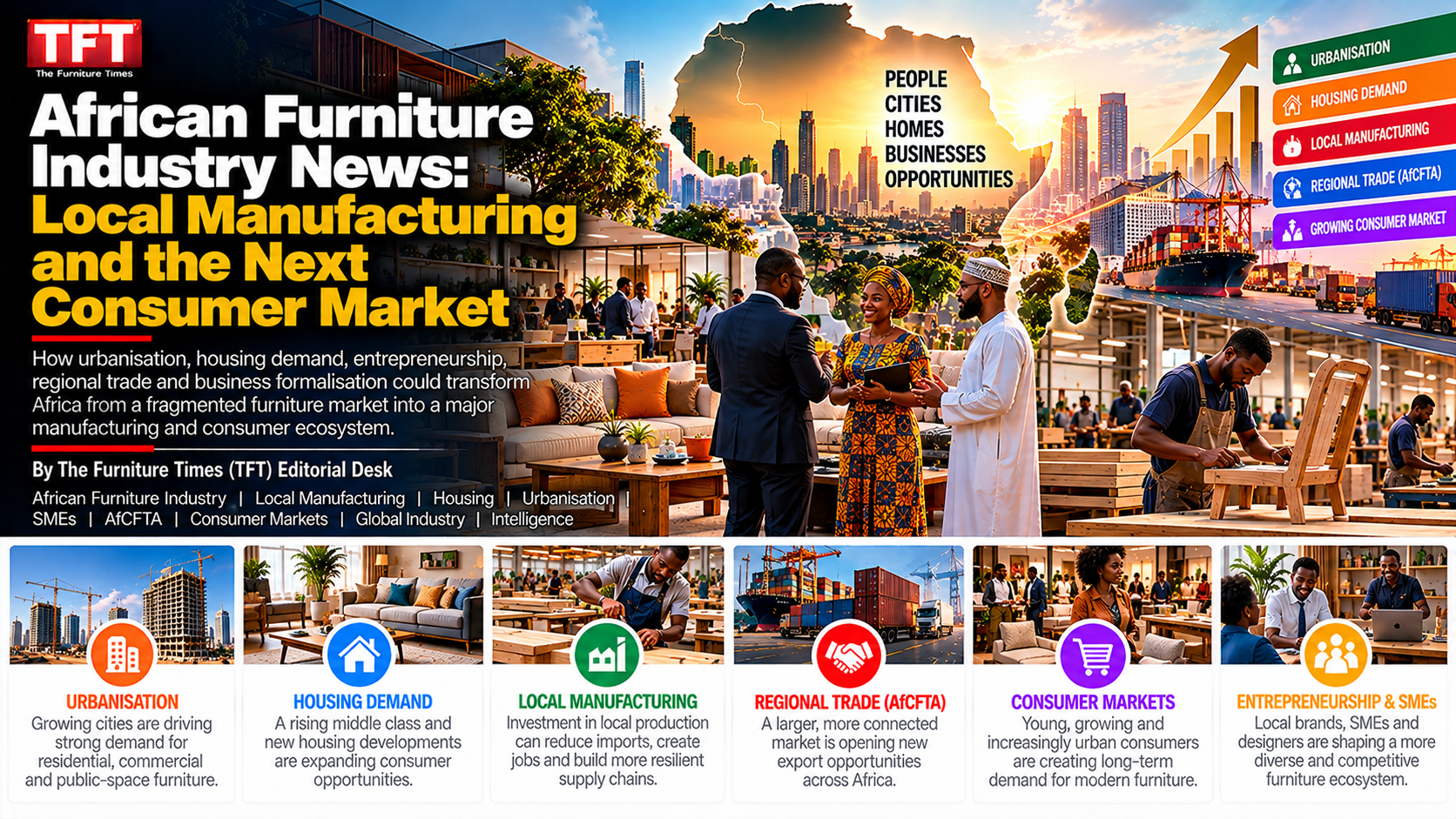
African Furniture Industry News: Local Manufacturing and the Next Consumer Market
African Furniture Industry News: Local Manufacturing and the Next Consumer Market
How urbanisation, housing demand, entrepreneurship, regional trade and business formalisation could transform Africa from a fragmented furniture market into a major manufacturing and consumer ecosystem
By The Furniture Times (TFT) Editorial Desk
African Furniture Industry | Local Manufacturing | Housing | Urbanisation | SMEs | AfCFTA | Consumer Markets | Global Industry Intelligence
Africa’s furniture industry is moving toward a decisive period.
The continent’s cities are expanding. Housing shortages are intensifying. A young population is establishing households, entering workplaces and creating businesses. Hotels, schools, hospitals, offices, rental properties and retail developments require furnishing. Digital commerce is making products more visible across borders, while the African Continental Free Trade Area is creating a framework for larger regional markets.
Yet Africa remains one of the world’s most fragmented furniture ecosystems.
The continent contains major timber resources, skilled artisans, established industrial manufacturers, metalworking capability, expanding foam and mattress production and a deep tradition of furniture-making.
At the same time, many markets remain heavily dependent on imports for:
- Finished furniture
- Engineered boards
- Hardware
- Mechanisms
- Fabrics
- Foam chemicals
- Coatings
- Wood-processing machinery
- Production technology
Local manufacturers frequently operate with unreliable electricity, limited access to affordable finance, informal supply chains, inconsistent material quality and weak regional distribution.
The opportunity is therefore larger than selling more tables, beds, chairs and sofas.
Africa has the potential to create integrated furniture value chains connecting:
Forestry → timber processing → board manufacturing → components → furniture production → logistics → retail → installation → repair → reuse
Whether that potential becomes a major industrial reality will depend on policy, infrastructure, finance, training, formalisation and the ability of African furniture businesses to scale without losing their local identity.
Africa Is Not One Furniture Market
Any serious analysis must begin with a warning: Africa cannot be treated as one uniform consumer market.
It consists of 54 countries with different:
- Income levels
- Languages
- Legal systems
- Trade rules
- Currency conditions
- Housing structures
- Consumer preferences
- Manufacturing capabilities
- Retail networks
- Logistics infrastructure
- Timber resources
- Urbanisation patterns
North Africa has strong links with Europe, the Mediterranean and the Middle East.
West Africa contains large consumer markets, entrepreneurial manufacturing clusters and extensive informal furniture production.
East Africa combines rapid population growth, expanding cities, tourism demand and growing regional integration.
Central Africa possesses significant forest resources but still exports too much value in raw or semi-processed form.
Southern Africa contains some of the continent’s most established industrial, retail and design capabilities, led by South Africa, while also facing weak growth, import pressure and infrastructure constraints.
The African furniture opportunity should therefore be approached as a series of connected regional markets—not one standard continental strategy.
Urbanisation Is the Largest Structural Driver
Africa’s cities are being built now.
UN-Habitat’s State of African Cities Report 2026 identifies urbanisation as one of the continent’s most consequential megatrends. It projects that Africa’s urban population could reach approximately 1.4 billion by 2050 and notes that more than half of the continent’s future urban infrastructure has yet to be constructed.
Every new urban household creates potential demand for:
- Beds
- Mattresses
- Wardrobes
- Tables
- Seating
- Storage
- Kitchen furniture
- Children’s furniture
- Outdoor products
- Work-from-home furniture
Every growing city also requires:
- School desks and chairs
- Hospital furniture
- Office furniture
- Hotel furniture
- Restaurant furniture
- Retail fixtures
- Public-space furniture
- Student accommodation
- Rental-property packages
This makes urbanisation more than a demographic story.
It is a furniture-demand story.
But urban growth does not automatically create an affluent market
Many African cities are expanding faster than formal employment, infrastructure and household income.
Urban families may face:
- High housing costs
- Limited living space
- Irregular income
- Transport expenses
- Energy costs
- Limited access to consumer credit
- Currency and inflation pressure
The market opportunity will therefore not be captured only by premium imported furniture.
It will require products that are:
- Affordable
- Durable
- Compact
- Repairable
- Easy to transport
- Available in stages
- Suitable for rental housing
- Adapted to local climate
- Compatible with irregular room dimensions
- Supported by local service
Africa’s Housing Deficit Is Also a Furniture Challenge
UN-Habitat stated in April 2026 that Africa faced a housing deficit exceeding 51 million units, potentially rising to 130 million by 2030.
The numbers underline the scale of unmet need, but housing and furniture demand should not be confused.
A new house is not automatically a fully furnished home.
Many households furnish gradually:
- Mattress
- Bedframe
- Storage
- Dining table
- Chairs
- Sofa
- Additional bedroom furniture
- Decorative and outdoor products
This creates opportunities for manufacturers and retailers that understand staged purchasing.
The furniture industry must connect with housing policy
Affordable-housing programmes usually focus on:
- Land
- Finance
- Infrastructure
- Construction
- Utilities
Furniture is frequently treated as an afterthought.
However, poorly planned furniture can make small homes less functional.
The industry can contribute through:
- Space-efficient products
- Modular storage
- Folding furniture
- Sofa beds
- Bunk beds
- Stackable seating
- Integrated work-and-dining furniture
- Furniture packages for first-time homeowners
- Locally manufactured kitchen and wardrobe systems
Housing delivery should be considered incomplete if families cannot use the space effectively.
The Next Consumer Market Will Not Be Built on Luxury Alone
Africa contains affluent consumer segments and important luxury markets in cities such as:
- Cairo
- Casablanca
- Marrakech
- Johannesburg
- Cape Town
- Lagos
- Abuja
- Nairobi
- Accra
- Abidjan
- Dakar
- Kigali
- Addis Ababa
- Luanda
Premium residential, hospitality and office projects create demand for high-value furniture, custom joinery and interior design.
However, the largest long-term volume opportunity may come from middle- and lower-middle-income households seeking dependable products at accessible prices.
This market needs:
- Honest material descriptions
- Reasonable warranties
- Installment purchasing
- Reliable delivery
- Spare parts
- Repair services
- Compact packaging
- Products designed for repeated relocation
- Quality that exceeds disposable imports
- Prices aligned with local income
The manufacturer that combines affordability with durability may build stronger loyalty than a business competing only through the cheapest possible construction.
Economic Growth Remains Resilient—but Uneven
The African Development Bank’s 2026 Economic Outlook projected continental growth of 4.2% in 2026, following an estimated 4.4% in 2025. The Bank described Africa as remaining resilient despite geopolitical tensions, tighter financial conditions and supply-chain disruptions.
However, regional performance varies considerably:
| African region | AfDB 2026 growth projection | Furniture-market interpretation |
|---|---|---|
| East Africa | 5.9% | Strong urban and infrastructure potential, but higher import and energy costs |
| West Africa | 4.7% | Large consumer base and entrepreneurial production, with currency and logistics risk |
| North Africa | 4.0% | Established manufacturing and export links, affected by tourism and global supply chains |
| Central Africa | 3.8% | Strong raw-material potential but limited downstream value addition |
| Southern Africa | 2.1% | More developed retail and manufacturing, but weaker growth and infrastructure pressure |
The International Monetary Fund later upgraded its 2026 Sub-Saharan African growth forecast to 4.5%, while warning that inflation, debt costs and weak policy buffers continued to threaten the outlook.
These figures support cautious optimism.
Growth does not automatically translate into furniture demand. The distribution of growth, household income, construction activity, credit and inflation matter just as much as headline GDP.
Inflation and Currency Pressure Reshape Furniture Buying
Furniture is frequently a postponed purchase.
When food, fuel, rent and transport costs rise, households may delay buying:
- Sofas
- Dining sets
- Wardrobes
- Outdoor furniture
- Decorative products
They may instead:
- Repair existing furniture
- Buy used products
- Commission local artisans
- Purchase one item at a time
- Trade down to cheaper materials
- Use installment plans
- Choose multifunctional furniture
For manufacturers, inflation can raise the cost of:
- Timber
- Foam
- Fabric
- Hardware
- Adhesives
- Coatings
- Electricity
- Fuel
- Imported machinery
- Finance
The result is a difficult margin equation: production costs rise while consumers become more price-sensitive.
This creates a strong case for:
- Local material development
- Waste reduction
- Standardised components
- Efficient packaging
- Regional supply chains
- Repairability
- Product simplification without unsafe cost-cutting
Local Manufacturing Is the Strategic Opportunity
Africa should not become only the next market for imported furniture.
Its larger opportunity is to manufacture more of what it consumes.
Local production can provide:
- Shorter lead times
- Lower freight exposure
- Local employment
- Product adaptation
- Faster customisation
- Repair capability
- Reduced currency risk
- Stronger regional value chains
- Skills development
- Industrial tax revenue
Furniture is particularly suitable for local manufacturing because it connects several economic activities:
- Forestry
- Agriculture
- Metals
- Chemicals
- Textiles
- Design
- Transport
- Retail
- Construction
- Tourism
- Digital commerce
It is also labour-intensive, offering employment opportunities across different skill levels.
Africa Must Move Beyond Raw-Material Exports
Several African countries possess valuable forestry resources but capture limited value from finished products.
The value difference between exporting logs and exporting designed, manufactured furniture can be enormous.
The continent needs more investment in:
- Sustainable forestry
- Kiln drying
- Sawmilling
- Veneer
- Plywood
- Particleboard
- Fibreboard
- Laminates
- Component manufacturing
- Hardware
- Finishing
- Upholstery
- Packaging
- Furniture design
Gabon shows the value-addition possibility
Gabon has used industrial-zone and timber-processing strategies to move away from unprocessed log exports.
The Africa Finance Corporation has highlighted a furniture-manufacturing cluster connecting sustainable forestry, processing, manufacturing and related activities. It estimates that value can rise dramatically as the same material moves from logs to finished furniture.
The strategic lesson is broader than Gabon:
Africa should not export raw timber and import finished furniture made from that same economic value chain.
Nigeria: Scale, Entrepreneurship and Local Value Addition
Nigeria is one of Africa’s largest potential furniture markets because of its:
- Population
- Urban growth
- Housing requirements
- Entrepreneurial culture
- Hospitality market
- Public-sector demand
- Large informal manufacturing base
Major production and trade activity exists across Lagos, Abuja, Ogun State, Anambra and other clusters.
Nigeria’s local industry includes:
- Artisans
- Joinery workshops
- Upholsterers
- Mattress manufacturers
- Office-furniture suppliers
- Residential manufacturers
- Interior contractors
- Imported-furniture retailers
The raw-wood debate
Nigeria’s restrictions on raw-wood exports have been presented by local industry representatives as an opportunity to increase domestic processing, furniture production, employment and finished-product exports.
However, restrictions alone will not build a competitive furniture industry.
Manufacturers also need:
- Reliable electricity
- Industrial finance
- Sustainable timber supply
- Modern machinery
- Quality hardware
- Skills training
- Standardisation
- Logistics
- Market access
- Stronger design capability
If these conditions remain weak, restricting exports may create shortages or higher input costs rather than industrial transformation.
South Africa: Rebuilding an Established Manufacturing Base
South Africa has one of the continent’s most developed furniture ecosystems, including:
- Industrial manufacturers
- National retail chains
- Design brands
- Upholstery capability
- Mattress production
- Board manufacturing
- Export experience
- Formal testing and standards infrastructure
However, the industry has faced:
- Import competition
- Weak domestic demand
- Factory closures
- Skills loss
- Logistics problems
- Electricity disruptions
- Low-cost imported products
- Pressure on small manufacturers
The Furniture Industry Master Plan
The South African government and industry have continued implementing the Furniture Industry Master Plan, which is intended to protect capacity, increase local supply and improve global competitiveness.
In March 2026, the Department of Trade, Industry and Competition highlighted progress under the plan and support initiatives including a furniture light-manufacturing programme in Cape Town.
Furniture manufacturing remains a labour-intensive part of South African industry. Government reporting places its contribution at approximately 0.95% of manufacturing GDP and 1.6% of manufacturing employment.
South Africa’s strongest opportunities may include:
- Replacing imports
- Supplying public procurement
- Exporting regionally
- Supporting hospitality
- Growing furniture design brands
- Developing sustainable products
- Manufacturing components
- Using digital platforms to connect with buyers
Housing demand remains substantial
The South African government has referred to a housing backlog of approximately 2.6 million units affecting more than 12 million people.
Affordable housing and furniture should be planned together, especially where households occupy compact units and need multipurpose solutions.
East Africa: Fast Growth and Expanding Cities
East Africa is projected to remain the continent’s fastest-growing region, although higher energy and import costs have weakened the near-term outlook.
Key furniture markets include:
- Kenya
- Ethiopia
- Tanzania
- Uganda
- Rwanda
Growth drivers include:
- Urbanisation
- Residential construction
- Tourism
- Offices
- Education
- Healthcare
- Retail
- Regional trade
- Diaspora investment
Kenya
Nairobi is a major East African business, technology, hospitality and design centre.
Opportunities include:
- Apartment furniture
- Office and co-working furniture
- Hotel and safari-lodge furniture
- School furniture
- Healthcare furniture
- Retail fixtures
- Outdoor hospitality furniture
Kenya’s housing programmes could create demand for locally manufactured furniture packages, particularly when combined with SME participation, vocational training and standardised procurement.
Ethiopia
Ethiopia offers:
- A large population
- Growing cities
- Industrial parks
- Hospitality development
- Significant housing need
- Regional export potential
Constraints include foreign-exchange availability, imported components, logistics and access to modern machinery.
Rwanda
Rwanda’s planning, tourism and formalisation agenda creates a relatively structured environment for quality-oriented SMEs, though its domestic market is smaller.
Local manufacturers may expand through East African regional trade.
Tanzania and Uganda
Both markets combine urban growth, tourism, housing and local artisan capacity.
The opportunity is to move from fragmented workshops toward stronger clusters, shared machinery, better finishing, standardisation and regional distribution.
North Africa: Manufacturing, Exports and Regional Integration
North Africa combines large domestic markets with access to Europe, the Middle East and the wider African continent.
Egypt
Egypt possesses:
- A large population
- Extensive housing demand
- Established furniture clusters
- Skilled craftspeople
- Panel and upholstery capability
- Hospitality and real-estate projects
- Export potential
Damietta remains internationally recognised as a furniture-manufacturing centre.
Egypt’s opportunities include:
- Export upgrading
- Contemporary design
- Hotel and resort furniture
- Regional component supply
- Flat-pack production
- Digital export channels
- Gulf and African market access
Currency and imported-input costs remain important risks.
Morocco
Morocco benefits from:
- Proximity to Europe
- Port infrastructure
- Automotive and industrial capability
- Tourism
- Construction
- Design and craft traditions
- French-, Arabic- and African-market connections
The country can develop stronger furniture value chains connecting craftsmanship with industrial production.
Tunisia and Algeria
Both possess manufacturing capability and domestic demand, but investment conditions, trade rules and economic management will determine how quickly their furniture sectors expand.
West Africa: The Entrepreneurial Furniture Belt
West Africa contains several high-potential markets:
- Nigeria
- Ghana
- Côte d’Ivoire
- Senegal
- Benin
- Togo
The region has strong entrepreneurial activity and a large network of artisans, traders, small workshops and informal retailers.
Ghana
Ghana can serve both its domestic market and regional trade.
Opportunities include:
- Residential furniture
- Hospitality furniture
- School furniture
- Office products
- Custom joinery
- Wood processing
- Digital retail
- Regional distribution
Accra’s position as the headquarters of the AfCFTA Secretariat also gives Ghana symbolic and practical importance in continental trade integration.
Côte d’Ivoire and Senegal
Abidjan and Dakar are important Francophone business and construction centres.
Demand comes from:
- Urban housing
- Hotels
- Offices
- Government facilities
- Education
- Retail
- Restaurants
- Expanding middle-income households
Local manufacturers need improved access to machinery, materials, finance and cross-border markets.
Central Africa: Turning Forest Wealth Into Furniture Value
Central Africa contains some of the world’s most important tropical forests.
Countries including:
- Gabon
- Cameroon
- Republic of the Congo
- Democratic Republic of the Congo
- Central African Republic
- Equatorial Guinea
have strong theoretical potential in wood processing and furniture manufacturing.
But the region faces serious barriers:
- Weak transport infrastructure
- Limited processing capacity
- Informal trade
- Governance problems
- Electricity constraints
- Skills gaps
- Sustainability concerns
- Difficulty accessing international markets
The region must avoid two damaging extremes:
- Exporting raw materials without sufficient local value addition
- Expanding furniture production through unsustainable forest extraction
The future must combine:
- Legal sourcing
- Forest management
- Chain of custody
- Efficient processing
- Higher material recovery
- Local manufacturing
- Design
- Long product life
- Restoration and reuse
The Informal Furniture Economy Is Not a Side Issue
Across Africa, much furniture production and retail activity occurs informally.
This includes:
- Roadside workshops
- Home-based upholsterers
- Carpenters
- Welders
- Market traders
- Small sawmills
- Repairers
- Transporters
- Independent installers
These businesses provide employment, local service and affordable products.
They should not be dismissed as unproductive simply because they are small or informal.
However, informality can restrict access to:
- Bank finance
- Government tenders
- Export markets
- Insurance
- Formal premises
- Machinery leasing
- Training
- Digital payments
- Larger corporate contracts
- Legal protection
In July 2026, the International Labour Organization called for stronger vocational and skills systems to support Africa’s transition from informal activity toward more professionalised and formal economic structures.
Formalisation Must Offer Benefits, Not Only Obligations
Small furniture businesses may resist formalisation when it appears to mean:
- More taxes
- More paperwork
- More inspections
- Higher operating costs
- No improvement in finance or market access
A successful formalisation strategy should provide visible benefits.
These may include:
- Simplified registration
- Proportionate taxation
- Access to public tenders
- Training
- Shared machinery
- Affordable industrial space
- Credit guarantees
- Digital payment systems
- Product testing
- Export support
- Cooperative purchasing
- Legal identity
- Social protection
The World Bank has highlighted how bringing business-registration services closer to entrepreneurs in the Democratic Republic of Congo helped thousands of MSMEs register and improved their potential access to finance, tenders, export markets and legal security.
Formalisation should be a growth pathway—not punishment for survival entrepreneurship.
Furniture Clusters Can Help SMEs Scale
Many small manufacturers cannot individually afford:
- CNC machines
- Kilns
- Spray booths
- Testing equipment
- Edge-banding machines
- Upholstery equipment
- Packaging lines
- Digital-design software
- Export marketing
Furniture clusters can provide shared access.
A productive cluster may include:
- Material suppliers
- Machine centres
- Training facilities
- Testing laboratories
- Design studios
- Packaging services
- Logistics providers
- Showrooms
- Digital marketplaces
- Export agencies
- Finance providers
Clusters can help businesses preserve specialisation while gaining industrial efficiency.
One workshop may produce frames. Another may specialise in finishing. A third may provide upholstery. A shared platform can connect them with buyers.
The AfCFTA Could Reshape Furniture Trade
The African Continental Free Trade Area creates a framework for a larger, more integrated market in goods and services.
Its potential benefits for furniture include:
- Lower tariff barriers
- Larger customer markets
- Regional value chains
- Component specialisation
- Cross-border investment
- Better distribution
- Increased competition
- Greater manufacturing scale
The World Bank has argued that Africa’s integration challenge is shifting from establishing a framework toward making markets work together through transport, finance, digital services, professional services and regional production networks.
For furniture, a regional value chain could look like:
- Timber from one country
- Processed board from another
- Hardware from another
- Upholstery fabric from another
- Final assembly near the customer
- Regional digital sales
- Cross-border logistics and installation
But the barriers remain substantial
AfCFTA implementation still depends on:
- Rules of origin
- Customs efficiency
- Road and rail links
- Border procedures
- Product standards
- Payments
- Currency conversion
- Mutual recognition
- Dispute resolution
- Business awareness
A continental agreement does not automatically make a sofa easy to transport across five borders.
Furniture Logistics Remains a Structural Challenge
Furniture is costly to transport because it occupies significant space.
African manufacturers face:
- Poor roads
- Port congestion
- Long border delays
- High fuel costs
- Limited rail connectivity
- Damage risk
- Few specialised furniture carriers
- Inadequate warehousing
- Difficult last-mile delivery
Solutions may include:
- Flat-pack design
- Knock-down construction
- Modular products
- Regional assembly
- Component shipping
- Better packaging
- Consolidated transport
- Urban fulfilment centres
- Local installation networks
The future African furniture company may not manufacture every product centrally. It may operate through connected regional production and assembly hubs.
Imports: Competition and Necessary Supply
Imported furniture creates pressure on local manufacturers, particularly when mass-produced products enter at low prices.
Imports can provide:
- Consumer choice
- Modern designs
- Competitive pressure
- Products unavailable locally
- Component access
- Technology transfer
But excessive dependence creates risks:
- Currency exposure
- Freight volatility
- Local job losses
- Weak domestic value addition
- Limited repair support
- Inconsistent spare parts
- Vulnerability to supply disruption
The correct policy is not necessarily to prohibit all furniture imports.
It is to build local manufacturers capable of competing on:
- Quality
- Design
- Delivery
- Customisation
- Repairability
- Cultural relevance
- Service
- Lifecycle value
Public Procurement Can Build—or Weaken—the Industry
African governments purchase large quantities of:
- School furniture
- Hospital furniture
- Office furniture
- Dormitory furniture
- Courtroom furniture
- Library furniture
- Public-housing furniture
Public procurement can support local manufacturing when it includes:
- Realistic local-content provisions
- Clear technical specifications
- Transparent tenders
- Reasonable payment periods
- SME-accessible lot sizes
- Product testing
- Fair evaluation
- Long-term supplier development
It can weaken the industry when contracts are awarded solely on the lowest initial price without considering:
- Durability
- Repair
- Replacement parts
- Safety
- Delivery reliability
- Local employment
- Lifecycle cost
A cheap school desk that fails quickly is not a saving.
Product Standards Will Become More Important
As the market formalises, furniture businesses will face greater expectations around:
- Safety
- Stability
- Strength
- Durability
- Fire performance
- Chemical emissions
- Labelling
- Warranty
- Traceability
- Sustainability
Standards must be accessible to SMEs.
If testing is expensive and laboratories are distant, small manufacturers may remain excluded from formal procurement.
Africa needs:
- Regional furniture-testing laboratories
- Shared testing facilities
- Training on standards
- Harmonisation
- Affordable conformity assessment
- Clear buyer specifications
- Technical assistance
Quality systems should help local manufacturers improve—not create a permanent barrier protecting imports and large firms.
Digital Commerce Changes Who Can Reach the Customer
Historically, a furniture manufacturer needed:
- A showroom
- A dealer network
- Printed catalogues
- Physical market access
Digital platforms now allow smaller businesses to display products beyond their immediate location.
The opportunity includes:
- Social commerce
- Online marketplaces
- Business directories
- Virtual showrooms
- Digital catalogues
- Messaging-based sales
- Online payments
- Furniture visualisation
- AI-assisted recommendations
- Cross-border B2B discovery
However, digital visibility must be supported by reliable operations.
A beautiful online image cannot compensate for:
- Incorrect dimensions
- Poor packaging
- Delayed delivery
- Unresponsive service
- Misleading materials
- No return process
- No warranty support
Digital growth must be connected with product data, logistics and trust.
Entrepreneurship Is Africa’s Competitive Advantage
Africa’s furniture sector contains a vast base of entrepreneurs who understand:
- Local spaces
- Climate
- Household budgets
- Cultural preferences
- Available materials
- Repair needs
- Customer relationships
Their challenge is often not creativity.
It is scale.
Furniture entrepreneurship can be strengthened through:
- Business training
- Digital visibility
- Machine access
- Design development
- Working-capital finance
- Cooperative purchasing
- Quality systems
- Branding
- Export readiness
- Mentorship
- Succession planning
The aim should not be to turn every artisan into a large factory.
It should be to give each business the opportunity to choose a sustainable path:
- Artisan studio
- Specialist component manufacturer
- Local workshop
- Contract producer
- Regional brand
- Export manufacturer
- Repair and restoration enterprise
The Emerging Circular Furniture Economy
Affordability and resource constraints make circular furniture particularly relevant to Africa.
Opportunities include:
- Repair
- Reupholstery
- Refinishing
- Resale
- Rental
- Refurbishment
- Remanufacturing
- Component harvesting
- Hotel-furniture renewal
- Office-furniture reuse
Many African communities already practise furniture repair and reuse out of economic necessity.
The industry can professionalise these activities through:
- Warranty-linked repair networks
- Spare-parts catalogues
- Technician training
- Refurbishment standards
- Digital resale platforms
- Collection services
- Product designs that can be disassembled
Circularity should not be imported as a fashionable concept. It should build on existing local knowledge.
What the Next African Consumer Will Expect
Africa’s future furniture customer will not be defined by one income level or lifestyle.
However, several expectations are likely to strengthen:
- Mobile-first discovery
- Transparent prices
- Clear dimensions
- Genuine product images
- Digital payment
- Delivery tracking
- Installment options
- Reliable warranties
- Reviews
- Customisation
- Local availability
- Faster delivery
- Durable construction
- Repair support
The companies that organise their information and service systems now will be better prepared for this next consumer market.
Strategic Opportunities by Segment
| Furniture segment | Growth driver | Local manufacturing opportunity |
|---|---|---|
| Affordable residential furniture | Urban households and housing demand | Modular, compact and staged-purchase collections |
| Mattresses and beds | Household formation and replacement | Local foam, textile and frame production |
| School furniture | Population growth and public investment | Standardised, repairable desks and seating |
| Office furniture | Services, SMEs and public administration | Modular workstations and local installation |
| Hospitality furniture | Tourism, lodges and business travel | Custom joinery, upholstery and outdoor products |
| Healthcare furniture | Expanding health infrastructure | Durable, cleanable and specialised products |
| Student housing | Young population and education | Bunk beds, desks and compact storage |
| Outdoor furniture | Hospitality and climate | Regionally suitable metal, timber and woven products |
| Kitchen and storage | Urban housing | Modular cabinets and local assembly |
| Repair and refurbishment | Affordability and circularity | Skilled local service networks |
A 10-Point Action Agenda
1. Build regional manufacturing clusters
Connect raw materials, machinery, skills, testing and logistics.
2. Improve access to finance
Create equipment leasing, credit guarantees and working-capital facilities.
3. Support formalisation
Link registration with market access, training and finance.
4. Develop furniture skills
Train designers, carpenters, upholsterers, welders, finishers, CNC operators and quality personnel.
5. Expand testing capacity
Create affordable regional laboratories and shared facilities.
6. Strengthen local materials
Invest in sustainable timber, engineered boards, hardware, foam, fabrics and finishes.
7. Use public procurement strategically
Support competitive local firms without sacrificing quality.
8. Improve regional logistics
Simplify borders, payments and product movement under AfCFTA.
9. Digitise the ecosystem
Make manufacturers, suppliers, retailers, artisans and service providers searchable.
10. Build African furniture brands
Compete through design, quality, service, identity and trust—not only price.
The Global Furniture Ecosystem
The Furniture Industry is a $1 Trillion USD Ecosystem in the world.
Africa should not remain an under-documented source of raw materials, informal production and imported finished goods.
It can become a connected ecosystem of:
- Manufacturers
- Suppliers
- Artisans
- Designers
- Retailers
- Exporters
- Logistics providers
- Installers
- Repairers
- Technology businesses
- Training institutions
- Testing laboratories
But these businesses must be visible.
Furniture Industry Search Engine – FISE helps the world find them.
The Furniture Times – TFT tells their story.
FurniReviewology helps the world trust them.
African furniture businesses should list and publish their:
- Company identity
- Product categories
- Manufacturing capabilities
- Materials
- Locations
- Export readiness
- Certifications
- Services
- Project experience
- Customer reviews
Search is the new marketplace.
Listings are the new storefronts.
If you are not searchable, you do not exist.
TFT’s Final Assessment
Africa is likely to become one of the world’s most important long-term furniture consumer markets—but consumption alone should not define the opportunity.
The continent must manufacture, design, repair, distribute and export more furniture.
Urbanisation and housing demand will expand the need for furnishings. Entrepreneurship provides a strong production foundation. AfCFTA offers a framework for regional scale. Local materials create value-chain opportunities. Digital discovery can connect small manufacturers with larger markets.
But success is not guaranteed.
Without investment in electricity, logistics, materials, finance, testing, skills and formalisation, imported products may capture much of the future demand.
The strategic choice is clear:
Africa can become simply the next destination for global furniture exports—or it can build the next generation of globally competitive furniture manufacturers and brands.
The strongest outcome is not isolation from the world.
It is participation in the world from a position of greater local value, capability and confidence.
Africa’s cities are being built now. Its furniture industry must be built with them.
Sources:
UN-Habitat—State of African Cities Report 2026, UN-Habitat—State of African Cities Report 2026 Executive Summary, African Development Bank—African Economic Outlook 2026, African Development Bank—Industrialise Africa, International Labour Organization—Skills and Formalisation in Africa, World Bank—Integrating Africa: From Threads to Hubs, South African Department of Trade, Industry and Competition—Furniture Master Plan
