
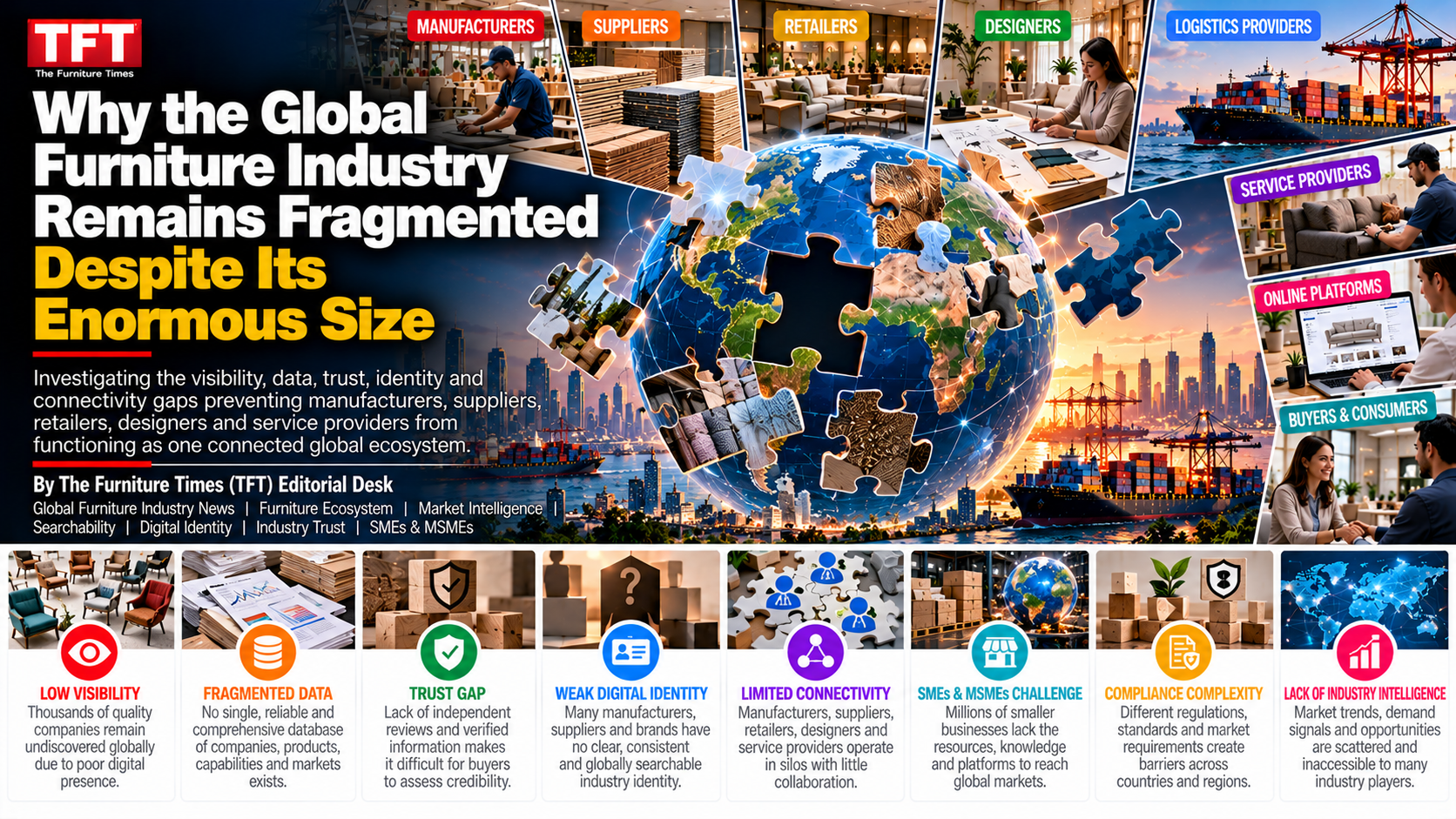
Why the Global Furniture Industry Remains Fragmented Despite Its Enormous Size
Why the Global Furniture Industry Remains Fragmented Despite Its Enormous Size
Investigating the visibility, data, trust, identity and connectivity gaps preventing manufacturers, suppliers, retailers, designers and service providers from functioning as one connected global ecosystem
By The Furniture Times (TFT) Editorial Desk | Global Furniture Industry News | Furniture Ecosystem | Market Intelligence | Searchability | Digital Identity | Industry Trust | SMEs & MSMEs
The global furniture industry is enormous—but it does not operate like one connected industry.
It operates as thousands of separate markets, manufacturing clusters, material networks, retail channels, trade fairs, professional communities and informal business relationships.
A furniture manufacturer in Malaysia may be invisible to a hotel buyer in the Middle East. A hardware producer in China may struggle to reach a furniture factory in Africa. A designer in India may never discover a craft workshop in Indonesia. A specialist installation company may remain unknown outside its local property market. A retailer may sell thousands of products without knowing who made many of the components inside them.
This fragmentation exists even though furniture touches almost every part of human life:
- Homes
- Workplaces
- Hotels
- Restaurants
- Hospitals
- Schools
- Universities
- Airports
- Retail spaces
- Public buildings
- Gardens
- Short-term rentals
- Senior-living facilities
It also connects an immense economic ecosystem of timber, panels, metals, foam, textiles, leather, chemicals, components, machinery, manufacturing, logistics, retail, installation, repair, technology and professional services.
The furniture industry ecosystem is a $1 trillion industry ecosystem, yet no single global system adequately maps all of its participants, transactions and relationships.
The industry has companies—but lacks a complete directory.
It generates data—but lacks a unified intelligence layer.
It has reviews—but lacks furniture-specific reputation infrastructure.
It has trade events—but lacks continuous connectivity.
It has brands—but millions of capable SMEs remain digitally invisible.
The problem is not the absence of businesses. It is the absence of connected identity, discovery, data and trust.
The Fragmentation Problem at a Glance
| Gap | What is missing | Commercial consequence |
|---|---|---|
| Visibility gap | Many companies cannot be found internationally | Buyers repeatedly discover only dominant brands |
| Identity gap | Business information is incomplete or inconsistent | Buyers cannot verify who a company really is |
| Classification gap | Categories differ between countries and platforms | Companies and products are difficult to compare |
| Data gap | Market information is scattered and incompatible | Decision-makers operate without reliable intelligence |
| Product-information gap | Specifications are incomplete or unstructured | Buyers face risk and search systems misunderstand products |
| Trust gap | Reviews and credentials are difficult to verify | Good suppliers struggle to prove reliability |
| Connectivity gap | Industry participants operate in isolated networks | Opportunities fail to reach suitable businesses |
| SME digital gap | Smaller businesses lack resources and expertise | Capability remains invisible |
| Transaction gap | Discovery does not lead smoothly to enquiries or deals | Interest is lost before commercial engagement |
| After-sales gap | Repairers, parts and service records are disconnected | Products are replaced instead of repaired |
| Intelligence gap | News is isolated from searchable company records | Information does not become lasting industry knowledge |
1. Furniture Is Not One Industry—It Is a Network of Industries
The first reason for fragmentation is structural.
Furniture is assembled from many different industries.
A sofa can involve:
- Timber
- Plywood
- Steel
- Springs
- Foam
- Fabric
- Leather
- Adhesives
- Plastic feet
- Fasteners
- Mechanisms
- Packaging
- Freight
- Warehousing
- Retail
- Delivery
- Installation
- Repair
Each input may come from a different company, region or country.
A product sold under one furniture brand may involve dozens of businesses that remain invisible to the final customer.
The United Nations classifies furniture manufacturing as a distinct industrial division covering furniture and related products made from different materials. It recognises manufacturing processes such as cutting, moulding, laminating and assembling, while also acknowledging the importance of aesthetic and functional design. UNSD — Classification Detail
This definition is useful for official statistics, but the commercial furniture ecosystem is far wider.
It includes:
Upstream participants
- Forest owners
- Timber traders
- Sawmills
- Veneer producers
- Panel manufacturers
- Steel and aluminium companies
- Foam producers
- Textile mills
- Leather processors
- Chemical suppliers
Production participants
- Furniture manufacturers
- Component producers
- Hardware companies
- Machinery suppliers
- Tooling specialists
- Packaging providers
- Testing laboratories
- Certification consultants
Downstream participants
- Importers
- Exporters
- Distributors
- Wholesalers
- Retailers
- Marketplaces
- Interior contractors
- Installers
- Logistics providers
- Repairers
- Reupholsterers
- Recyclers
Knowledge participants
- Designers
- Architects
- Industry associations
- Trade fairs
- Training providers
- Media organisations
- Market researchers
- Software companies
- Review platforms
- Search platforms
Traditional industry measurement captures only part of this network.
That is why the total furniture ecosystem can reasonably be discussed as a $1 trillion economic ecosystem even though commercial estimates of the narrowly defined furniture-product market are often lower and vary substantially.
2. Millions of Furniture SMEs Operate Outside Global Visibility
The furniture industry is dominated by small and medium-sized companies.
The European Commission describes European furniture manufacturing as a labour-intensive sector dominated by SMEs and micro-enterprises. The same structural pattern is visible in many manufacturing countries across Asia, Africa, Latin America and the Middle East.
Many furniture companies begin as:
- Family workshops
- Local carpentry businesses
- Upholstery operations
- Component suppliers
- Retail stores
- Interior contractors
- Artisan groups
- Small factories
- Repair businesses
These companies may possess valuable skills but limited digital capacity.
A workshop may be capable of producing excellent hotel furniture while having:
- No proper website
- No English-language profile
- No structured product catalogue
- No updated contact information
- No business verification
- No independent reviews
- No search-engine visibility
- No media coverage
The company exists physically but barely exists digitally.
Visibility is unevenly distributed
Global buyers frequently discover the same businesses repeatedly because those companies have:
- Strong websites
- Paid advertising
- Exhibition budgets
- International sales staff
- Search-engine optimisation
- Marketplace presence
- Media relationships
This does not always mean they are the most suitable suppliers. They are simply the most discoverable.
Smaller businesses can remain hidden despite offering:
- Better craftsmanship
- Greater flexibility
- Lower minimum orders
- Local materials
- Faster customisation
- Specialist knowledge
- Competitive pricing
Fragmentation therefore creates a visibility inequality.
The industry does not always reward the best capability. It often rewards the capability that is easiest to find.
3. The Industry Has No Complete Global Business Identity System
A basic question exposes the problem:
How many furniture-related businesses operate globally?
No authoritative database provides a complete answer.
Business registries classify companies differently. Some manufacturers operate informally. Some companies manufacture furniture while registered under timber, interior design, construction or general trading. Others outsource production entirely but identify themselves as manufacturers.
One business may appear online under several names:
- Registered company name
- Brand name
- Factory name
- Export entity
- Marketplace seller
- Social-media name
- Website domain
Without a persistent identity connecting these names, buyers and data systems may treat them as separate businesses—or fail to recognise them entirely.
A complete furniture-industry identity should include
- Registered business name
- Trading name
- Brand names
- Country and location
- Business-registration details
- Year established
- Ownership or management
- Product categories
- Materials
- Manufacturing capabilities
- Factory locations
- Markets served
- Certifications
- Contact details
- Official website
- Verified social profiles
- Review records
- News coverage
Most available directories capture only a few of these fields.
The result is an industry full of names but short of verified identities.
4. Furniture Classification Remains Too Broad and Inconsistent
Classification is another major source of fragmentation.
Furniture is grouped differently according to:
- Customs codes
- Manufacturing statistics
- Retail categories
- E-commerce marketplaces
- Trade-fair sectors
- Company catalogues
- Procurement systems
- Search-engine taxonomies
International trade analysis often relies on Harmonized System headings such as:
- HS 9401 for seats
- HS 9402 for medical and related furniture
- HS 9403 for other furniture and parts
More detailed subheadings may distinguish furniture by material or use, but many categories remain broad. furnilytics.com
“Other furniture” can include products with completely different:
- Materials
- Functions
- Customers
- Production processes
- Safety requirements
- Market conditions
The category-language problem
One company may call a product:
- Garden set
- Patio set
- Outdoor dining set
- Terrace furniture
- Balcony furniture
- Resort furniture
These may refer to nearly identical products.
Another company may offer “contract furniture” without specifying whether it serves:
- Hotels
- Offices
- Healthcare
- Education
- Restaurants
- Retail stores
Search systems cannot connect businesses effectively when product terminology is inconsistent.
The solution is not one rigid vocabulary
The industry needs an interoperable taxonomy that connects:
- Product type
- Application
- Material
- Style
- Buyer segment
- Manufacturing capability
- Certification
- Geography
- Service type
A company should be discoverable through different terms without duplicating its identity.
5. Furniture Market Data Is Scattered Across Incompatible Systems
The furniture industry produces enormous quantities of data, but the information is dispersed.
Relevant data exists in:
- Customs records
- National manufacturing statistics
- Retail reports
- Housing indicators
- Company accounts
- Trade-fair records
- Port data
- Market-research reports
- Industry associations
- E-commerce platforms
- Customer reviews
- Logistics systems
- Certification databases
These sources rarely align.
Why market-size estimates differ
Commercial estimates for the global furniture market vary by hundreds of billions of dollars.
The variation frequently results from differences in:
- Geographic coverage
- Retail value versus factory output
- Residential versus commercial products
- Indoor versus outdoor furniture
- Inclusion of mattresses
- Inclusion of kitchens
- Built-in versus movable furniture
- Informal-sector production
- Online-marketplace sales
- Installation and delivery
- Used and refurbished furniture
A report may be internally valid while remaining incomparable with another report using a different scope.
The ecosystem is larger than product sales
Traditional market reports often exclude:
- Furniture machinery
- Components
- Logistics
- Installation
- Repair
- Design fees
- Certification
- Software
- Media
- Reviews
- Financial services
This underrepresents the industry’s wider economic influence.
A meaningful global furniture intelligence system needs to separate:
- Finished furniture sales
- Furniture manufacturing output
- International furniture trade
- Materials and components
- Machinery and technology
- Professional and operational services
- Circular-economy activity
Only then can the industry understand its true scale.
6. Product Information Is Often Incomplete or Unreliable
Even when a company is discoverable, its products may not be understandable.
Furniture catalogues frequently omit:
- Exact dimensions
- Weight
- Load capacity
- Material composition
- Timber species
- Foam density
- Fabric performance
- Hardware specifications
- Packaging dimensions
- Assembly requirements
- Warranty conditions
- Spare-parts availability
- Test standards
- Country of manufacture
A photograph is not a product specification.
The model-number problem
The same product may have:
- Factory model number
- Retailer SKU
- Export code
- Customer-specific code
- Colour code
- Marketplace identifier
If these identifiers are not linked, manufacturers cannot easily trace:
- Drawings
- Bills of materials
- Test reports
- Production batches
- Warranty claims
- Replacement parts
This weakens compliance, after-sales service and future Digital Product Passport readiness.
Product information must become structured data
Every significant product should have a digital record covering:
Identity
→ Model
→ Variant
→ Dimensions
→ Materials
→ Components
→ Test evidence
→ Production source
→ Packaging
→ Warranty
→ Repair
→ End-of-life information
Without this foundation, search engines, AI assistants, procurement platforms and regulators receive fragmented or contradictory information.
7. Trust Is Distributed Across General Platforms
Furniture purchases involve significant risk.
A buyer may need to know:
- Is the product durable?
- Is the seller legitimate?
- Will delivery occur on time?
- Will the colour match?
- Will installation be professional?
- Will warranty claims be handled?
- Can replacement parts be obtained?
- Can the supplier complete a large project?
General review platforms can provide valuable information, but they are not built around the furniture industry’s full complexity.
A single rating may mix reviews of:
- Product quality
- Retail service
- Delivery
- Installation
- Warranty
- Store cleanliness
- Staff behaviour
A manufacturer, retailer, logistics provider and installer may all contribute to the final experience, yet the review may be assigned entirely to one company.
Furniture needs category-specific trust
A useful furniture-review system should distinguish among:
Product performance
- Comfort
- Stability
- Finish quality
- Durability
- Assembly
- Material accuracy
Commercial performance
- Quotation accuracy
- Lead time
- Communication
- Documentation
- Order consistency
Delivery performance
- Scheduling
- Damage
- Handling
- Installation
- Packaging removal
After-sales performance
- Responsiveness
- Spare parts
- Repairs
- Warranty handling
- Complaint resolution
This is the opportunity for FurniReviewology: creating a furniture-specific reputation layer rather than relying exclusively on generic star ratings.
8. Certifications and Claims Are Difficult to Verify
Furniture companies commonly publish claims such as:
- Certified wood
- Sustainable
- Commercial grade
- Fire resistant
- Ergonomic
- Weather resistant
- Eco-friendly
- Tested
- Export quality
These descriptions may be accurate—but often lack accessible supporting evidence.
A buyer may not know:
- Who issued the certificate
- Which product was tested
- Which model variant was covered
- Whether the certificate is current
- Which factory produced the item
- Whether materials changed afterward
Certification without connection creates confusion
A laboratory report has limited value if it cannot be connected confidently to the product being sold.
The chain should be clear:
Company
→ Factory
→ Product family
→ Representative model
→ Declared variants
→ Test report
→ Production controls
→ Marketed product
If any connection is missing, buyers and regulators may question the claim.
Future product records must connect evidence directly with models and variants.
9. Trade Fairs Create Meetings—but Not Always Permanent Connectivity
Furniture exhibitions play an essential role.
They allow buyers to:
- Inspect products
- Meet factories
- Compare suppliers
- Discover designs
- Negotiate orders
- Understand capabilities
However, exhibition-based connectivity is temporary.
After an event:
- Business cards are misplaced.
- Product catalogues become outdated.
- Staff members change.
- Leads receive inconsistent follow-up.
- Exhibitor pages disappear.
- Buyer interest becomes difficult to track.
The industry often rebuilds the same network at the next exhibition.
The future trade fair needs a permanent digital layer
Every exhibitor should have a continuing profile containing:
- Verified identity
- Product categories
- Factory capabilities
- Certifications
- News
- Contact details
- Reviews
- RFQ options
- Exhibition history
The trade fair should become one moment inside a year-round discovery system.
Physical events create relationships. Digital infrastructure should preserve and expand them.
10. Industry Associations Remain Geographically and Sectorally Divided
Furniture associations usually represent:
- One country
- One region
- One material
- One profession
- One product segment
- One trade exhibition
This focus can be valuable, but it also creates silos.
A national manufacturers’ association may not include:
- Designers
- Logistics companies
- Repairers
- Digital platforms
- Artisans
- Furniture-technology companies
- Installation specialists
Associations may also use different membership standards and data structures, making international integration difficult.
The industry needs collaboration without erasing local identity.
A global system should allow associations to preserve their independence while connecting their members through shared categories and verified profiles.
11. The Manufacturing and Design Communities Remain Disconnected
Furniture designers may not know which factories can execute their ideas.
Factories may not know which designers understand their materials or production methods.
This creates several problems:
- Unmanufacturable concepts
- Missed collaboration opportunities
- Excessive prototyping
- Poor material selection
- Intellectual-property concerns
- Dependence on existing catalogues
A searchable furniture ecosystem should connect design requirements with manufacturing capabilities.
A buyer should be able to search for:
- Rattan furniture manufacturers in Indonesia
- Hospitality casegoods factories in Vietnam
- Metal furniture producers in Turkey
- Outdoor furniture suppliers in Malaysia
- School furniture manufacturers in India
- Upholstery specialists in Eastern Europe
The search should identify capability—not simply businesses that purchased an advertisement.
12. Logistics Providers Are Missing From Furniture Discovery
Logistics is frequently treated as separate from the furniture industry, despite being critical to its success.
Furniture requires specialised handling because it is:
- Bulky
- Damage-prone
- Difficult to return
- Often assembled
- Sensitive to moisture
- Dependent on delivery appointments
- Sometimes installed on-site
A general freight provider may move the carton but not understand the product.
The furniture ecosystem requires searchable specialists in:
- Container consolidation
- Furniture packaging
- Warehousing
- White-glove delivery
- Installation
- Project logistics
- Reverse logistics
- Repair coordination
- Export documentation
A manufacturer may produce an excellent product and still lose the customer because the logistics experience fails.
13. Repair, Spare Parts and Circular Services Are Almost Invisible
When furniture breaks, customers often struggle to identify:
- The manufacturer
- Model number
- Original retailer
- Component supplier
- Suitable repairer
- Replacement part
- Upholstery specification
As a result, repairable furniture is frequently discarded.
This is not only a sustainability problem. It is a connectivity problem.
A functioning circular ecosystem needs to connect
- Product identity
- Ownership
- Warranty
- Spare parts
- Repairers
- Refurbishers
- Resellers
- Recyclers
The European Commission describes the Digital Product Passport as a mechanism for storing relevant information about products, components and materials while supporting sustainability, circularity and legal compliance. single-market-economy.ec.europa.eu
But regulatory product passports alone will not create a circular economy.
Businesses and consumers must also be able to find the people who can repair, move, refurbish, resell or recycle the item.
14. Smaller Businesses Face a Digital-Capability Gap
Digital transformation requires:
- Time
- Skills
- Software
- Photography
- Translation
- Product data
- Marketing
- Cybersecurity
- Maintenance
Many SMEs lack dedicated teams for these functions.
The OECD recognises that online platforms can help SMEs reach larger customer bases, access digital tools and benefit from business intelligence. It also warns about risks including reputational damage, competition distortions, security concerns and platform dependency. oecd.org
The solution cannot be simply telling every small furniture company to build expensive independent technology.
Shared industry infrastructure can lower the barrier.
An SME should be able to create one structured industry profile and use it to support:
- Searchability
- Buyer discovery
- RFQs
- Media coverage
- Reviews
- AI visibility
- Product presentation
- International networking
The industry needs “digital scale without corporate scale.”
15. AI Could Deepen Fragmentation Unless Industry Data Improves
Artificial intelligence can make the industry easier to navigate—or increase the dominance of already visible companies.
AI systems learn from accessible information.
If a company has:
- No website
- Inconsistent name
- Minimal product descriptions
- Few trusted references
- No structured profile
- No independent coverage
AI systems may overlook it.
Meanwhile, the largest brands may appear repeatedly because they possess the greatest volume of accessible information.
AI visibility is not automatic fairness
AI may recommend what it can identify confidently, not necessarily what is objectively best.
To become understandable to AI systems, furniture businesses need:
- Consistent identity
- Specific categories
- Detailed capabilities
- Geographic clarity
- Verified contact information
- Product data
- Independent references
- Reviews
- Recent updates
OECD research indicates that SME adoption of off-the-shelf AI tools is increasing, but adoption does not remove the need for sound data, skills and governance. oecd.org
The next visibility divide may be between businesses AI can understand and businesses it cannot.
16. News Is Published but Rarely Converted Into Permanent Intelligence
Furniture companies announce:
- Factory openings
- New collections
- Partnerships
- Certifications
- Investments
- Appointments
- Export achievements
- Sustainability programmes
- Trade-fair participation
These announcements appear across websites, press releases and social media. They may receive temporary attention and then disappear from view.
News should become part of a permanent industry record.
A company profile should connect with:
- Past announcements
- Leadership
- Investment history
- Certifications
- Market expansions
- Product launches
- Awards
- Reviews
This connection turns publicity into intelligence.
Without it, every article remains an isolated document.
The True Cost of Fragmentation
Fragmentation creates costs throughout the ecosystem.
For manufacturers
- Difficulty finding buyers
- Dependence on intermediaries
- Weak bargaining power
- Duplicated marketing costs
- Limited market intelligence
For buyers
- Slow supplier discovery
- Repeated verification
- High sourcing risk
- Limited comparison
- Dependence on existing networks
For consumers
- Incomplete product information
- Difficulty checking reviews
- Poor after-sales access
- Confusion over warranties
- Limited repair options
For governments
- Incomplete industry statistics
- Difficulty supporting SMEs
- Weak export visibility
- Poor understanding of workforce needs
- Limited policy targeting
For investors
- Difficult market mapping
- Unclear company identity
- Limited comparable data
- Hidden innovation
- Underestimated service sectors
Fragmentation is not an abstract problem. It wastes time, raises costs and causes commercial opportunities to be missed.
What a Connected Furniture Ecosystem Should Look Like
The industry requires an infrastructure with seven connected layers.
| Layer | Required function |
|---|---|
| Identity | Verify who each participant is |
| Classification | Define what each participant offers |
| Discovery | Make businesses searchable |
| Intelligence | Connect news, markets and regulatory developments |
| Trust | Organise reviews and supporting evidence |
| Transactions | Enable enquiries, RFQs and commercial contact |
| Lifecycle | Connect products with service, repair and circularity |
No single layer is sufficient.
A directory without verification becomes cluttered.
News without structured identity becomes temporary.
Reviews without company matching become unreliable.
Search without taxonomy produces poor results.
Transactions without trust create risk.
TFT, FISE and FurniReviewology: Three Different but Connected Roles
The solution requires specialised platforms working together.
The Furniture Times: the intelligence and visibility layer
TFT can cover:
- Global industry news
- Company announcements
- Market analysis
- Investments
- Policies
- Manufacturing
- Materials
- Retail
- Technology
- Logistics
- Leadership
- Sustainability
The objective is to bring furniture businesses into the global spotlight and create a continuous record of industry development.
Furniture Industry Search Engine: the discovery layer
FISE can organise and connect:
- Manufacturers
- Material suppliers
- Component companies
- Machinery businesses
- Importers
- Exporters
- Retailers
- Designers
- Logistics providers
- Installers
- Repairers
- Technology companies
Its role is not merely to list names. It is to make the ecosystem searchable by capability, category, country and commercial need.
Search. Connect. Discuss. Deal.
FurniReviewology: the trust layer
FurniReviewology can provide structured reviews relating to:
- Products
- Manufacturers
- Suppliers
- Retailers
- Delivery providers
- Installers
- Repairers
- Customer service
It can help distinguish product quality from service, delivery and after-sales performance.
Together:
The Furniture Times tells their story.
Furniture Industry Search Engine helps the world find them.
FurniReviewology helps the world trust them.
A Proposed Global Furniture Ecosystem Record
Every participant should be able to maintain a structured profile containing:
Company identity
- Legal name
- Brand name
- Country
- Location
- Year established
- Website
- Verified contacts
Business category
- Manufacturer
- Supplier
- Retailer
- Designer
- Installer
- Logistics provider
- Repairer
- Technology company
- Association
- Trade fair
Capabilities
- Product categories
- Materials
- Production processes
- Customisation
- Minimum order
- Capacity
- Markets served
Verification
- Business registration
- Certifications
- Test reports
- Factory information
- Awards
- Memberships
Intelligence
- Company news
- Investments
- Product launches
- Leadership updates
- Trade-fair participation
Trust
- Customer reviews
- Buyer reviews
- Project reviews
- Delivery reviews
- Complaint responses
Commercial connection
- Request for quotation
- Distribution enquiry
- Project opportunity
- Collaboration
- Employment
- Investment
This would turn fragmented company information into usable industry infrastructure.
An Action Plan for Furniture Businesses
Companies should not wait for the entire industry to become connected before improving their own position.
Step 1: Standardise identity
Use the same business name, address and contact information across platforms.
Step 2: Define exact categories
Avoid descriptions such as “all types of furniture.” Identify products, materials, applications and capabilities.
Step 3: Publish verified information
Make registrations, certifications and test evidence understandable and current.
Step 4: Structure product data
Connect every model, variant, drawing, material and report.
Step 5: Build independent visibility
Publish company news and industry insights beyond owned social-media pages.
Step 6: Collect credible reviews
Encourage product, delivery, service and project feedback.
Step 7: Join specialised industry discovery systems
Ensure that buyers searching by country or capability can find the company.
Step 8: Remain current
Update new products, contact details, certifications and market coverage.
A profile created once and abandoned becomes another source of misinformation.
What Governments and Associations Should Do
Public institutions and industry organisations can reduce fragmentation by:
- Maintaining current manufacturer databases
- Publishing machine-readable trade statistics
- Harmonising product terminology
- Supporting SME digitalisation
- Linking certification databases
- Mapping industrial clusters
- Recording workforce capabilities
- Promoting repair and refurbishment networks
- Encouraging interoperable digital identities
- Partnering with specialised industry platforms
UNIDO’s work on global value chains emphasises connecting enterprises—particularly SMEs—with the skills, technology and resources required to participate in sustainable value chains. unido.org
The furniture industry needs this principle applied globally and continuously.
Editorial Conclusion
The global furniture industry remains fragmented because its growth has been physical rather than informational.
Factories were built.
Stores opened.
Trade expanded.
Exhibitions multiplied.
Product categories grew.
But the infrastructure connecting identities, capabilities, data, reviews and commercial opportunities did not develop at the same pace.
The result is a $1 trillion ecosystem that still struggles to answer basic questions:
- Who operates in the industry?
- Where are they located?
- What can they produce or provide?
- Which information is verified?
- Who has a reliable reputation?
- Which businesses are ready for international opportunities?
- How can buyers connect with them directly?
This fragmentation will not disappear automatically.
It requires a deliberate global architecture built around visibility, discoverability, intelligence and trust.
The future of the furniture industry will not be created only in factories and showrooms. It will also be created in the digital systems that allow the world to understand how the ecosystem fits together.
The industry already has scale.
Now it needs connectivity.
The Global Furniture Ecosystem
The Furniture Industry is a $1 Trillion USD Ecosystem in the world.
Furniture Industry Search Engine – FISE helps the world find them.
The Furniture Times – TFT tells their story.
FurniReviewology helps the world trust them.
If you are not searchable, you do not exist.
Listings are the new storefronts.
Search is the new marketplace.
Be the next one. Be part of the movement.
Sources:
United Nations Statistics Division—Manufacture of Furniture, European Commission—Furniture Industry, OECD—Digital Transformation of SMEs, UNIDO—Global Value Chains and Development, European Commission—Digital Product Passport