Global Furniture Industry News: The Complete 2027 Market Outlook
Demand, production, exports, retail performance, investment, technology and the major risks that will shape the global furniture industry in 2027
By The Furniture Times (TFT) Editorial Desk | Global Furniture Industry News | Market Outlook | Manufacturing | Trade | Retail | Investment | Industry Intelligence
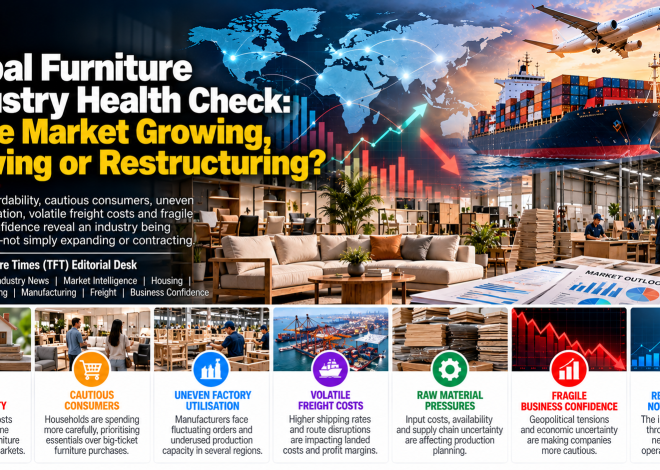
The global furniture industry is preparing for 2027 with cautious optimism—but not with confidence in a simple or universal recovery.
Worldwide economic growth is expected to improve, international merchandise trade is forecast to expand and several developing regions continue to create demand through urbanisation, housing, hospitality, infrastructure and income growth.
Yet the recovery will be uneven.
Furniture manufacturers, retailers and suppliers will enter 2027 facing high energy prices, expensive finance, geopolitical conflicts, fragile shipping routes, weak housing activity in some major markets, aggressive cross-border e-commerce and continued pressure on household purchasing power.
The industry is not moving from crisis directly into expansion. It is entering a period of selective recovery, operational restructuring and strategic separation between businesses that are prepared for volatility and those still depending on pre-crisis assumptions.
Global furniture consumption is expected to record only a modest improvement in 2027. Industry forecasts cited by CSIL-linked reporting indicate growth of approximately 1.4%, following a weak 2026. This suggests recovery rather than a furniture boom, with substantial downside risks from geopolitical tensions, protectionism and economic uncertainty.
The central message for 2027 is therefore clear:
Global furniture demand may improve, but growth will not be distributed equally across countries, categories, price segments or companies.
Businesses with diversified markets, controlled costs, strong digital visibility, credible brands and resilient supply chains will be better positioned to capture the recovery. Companies depending on one market, one platform, one supplier or permanent discounting will remain exposed.
Executive Outlook for 2027
| Indicator | 2027 direction | Furniture-industry implication |
|---|---|---|
| Global economic growth | Moderate improvement | Supports demand but does not guarantee a furniture boom |
| Furniture consumption | Marginal recovery | Competition for every order will remain intense |
| Merchandise trade | Stronger growth projected | Export opportunities improve, subject to geopolitical risk |
| Services trade | Expected rebound | Better outlook for travel, hospitality and commercial projects |
| Housing | Uneven by country | Residential furniture recovery will vary significantly |
| Interest rates | Likely to remain restrictive in many markets | Consumer credit and business investment may remain expensive |
| Energy costs | Highly uncertain | Manufacturing and freight costs remain vulnerable |
| Retail | Continued restructuring | Weak retailers may close, consolidate or reduce physical space |
| E-commerce | Continued expansion | More price transparency and international competition |
| AI and automation | Faster adoption | Productivity, forecasting and discovery become strategic |
| Sustainability | Greater commercial importance | Compliance increasingly affects market access |
| Investment | Selective and productivity-led | Factories will prioritise automation and flexibility |
| Geopolitical risk | Elevated | Supply-chain diversification becomes essential |
The Economic Background: Growth Returns, but Risks Remain
The International Monetary Fund’s October 2026 outlook projects global economic growth of 3.4% in 2027, compared with 3.1% in 2026. Global inflation is also expected to moderate after rising during the 2026 energy shock.
That improvement should be positive for furniture demand, but the headline growth rate hides considerable differences.
Some economies are benefiting from investment in artificial intelligence, semiconductors, data centres and digital infrastructure. Others remain burdened by conflict, high energy-import costs, weak currencies and rising public debt.
The IMF has warned that growth is becoming increasingly concentrated in a smaller number of countries and that global resilience is being tested by war, energy disruption and financial pressure.
For the furniture industry, this means macroeconomic expansion may not translate immediately into strong household-furnishing purchases.
Furniture demand typically depends on:
- Housing sales
- New residential construction
- Household formation
- Mortgage availability
- Consumer confidence
- Disposable income
- Tourism investment
- Office development
- Government projects
- Access to credit
Consumers may experience GDP growth while still postponing the purchase of a sofa, dining set, bed or wardrobe. A furniture recovery therefore requires more than general economic expansion—it requires confidence in households, property markets and business investment.
World Trade Is Expected to Strengthen
The World Trade Organization forecasts global merchandise-trade volume growth of approximately 4.1% in 2027, following an estimated 3.9% expansion in 2026.
Commercial-services trade is forecast to rebound more strongly in 2027 after being constrained by high aviation-fuel costs and Middle East disruption during 2026.
The stronger trade outlook should support furniture exporters, logistics providers and international project suppliers. However, the composition of trade growth matters.
A significant portion of recent expansion has been driven by AI-enabling products, semiconductors and data-centre investment. Furniture and other consumer durables have not necessarily experienced the same momentum.
Furniture exporters should therefore avoid assuming that stronger global trade automatically means stronger furniture orders.
Export success in 2027 will depend on:
- Market diversification
- Competitive landed cost
- Product compliance
- Reliable delivery
- Design originality
- Country-of-origin advantages
- Currency conditions
- Distribution partnerships
- Digital discoverability
- After-sales support
The volume of global trade may rise while an individual furniture exporter’s orders continue to fall if that company remains dependent on a slowing market or undifferentiated product category.
The Global Furniture Market: Recovery Without a Boom
Published market-size estimates vary significantly because research organisations use different definitions.
Some include only household furniture. Others include office, outdoor, hospitality, institutional, kitchen, mattress, component and specialised categories. Certain estimates measure manufacturer revenue, while others use retail value.
For that reason, The Furniture Times does not recommend relying on one headline market number without understanding its scope.
The more useful indicator for 2027 is the direction of demand.
The available evidence points toward:
- Modest global consumption recovery
- Stronger performance in selected emerging markets
- Continued weakness in parts of Europe
- Slow stabilisation in China
- Mixed conditions in North America
- Project-driven opportunities in the Gulf
- Growing demand in India and Southeast Asia
- Continued expansion of online furniture commerce
- Greater interest in affordable and multifunctional products
- Selective premium demand rather than universal luxury growth
The global furniture industry remains a $1 trillion industry ecosystem when its full network is considered—not only furniture sales, but also materials, machinery, logistics, retail, design, installation, repair, technology, media and related services.
However, the industry’s size does not protect every participant. Large ecosystems can still contain thousands of vulnerable companies.
Residential Furniture Outlook
Residential furniture will remain the industry’s largest demand engine, but its 2027 performance will depend heavily on housing activity and household affordability.
Factors supporting residential demand
- Population growth
- Household formation
- Urban migration
- Renovation
- Smaller apartments
- Replacement purchases
- Remote and hybrid work
- Rental-property furnishing
- E-commerce availability
- Growth of middle-income consumers
Factors limiting demand
- High mortgage costs
- Weak housing turnover
- Expensive rent
- Consumer debt
- Low confidence
- Rising food and energy expenses
- Delayed homeownership
- Smaller living spaces
- Competition from used furniture
- Longer product-replacement cycles
The furniture categories most likely to benefit are those connected to practical needs:
- Beds and mattresses
- Storage furniture
- Compact dining
- Multifunctional furniture
- Home-office products
- Children’s furniture
- Rental-property packages
- Modular sofas
- Space-saving furniture
- Ready-to-assemble products
Large, expensive and purely decorative purchases may recover more slowly where consumers remain financially cautious.
Office Furniture Outlook
The office-furniture market is no longer driven primarily by the number of desks required.
Hybrid work, employee wellbeing, collaboration, technology integration and corporate space reduction are changing demand.
In 2027, businesses are likely to invest in:
- Ergonomic work chairs
- Height-adjustable desks
- Collaboration tables
- Acoustic booths
- Flexible partitions
- Modular meeting spaces
- Technology-integrated furniture
- Informal work lounges
- Reception and hospitality-style spaces
- Home-office products
Office furniture suppliers should not expect every company to return to traditional workplace density. Many organisations are reducing floor area while spending more carefully on the quality and flexibility of the space retained.
Demand will therefore favour suppliers capable of offering planning, installation, reconfiguration, asset tracking, refurbishment and furniture reuse—not only new product sales.
Hospitality Furniture Outlook
Hospitality furniture could be one of the more promising categories in 2027 if international travel and hotel investment continue recovering.
Demand may come from:
- New hotels
- Resort developments
- Serviced apartments
- Restaurants
- Wellness retreats
- Airbnb properties
- Homestays
- Cruise facilities
- Airport lounges
- Refurbishment cycles
The Gulf, Southeast Asia, India and selected tourism markets are expected to generate continued opportunities.
Nevertheless, conflict in the Middle East and disruption to aviation, energy and shipping remain significant risks. Hotel developers may proceed with projects but demand more competitive pricing, phased deliveries and locally available alternatives.
Hospitality furniture manufacturers should be prepared to demonstrate:
- Commercial durability
- Fire and safety compliance
- Replacement availability
- Customisation
- Short lead times
- Installation capability
- Warranty support
- Lifecycle cost
The market will increasingly favour suppliers that can manage the entire process from design development to delivery, installation and after-sales service.
Outdoor Furniture Outlook
Outdoor living continues to move beyond a seasonal residential category.
Hotels, restaurants, cafés, resorts, condominiums, offices, schools and public spaces are investing in terraces, balconies, courtyards and poolside areas.
Demand in 2027 should favour:
- Weather-resistant seating
- Commercial parasols
- Modular outdoor lounges
- Aluminium furniture
- Synthetic rattan
- Teak and certified timber
- Outdoor dining
- Pool loungers
- Compact balcony furniture
- Repairable cushions and covers
Climate performance will become increasingly important. Buyers want clear information about UV resistance, corrosion, water drainage, wind exposure, fabric durability and replacement components.
Manufacturers that treat outdoor furniture as simple residential decoration may lose ground to suppliers offering tested commercial solutions.
Healthcare, Education and Institutional Furniture
Institutional categories can provide stability when consumer retail is weak.
Governments and private operators continue to require furniture for:
- Hospitals
- Clinics
- Elderly-care facilities
- Schools
- Universities
- Libraries
- Government offices
- Military accommodation
- Public housing
- Emergency shelters
These markets require stronger documentation than ordinary residential retail.
Suppliers may need to demonstrate:
- Cleanability
- Stability
- Load performance
- Accessibility
- Fire performance
- Material safety
- Ergonomics
- Replacement parts
- Traceability
- Long-term supply capability
Institutional furniture is less dependent on fashion, but it is highly dependent on procurement rules, approved budgets and technical compliance.
North America: Large Market, Uneven Recovery
The United States will remain one of the world’s most important furniture markets.
CSIL-linked analysis has estimated that the US accounts for about one quarter of global furniture imports, making it a critical destination for exporters across Asia, Europe and the Americas. World Furniture Outlook 2026–2027
The 2027 outlook will depend on:
- Housing transactions
- Interest rates
- Consumer credit
- Tariff policy
- Import costs
- Retail consolidation
- Inventory levels
- Employment
- Domestic manufacturing investment
The IMF forecasts US economic growth of approximately 2.3% in 2027.
This suggests continued economic activity, but furniture companies should not interpret it as guaranteed retail acceleration.
American consumers remain highly promotion-sensitive, and retailers face pressure from online competition, high delivery costs and expensive customer acquisition.
Tariff uncertainty could alter sourcing patterns. Vietnam, Mexico, Malaysia, Indonesia, India and other producing countries may gain opportunities as buyers diversify away from excessive reliance on one manufacturing location.
However, diversification will not happen automatically. Exporters must meet expectations involving:
- Scale
- Quality consistency
- Social compliance
- Product testing
- Packaging
- Lead times
- Intellectual-property protection
- Digital data
- Delivery reliability
Europe: Selective Recovery and Structural Pressure
Europe is expected to remain one of the most difficult major furniture markets.
Industry analysis indicates that European furniture demand was likely to remain nearly stagnant during 2026, with the 2026–2027 period characterised by selective recovery and considerable differences between countries. worldfurnitureonline.com
The European furniture industry faces:
- Weak consumer confidence
- High household savings
- Energy costs
- Expensive labour
- Regulatory pressure
- Competition from imports
- Ageing populations
- Slow construction in several markets
- Retail restructuring
- The continuing war in Ukraine
Premium design, sustainability, contract furniture and specialised manufacturing remain European strengths. But mid-market mass furniture production faces intense competition.
European businesses are likely to invest in:
- Automation
- Energy efficiency
- Circularity
- Product passports
- Repairability
- Low-emission materials
- Digital retail
- Export diversification
Poland, Italy and Germany will remain important manufacturing centres, while Türkiye and Asian suppliers continue to influence the competitive landscape.
China: Manufacturing Strength, Domestic-Demand Challenge
China will remain the world’s most influential furniture-manufacturing base, but its domestic market faces structural challenges.
The IMF expects China’s economic growth to slow from 4.5% in 2026 to about 4% in 2027, with weak domestic demand and the prolonged property crisis remaining major concerns. reuters.com
Housing is closely connected to furniture demand. Fewer property transactions and unfinished or unsold developments can weaken purchases of living-room, dining-room and bedroom furniture.
China’s manufacturers are responding through:
- Export expansion
- Factory-direct e-commerce
- Automation
- Aggressive pricing
- Product diversification
- Overseas warehouses
- International branding
- Investment in foreign markets
This creates considerable pressure for furniture manufacturers elsewhere. Chinese companies are no longer competing only as anonymous factories. More are becoming direct-to-consumer sellers, platform brands and overseas investors.
The 2027 challenge for other countries will be to compete through design, local service, trust, quality, delivery and specialisation—not only through price.
India: One of the Strongest Growth Opportunities
India is expected to remain among the fastest-growing major economies, with IMF projections indicating growth around 7% in 2027. reuters.com
The country’s furniture opportunity is supported by:
- Urbanisation
- New housing
- Rising incomes
- Organised retail
- E-commerce
- Hospitality
- Office development
- Domestic manufacturing policy
- Growing design awareness
However, market formalisation and certification will reshape competition.
Furniture manufacturers and importers must prepare for stronger requirements involving standards, testing, factory systems, documentation and model declarations.
India’s growth opportunity is therefore accompanied by a compliance challenge. Companies entering the market without preparing for product standards and certification could face delays or exclusion.
Southeast Asia: Manufacturing Diversification and Consumer Growth
Vietnam, Malaysia, Indonesia and Thailand will remain central to international furniture sourcing.
Their opportunity comes from:
- Established manufacturing capabilities
- Timber and material expertise
- Competitive labour
- Export infrastructure
- Proximity to Asian supply chains
- Diversification away from China
- Regional consumer growth
However, these countries must move beyond low-cost contract production.
Long-term competitiveness will depend on:
- Original design
- Automation
- Local brands
- Certification
- Sustainable materials
- Skilled labour
- Supplier development
- Digital visibility
- Direct access to buyers
Malaysia must pay particular attention to labour availability, energy costs, raw-material access, domestic retail pressure and the visibility of smaller manufacturers.
Vietnam remains a major export platform but is highly exposed to changes in US demand and trade policy.
Indonesia has strengths in timber, craftsmanship and natural materials but must continue improving consistency, scale and logistics.
Middle East: Conflict Risk and Project Opportunity
The Middle East presents the industry’s greatest contrast between risk and opportunity.
The region faces war, maritime insecurity, high insurance costs and interruptions around the Strait of Hormuz and Red Sea. At the same time, Gulf governments continue investing in:
- Tourism
- Hospitality
- Housing
- Offices
- Healthcare
- Education
- Sports
- Urban development
- Entertainment
- Infrastructure
Saudi Arabia, the UAE, Qatar and other Gulf markets can continue generating significant contract-furniture demand.
However, suppliers should expect:
- More cautious project approvals
- Stronger price negotiations
- Phased procurement
- Demand for local stock
- Alternative shipping routes
- Increased preference for local assembly
- Greater scrutiny of supplier reliability
- More complex insurance and contract terms
The Middle East should not be viewed as either a collapsing market or a guaranteed growth market. It is a high-opportunity, high-risk environment requiring strong partners and careful contract management.
Africa: Long-Term Growth, Immediate Constraints
Africa’s long-term furniture potential remains substantial because of:
- Population growth
- Urbanisation
- Housing need
- Commercial development
- Education
- Hospitality
- Expanding cities
- Entrepreneurial activity
The WTO expects Africa to remain an important contributor to trade growth, with strong import and export expansion recorded in its 2026 outlook. reuters.com
Yet the region faces significant obstacles:
- Currency weakness
- Expensive credit
- Import dependency
- Informal competition
- Electricity shortages
- Limited logistics
- Conflict
- Low consumer purchasing power
- Inconsistent enforcement
The greatest opportunity may not lie in shipping expensive finished furniture from distant markets. It may come from local manufacturing, flat-pack systems, regional component supply and partnerships with domestic entrepreneurs.
Latin America: Regional Manufacturing Gains Importance
Latin America can benefit from regionalisation and nearshoring.
Mexico is strategically positioned to supply North America, while Brazil remains a major consumer and producer. Colombia, Chile and other markets offer specialised opportunities.
The region’s 2027 performance will depend on:
- Currency stability
- Interest rates
- Housing
- Political conditions
- Trade access
- Infrastructure
- Consumer confidence
Local materials and manufacturing capabilities can support growth, but logistics and financing remain significant constraints.
Furniture Production in 2027
The defining production issue will not be whether factories can manufacture furniture. It will be whether they can do so profitably, flexibly and predictably.
Manufacturers will focus investment on:
- CNC machinery
- Robotic finishing
- Automated cutting
- Digital production planning
- Energy efficiency
- Material optimisation
- Quality-control systems
- Warehouse automation
- Product configuration
- Traceability
The traditional high-volume factory model will continue, but smaller, digitally connected factories may gain advantages in customised and short-run production.
Factories must be able to change products more quickly. Retailers no longer want to hold enormous inventories of slow-moving designs.
The manufacturer of 2027 must support smaller batches, faster samples, digital catalogues, accurate product data and dependable replenishment.
Global Furniture Export Outlook
Export growth will remain highly concentrated.
Leading exporting nations—including China, Vietnam, Poland, Italy, Germany, Türkiye, Malaysia and Indonesia—will compete for buyers seeking a balance of cost, quality, reliability and market access.
The most successful exporters will avoid excessive dependence on one country.
A manufacturer sending more than half its exports to one destination may be vulnerable to:
- Tariffs
- Currency changes
- Retail failures
- Political disputes
- Anti-dumping action
- Housing downturns
- Changes in consumer taste
Exporters should seek a portfolio of markets across North America, Europe, the Gulf, Asia-Pacific and emerging economies.
They should also build their own identities. Remaining permanently invisible behind a foreign retailer prevents a manufacturer from building brand equity, pricing power and direct recognition.
Retail Performance: Consolidation Will Continue
Furniture retail in 2027 will remain highly competitive.
Physical retail will not disappear, but weak and undifferentiated stores will face difficulty.
The retailers most exposed are those with:
- High rent
- Large debt
- Excess inventory
- Weak online visibility
- Identical products
- Permanent discounting
- Poor delivery service
- Limited customer data
- No after-sales capability
- Weak product information
Strong retailers will combine showrooms with digital tools.
The showroom’s purpose will shift from storing every product to providing:
- Product experience
- Material samples
- Comfort testing
- Design consultation
- Digital configuration
- Professional advice
- Delivery coordination
- Trust
Retailers should measure profit by customer and order, not only gross sales. An online order generating revenue can still lose money after commissions, advertising, delivery, return and damage costs.
Furniture E-Commerce in 2027
Online furniture purchasing will continue expanding, but the industry must solve its structural problems.
The largest barriers remain:
- Uncertainty about dimensions
- Colour differences
- Comfort
- Material quality
- Assembly
- Delivery
- Damage
- Returns
- Warranty enforcement
- Seller credibility
Technologies such as augmented reality, 3D visualisation and AI recommendations can improve the experience, but they cannot compensate for inaccurate product information.
Winning furniture listings will provide:
- Exact dimensions
- Material composition
- Weight
- Load capacity
- Assembly requirements
- Delivery conditions
- Warranty coverage
- Care instructions
- Customer photographs
- Verified reviews
Cross-border platforms will intensify price competition, creating policy debates about taxation, product safety and local accountability.
Investment Priorities for 2027
Furniture companies should not invest simply because economic conditions may improve. They should invest where a clear operational problem can be solved.
Priority investments
Digital product information
Every product should have structured specifications, images, drawings, finishes, materials, dimensions and compliance information.
Energy efficiency
Factories should measure energy use by process and product.
Flexible manufacturing
Equipment should support multiple product configurations and smaller production runs.
Supply-chain visibility
Businesses need to know where materials come from, where shipments are located and which components are at risk.
Repair and spare parts
After-sales support can become a source of differentiation and recurring revenue.
Search visibility
Companies must become discoverable across search engines, industry platforms and AI assistants.
Customer trust
Verified reviews, case studies and transparent business credentials can reduce buying risk.
The Major Risks Shaping 2027
1. Middle East conflict
Escalation could raise energy, insurance and freight costs while disrupting Gulf projects and global shipping.
2. Russia-Ukraine war
Continued attacks could affect European energy, timber, metals, logistics and business confidence.
3. Trade protectionism
Tariffs, anti-dumping measures and localisation rules could alter sourcing rapidly.
4. High interest rates
Expensive credit may restrict housing, retail purchases, factory investment and inventory financing.
5. Weak housing markets
Furniture demand may remain limited in markets where transactions and new construction stay low.
6. Chinese overcapacity and export pressure
Weak domestic demand could encourage more aggressive overseas pricing.
7. Freight disruption
Hormuz, the Red Sea, the Black Sea, port congestion and extreme weather remain serious risks.
8. Currency volatility
Importers can lose margin between ordering and payment.
9. Retail failures
Manufacturers supplying financially weak retailers face unpaid invoices and cancelled orders.
10. Cybersecurity
Connected factories, e-commerce systems and logistics platforms are increasingly exposed.
11. Climate events
Floods, fires, storms and drought can damage forests, factories, ports and transportation networks.
12. Skills shortages
Factories need technicians, engineers, digital specialists, upholsterers, installers and quality personnel.
13. Regulatory complexity
Furniture businesses face requirements involving timber legality, chemicals, product safety, recycling and environmental disclosure.
14. Digital invisibility
A capable manufacturer can still lose business if international buyers and AI systems cannot find or understand it.
Three Scenarios for 2027
Base Scenario: Selective Recovery
Global furniture demand improves modestly. Freight remains manageable, inflation moderates and project activity continues. Strong companies grow while weak retailers and factories consolidate.
Upside Scenario: Faster Consumer and Housing Recovery
Interest rates decline, housing transactions increase, geopolitical conditions improve and consumer confidence returns. Residential and retail furniture outperform expectations.
Downside Scenario: Conflict and Energy Shock
Middle East escalation or another major geopolitical disruption raises energy and shipping costs. Inflation remains elevated, interest-rate reductions are delayed and furniture demand weakens.
Businesses should prepare budgets for all three scenarios.
What Furniture Businesses Must Do Before 2027
- Review dependence on individual markets.
- Identify every critical single-source material.
- Recalculate landed costs.
- Update freight and currency clauses.
- Assess customer credit risk.
- Reduce slow-moving inventory.
- Build alternative product specifications.
- Strengthen direct customer channels.
- Improve website and catalogue information.
- Collect verified reviews.
- Publish company news consistently.
- Invest in searchability.
- Protect the minimum viable marketing budget.
- Develop repair and spare-parts services.
- Build partnerships in emerging markets.
- Prepare a crisis-communication plan.
The greatest mistake would be to wait for certainty. By the time economic recovery becomes obvious, the best distributors, projects and partnerships may already be committed.
TFT, FISE and FurniReviewology: Infrastructure for the Next Furniture Economy
The furniture industry does not suffer from a shortage of companies. It suffers from fragmentation.
Thousands of capable manufacturers, suppliers, retailers, designers, installers and service providers remain difficult to discover and evaluate.
The Furniture Times—TFT provides news, intelligence and global visibility.
Furniture Industry Search Engine—FISE creates structured discovery across the furniture ecosystem.
FurniReviewology builds credibility through reviews, reputation and customer experience.
The Furniture Times tells their story.
Furniture Industry Search Engine helps the world find them.
FurniReviewology helps the world trust them.
In 2027, visibility will be an operational asset. Buyers will increasingly use search engines, specialised platforms and AI assistants to identify suppliers before attending exhibitions or requesting quotations.
If a furniture company cannot be found, understood or independently evaluated, it may never enter the buyer’s consideration.
Final Outlook
The global furniture industry enters 2027 with genuine opportunity—but also with limited tolerance for weak strategy.
Demand is expected to recover modestly. Trade is projected to grow. Hospitality, infrastructure, urbanisation and emerging-market consumption will create new business. Technology can improve productivity and customer experience.
But growth will be selective.
Factories that cannot control costs will struggle. Retailers without differentiation will remain vulnerable. Exporters dependent on one market will carry excessive risk. Brands that disappear from public view during the slowdown may find that customers have moved elsewhere when conditions improve.
The winners of 2027 will not necessarily be the largest furniture companies.
They will be the companies that are:
- Searchable
- Credible
- Flexible
- Data-informed
- Financially disciplined
- Supply-chain resilient
- Close to their customers
- Ready to move before the recovery becomes obvious
The global furniture industry is not returning to its old operating model.
It is building a new one.
Sources:
International Monetary Fund—World Economic Outlook, October 2026
World Trade Organization—Global Trade Outlook and Statistics
CSIL—World Furniture Outlook 2026–2027
World Furniture Online—Europe’s Furniture Market