GCC Office Furniture Market Set to Reach US$1.85 Billion by 2034 as Gulf Workplaces Enter a New Era
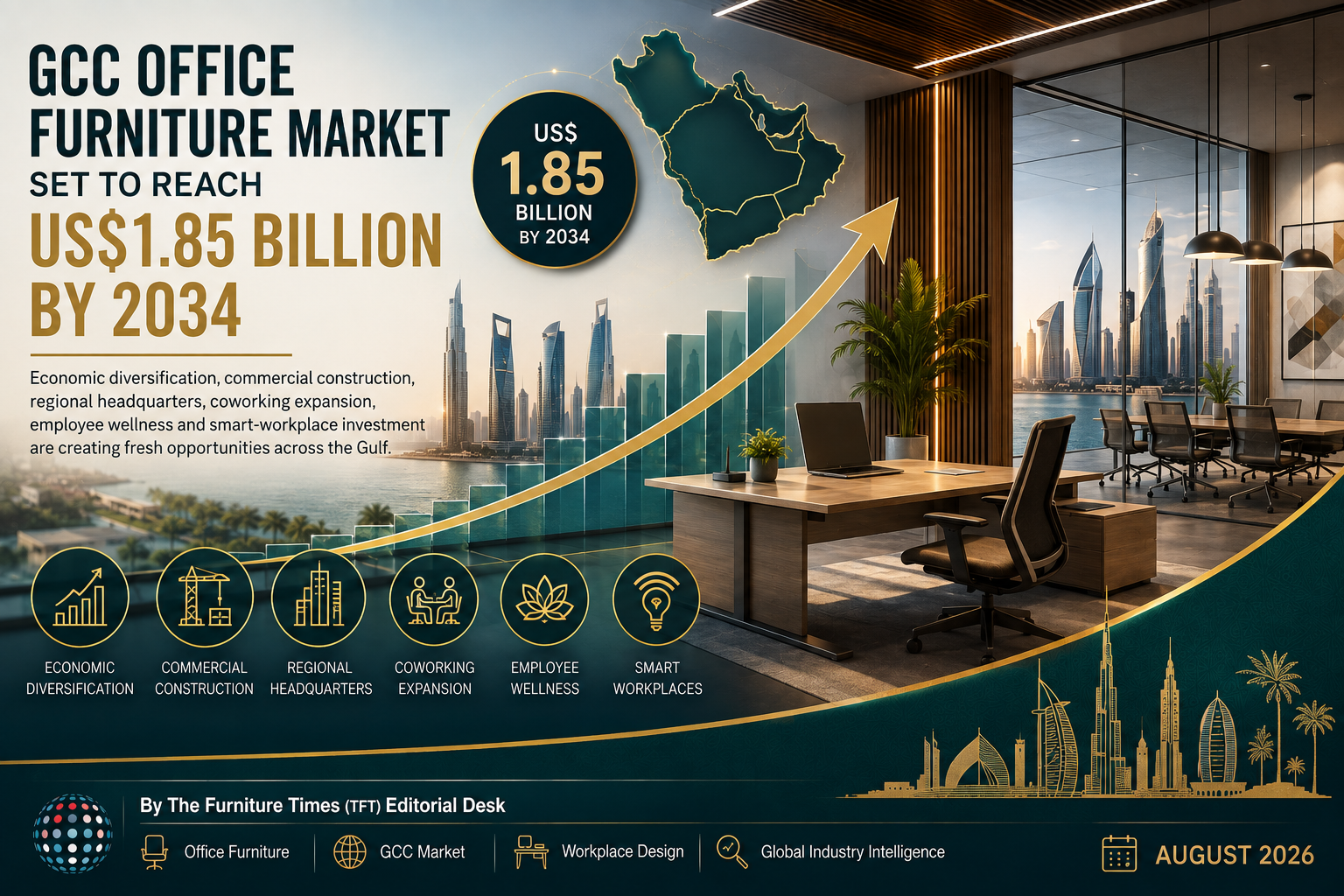
Economic diversification, commercial construction, regional headquarters, coworking expansion, employee wellness and smart-workplace investment are creating fresh opportunities across Saudi Arabia, the UAE, Qatar, Kuwait, Oman and Bahrain
By The Furniture Times (TFT) Editorial Desk | Office Furniture | GCC Market | Workplace Design | Global Industry Intelligence
The Gulf Cooperation Council’s office furniture industry is entering a new phase of development as governments, corporations, startups and international investors reshape how commercial workplaces are planned, furnished and operated.
According to a market announcement published by IMARC Group through OpenPR, the GCC office furniture market was valued at approximately US$1.31 billion in 2025. The research company expects it to reach approximately US$1.85 billion by 2034, representing a compound annual growth rate of 3.85% from 2026 to 2034. OpenPR report announcement
The projected increase of approximately US$540 million between 2025 and 2034 indicates steady rather than explosive growth. However, the headline market value tells only part of the story.
The deeper transformation involves a move away from conventional desks, fixed workstations and uniform executive offices toward more flexible, ergonomic, technology-ready and environmentally responsible workplace systems.
Across the Gulf, an office is increasingly expected to perform several functions at once. It must support concentrated individual work, teamwork, video meetings, client presentations, informal communication, employee wellness and changing occupancy levels.
As companies compete for talent and governments work to create knowledge-based economies, workplace furniture is becoming part of corporate strategy rather than a simple procurement expense.
GCC Office Furniture Market at a Glance
| Market indicator | Reported figure |
|---|---|
| GCC market size in 2025 | US$1.31 billion |
| Projected market size in 2034 | US$1.85 billion |
| Expected absolute expansion | Approximately US$540 million |
| Forecast CAGR | 3.85% |
| Forecast period | 2026–2034 |
| Geographic coverage | Saudi Arabia, UAE, Qatar, Kuwait, Oman and Bahrain |
These estimates originate from IMARC Group’s market research and were presented in a press-release announcement. Forecasts are projections, not guaranteed outcomes. Actual performance may be affected by construction activity, economic conditions, oil prices, public expenditure, interest rates, supply-chain disruptions and geopolitical developments.
The GCC Is More Than One Office-Furniture Market
Although the six GCC countries share geographic, commercial and cultural connections, their office-furniture markets are not identical.
Saudi Arabia offers enormous development potential through its economic-diversification programme, regional-headquarters activity, technology investment and commercial construction.
The United Arab Emirates is a mature regional business and logistics hub with a highly international corporate population.
Qatar continues to develop its professional-services, energy, tourism and institutional sectors.
Kuwait has a strong public sector and an established commercial market, although project timing can influence demand.
Oman offers opportunities connected to economic diversification, tourism, logistics and SME development.
Bahrain remains an important financial and professional-services centre despite its smaller population and geographic scale.
Suppliers entering the region therefore need country-specific strategies rather than treating the GCC as one uniform purchasing territory.
Saudi Arabia: The Market’s Largest Growth Engine
Saudi Arabia is expected to play the leading role in the region’s office-furniture expansion.
The Kingdom’s Vision 2030 programme is encouraging economic diversification, urban development, tourism, technology, entrepreneurship and the creation of new commercial districts. These activities require offices, coworking centres, government facilities, corporate headquarters, educational buildings and innovation hubs.
A separate IMARC assessment values Saudi Arabia’s office-furniture market at US$745.07 million in 2025 and projects it to reach approximately US$1.306 billion by 2034, at a reported CAGR of 6.44%. That report identifies seating as the leading product category, wood as the largest material category and direct sales as an important distribution channel. IMARC’s Saudi Arabia office-furniture report
The Saudi-specific estimate is particularly significant when compared with the GCC-wide forecast. It suggests that Saudi Arabia may account for a substantial proportion of the region’s future office-furniture opportunity.
However, market estimates should be compared carefully. Reports may use different definitions, research dates, datasets and product boundaries. A corporate buyer should not assume that figures from separate reports are perfectly comparable simply because they are published by the same research organisation.
Regional headquarters are increasing workplace demand
Saudi Arabia has been working to attract multinational companies and encourage them to establish regional headquarters in the Kingdom.
When an international company creates or expands a regional headquarters, furniture demand can extend beyond desks and chairs. A complete workplace may require:
- Executive offices
- Open-plan workstations
- Task seating
- Meeting tables
- Conference chairs
- Reception furniture
- Acoustic booths
- Collaborative seating
- Storage systems
- Training-room furniture
- Café and breakout furniture
- Outdoor workplace furniture
- Video-conferencing systems
- Custom joinery
- Signage and interior accessories
These projects are frequently specification-led. Architects, designers, project managers and corporate procurement teams may influence purchasing alongside the final occupier.
Riyadh is emerging as a major office-development centre
IMARC’s Saudi assessment indicates that Riyadh could add more than 1.6 million square metres of Grade A office space by 2028. If delivered and occupied, this pipeline could create sustained demand for workstations, seating, meeting furniture, acoustic products and workplace technology.
The opportunity is not only the initial installation.
Furniture eventually requires:
- Maintenance
- Repairs
- Replacement components
- Reconfiguration
- Reupholstery
- Refurbishment
- Expansion
- Relocation
- Responsible disposal
The value of the market therefore extends beyond the first product sale.
United Arab Emirates: A Mature Regional Workplace Hub
The UAE—particularly Dubai and Abu Dhabi—has long served as an international centre for finance, trade, tourism, real estate, technology and professional services.
Its office-furniture market is influenced by multinational corporations, government-related entities, family businesses, startups, free-zone companies and coworking operators.
Dubai’s frequent movement of companies between offices generates demand for furniture installation, reconfiguration, relocation and resale. Abu Dhabi provides opportunities connected to public institutions, financial services, energy, technology and large corporate projects.
The UAE is also an important import and re-export hub. Furniture arriving through its ports may be sold domestically or distributed to other Gulf and regional markets.
The UAE market is highly competitive
International furniture brands, regional distributors, local manufacturers, interior contractors and online retailers all compete for business.
This creates pressure on suppliers to provide more than products. Buyers may expect:
- Space planning
- Rapid quotations
- Product samples
- Mock-up workstations
- Local inventory
- Project management
- Delivery coordination
- Installation
- Warranty support
- Replacement parts
- After-sales maintenance
A company without local technical support may struggle even when its products are competitively priced.
Qatar: Project-Based and Specification-Led Demand
Qatar’s office-furniture demand is connected to government institutions, energy companies, financial services, education, professional services, hospitality and major infrastructure.
The country’s smaller population does not eliminate its commercial importance. Project values can be significant because buyers frequently require high-quality, specification-compliant and customised solutions.
Qatar also has an opportunity to convert buildings and infrastructure developed during previous investment cycles into long-term commercial, institutional and tourism assets.
For furniture suppliers, success may depend on prequalification, consultant relationships, technical submittals, fire-safety documentation, samples and installation capacity.
Kuwait: Government, Corporate and Institutional Opportunities
Kuwait’s office-furniture market is supported by public-sector offices, financial institutions, oil and gas companies, family-owned groups, professional services and educational organisations.
Project schedules can be influenced by public expenditure and procurement procedures. Suppliers may therefore experience uneven demand rather than a completely smooth annual purchasing cycle.
The market has opportunities for durable furniture capable of supporting high-use workplaces. Products designed for government offices, banks, training centres, universities and corporate headquarters may need longer warranties and dependable replacement components.
Oman: Diversification Creates New Workplace Requirements
Oman is expanding economic activity in logistics, tourism, manufacturing, mining, renewable energy, technology and SME development.
These sectors require offices across Muscat and other economic centres, including administrative buildings, logistics facilities, tourism offices and industrial workplaces.
The Omani market may reward suppliers that combine appropriate pricing with durable materials, dependable service and sensitivity to local design expectations.
Rather than focusing exclusively on luxury projects, suppliers should also examine opportunities in:
- SME offices
- Training facilities
- Government administration
- Educational institutions
- Industrial offices
- Healthcare administration
- Tourism and hospitality management
- Logistics and warehousing offices
Bahrain: Financial and Professional-Service Demand
Bahrain has a long-established financial-services sector and continues to serve as a base for banking, insurance, consulting, technology and regional business operations.
Its smaller scale makes it different from Saudi Arabia or the UAE, but it can remain commercially attractive for specialised office-furniture companies, workplace consultants and project suppliers.
Coworking, fintech, professional services and flexible offices may generate demand for modular furniture that can be rearranged as teams expand or contract.
Why the GCC Office-Furniture Market Is Growing
The projected rise from US$1.31 billion to US$1.85 billion is supported by several structural forces.
Economic diversification
Gulf economies are investing in sectors beyond hydrocarbons, including:
- Tourism
- Entertainment
- Technology
- Financial services
- Advanced manufacturing
- Logistics
- Healthcare
- Education
- Renewable energy
- Creative industries
- Professional services
Every expanding sector requires places for people to work, meet, train and collaborate.
Office furniture becomes one of the physical foundations supporting this economic transformation.
Commercial construction
New business districts, mixed-use developments, free zones and corporate campuses create direct furnishing requirements.
However, new construction is only one source of demand. Existing buildings are also being renovated to improve energy performance, workplace experience and space efficiency.
Refurbishment may become increasingly important as companies decide to modernise existing offices instead of moving into new buildings.
Coworking and flexible offices
Startups, international companies, consultants, freelancers and project teams are increasing demand for serviced and flexible workspaces.
A coworking facility needs furniture that can withstand frequent use and accommodate people with different working styles.
Typical requirements include:
- Hot-desking systems
- Height-adjustable desks
- Lockers
- Phone booths
- Shared tables
- Training furniture
- Lounge seating
- Mobile partitions
- Modular meeting rooms
- Charging stations
- Café-style work areas
The Saudi flexible-office market is itself forecast to grow strongly. One current estimate values it at approximately US$1.73 billion in 2026 and projects it to reach US$2.87 billion by 2031. While that is a different market from furniture, the expansion of flexible workspace provides a useful indicator of potential demand. Mordor Intelligence’s Saudi flexible-office analysis
Hybrid work
Hybrid work has not eliminated the office. It has changed its purpose.
When employees can perform individual tasks remotely, offices must provide stronger reasons for attendance. They increasingly become places for:
- Collaboration
- Team identity
- Mentoring
- Training
- Client meetings
- Social connection
- Innovation
- Access to specialist facilities
This reduces demand for rows of identical fixed desks while increasing interest in collaborative tables, flexible seating, project rooms and acoustic spaces.
Employee health and wellness
Organisations are paying more attention to posture, movement, comfort, lighting, acoustics and indoor environmental quality.
Ergonomic furniture is becoming more important because employees may spend many hours using computers. Workplace buyers are looking at adjustability, lumbar support, armrest design, movement, desk height and monitor positioning.
A product described as ergonomic should be supported by credible design information and testing. The term should not be used only as a promotional label.
Corporate competition for talent
Workplace quality can influence employee recruitment and retention.
A poorly designed office can signal that the organisation does not value employee experience. A thoughtful workplace may communicate professionalism, culture, care and ambition.
Furniture therefore contributes to employer branding. It becomes part of how a company presents itself to current employees, prospective recruits, clients and investors.
Seating Will Remain a Critical Product Category
Seating is one of the most frequently used and performance-sensitive elements of any workplace.
It includes:
- Task chairs
- Executive chairs
- Conference chairs
- Training chairs
- Visitor seating
- Lounge furniture
- Collaborative stools
- Beam seating
- Reception seating
The Saudi market analysis cited by IMARC assigns seating a 65.1% share of that country’s office-furniture market in 2025. Although this percentage should not automatically be applied to the whole GCC, it demonstrates the commercial importance of workplace seating.
The category is also highly competitive because buyers can choose among low-cost imports, regional producers and premium international ergonomic brands.
Manufacturers need to compete across several dimensions:
- Comfort
- Adjustability
- Durability
- Warranty
- Safety
- Fabric performance
- Component availability
- Design
- Price
- Delivery time
- Sustainability
A chair’s long-term value cannot be judged by appearance alone. Gas lifts, castors, bases, mechanisms, foam and upholstery determine its reliability over years of use.
Modular Furniture Is Becoming Essential
A modern GCC office may change more frequently than a traditional workplace.
Teams expand, projects end, departments relocate and hybrid schedules alter occupancy. Furniture must therefore support reconfiguration without requiring a complete replacement.
Modular systems can reduce the cost and disruption of these changes.
Demand is likely to grow for:
- Reconfigurable workstations
- Mobile tables
- Stackable seating
- Modular storage
- Demountable partitions
- Flexible power systems
- Mobile acoustic screens
- Furniture on castors
- Components that can be replaced separately
Manufacturers that design for disassembly and reconfiguration may gain an advantage, particularly as circular-economy expectations strengthen.
Smart Office Furniture Moves from Novelty to Application
Technology integration is becoming more practical.
Smart workplace furniture can include:
- Wireless charging
- Integrated power outlets
- USB connections
- Occupancy sensors
- Desk-booking indicators
- Cable-management systems
- Adjustable-height controls
- Environmental sensors
- Connected lockers
The greatest opportunity may not come from adding technology to every product. It will come from solving real problems without creating maintenance burdens.
A technology-enabled desk is only valuable if its electronics are safe, repairable and compatible with the building’s systems.
Manufacturers should also consider cybersecurity and privacy when connected furniture collects occupancy or behavioural data.
Sustainability Is Becoming a Procurement Issue
Sustainability is moving from general corporate messaging into product specifications and tender requirements.
Buyers may ask for information concerning:
- Material origin
- Recycled content
- Recyclability
- Indoor emissions
- Certified wood
- Chemical safety
- Manufacturing waste
- Packaging
- Product lifespan
- Repairability
- Take-back programmes
- Carbon information
GCC sustainability requirements will continue to develop as governments and corporations strengthen environmental policies.
Furniture suppliers should avoid unsupported green claims. Statements such as “eco-friendly” or “100% sustainable” require credible evidence.
Products with replaceable components, durable structures and refurbishment potential can offer stronger environmental value than products intended for rapid disposal.
The Climate Creates Special Product Requirements
The Gulf climate influences furniture performance even inside air-conditioned buildings.
Products may experience:
- High external temperatures during transportation
- Humidity in coastal areas
- Strong sunlight near windows
- Dust
- Rapid temperature changes
- Intensive cooling
- Heavy commercial use
Materials, adhesives, finishes, electronics and upholstery must be selected accordingly.
Furniture stored improperly at ports, warehouses or construction sites may be damaged before installation. Packaging and logistics are therefore part of product quality.
Local Manufacturing Versus Imports
The GCC office-furniture market is supplied through a mixture of local manufacturing, regional assembly and imported finished products.
Imports provide access to international design, advanced ergonomic products and large global catalogues. Local production offers potential advantages in lead time, customisation and after-sales service.
The most resilient future model may combine both.
For example:
- Imported mechanisms with locally made workstations
- International chair designs with regional inventory
- Imported components assembled within the GCC
- Locally produced joinery combined with global systems furniture
- Regional refurbishment supported by international spare parts
Saudi Arabia’s localisation policies may encourage more manufacturers to establish production, assembly or partnerships inside the Kingdom.
This creates opportunities for machinery suppliers, component manufacturers, foam producers, textile companies, panel suppliers and workforce-training providers.
Direct Sales Will Remain Important
Large office-furniture purchases are rarely simple retail transactions. They involve technical and commercial coordination among multiple participants.
The buying chain may include:
- Property developer
- Building owner
- Tenant
- Architect
- Interior designer
- Workplace consultant
- Project manager
- Quantity surveyor
- Main contractor
- Fit-out contractor
- Furniture dealer
- Manufacturer
- Installer
- Facilities-management team
Direct sales are therefore important because projects require consultation, product approval, site coordination and customised quotations.
Digital sales channels will still grow, particularly for standard desks, chairs, storage and home-office products. However, large corporate projects will continue to depend on specification, samples, negotiation and project management.
Opportunities for Furniture Components and Accessories
The forecast creates opportunities beyond finished office furniture.
Each workstation or chair depends on a hidden network of components, including:
- Chair mechanisms
- Gas lifts
- Castors
- Bases
- Drawer slides
- Hinges
- Connectors
- Modesty panels
- Screens
- Cable trays
- Power modules
- Locks
- Handles
- Glides
- Table frames
- Adjustable legs
- Acoustic materials
- Upholstery textiles
- Foam
- Adhesives
- Finishes
A failure in one inexpensive component can damage the reputation of the complete product.
GCC buyers should therefore evaluate component quality, cycle testing, warranties and replacement availability—not only exterior design.
Component suppliers that maintain regional stock may gain business because contractors cannot always wait several months for a replacement mechanism or fitting.
Opportunities for SMEs and Artisans
Large corporate projects often favour established international brands, but smaller companies can still compete in carefully selected areas.
Potential niches include:
- Bespoke executive furniture
- Reception counters
- Meeting tables
- Custom joinery
- Acoustic wall features
- Heritage-inspired interiors
- Modular storage
- Furniture repair
- Reupholstery
- Refurbishment
- Replacement components
- Small-office packages
- Rapid local installation
SMEs may outperform large suppliers when a project requires speed, flexibility, custom sizes or local service.
However, they must become visible to architects, contractors and procurement teams. Many capable workshops remain absent from searchable directories and digital procurement networks.
The After-Sales Economy Must Not Be Ignored
The value of an office-furniture contract does not end when installation is completed.
Corporate clients may need years of support:
- Warranty claims
- Spare components
- Chair repairs
- Desk reconfiguration
- Fabric replacement
- Additional furniture
- Moves and relocations
- Inventory audits
- Refurbishment
- Responsible disposal
Suppliers that treat after-sales service as a core business capability can build recurring revenue and long-term client relationships.
The region also needs more organised refurbishment systems. High-quality furniture should not be discarded simply because a company relocates or changes its colour scheme.
A circular office-furniture market could create jobs in collection, inspection, repair, cleaning, reupholstery, resale and material recovery.
The Importance of Digital Visibility
The GCC office-furniture market will become more digitally researched even when final transactions remain project-based.
Architects, corporate buyers and contractors search online for suppliers before issuing enquiries. AI platforms are also beginning to influence how buyers discover products and compare companies.
A professional office-furniture supplier should make the following information searchable:
- Company location
- Product categories
- Brand partnerships
- Project capabilities
- Certifications
- Warranty
- Delivery coverage
- Installation services
- Previous projects
- Product specifications
- Sustainability information
- Contact details
A website containing only photographs and telephone numbers is no longer sufficient.
Manufacturers should publish clear dimensions, materials, finishes, testing information, lead times and downloadable technical resources.
If search engines and AI systems cannot understand a supplier’s capabilities, that business may not be included when buyers search for suitable companies.
The Role of Reviews and Reputation
Office-furniture transactions depend heavily on trust.
Corporate buyers want to know whether the supplier can:
- Deliver on time
- Match approved samples
- Coordinate with contractors
- Protect finished interiors
- Install correctly
- Resolve defects
- Provide spare parts
- Honour warranties
Traditional consumer-star ratings may not fully capture this performance. The sector needs detailed, verified project reviews that evaluate service, technical compliance and after-sales support.
FurniReviewology’s future role can extend beyond consumer reviews by helping the wider furniture ecosystem develop structured, category-relevant trust signals.
Major Risks to the Forecast
The projected 3.85% annual growth rate should not be treated as guaranteed.
Several factors could weaken performance.
Construction delays
Office-furniture demand depends on buildings reaching fit-out and occupancy stages. Project postponements can move orders from one financial year to another.
Raw-material volatility
Prices for wood, panels, metals, foam, textiles and plastics can change rapidly, affecting quotations and profit margins.
Import dependency
Many GCC suppliers depend on overseas factories and components. Disruption at ports or shipping routes can delay projects.
Price competition
Buyers may compare products primarily by initial price, creating pressure on quality and after-sales service.
Geopolitical uncertainty
Regional conflict or transport disruption can affect business confidence, freight rates and investment schedules.
Skills shortages
Complex installations require trained project managers, installers, technicians and service teams.
Late payments
Project businesses can face lengthy payment cycles, retention amounts and disputes over variation orders.
Product commoditisation
If every supplier offers visually similar desks and chairs, buyers may treat products as interchangeable and choose only by price.
What Manufacturers Should Prepare for Before 2034
Office-furniture companies seeking GCC growth should develop a long-term market-entry strategy.
Build regional partnerships
A reliable local distributor, project dealer or installation partner can be essential.
Understand procurement
Government, corporate and private projects may have different registration, tender and prequalification requirements.
Maintain technical documentation
Product data should include dimensions, materials, warranties, testing, care instructions and installation requirements.
Hold essential inventory
Regional stock can become a competitive advantage, especially for standard products and replacement components.
Offer multiple price levels
The GCC includes premium headquarters, government offices, SME workplaces and cost-sensitive projects. One product range may not serve all segments.
Design for flexibility
Furniture should support reconfiguration, hybrid work and changing team sizes.
Strengthen after-sales service
Service response can determine whether a supplier receives repeat business.
Demonstrate sustainability
Environmental claims should be specific, documented and relevant to procurement requirements.
Become searchable
Companies should establish accurate websites, directory listings, product information, project evidence and verified reviews.
A Market That Extends Across the Entire Furniture Ecosystem
The forecast US$1.85 billion opportunity will not benefit only desk and chair manufacturers.
Its economic influence can reach:
- Designers
- Architects
- Workplace strategists
- Furniture factories
- Component suppliers
- Textile producers
- Foam manufacturers
- Hardware companies
- Machinery suppliers
- Logistics providers
- Warehouses
- Dealers
- Installers
- Technology companies
- Maintenance specialists
- Upholsterers
- Recyclers
- Training organisations
- Review platforms
- Industry media
- Search and discovery services
This is why office furniture must be understood as an ecosystem.
A single corporate fit-out can involve dozens of businesses, hundreds of components and several months of coordination.
Outlook: From Furniture Supply to Workplace Performance
The GCC office-furniture market is moving toward a more sophisticated value proposition.
The future will not be defined only by how many desks and chairs are sold. It will be defined by how effectively furniture supports:
- Productivity
- Employee wellness
- Collaboration
- Flexibility
- Technology
- Corporate identity
- Space efficiency
- Sustainability
- Long-term asset value
Suppliers that continue competing only on appearance and price may struggle to protect their margins.
Those that provide research, workplace planning, reliable components, regional service, digital information and measurable performance will be better positioned.
Conclusion
IMARC Group’s forecast that the GCC office-furniture market could grow from US$1.31 billion in 2025 to US$1.85 billion by 2034 reflects a region undergoing economic, physical and workplace transformation.
Saudi Arabia is likely to be the most powerful growth engine, supported by Vision 2030, headquarters expansion and commercial development. The UAE will remain an important international business, design and distribution hub. Qatar, Kuwait, Oman and Bahrain will continue generating opportunities through government, corporate, institutional and diversification-led investment.
The projected 3.85% CAGR may appear moderate, but the underlying opportunity is substantial. Every new headquarters, coworking facility, technology hub and government building requires a connected network of products and services.
The winners will not necessarily be the companies selling the cheapest furniture.
They will be the businesses that understand the Gulf’s changing workplaces, maintain quality, deliver reliably, support clients after installation and make themselves easy to find and trust.
Source and Methodology Note
The principal market figures in this article originate from an IMARC Group market announcement published through OpenPR. Market forecasts are estimates based on the research provider’s methodology. They may differ from other reports because researchers can use different market definitions, product coverage, base years, exchange rates and data sources. Readers should consult the complete underlying report and conduct independent due diligence before making investment or commercial decisions.
The Furniture Times (TFT) & Furniture Industry Search Engine (FISE)
“TFT tells their story. FISE helps the world find them.”
FurniReviewology helps the world trust them.
The furniture industry ecosystem is a $1 trillion industry ecosystem. Be searchable. Be visible. Be trusted.