If You Think Press Releases Are Dead, It’s Because You’re Using Them Incorrectly
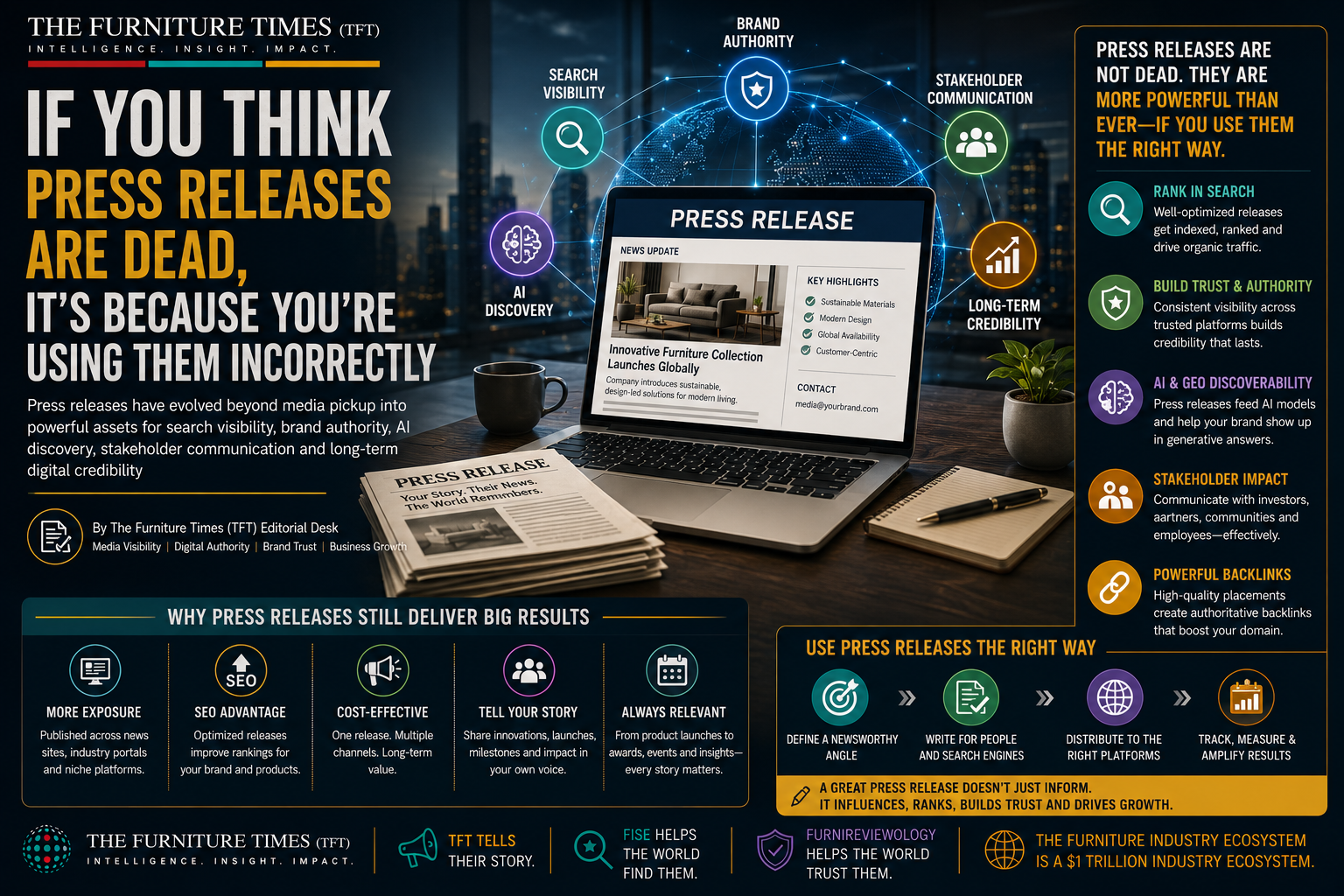
Press releases have evolved beyond media pickup into powerful assets for search visibility, brand authority, AI discovery, stakeholder communication and long-term digital credibility
By The Furniture Times (TFT) Editorial Desk | Media Visibility | Digital Authority | Brand Trust | Business Growth
For years, business leaders, marketers and even some public-relations professionals have repeated the same provocative statement: “The press release is dead.”
Their argument usually follows a familiar pattern. Journalists receive too many announcements. Newsrooms have fewer employees. Social media allows companies to communicate directly with customers. People no longer wait for newspapers to discover what businesses are doing. Therefore, the traditional press release must have lost its relevance.
This conclusion misunderstands what has actually happened.
The press release has not disappeared. Its role has expanded.
It remains a formal way to announce verified company information, but it now performs additional functions across search engines, news databases, investor research, industry platforms, social media, artificial-intelligence systems and corporate archives. A well-written release can help reporters understand an announcement, give customers a reliable source, provide sales teams with credible material and create a searchable record of a company’s development.
The real problem is not that press releases are dead. The problem is that too many companies use them incorrectly.
They distribute announcements with no genuine news value. They write promotional headlines that sound like advertisements. They overload the copy with unsupported claims, fail to include evidence and expect one publication to create immediate media coverage, backlinks, rankings and sales.
When those unrealistic expectations are not met, they declare that the format no longer works.
A recent PR Newswire analysis makes a similar argument: the press release has evolved from a tool focused mainly on media pickup into an asset that can also support search visibility, authority and discovery through AI-powered answer systems. The article argues that structured, credible and properly distributed releases may be increasingly valuable as audiences discover information through search engines and generative AI. Read the original PR Newswire analysis
For businesses across the global furniture industry ecosystem, this evolution is especially important. Manufacturers, retailers, suppliers, designers, technology providers, logistics companies, trade shows and service businesses all have stories worth documenting—but many remain digitally silent.
In an economy where visibility influences credibility, being silent can be more damaging than being small.
The Press Release Was Never Just an Advertisement
One of the most common mistakes is treating a press release as a sales brochure.
A sales advertisement asks people to buy. A press release announces something that has happened, is happening or is about to happen. It should offer information that is timely, specific, verifiable and relevant to a defined audience.
A legitimate furniture-industry press release might announce:
- The opening of a new factory or showroom
- A new furniture collection
- Entry into an international market
- A strategic partnership
- A major contract
- A sustainability certification
- Investment in manufacturing technology
- Participation in a trade exhibition
- Appointment of a senior executive
- A merger, acquisition or joint venture
- A research report
- A product safety initiative
- A circular-economy program
- Expansion of warehousing or logistics capacity
- New employment or training opportunities
- A design award
- A digital platform launch
- A verified business milestone
These developments may be commercially beneficial, but the release should explain their wider meaning rather than repeatedly calling the company “leading,” “revolutionary” or “world-class.”
A business becomes credible through evidence—not adjectives.
Why So Many Press Releases Fail
Press releases usually fail for strategic reasons rather than because the format itself is obsolete.
1. There is no real news
Changing a website banner, offering an ordinary discount or publishing a routine social-media post may matter internally, but it does not automatically justify a public announcement.
Before writing, the company should ask:
- What has changed?
- Why does it matter now?
- Who is affected?
- What evidence supports the announcement?
- Why should anyone outside the company care?
If those questions cannot be answered, the organization may need a blog post, advertisement or social-media update instead of a press release.
2. The headline is promotional instead of informative
Headlines such as “Amazing Furniture Company Launches the Best Sofa Ever” damage credibility.
A stronger headline communicates the development directly:
Furniture Manufacturer Opens New Johor Facility to Expand Outdoor Production Capacity
The second version identifies the company action, location and commercial significance.
3. The important information is buried
Readers should not have to examine several paragraphs before understanding the announcement.
The opening should explain:
- Who made the announcement
- What happened
- Where it happened
- When it occurred
- Why it matters
- How it affects the market or audience
This is particularly important for journalists, analysts and AI systems scanning large volumes of information.
4. The release contains no evidence
Claims such as “fastest-growing,” “most trusted” or “number one” need support.
Evidence may include:
- Production capacity
- Investment amount
- Number of locations
- Export markets
- Certification details
- Survey methodology
- Research findings
- Product specifications
- Measured environmental improvements
- Named partnerships
- Documented customer outcomes
Unsupported superlatives weaken the entire release.
5. The distribution is poorly targeted
Sending every announcement to every journalist is inefficient and can damage relationships.
A new upholstery-fabric technology may interest textile, manufacturing and furniture-component publications. A showroom opening may be more relevant to local business, property, retail and interior-design media.
Distribution should reflect the story.
6. There is no follow-up plan
Many companies distribute a release and wait passively.
A serious campaign may also include:
- Direct journalist outreach
- Executive availability
- Fact sheets
- Product images
- Video material
- Data visualizations
- Social-media posts
- Newsletter distribution
- Customer communication
- Sales-team materials
- Website publication
- Industry-directory updates
The release is the verified information center around which the broader campaign is built.
7. Expectations are unrealistic
A press release does not guarantee:
- Front-page coverage
- A top Google ranking
- Sales
- Investment
- Backlinks
- AI recommendations
- Journalist interviews
Distribution creates an opportunity to be discovered. It does not force audiences or algorithms to respond.
From Media Pickup to Search Visibility
Historically, the primary objective of a press release was to attract news coverage. That objective remains important, but the information environment has changed.
People now discover business information through:
- Search engines
- News websites
- Industry platforms
- Online directories
- Social networks
- Research databases
- Email newsletters
- AI assistants
- Company websites
- Review platforms
This means a release can create value even when a journalist does not turn it into a separate article.
It can become a dated and searchable record confirming that a company introduced a product, opened a facility, entered a market or formed a partnership.
PR Newswire’s analysis notes that the role of releases expanded as search became a central method of content discovery. It highlights the value of technically accessible pages, structured content, clear headings and the experience, expertise, authority and trust concepts commonly discussed through the E-E-A-T framework. PR Newswire’s discussion of press releases, SEO and AI discovery
However, companies should understand an important distinction: a release should not be treated as a link-manipulation device.
Modern search optimization is not about repeating a keyword dozens of times or distributing the same promotional copy across low-quality websites. Search visibility is more likely to benefit when the announcement is original, useful, well structured and connected to a credible company.
Press Releases and SEO: What They Can Realistically Do
Press releases can support SEO indirectly and, in some circumstances, directly—but they are not a shortcut to guaranteed rankings.
Establish a searchable company history
A consistent release program can document:
- Company launches
- Leadership changes
- Market expansion
- Product development
- Investments
- Partnerships
- Certifications
- Research
- Events
- Awards
Over time, this creates a public chronology of the brand.
When customers, distributors, investors, journalists or AI systems investigate the company, they can find evidence of what it has done.
Increase brand-name visibility
Publishing verified information can create more searchable references connecting the company’s name with its products, leadership, markets and expertise.
A furniture-hardware supplier, for example, may become associated with soft-close systems, concealed hinges or sustainable coatings through repeated, evidence-based announcements.
Provide information that other publishers can cite
An original report, investment announcement or product innovation may be referenced by industry publications. Those independent citations can strengthen awareness and authority.
Support branded search results
When someone searches for a company, a strong release may appear among the results, helping the organization present accurate information about significant developments.
Create content for internal linking
A company can link from its newsroom release to relevant product, report, executive or project pages. Related pages can also link back to the announcement.
Supply structured information to discovery systems
Clear headlines, dates, names, locations, quotes and factual statements make the release easier for machines to interpret.
None of these outcomes should be confused with purchasing rankings. Google does not guarantee visibility merely because a release has been distributed.
Why E-E-A-T Matters to Press Releases
PR Newswire’s article connects the modern release with the concepts of experience, expertise, authoritativeness and trustworthiness.
For company communication, these principles can be translated into practical questions.
Experience
Does the organization have direct involvement in the subject?
A furniture manufacturer discussing production efficiency should provide information based on its actual factory operations. A retailer discussing consumer behavior should draw from documented sales or customer research.
Expertise
Does the spokesperson understand the announcement?
A technical product release may need comments from an engineer or product-development leader rather than a generic marketing quote.
Authoritativeness
Is the company recognized as a legitimate participant in the field?
Industry memberships, certifications, partnerships, patents, verified listings and independent coverage can help establish this authority.
Trustworthiness
Can the claims be checked?
The release should include:
- The correct legal or trading name
- A real website
- Accurate contact information
- Named spokespeople
- Verifiable statistics
- Clear dates
- Transparent sources
- Honest limitations
Trust is the foundation. A perfectly optimized release containing misleading information is still a poor release.
AI Search Is Giving Press Releases a New Role
The transition from traditional search to AI-assisted discovery is changing how companies should think about public communication.
Users increasingly ask questions rather than entering short keywords:
- Which furniture manufacturers are expanding in Southeast Asia?
- What companies produce sustainable outdoor furniture?
- Which hardware brands have introduced smart cabinet systems?
- What furniture businesses are investing in circular production?
- Which suppliers serve the hospitality furniture market?
- What new furniture showrooms have opened in Kuala Lumpur?
AI systems may assemble answers from multiple accessible sources. A company with no structured, credible and current information is less likely to be understood than one that consistently documents its activities.
PR Newswire describes two emerging ideas:
- Answer engine optimization, or AEO: preparing content so answer systems can extract useful responses.
- Generative engine optimization, or GEO: improving the likelihood that a brand or its information will be referenced in generative responses.
These concepts do not replace SEO entirely. They extend the need for clear structure, credible sourcing and accessible information.
A release written for AI discovery should include
- A direct, factual headline
- A clear summary
- Full company name
- Relevant location
- Publication date
- Specific product or service information
- Named executives
- Verifiable figures
- Descriptive headings
- Short, focused paragraphs
- Relevant links
- An accurate boilerplate
- Media contact details
This structure also benefits human readers.
Why Press Releases Matter to the Furniture Industry
The furniture ecosystem contains thousands of capable SMEs that remain underrepresented in global media and digital search.
Many manufacturers produce excellent goods but rely primarily on:
- Trade exhibitions
- Personal networks
- Printed catalogs
- Agents
- Existing distributors
- Social-media posts
These channels remain useful, but they do not always create a permanent, searchable record.
A social post may disappear in a busy feed. A private message cannot be indexed publicly. A trade-show conversation may reach only those who attended. A printed catalog becomes outdated.
A press release can convert a business development into a public information asset.
For example, when a Malaysian furniture producer begins exporting to a new region, that development can be documented through a release. The announcement may reach distributors, trade media, government agencies, investors, customers and search systems.
If the company remains silent, the milestone exists operationally but not digitally.
Press Releases During Difficult Economic Conditions
Businesses often reduce communication when sales weaken or markets become uncertain. This can be a strategic mistake.
Difficult periods increase the need for credible information.
Customers, employees, suppliers and investors may want to know:
- Is the company still operating?
- Has it introduced new services?
- Is it entering new markets?
- Is it changing its supply chain?
- Is it investing in technology?
- Has it secured new contracts?
- How is it responding to market conditions?
Silence creates an information vacuum. Competitors, rumors and outdated search results may define the company instead.
A press release cannot solve operational problems, but it can communicate verified action.
During challenging periods, suitable announcements may include:
- New financing
- Business restructuring
- Cost-saving innovation
- Export diversification
- Digital transformation
- Workforce training
- Local sourcing
- New commercial partnerships
- Product repositioning
- Sustainability improvements
The communication must remain honest. Difficult circumstances should not be hidden behind exaggerated optimism.
What Makes an Announcement Newsworthy?
Not every company update deserves public distribution. A practical newsworthiness test can evaluate the following factors.
Timeliness
Is the development new or connected to a current issue?
Impact
Will it affect customers, employees, suppliers, investors or the wider industry?
Relevance
Does it matter to the intended audience?
Specificity
Can the company explain exactly what happened?
Evidence
Are there facts, figures, documents or named sources?
Difference
Does the announcement represent a meaningful change?
Human interest
Is there a story involving entrepreneurship, employment, craftsmanship, community or customer impact?
Wider context
Does the development relate to sustainability, housing, trade, technology, logistics, economic development or consumer behavior?
A release does not need to satisfy every factor, but it should satisfy several.
The Anatomy of an Effective Press Release
1. Informative headline
The headline should summarize the news without exaggeration.
Weak:
Innovative Furniture Company Announces Exciting Development
Stronger:
Malaysian Furniture Manufacturer Opens Second Production Facility to Expand Hospitality Exports
2. Supporting subheadline
The subheadline can explain why the announcement matters.
The new facility will add upholstery capacity and support shorter delivery times for regional hotel projects.
3. Dateline
The location and date establish when and where the announcement originated.
4. Strong opening paragraph
The opening should answer the most important questions immediately.
5. Supporting context
Explain the market problem, customer need or strategic reason behind the development.
6. Specific evidence
Include relevant figures, technical details, timelines and verified milestones.
7. Meaningful quotation
A quotation should add judgment, purpose or interpretation—not repeat the headline.
Weak quotation:
“We are excited to announce this exciting new launch.”
Better quotation:
“This investment allows us to shorten regional delivery times while retaining final quality control at our Malaysian facility.”
8. Multimedia
Relevant photographs, product images, charts or videos can improve understanding and make the announcement easier to use.
9. Call to action
Direct readers to an appropriate next step, such as:
- View the collection
- Download the report
- Register for the event
- Request product information
- Contact the media representative
- Visit the showroom
10. Company boilerplate
The boilerplate should briefly explain:
- What the company does
- Where it operates
- Whom it serves
- What differentiates it
- Where readers can learn more
11. Media contact
Provide a monitored email address and accurate contact information.
Distribution Is Not the Same as Publication
Many businesses believe the process ends when the release appears on a distribution platform.
In reality, distribution is the beginning of amplification.
After publication, the company should:
- Add the release to its newsroom.
- Share it through appropriate social channels.
- Send it to customers and stakeholders where relevant.
- Contact carefully selected journalists.
- Provide executives for interviews.
- Equip sales teams with the announcement.
- Link it to supporting pages.
- Update business and industry listings.
- Create short visual summaries.
- Monitor coverage, search results and enquiries.
A single release can be adapted into several supporting assets without copying the full text everywhere.
These may include:
- An executive LinkedIn post
- A short video explanation
- An email summary
- A data graphic
- A customer FAQ
- A behind-the-scenes feature
- A sales presentation slide
- A trade-show handout
The facts should remain consistent across every format.
Press Releases, News Articles and Advertisements Are Different
Businesses often confuse these formats.
Press release
A company-issued announcement presenting verified news and official comments.
Independent news article
Editorial content researched, written or assessed by a publication. It may include outside context, competing viewpoints and independent analysis.
Sponsored article
Paid content published with commercial disclosure.
Advertisement
A direct promotional message designed to generate action.
A press release may lead to independent coverage, but the two are not identical. Reputable publishers decide independently whether and how to cover an announcement.
Businesses should never imply that distribution automatically equals independent editorial endorsement.
The Role of Newswire Distribution
A professional newswire can help deliver an announcement to a wider and more relevant audience. Depending on the provider and package, distribution may offer:
- Journalist access
- Industry categorization
- Geographic targeting
- Editorial review
- Public hosting
- Multimedia support
- Measurement tools
- Search accessibility
- Brand verification
However, companies should evaluate providers carefully.
Important questions include:
- Which markets and industries does the service reach?
- Is the content reviewed?
- Where will the release appear?
- What reporting is provided?
- Are links handled transparently?
- Does the provider verify businesses?
- Can the release include multimedia?
- Is distribution relevant to the intended audience?
- Are there additional or hidden costs?
- What support is available?
The widest package is not always the most suitable. Relevant distribution usually matters more than raw volume.
Measuring the Real Value of a Press Release
Success should not be judged only by the number of websites reproducing an announcement.
Useful measurements include:
- Views
- Qualified website visits
- Media enquiries
- Independent coverage
- Branded-search activity
- Referral traffic
- Product enquiries
- Event registrations
- Report downloads
- Sales-team usage
- Investor or distributor interest
- Social engagement
- Geographic reach
- Quality backlinks
- Long-term search visibility
- Inclusion in research or AI-generated answers
Different announcements require different goals.
A new showroom release may prioritize local awareness and visits. A market report may aim for citations and downloads. A product launch may seek distributor enquiries.
The objective should be defined before publication.
Common Press-Release Myths
Myth 1: A press release must immediately generate news coverage
Media pickup is valuable, but a release can also support stakeholders, search, sales, research and brand history.
Myth 2: More keywords produce better rankings
Excessive repetition damages readability and may look manipulative. Natural, precise language is more useful.
Myth 3: Every company update needs a release
Only developments with sufficient relevance and evidence should be announced formally.
Myth 4: Distribution guarantees authority
Authority develops through consistent, credible action and independent recognition—not through one publication.
Myth 5: AI can write and publish the entire release without supervision
AI may assist with structure or drafting, but humans must verify facts, quotes, claims, dates and legal implications.
Myth 6: Press releases are only for large corporations
SMEs may benefit significantly because formal announcements help them establish public visibility and credibility.
Myth 7: The press release replaces journalist relationships
Distribution and direct media relationships complement each other.
A Practical Press-Release Strategy for Furniture Businesses
Furniture companies can build a responsible annual communication calendar around genuine milestones.
Quarterly planning
Identify expected developments in:
- Product launches
- Export expansion
- Trade exhibitions
- Certifications
- Technology investments
- Sustainability programs
- Showroom openings
- Partnerships
- Research
- Leadership
- Community initiatives
Pre-release preparation
Before writing:
- Confirm the facts
- Obtain internal approvals
- Select a spokesperson
- Gather photographs
- Prepare supporting data
- Identify audiences
- Set campaign goals
- Build a targeted media list
Publication
During distribution:
- Use a factual headline
- Select relevant categories
- Include multimedia
- link to a useful destination
- Make spokespeople available
- Publish the newsroom version
Post-release amplification
After publication:
- Conduct targeted outreach
- Share supporting content
- Respond quickly to enquiries
- Track coverage
- Monitor search visibility
- record lessons for the next campaign
Consistency is important, but quantity should never replace quality.
The New Formula: Newsworthiness, Structure, Authority and Distribution
An effective modern press release can be understood through four elements.
Newsworthiness
There must be a genuine development.
Structure
The information must be easy for people and machines to understand.
Authority
The claims must be credible, verifiable and connected to real expertise.
Distribution
The announcement must reach relevant audiences through appropriate channels.
If one element is missing, performance suffers.
A well-distributed release with no news value will be ignored. A valuable announcement with poor structure may be misunderstood. An optimized release containing unsupported claims will lose trust. A strong release that is never distributed may remain invisible.
Press Releases Are Becoming Part of AI Reputation
In the emerging AI-search environment, every credible public reference contributes to how a company may be understood.
An AI system attempting to answer a question about a furniture brand may look for consistent evidence across:
- The official website
- Product pages
- News releases
- Independent articles
- Business directories
- Review platforms
- Industry profiles
- Public records
- Social channels
Press releases provide first-party information. Independent coverage provides outside context. Reviews contribute customer experience. Verified listings confirm business identity.
Together, these sources form a digital reputation.
This is where TFT, FISE and FurniReviewology can play complementary roles within the furniture ecosystem:
- The Furniture Times tells the industry’s stories.
- FISE helps companies and products become searchable.
- FurniReviewology helps customers assess trust through reviews and reputation.
A press release is therefore not an isolated document. It can become one component of a much larger discovery and trust infrastructure.
Final Analysis: The Press Release Is Not Dead—Poor Strategy Is
Press releases did not become irrelevant when social media arrived. They did not become irrelevant when newsrooms changed. They did not become irrelevant when search engines evolved. They are not becoming irrelevant because AI can answer questions.
Their function has evolved with each technological change.
The modern press release can:
- Announce verified developments
- Support media outreach
- Create a searchable corporate record
- Strengthen stakeholder communication
- Supply structured information
- Contribute to brand authority
- Support SEO and discovery
- Provide source material for AI systems
- Give sales teams credible content
- Help SMEs enter the public conversation
But it can achieve these outcomes only when used correctly.
A press release must contain real news. It must be factual, clearly structured and relevant. It should be distributed strategically, supported by follow-up and evaluated through meaningful business outcomes.
Companies should stop asking whether press releases are dead.
The more useful question is:
Are we giving the market a genuine reason to notice, understand, remember and trust our announcement?
When the answer is yes, the press release remains one of the most practical and durable communication tools available to a business.
Source:
PR Newswire — If You Think Press Releases Are Dead, It’s Because You’re Using Them Incorrectly
The Furniture Times (TFT) & Furniture Industry Search Engine (FISE)
“TFT tells their story. FISE helps the world find them.”
FurniReviewology helps the world trust them.
The furniture industry ecosystem is a $1 trillion industry ecosystem.