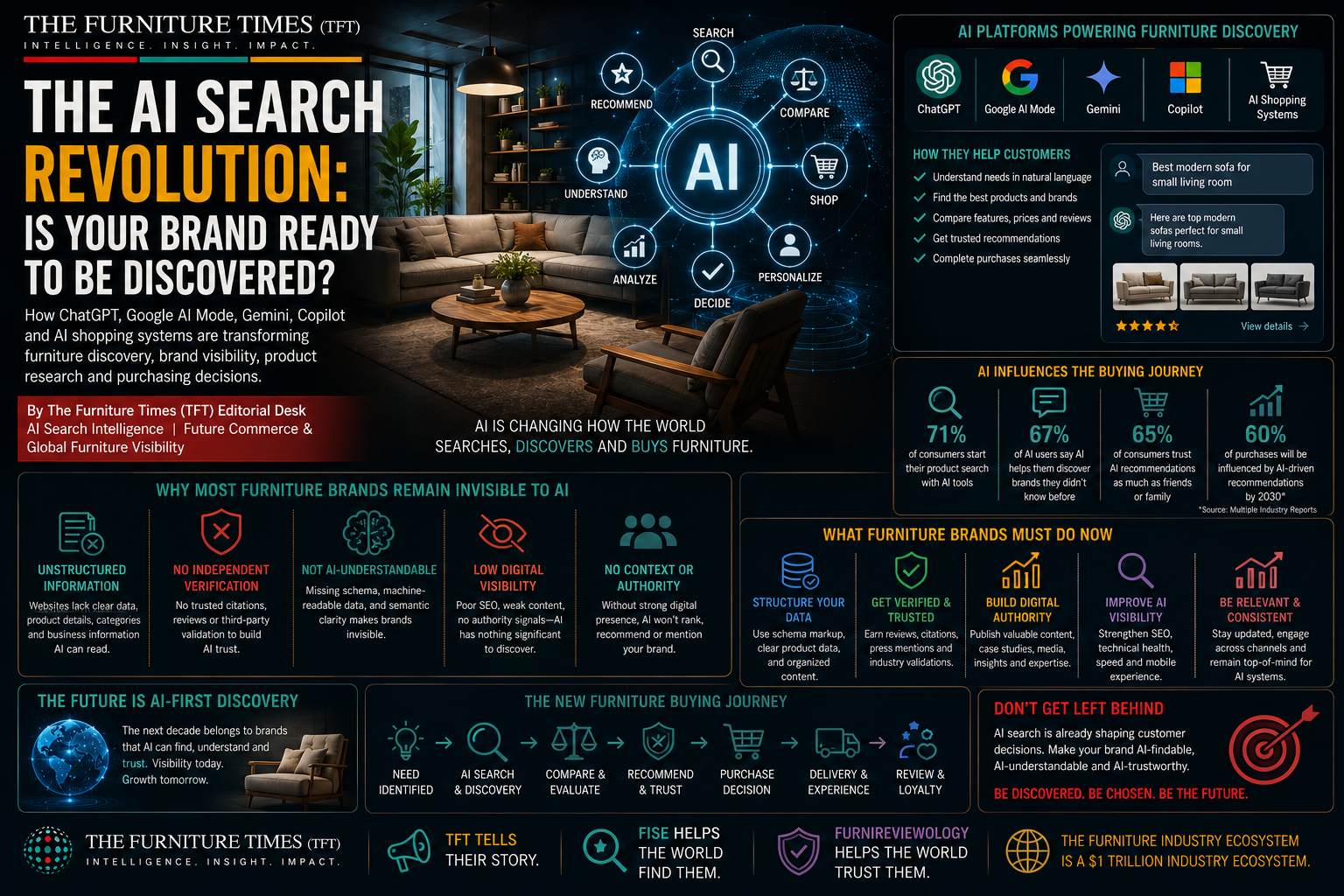
The AI Search Revolution: Is Your Brand Ready to Be Discovered?
How ChatGPT, Google AI Mode, Gemini, Copilot and AI shopping systems are transforming furniture discovery, brand visibility, product research and purchasing decisions
By The Furniture Times (TFT) Editorial Desk | AI Search Intelligence | Future Commerce & Global Furniture Visibility
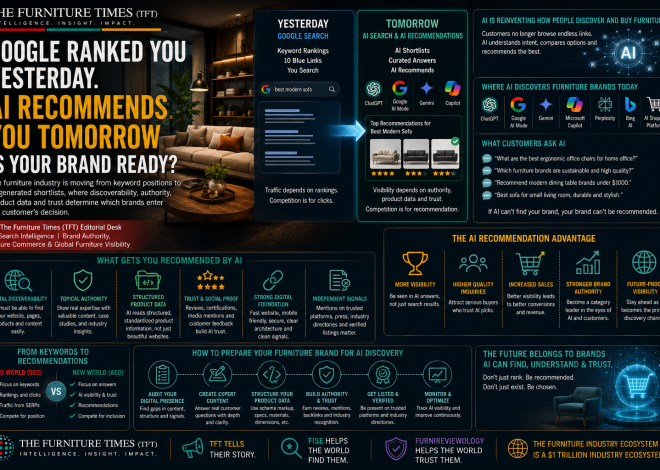
The global furniture industry is entering a new era of search.
For more than two decades, furniture companies built their digital strategies around conventional search engines. They researched keywords, created websites, purchased online advertisements and competed for positions on search-results pages.
That system is not disappearing—but it is changing rapidly.
Customers can now ask artificial-intelligence platforms complete, highly specific questions:
- Which outdoor furniture manufacturers in Malaysia supply international resort projects?
- What office chairs are suitable for employees working eight hours a day?
- Which furniture brands use certified timber?
- Where can I source customized hotel bedroom furniture with installation?
- What are the best space-saving dining tables for a small apartment?
- Which cabinet-hardware companies manufacture reliable soft-close systems?
- What furniture suppliers can meet a project deadline within eight weeks?
- Which brands offer strong warranties and dependable after-sales service?
AI systems can interpret these complex requests, conduct searches, compare information, summarize alternatives and help users move toward a decision.
This changes the competitive question facing every furniture company.
The old question was:
“Does our website rank on Google?”
The new question is:
“When buyers ask AI for a solution, is our brand discovered, accurately understood and considered trustworthy enough to be included?”
For many furniture manufacturers, retailers, suppliers and service providers, the answer remains uncertain.
Search Is Moving From Links to Answers
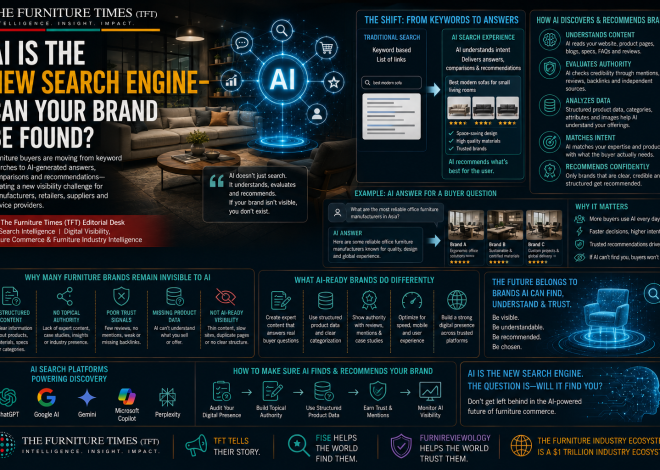
Traditional search usually presents a list of pages. The user opens several websites and conducts the comparison.
AI-powered search can complete part of that work for the user.
A system may:
- Interpret the customer’s objective.
- Break the question into several related searches.
- Retrieve information from multiple sources.
- Compare products or companies.
- Summarize advantages and limitations.
- Provide citations or product links.
- Answer follow-up questions.
- Help the user narrow the shortlist.
Google explains that its generative search systems may use “query fan-out,” generating multiple related searches to answer a complex question. A furniture buyer asking about the best outdoor dining set may indirectly trigger searches concerning materials, weather resistance, dimensions, maintenance, warranties, delivery and reviews.
This means brands must be relevant across the complete decision journey—not only for one broad keyword.
A company might rank for “outdoor furniture,” yet remain absent from more valuable questions concerning resort supply, coastal durability, commercial warranties or international shipping.
AI Search Is Becoming Commercial Infrastructure
AI-powered discovery is moving beyond informational questions and into shopping.
OpenAI has introduced shopping research that can help users describe their needs, compare options and receive a personalized buyer’s guide. It is also developing product-feed infrastructure that enables merchants to provide structured catalogue information for accurate discovery.
OpenAI’s product-feed documentation explains that feeds can help ChatGPT surface products with current pricing, availability and seller information. The company has also described an agentic-commerce direction in which product discovery, comparison and purchasing become more closely connected.
For furniture businesses, this is significant.
Furniture is a research-intensive purchase. Buyers compare:
- Style
- Dimensions
- Materials
- Comfort
- Durability
- Price
- Finish options
- Warranty
- Availability
- Delivery cost
- Assembly
- Reviews
- Return conditions
AI systems are well suited to organizing this information—provided that brands make the data available.
If product information is incomplete, outdated or inaccessible, the brand may be excluded before the customer reaches its website.
Furniture Is Highly Suitable for Conversational Search
Furniture customers rarely make decisions through one keyword.
A shopper may begin with:
“I need a sofa.”
After several questions, the real requirement becomes:
“I need a stain-resistant, three-seat modular sofa under 220 centimetres wide, suitable for a family apartment, available in Kuala Lumpur and deliverable within two weeks.”
A hotel buyer may begin by searching for “hotel furniture suppliers” but later specify:
- 150 guest rooms
- Fire-performance requirements
- Customized finishes
- Phased delivery
- On-site installation
- Replacement-parts support
- A fixed opening deadline
Conversational AI allows buyers to express these requirements naturally. It can then search for brands whose published capabilities match them.
This can benefit specialist furniture companies. A smaller manufacturer may not rank for a broad phrase such as “furniture company,” but it may become highly relevant to a precise question about custom teak resort furniture, acoustic office pods or institutional seating.
The opportunity belongs to brands that document their specialization clearly.
The AI Visibility Gap
The furniture industry contains thousands of capable businesses that remain underrepresented online.
Many depend on:
- Exhibitions
- Agents
- Printed catalogues
- Physical showrooms
- Personal networks
- Repeat buyers
- Local reputation
These channels can generate business, but they do not automatically provide AI systems with a complete and verifiable understanding of the brand.
A furniture factory may have advanced machinery, skilled workers and international experience, yet its website may contain only photographs and a contact form.
A retailer may carry thousands of products but publish no structured catalogue.
A component supplier may possess decades of engineering knowledge but provide no technical pages explaining its products.
The result is a gap between real capability and digital discoverability.
AI Visibility Is Not the Same as Website Traffic
Traditional digital marketing often measures sessions, page views and rankings.
AI visibility introduces additional outcomes:
- Brand mentions
- Product mentions
- Citations
- Recommendations
- Comparison inclusion
- Accurate brand descriptions
- Positive or negative sentiment
- Share of voice against competitors
- Visibility across buyer questions
A user may learn about a brand inside an AI answer without immediately visiting its website. That exposure can still influence later searches, dealer enquiries, store visits or purchasing decisions.
Brands therefore need to measure both direct traffic and indirect influence.
The Five Stages of AI Discovery
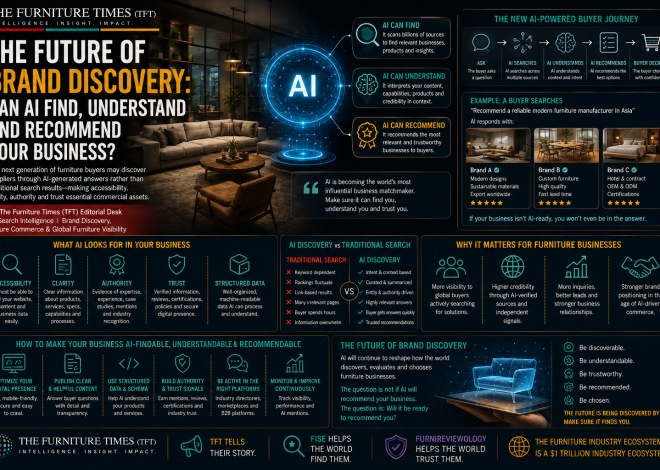
For an AI system to mention a furniture brand appropriately, several conditions usually need to be satisfied.
1. Access
Can search and AI crawlers reach the company’s public information?
2. Understanding
Can machines determine what the company does, where it operates and whom it serves?
3. Relevance
Does the brand’s information match the customer’s question?
4. Corroboration
Do independent sources support important claims?
5. Confidence
Is the information sufficiently current, consistent and trustworthy to present to the user?
A weakness at any stage can reduce visibility.
A technically accessible website may still be poorly understood. A clearly described company may lack independent authority. A recognized brand may have outdated product information.
AI readiness requires all five stages to work together.
Is SEO Still Important?
Yes.
Google’s official guidance states that traditional SEO best practices remain relevant because AI Overviews and AI Mode are connected to Google’s search index and quality systems.
To be eligible for Google’s generative AI features, a page generally needs to be indexable, technically accessible and eligible to appear with a search snippet.
Google also advises website owners to focus on unique, valuable and people-first content instead of searching for unsupported AI-search shortcuts. Its guidance specifically says that no special AI markup or llms.txt file is required for visibility in Google’s generative search features.
This provides an important warning for furniture companies: there is no single code, plugin or “GEO hack” that can manufacture authority.
Strong AI visibility is built on strong digital fundamentals.
SEO, AEO and GEO: What Do They Mean?
Three terms are frequently used to describe modern search work.
Search Engine Optimization
SEO improves a website’s accessibility, relevance and visibility in conventional search results.
Answer Engine Optimization
AEO helps content answer questions clearly enough to be extracted or summarized by search and answer platforms.
Generative Engine Optimization
GEO focuses on improving the likelihood that a brand or source is appropriately represented in AI-generated answers.
These are not completely separate disciplines.
For furniture companies, a useful model is:
SEO makes the brand discoverable. AEO makes its expertise answerable. GEO makes it understandable and relevant within AI-generated responses.
Google views generative-search optimization as an evolution of SEO rather than a replacement for it. Brands should therefore strengthen proven fundamentals while adapting content and measurement to conversational discovery.
Why Many Furniture Brands Are Not Ready
Their websites do not explain what they do
Statements such as “quality furniture solutions” provide little usable information.
AI needs explicit facts about products, materials, business models, customer groups, locations and capabilities.
Their products exist only as pictures
A photograph without a descriptive product page offers limited information about size, material, use, warranty or availability.
Their catalogues exist only in PDFs
PDFs can support buyers, but important categories and products should also have accessible webpage versions.
Their information is inconsistent
Different names, addresses, categories and descriptions create confusion.
They have little independent coverage
AI systems may find company claims but no third-party evidence confirming them.
Their reviews are missing or weak
Limited customer evidence makes commercial confidence harder to establish.
Their websites block crawlers accidentally
Incorrect technical settings can prevent public content from entering search and AI retrieval systems.
Their products have outdated data
Incorrect stock, pricing, location or warranty details can make recommendations unreliable.
Their expertise has never been published
Decades of knowledge remain inside the factory rather than becoming searchable case studies, guides and explanations.
AI Readiness Begins With a Clear Brand Entity
A brand must be more than a name and logo. It must be an understandable digital entity.
The official website should clearly establish:
- Brand name
- Legal company name
- Year established
- Headquarters
- Factory and showroom locations
- Business classification
- Product categories
- Materials and production capabilities
- Markets served
- Certifications
- Warranty policy
- Official contact details
- Social profiles
- Distributors or authorized retailers
This information should remain consistent across important third-party sources.
When AI systems repeatedly encounter the same company, location, category and specialization, the brand becomes easier to identify correctly.
Product Information Is the Foundation of AI Commerce
Furniture brands should treat product information as commercial infrastructure.
Every priority product page should contain:
- Product name
- Model or stock-keeping unit
- Clear description
- Furniture category
- Intended use
- Dimensions
- Materials
- Construction details
- Finish and color options
- Care instructions
- Assembly requirements
- Indoor or outdoor suitability
- Warranty
- Availability
- Delivery territory
- Price or quotation process
- Return conditions
- Original images
A chair described only as “Model A12” is difficult to match with a detailed buyer request.
A chair described as a stackable powder-coated aluminum dining chair for outdoor hospitality environments provides specific information that AI can connect with commercial intent.
Structured Product Feeds Will Become More Important
Webpages serve both people and search systems. Product feeds provide structured catalogue data directly to commerce platforms.
OpenAI’s current commerce documentation allows merchants to provide standardized product information so ChatGPT can represent products more accurately. Google also recommends tools such as Merchant Center feeds and Business Profiles where appropriate for product and local-business discovery.
Furniture feeds may be more complicated than feeds for small standardized products because furniture frequently has:
- Fabric options
- Finish choices
- Multiple sizes
- Modular configurations
- Customized quotations
- Regional pricing
- Long lead times
- Installation requirements
Nevertheless, the direction is clear: brands with organized product data will be better prepared for AI-assisted commerce than companies relying entirely on photographs and PDF catalogues.
Original Expertise Will Outperform Commodity Content
The internet is becoming saturated with generic content created from the same widely available information.
Google’s 2026 guidance encourages businesses to create valuable, non-commodity content—information that is unique, useful and grounded in genuine expertise.
Furniture companies have substantial original knowledge that is rarely documented:
- Why certain joints fail
- How upholstery fabrics are tested
- How foam density affects performance
- How tropical weather affects outdoor materials
- How furniture is packaged for export
- How hotel projects are installed
- How replacement parts reduce waste
- How component quality affects product life
- How timber is dried and selected
- How furniture damage occurs during transportation
Publishing this expertise can create value for buyers while giving search and AI systems stronger evidence of specialization.
Independent Mentions Build Corroboration
Brands cannot build authority entirely through self-description.
A 2025 Ahrefs analysis of approximately 75,000 brands found that branded web mentions had a stronger correlation with visibility in Google AI Overviews than raw backlink volume. A later Ahrefs study reported that YouTube mentions showed a particularly strong correlation with AI brand visibility.
These studies identify associations rather than confirmed ranking rules. They nevertheless reinforce the value of a broad and authentic digital presence.
Credible mentions can come from:
- Industry publications
- News reports
- Exhibition websites
- Trade associations
- Distributors
- Project partners
- Certification bodies
- Independent reviews
- Expert interviews
- Educational videos
- Business directories
Furniture companies should seek genuine visibility—not mass-produced mentions, fake articles or manufactured reviews.
News and Public Relations Become Search Infrastructure
A legitimate press release or news feature creates a dated, accessible record of a business development.
Newsworthy topics may include:
- Factory expansion
- New machinery
- Product launches
- Exhibition participation
- Certifications
- Sustainability initiatives
- Market entry
- Partnerships
- Major projects
- Research and innovation
- Workforce programs
- Awards from credible institutions
Public relations should not consist of exaggerated claims. Its value comes from documenting real events and providing facts that buyers, journalists and AI systems can evaluate.
The Furniture Times can help tell these industry stories, especially for SMEs that rarely receive international media attention.
Reviews Form the Trust Layer
AI discovery can bring a company into consideration, but trust influences the final decision.
Authentic reviews can provide evidence relating to:
- Product quality
- Description accuracy
- Comfort
- Delivery
- Assembly
- Installation
- Service
- Warranty handling
- Long-term durability
Furniture companies should request detailed, honest feedback and respond responsibly to complaints.
Fake reviews create reputational and platform risks. The objective is not to remove every negative comment but to demonstrate consistent service and accountable problem-solving.
FurniReviewology can support this trust layer by organizing furniture-specific reputation and review information.
Video Is Becoming a Powerful Discovery Format
Furniture is visual, physical and difficult to explain through text alone.
Useful video content can show:
- Factory processes
- Product demonstrations
- Assembly
- Mechanisms
- Material comparisons
- Quality testing
- Showroom tours
- Project installations
- Care and maintenance
- Designer explanations
Videos should include accurate titles, descriptions, captions and links to relevant product or company pages.
A factory video titled “Our Latest Video” provides little context. A title such as “How Our Malaysian Factory Manufactures Powder-Coated Aluminum Outdoor Furniture” communicates far more meaning.
Local AI Discovery Matters for Retailers
Furniture retailers, repair companies, installers and interior service providers depend heavily on location.
Their AI readiness should include:
- Accurate Google Business Profile
- Correct address
- Opening hours
- Telephone number
- Service areas
- Product categories
- Showroom images
- Reviews
- Delivery information
- Website links
- Regular updates
A customer asking for a furniture shop “near me” or a sofa-repair specialist in a specific city gives AI systems strong location intent.
Businesses with incomplete or conflicting local information may be overlooked.
AI Search Creates Opportunities for Furniture SMEs
The AI search revolution is not only for large companies.
A small manufacturer may have limited authority for a broad query, but it can establish relevance within a specific niche.
Examples include:
- Teak outdoor furniture for tropical climates
- Custom banquette seating for restaurants
- Small-batch brass furniture hardware
- School furniture designed for flexible classrooms
- Flat-pack furniture for small apartments
- Furniture repair and reupholstery
- Hospitality headboards and wall panels
- Bespoke furniture for luxury villas
Specific expertise can compete with corporate scale when it is documented clearly and verified independently.
SMEs should not attempt to become relevant to every furniture question. They should become exceptionally clear about the problems they solve best.
The AI Search Readiness Scorecard
Furniture companies can conduct a preliminary assessment using the following framework.
| Readiness area | Points |
|---|---|
| Crawler access and technical SEO | 15 |
| Brand identity and consistency | 15 |
| Product and category information | 15 |
| Original expertise and case studies | 15 |
| Independent media and authority | 15 |
| Reviews and trust signals | 10 |
| Structured data and product feeds | 10 |
| Measurement and internal ownership | 5 |
| Total | 100 |
Score interpretation
| Score | Readiness level |
|---|---|
| 0–20 | Not prepared |
| 21–40 | Technically present but weak |
| 41–60 | Partially discoverable |
| 61–80 | Strong foundation |
| 81–100 | Advanced AI-search readiness |
This is a TFT editorial assessment framework, not an official score used by an AI or search platform.
The 15-Point AI Search Readiness Checklist
A furniture brand should be able to answer yes to the following:
- Can search and AI crawlers access our public pages?
- Does our website clearly explain what we do?
- Is our brand information consistent across platforms?
- Does every priority product have a detailed webpage?
- Are our prices, availability and warranties current?
- Do we have detailed category pages?
- Have we published real project case studies?
- Do credible independent sources mention us?
- Do we have authentic customer reviews?
- Is appropriate structured data implemented correctly?
- Are our product feeds ready for AI commerce?
- Do we publish original expertise?
- Can buyers find useful videos about our products and capabilities?
- Do we measure AI mentions, citations and accuracy?
- Is one person or team responsible for AI visibility?
A “no” answer identifies a practical improvement opportunity.
How to Test Whether AI Can Discover Your Brand
Testing should use realistic buyer prompts rather than only searching for the company name.
Brand-understanding prompts
- What does [Brand Name] manufacture?
- Where is [Brand Name] based?
- What products does [Brand Name] specialize in?
- Does [Brand Name] serve international customers?
Discovery prompts
- Which companies manufacture in [country]?
- Who supplies [furniture category] for hospitality projects?
- What brands offer [specific material or capability]?
Trust prompts
- Is [Brand Name] reliable?
- What reviews are available for [Brand Name]?
- What warranties does [Brand Name] provide?
- Are its sustainability claims supported by evidence?
Comparison prompts
- Compare [Brand Name] with [Competitor].
- Which company is better suited to [specific use case]?
- What are the strengths and limitations of each supplier?
Record the platform, date, wording, response, citations and errors. Results can change, so one test should never be treated as permanent.
A 100-Day Preparation Plan
Days 1–25: Establish discoverability
- Audit crawler access.
- Fix indexing problems.
- Submit accurate sitemaps.
- Improve hosting reliability and speed.
- Standardize brand information.
- Create a complete company profile.
- Establish an AI-visibility baseline.
Days 26–50: Build product clarity
- Develop detailed category pages.
- Upgrade priority product pages.
- Add specifications, materials and dimensions.
- Correct outdated products.
- Add warranty and delivery information.
- Implement relevant structured data.
- Prepare a central product database.
Days 51–75: Build authority and trust
- Publish case studies.
- Create expert-led technical articles.
- Produce useful videos.
- Seek credible news coverage.
- Update exhibition and association profiles.
- Collect authentic reviews.
- Correct conflicting third-party information.
Days 76–100: Prepare for AI commerce
- Evaluate product-feed requirements.
- Improve inventory accuracy.
- Standardize product identifiers.
- Connect product, delivery and return data.
- Track AI referrals.
- Compare visibility with competitors.
- Establish monthly reporting and quarterly audits.
What Brands Should Avoid
The AI search revolution will attract questionable shortcuts.
Furniture companies should avoid:
- Fake reviews
- Fabricated media coverage
- False certifications
- Hidden structured-data claims
- Mass-produced low-value pages
- Copied product descriptions
- Irrelevant backlinks
- Inauthentic forum mentions
- Incorrect product availability
- Misleading comparisons
- Unsupported claims of being “the best”
- Treating
llms.txtas a guaranteed visibility solution
Google specifically warns that creating large volumes of AI-generated pages without meaningful user value may violate its policy against scaled content abuse.
AI should help companies organize and improve real expertise—not manufacture expertise they do not possess.
Measuring the New Visibility Economy
A modern visibility dashboard should include:
- Traditional search rankings
- Search impressions
- AI feature impressions
- Brand mention rate
- Citation rate
- Recommendation rate
- Accuracy rate
- Competitive share of voice
- Sentiment
- Product visibility
- Review growth
- AI referral sessions
- Enquiries influenced by AI
OpenAI states that referral links from ChatGPT Search contain a source parameter that can be identified in analytics. Google has also introduced a dedicated generative AI performance view within Search Console.
These developments indicate that AI-search visibility is becoming a measurable commercial channel.
The Role of TFT, FISE and FurniReviewology
The furniture industry needs an integrated discovery infrastructure.
The Furniture Times (TFT) documents companies, innovation, market developments, people and ideas across the furniture ecosystem.
Furniture Industry Search Engine (FISE) organizes manufacturers, retailers, suppliers and service providers into searchable industry categories.
FurniReviewology helps buyers evaluate reputation, customer experience and trust.
These functions represent three connected stages:
- Storytelling — explaining who the company is.
- Discovery — helping the market find it.
- Trust — helping customers evaluate it.
This is especially important for furniture SMEs whose real capabilities are far greater than their digital visibility.
Final Analysis: Being Online Is No Longer Enough
The AI search revolution is changing the starting point of the customer journey.
Customers may ask AI which materials are suitable, which manufacturers are credible, which products match their space and which brands deserve consideration—before visiting a showroom, exhibition or company website.
By the time a buyer contacts a supplier, AI may already have influenced the shortlist.
Furniture brands must therefore become:
- Accessible to search systems
- Clear about their identity
- Detailed about their products
- Consistent across platforms
- Supported by independent evidence
- Trusted through authentic reviews
- Prepared with structured product data
- Measurable across AI discovery channels
The companies that prepare now can strengthen their position in a new search economy. Those that remain digitally unclear may lose opportunities without receiving a rejection, quotation request or enquiry.
The decisive question is no longer whether AI search will influence the furniture industry.
It already does.
The decisive question is:
Is your brand ready to be discovered?
Editorial note: AI-generated answers are dynamic and can vary by platform, prompt, date, language, location and available sources. No SEO, AEO or GEO activity can guarantee a citation, mention or recommendation. Independent studies cited in this article report correlations and observed patterns, not confirmed universal ranking factors.
Reference sources: Google’s generative AI optimization guidance, Google AI features documentation, OpenAI crawler documentation, OpenAI product discovery, OpenAI product-feed documentation, and Ahrefs’ brand-visibility research.
The Furniture Times (TFT) & Furniture Industry Search Engine (FISE)
“TFT tells their story. FISE helps the world find them.”
FurniReviewology helps the world trust them.
The furniture industry ecosystem is a $1 trillion industry ecosystem.