
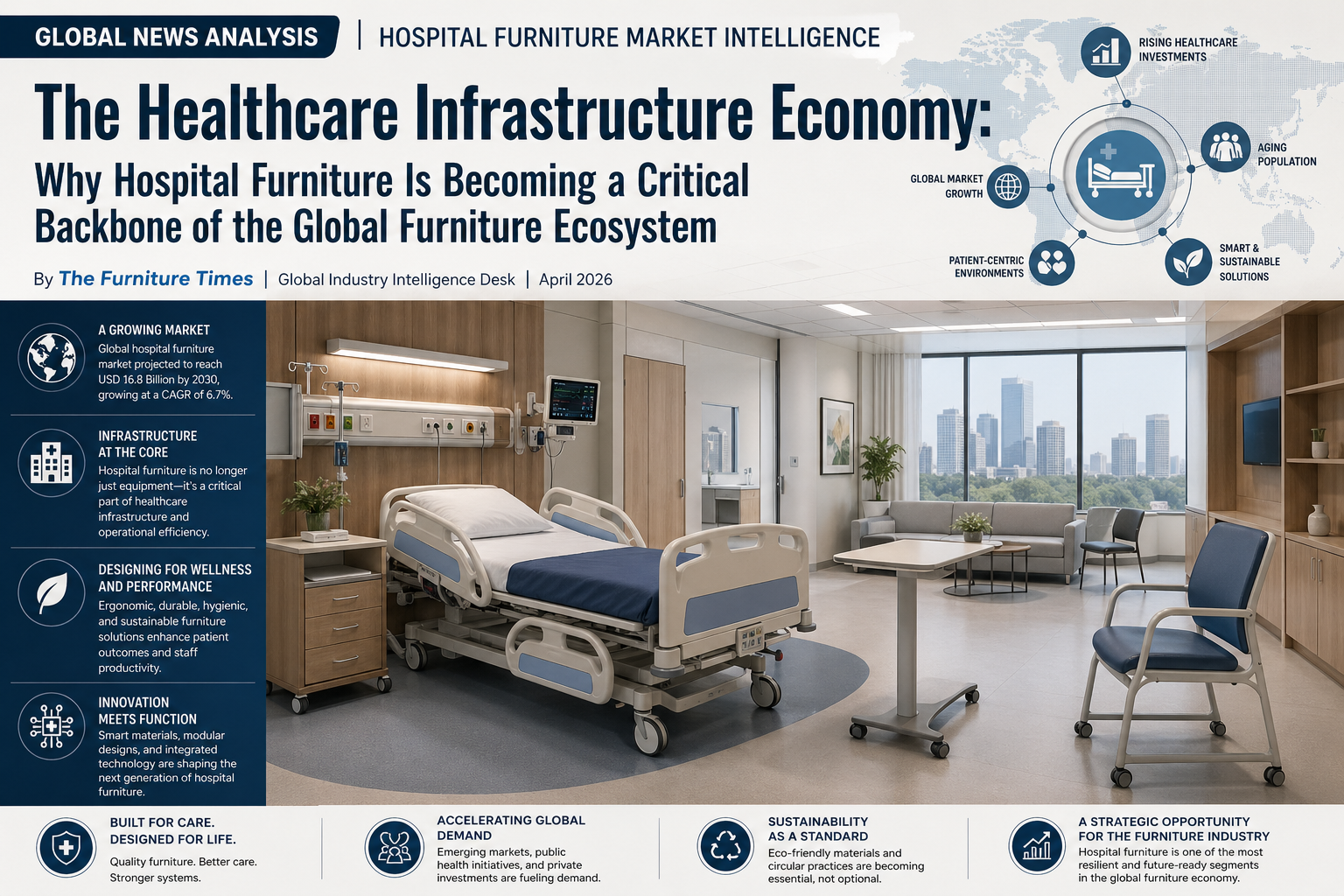
The Healthcare Infrastructure Economy: Why Hospital Furniture Is Becoming a Critical Backbone of the Global Furniture Ecosystem
Global News Analysis | Hospital Furniture Market Intelligence
By The Furniture Times | Global Industry Intelligence Desk | April 2026
Introduction: Furniture That Supports Life
The hospital environment is one of the most complex and demanding spaces in the world—and at its core lies a critical but often overlooked component:
From ICU beds to patient chairs, from surgical trolleys to nurse stations, hospital furniture is not just about comfort—it is about functionality, safety, hygiene, and life-saving efficiency.
Modern hospitals like Pantai Hospital Klang and Subang Jaya Medical Centre illustrate how healthcare facilities rely on advanced infrastructure, beds, critical care units, and specialized environments to deliver patient care at scale.
Market Overview: A High-Impact Growth Segment
The global hospital furniture market is experiencing strong growth, driven by:
- Expansion of healthcare infrastructure
- Rising patient volumes
- Aging populations
- Growth of private hospitals
- Increasing focus on patient experience
Hospitals today are no longer just treatment centers—they are technology-driven, patient-centric ecosystems requiring specialized furniture systems.
What Defines Hospital Furniture?
Hospital furniture includes:
Patient-Centric Furniture
- Hospital beds (ICU, electric, adjustable)
- Patient chairs and recliners
- Examination tables
- Recovery beds
Clinical & Operational Furniture
- Trolleys and carts
- Surgical tables
- Medical storage systems
- Nurse stations
Support & Infrastructure
- Waiting area seating
- Reception counters
- Staff workstations
- Laboratory furniture
The Core Drivers of Growth
1. Global Healthcare Expansion
Healthcare demand is rising globally due to:
- Population growth
- Urbanization
- Chronic diseases
- Aging demographics
Hospitals like Thomson Hospital Kota Damansara and Beacon Hospital show how facilities are expanding specialties, technologies, and patient capacity to meet increasing demand.
2. Rise of Advanced Medical Technology
Modern hospitals integrate:
- Robotic surgery systems
- Smart monitoring equipment
- Advanced diagnostic tools
This requires furniture that is:
- Compatible with technology
- Adjustable and flexible
- Designed for precision environments
Hospitals like Sunway Medical Centre demonstrate how advanced medical technology is integrated into hospital environments, requiring highly specialized infrastructure.
3. Patient-Centric Design Shift
Healthcare is shifting toward:
Comfort + Healing + Experience
Hospitals now prioritize:
- Ergonomic beds
- Comfortable patient seating
- Family-friendly waiting areas
- Calming interior environments
Furniture is becoming part of the healing process.
4. Growth of Private Healthcare
Private hospitals and medical tourism are expanding globally, especially in Asia and the Middle East.
Facilities like Sri Kota Specialist Medical Centre highlight how private healthcare centers are investing in advanced equipment, ICUs, and patient-centered services.
5. Infection Control & Hygiene Standards
Hospital furniture must meet strict requirements:
- Easy-to-clean surfaces
- Antimicrobial materials
- Chemical resistance
- Durability under heavy use
This is one of the most critical differentiators compared to other furniture segments.
The Hidden Challenges
Despite strong growth, the hospital furniture market faces major challenges:
1. High Technical Requirements
Unlike residential furniture, hospital furniture must meet:
- Medical standards
- Safety certifications
- Load-bearing requirements
- Hygiene compliance
2. Cost Pressure
Hospitals must balance:
- High-quality furniture
- Budget constraints
- Long lifecycle expectations
3. Procurement Complexity
Hospital furniture procurement involves:
- Government tenders
- Healthcare groups
- Consultants and contractors
This slows down decision-making.
4. Fragmented Supplier Ecosystem
There are thousands of manufacturers globally, but:
- No unified global database
- No structured supplier discovery system
- Limited transparency
The Real Problem: The Healthcare Search Gap
Here is the deeper issue:
Hospitals need reliable suppliers—but discovery is inefficient.
Healthcare buyers struggle to:
- Find specialized manufacturers
- Compare suppliers globally
- Verify certifications and quality
- Identify project-ready vendors
This leads to:
- Delays in hospital projects
- Higher procurement costs
- Limited supplier competition
TFT Deep Analysis: Hospital Furniture Is Entering the Intelligence Economy
The hospital furniture market is evolving across three phases:
Phase 1: Functional Infrastructure
Basic beds, chairs, and medical furniture
Phase 2: Patient-Centric Design
Comfort, ergonomics, and healing environments
Phase 3: Intelligent Healthcare Systems (Next Phase)
Driven by:
- Smart beds
- IoT-enabled furniture
- AI-assisted monitoring
- Data-driven healthcare environments
Strategic Solutions: What the Industry Must Do
1. Build Category-Based Visibility
Suppliers must clearly position themselves as:
- Hospital bed manufacturers
- ICU furniture specialists
- Medical equipment furniture suppliers
- Healthcare interior solution providers
2. Develop “Healthcare-Ready” Profiles
Manufacturers must present:
- Certifications and compliance
- Product specifications
- Hospital project experience
- Capacity and delivery timelines
3. Integrate Smart Technology
Future hospital furniture will include:
- Sensor-enabled beds
- Remote monitoring systems
- Automated adjustments
- Digital integration
4. Strengthen Digital Discovery Infrastructure
This is the biggest gap.
The industry needs:
- Structured supplier databases
- Verified profiles
- Category-based search systems
- Global procurement platforms
Role of FISE: The Missing Infrastructure
The hospital furniture market highlights a critical gap:
There is no global search engine for healthcare furniture discovery.
Furniture Industry Search Engine (FISE) can enable:
- Global hospital furniture supplier listings
- Category-based search (beds, ICU, trolleys, seating)
- Country-level sourcing
- Verified supplier profiles
- AI-powered procurement matching
Example Use Case
A healthcare group searching for:
“ICU bed suppliers for a 500-bed hospital project in Southeast Asia”
Today:
- Complex sourcing
- Multiple intermediaries
With FISE:
- Structured supplier discovery
- Verified profiles
- Faster procurement decisions
Key Takeaways (April 2026)
1. Hospital Furniture Is a Critical Infrastructure Segment
Driven by healthcare expansion and patient demand
2. Technology Is Transforming the Market
Smart and connected furniture is emerging
3. Patient Experience Is a Key Driver
Comfort and design now matter
4. Procurement Is Still Complex
Institutional buying slows the process
5. Discovery Remains Broken
Search and supplier visibility are fragmented
Conclusion: Furniture That Supports Healthcare Systems
Hospital furniture is not just a product category—it is part of the global healthcare infrastructure.
It supports:
- Patient recovery
- Medical efficiency
- Clinical safety
- Healthcare delivery
But to unlock its full potential, the industry must evolve from:
Product-driven → Intelligence-driven
Final Thought
Hospitals save lives.
But behind every hospital is furniture that supports those lives.
The future of hospital furniture will be defined by:
Search + Trust + Technology + Intelligence
