
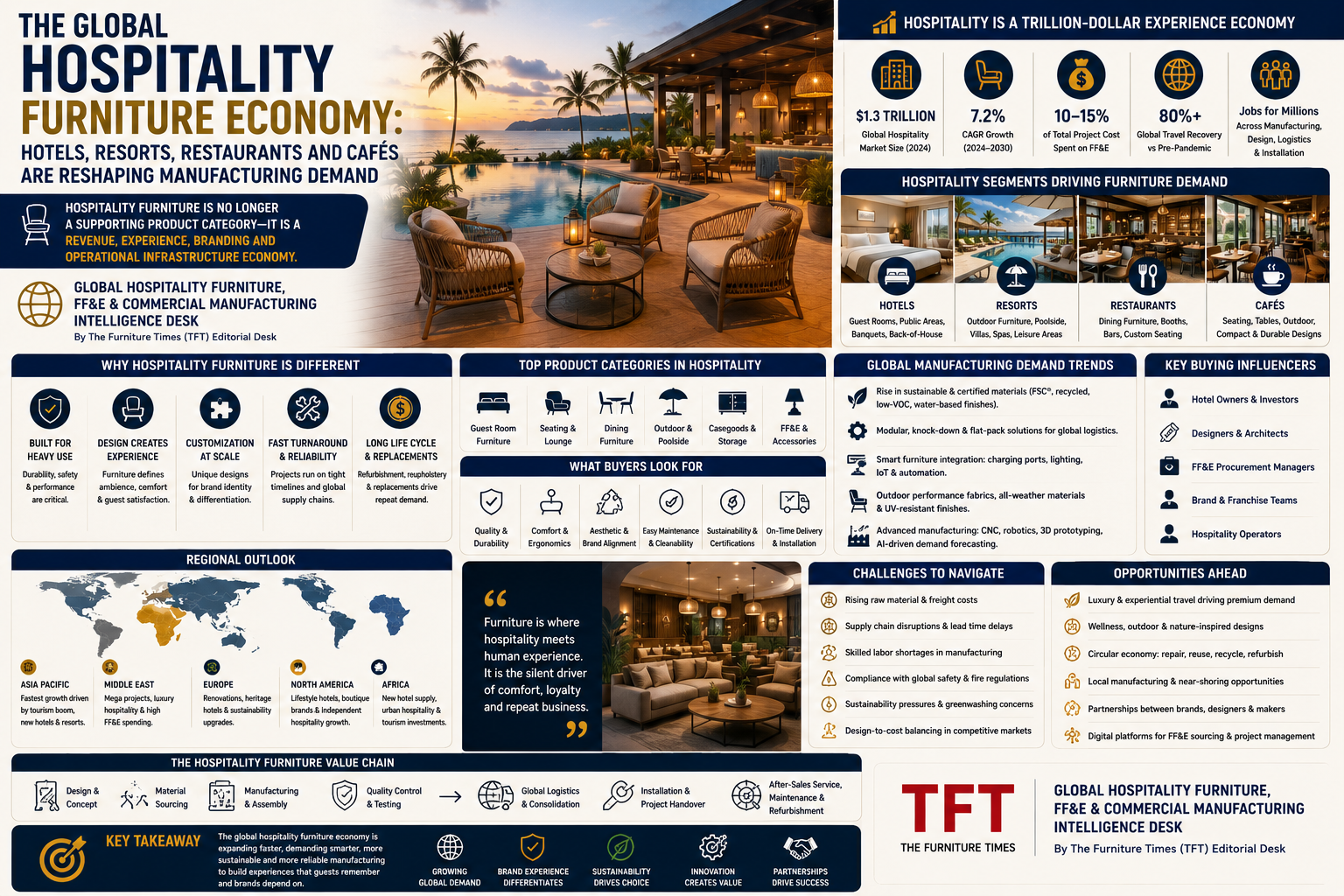
The Global Hospitality Furniture Economy: Hotels, Resorts, Restaurants and Cafés Are Reshaping Manufacturing Demand
Hospitality Furniture Is No Longer a Supporting Product Category—It Is a Revenue, Experience, Branding and Operational Infrastructure Economy
Global Hospitality Furniture, FF&E & Commercial Manufacturing Intelligence Desk
By The Furniture Times (TFT) Editorial Desk
Hospitality furniture is becoming one of the most strategically important segments of the global furniture industry ecosystem.
Hotels, resorts, restaurants, cafés, serviced apartments, beach clubs, rooftop venues, spas, wellness retreats, convention centres and entertainment destinations all depend on furniture to deliver their commercial promise.
A hotel room cannot generate revenue effectively without a functional bed, mattress, wardrobe, desk, chair, luggage unit and bedside furniture.
A restaurant cannot maximise capacity, comfort and table turnover without correctly designed dining tables, chairs, bar stools, banquettes and outdoor seating.
A resort cannot deliver a premium guest experience without loungers, daybeds, cabanas, dining furniture, poolside products and weather-resistant outdoor collections.
A café may use furniture to transform a limited floor area into a distinctive, photographable and commercially productive environment.
Furniture is therefore not simply placed inside hospitality properties after the main construction work is completed.
It forms part of the property’s:
- Revenue system
- Guest experience
- Brand identity
- Operational workflow
- Maintenance plan
- Social-media visibility
- Renovation cycle
- Asset value
The global hotel furniture, fixtures and equipment market was valued at approximately US$63.1 billion in 2025 and is projected to increase from around US$67.6 billion in 2026 to US$107.9 billion by 2033, representing estimated annual growth of 6.9%. North America accounted for approximately 38.8% of the market in 2025 under this broad FF&E definition.
The broader global contract-furniture market—which includes hospitality, offices, healthcare, education and other commercial applications—is projected to expand from approximately US$153.02 billion in 2026 to US$203.04 billion by 2034.
These figures show that hospitality furniture is not a small specialist niche.
It is part of a major commercial manufacturing, procurement, design, logistics, installation and after-sales economy.
Hospitality Growth Creates Furniture Demand at Every Stage
The hospitality furniture economy is influenced by three major property cycles:
New Development
Every newly built hotel, resort, restaurant or café creates a complete first-time furniture requirement.
Renovation and Repositioning
Existing properties replace furniture to remain competitive, update brand standards, improve guest experience or move into a higher market category.
Operational Replacement
Furniture is replaced because of wear, damage, hygiene, climate exposure, changing layouts or unavailable spare components.
New construction attracts the greatest public attention, but renovation and replacement can create equally important recurring demand.
A hotel may remain operational for decades while replacing or refurbishing furniture several times.
A restaurant may redesign its interior after only a few years to remain relevant.
A resort may replace outdoor cushions, slings, loungers and parasols more frequently than its indoor furniture because of climate exposure.
The hospitality furniture market should therefore be viewed as a continuous lifecycle rather than a one-time construction opportunity.
The Global Hotel Pipeline Is a Manufacturing Demand Pipeline
Every hotel in development represents future demand for furniture, fixtures, equipment, operating supplies and installation services.
The global hotel-development pipeline reached record levels during 2025. Lodging Econometrics forecast approximately 2,531 new hotels containing 382,942 rooms to open worldwide during 2026, following thousands of openings and planned projects during 2025.
The pipeline creates demand for:
- Guest-room beds
- Mattresses
- Headboards
- Bedside tables
- Wardrobes
- Desks
- Chairs
- Luggage benches
- Minibar units
- Lobby furniture
- Restaurant furniture
- Conference furniture
- Outdoor furniture
- Poolside loungers
- Spa furniture
- Staff-area furniture
The project opportunity is considerably larger than the number of hotel rooms alone suggests.
A hotel with 200 rooms may require thousands of individual furniture pieces across guest rooms, corridors, public spaces, restaurants, bars, meeting rooms, outdoor areas and staff facilities.
Hotel Investment Is Recovering—But Buyers Remain Selective
JLL’s 2026 Global Hotel Investment Outlook points to strengthening hotel investment conditions, supported by improving debt markets, available capital and renewed investor interest.
However, stronger investment does not mean buyers will accept inefficient procurement or poorly performing furniture.
Owners and operators remain focused on:
- Cost control
- Opening dates
- Guest satisfaction
- Brand standards
- Operational durability
- Energy and sustainability targets
- Renovation returns
- Replacement availability
- Lifecycle cost
Furniture manufacturers must therefore demonstrate more than aesthetic capability.
They must prove they can support the business performance of the hospitality property.
The Hospitality Furniture Ecosystem
The hospitality furniture economy involves a wide network of organisations.
Property Owners
They finance the project and focus on:
- Capital expenditure
- asset value
- opening schedules
- investment returns
- long-term renovation costs
Hotel Operators
They focus on:
- Guest experience
- operational efficiency
- brand standards
- housekeeping
- maintenance
- replacement continuity
Architects
They coordinate furniture with:
- Space planning
- accessibility
- circulation
- architecture
- power and data
- lighting
- safety
Interior Designers
They influence:
- Furniture style
- colour
- proportion
- materials
- custom design
- finish coordination
- guest atmosphere
Procurement Consultants
They may manage:
- Tendering
- quotations
- purchasing
- supplier coordination
- freight
- warehousing
- installation
- project reporting
Main Contractors and Fit-Out Contractors
They coordinate furniture installation with the building programme.
Furniture Manufacturers
They translate specifications into repeatable, commercially durable products.
Logistics Companies
They manage:
- Shipping
- customs
- warehousing
- site delivery
- room-by-room distribution
Installation Teams
They assemble, position, fix, inspect and prepare furniture for operational use.
Facility and Operations Teams
They maintain the furniture after opening.
A supplier that understands only manufacturing may struggle in this environment.
Hospitality projects require the ability to communicate across the entire ecosystem.
Hospitality Furniture Is Different From Residential Furniture
A chair used by one household is not exposed to the same conditions as a restaurant chair used by hundreds of guests every week.
Hospitality products experience:
- Intensive daily use
- Frequent cleaning
- Different body sizes
- Continuous movement
- Food and drink spills
- Suitcase impact
- Housekeeping equipment
- Outdoor exposure
- Commercial maintenance chemicals
- Rapid replacement expectations
A residential product may look suitable in a hotel or restaurant but fail quickly under commercial use.
Hospitality furniture should be designed around:
- Higher structural loads
- stronger joints
- commercial-grade upholstery
- stable finishes
- replaceable components
- ease of cleaning
- efficient repair
- consistent repeat production
The correct question is not:
Does this product look suitable for hospitality?
It is:
Can this product survive the operational reality of hospitality?
The Hotel Guest-Room Furniture Economy
The guest room is the most repeated furniture environment in a hotel.
A standard room may include:
- Bed base
- mattress
- headboard
- bedside tables
- desk or work surface
- task or lounge chair
- wardrobe
- luggage bench
- television unit
- minibar cabinet
- mirror
- occasional table
- sofa bed in selected rooms
Multiplying these items across hundreds of rooms creates substantial manufacturing demand.
Bed Systems
The bed is central to the hotel product because sleep quality directly affects guest satisfaction.
Hotels evaluate:
- Mattress comfort
- bed height
- housekeeping access
- durability
- movement
- replacement cycles
- brand consistency
Headboards
Headboards increasingly integrate:
- Lighting
- switches
- charging
- power outlets
- acoustic materials
- decorative finishes
- bedside storage
This requires coordination among furniture, electrical, lighting and interior contractors.
Wardrobes
Hotel wardrobes must balance storage with limited room area.
They may include:
- Hanging space
- drawers
- safe
- ironing equipment
- luggage storage
- minibar
- open shelving
Desks and Work Surfaces
Hybrid travel and mobile working have changed expectations.
Hotels may require compact but functional surfaces for:
- Laptops
- dining
- writing
- charging
- video meetings
Luggage Furniture
Luggage benches and racks must survive repeated impact from heavy suitcases.
Sofa Beds
Serviced apartments and family rooms increasingly use sofa beds to increase sleeping capacity without expanding floor area.
Hotels Are Moving From Standard Rooms to Experience-Based Rooms
Traditional hotel-room design focused heavily on standardisation.
Standardisation remains important, but many brands now want spaces that feel:
- Local
- memorable
- residential
- culturally connected
- photographable
- distinctive
This creates demand for furniture that combines repeat manufacturing with local identity.
Manufacturers may need to produce:
- Custom headboards
- regionally influenced tables
- locally woven furniture
- special upholstery
- natural-material accents
- furniture inspired by local craft
The challenge is maintaining:
- Consistency
- durability
- cost control
- replacement availability
- production schedules
Hospitality furniture must tell a story without becoming operationally impractical.
Luxury Hotels and Resorts Drive Custom Manufacturing
Luxury hospitality creates opportunities for:
- Bespoke furniture
- premium materials
- handcrafted pieces
- designer collaborations
- custom outdoor collections
- sculptural public-area products
- high-performance upholstery
- private-villa furniture
Luxury properties may require:
- Full-size prototypes
- mock-up rooms
- custom samples
- special finishes
- international approvals
- carefully controlled material batches
The higher selling price does not automatically create high profitability for the manufacturer.
Luxury projects can involve:
- Repeated revisions
- expensive samples
- low quantities per design
- complex approval chains
- demanding finishes
- specialist installation
- extended defect periods
Manufacturers must price design development, prototyping and project management correctly.
Midscale and Economy Hotels Create Volume Demand
Midscale, limited-service and economy hotels may use more standardised furniture packages.
These properties prioritise:
- Cost per room
- durability
- efficient manufacturing
- compact shipping
- fast installation
- simple maintenance
- dependable replacement
A furniture supplier may produce:
- Standard bed bases
- modular wardrobes
- combined desk and minibar units
- compact headboards
- standard lounge chairs
- luggage benches
Margins per item may be lower than in luxury projects, but volumes can be substantially higher.
Manufacturers with automated panel processing, standardised components and strong logistics can compete effectively in this segment.
Resorts Create a Complete Indoor–Outdoor Furniture Economy
Resorts require furniture across several environments.
Guest Accommodation
- Rooms
- suites
- villas
- bungalows
- serviced residences
Public Areas
- Lobbies
- lounges
- reception areas
- libraries
- waiting areas
Food and Beverage
- Restaurants
- cafés
- bars
- terraces
- beach dining
- room-service support areas
Recreation
- Pools
- beaches
- gardens
- spas
- wellness areas
- sports facilities
Events
- Ballrooms
- conference rooms
- wedding spaces
- temporary outdoor venues
Resort furniture must often operate in demanding climates involving:
- Humidity
- salt
- chlorine
- sunlight
- heavy rain
- wind
- sand
- frequent cleaning
This creates demand for climate-specific materials, replacement systems and long-term maintenance support.
Poolside Furniture Has Its Own Replacement Economy
Poolside furniture commonly includes:
- Loungers
- side tables
- umbrellas
- daybeds
- cabanas
- dining furniture
- towel stations
- storage
These products face:
- UV exposure
- water
- chlorine
- sunscreen
- wet towels
- continuous movement
- guest misuse
The frame may remain usable while the following components require replacement:
- Slings
- cushions
- covers
- wheels
- glides
- canopies
- hardware
Manufacturers can create recurring revenue by offering components for many years after installation.
A supplier that cannot replace a sling or cushion may force the hotel to replace the full product, creating waste and potentially losing the next project.
Restaurant Furniture Is Revenue-Generating Equipment
Restaurant furniture affects:
- Customer capacity
- comfort
- table turnover
- acoustic conditions
- circulation
- cleaning
- brand identity
- social-media appeal
A restaurant chair is not selected only for its appearance.
It must match the restaurant’s:
- Service model
- average dining duration
- customer profile
- table spacing
- cleaning routine
- indoor or outdoor environment
- design concept
Fast-Service Restaurants
May prioritise:
- Compact dimensions
- easy cleaning
- high turnover
- stackability
- cost
- rapid replacement
Casual Dining
May prioritise:
- Comfort
- durability
- coordinated design
- family use
- mixed seating
Fine Dining
May prioritise:
- Premium comfort
- craftsmanship
- distinctive design
- acoustic softness
- high-quality finishes
Banquet and Event Dining
May prioritise:
- Stackability
- transport
- storage density
- removable seat pads
- fast room changes
The furniture must support the operator’s business model.
Dining-Chair Economics
Dining chairs are among the most important hospitality furniture products because they are purchased in quantity and experience intensive use.
Profitability depends on:
- Material yield
- production speed
- upholstery complexity
- finishing
- packaging density
- freight
- damage rate
- replacement demand
A chair that stacks efficiently may reduce:
- Warehouse requirements
- transport volume
- event changeover time
A chair with replaceable upholstery can extend its commercial life.
A product that looks inexpensive but requires constant repair can become costly for the operator.
Banquette Seating Creates High-Value Custom Demand
Fixed and semi-fixed banquette seating is widely used in:
- Restaurants
- cafés
- hotel lounges
- bars
- food courts
- entertainment venues
It provides:
- Efficient use of wall space
- higher seating capacity
- visual identity
- acoustic value
- integrated power or storage possibilities
Banquettes typically require:
- Site measurement
- custom frames
- upholstery
- installation
- coordination with walls and floors
This makes them attractive to custom joinery and upholstery businesses.
However, errors in measurement or installation can be expensive.
Café Furniture Is Driving Compact and Flexible Design
Cafés operate across highly varied formats:
- Street cafés
- mall cafés
- hotel cafés
- bakery cafés
- co-working cafés
- kiosk concepts
- mobile and temporary formats
Café operators often need furniture that is:
- Compact
- movable
- easy to clean
- visually distinctive
- affordable
- suitable for laptops
- suitable for quick dining
- adaptable for different times of day
Common products include:
- Two-person tables
- bar-height tables
- stools
- benches
- lounge chairs
- communal tables
- outdoor bistro sets
Café furniture is becoming more multifunctional because customers use cafés for:
- Meetings
- study
- remote work
- socialising
- short meals
- content creation
The Social-Media Value of Hospitality Furniture
Hotels, resorts, restaurants and cafés increasingly compete through visual experience.
Guests photograph:
- Hotel lobbies
- rooftop terraces
- restaurant chairs
- poolside daybeds
- bedroom headboards
- café corners
- scenic dining tables
Furniture therefore contributes to organic marketing.
A distinctive chair or sofa may become one of the property’s most recognisable visual elements.
However, operators must balance visual impact with:
- Comfort
- durability
- cleaning
- maintenance
- replacement
A highly photographable chair that becomes uncomfortable after ten minutes may fail the operational requirement.
Hotel Lobbies Are Becoming Social and Commercial Spaces
Traditional hotel lobbies were primarily used for reception and waiting.
Modern lobbies may function as:
- Lounges
- informal workspaces
- cafés
- meeting areas
- bars
- event spaces
- community hubs
This creates demand for mixed furniture arrangements:
- Sofas
- lounge chairs
- communal tables
- work tables
- bar stools
- occasional tables
- movable screens
- power-integrated furniture
The furniture must support different users simultaneously:
- Guests waiting to check in
- travellers working
- visitors meeting
- customers dining
- event participants gathering
Modular and movable furniture can help the space change throughout the day.
Rooftops and Terraces Expand the Hospitality Footprint
Hotels, restaurants and cafés are activating:
- Rooftops
- balconies
- courtyards
- terraces
- pavement areas
- gardens
These spaces can create additional:
- Seating capacity
- food and beverage revenue
- event opportunities
- premium experiences
- brand visibility
Outdoor hospitality furniture must account for:
- Wind
- UV
- rain
- corrosion
- storage
- security
- layout changes
- night operations
Rooftop furniture may require:
- Weighted bases
- secure modular connections
- wind-conscious parasols
- lockable wheels
- cushions that can be stored quickly
- furniture anchoring systems
Beach Clubs and Resort Lounges Create Premium Demand
Beach clubs combine hospitality, entertainment and outdoor living.
Furniture may include:
- Sun loungers
- cabanas
- daybeds
- sofas
- dining sets
- side tables
- umbrellas
- bar furniture
The furniture may directly influence what guests are willing to pay for:
- Reserved beds
- private cabanas
- premium seating zones
- food and beverage packages
In these environments, furniture becomes part of the hospitality product sold to the guest.
Hospitality Furniture Manufacturing Requirements
Hospitality manufacturers must control five critical areas.
1. Repeatability
Products installed across dozens or hundreds of rooms must remain consistent.
2. Commercial Durability
Furniture must withstand more intensive use than ordinary household products.
3. Specification Accuracy
Dimensions, materials, finishes and hardware must match approved information.
4. Production Scheduling
Furniture must arrive in the sequence required by the construction and opening programme.
5. Replacement Continuity
The buyer may require matching products or components years after the initial order.
A beautiful prototype is not enough.
The manufacturer must reproduce it consistently at scale.
Material Demand in Hospitality Furniture
Hospitality projects use a wide range of materials.
Solid Wood
Used in:
- Dining tables
- chairs
- beds
- headboards
- luxury furniture
- outdoor products
It offers warmth, repairability and premium value.
Engineered Wood
Used in:
- Wardrobes
- desks
- minibar units
- headboards
- cabinetry
- hotel-room casegoods
It supports efficient, repeatable production.
Metal
Used in:
- Chair frames
- table bases
- beds
- shelving
- outdoor furniture
- luggage racks
Upholstery
Used across:
- Sofas
- chairs
- headboards
- banquettes
- beds
- acoustic products
Stone, Ceramic and Sintered Surfaces
Used for:
- Table tops
- counters
- outdoor furniture
- luxury public areas
Aluminium and Stainless Steel
Used strongly in:
- Outdoor furniture
- poolside products
- rooftop spaces
- coastal resorts
Rattan, Rope and Woven Materials
Used to create:
- Resort identity
- natural texture
- lightweight seating
- indoor–outdoor continuity
The correct material depends on application, climate, maintenance and guest expectations.
Hospitality Upholstery Must Balance Performance and Experience
Hospitality textiles influence:
- Comfort
- appearance
- acoustics
- cleaning
- product life
Commercial buyers may evaluate:
- Abrasion resistance
- colourfastness
- stain performance
- fire requirements
- cleaning compatibility
- UV resistance
- replacement availability
The same fabric may perform differently on:
- A decorative hotel chair
- a restaurant banquette
- a poolside cushion
- a guest-room headboard
Manufacturers should avoid applying one textile specification across every hospitality use.
Climate-Specific Hospitality Furniture
Tropical Resorts
Require:
- Quick drainage
- mould-conscious cushions
- corrosion-resistant frames
- UV-resistant textiles
- good ventilation
- easy cleaning
Coastal Hotels
Require:
- Salt-resistant materials
- appropriate metal grades
- protected fasteners
- replaceable components
- regular cleaning plans
Desert Resorts
Require:
- High-UV performance
- dust-friendly surfaces
- heat-conscious colours
- shaded furniture
- temperature-resistant materials
Cold-Climate Resorts
Require:
- Seasonal storage
- freeze-conscious drainage
- protected outdoor furniture
- warm indoor materials
- durable fireplace-area furniture
Climate suitability should be specified before the design is finalised.
FF&E Procurement Is a Complex Project Discipline
FF&E procurement may include:
- Budget development
- supplier sourcing
- quotation analysis
- sample management
- purchase orders
- production tracking
- inspection
- freight
- customs
- warehousing
- installation
- handover
A project can fail even when the furniture is manufactured correctly.
Potential failure points include:
- Late approvals
- incomplete specifications
- shipping delays
- customs documentation
- site unreadiness
- poor storage
- installation damage
- missing items
- inconsistent labelling
Hospitality furniture suppliers should build systems around the complete project rather than treating their responsibility as finished when products leave the factory.
Mock-Up Rooms Reduce Project Risk
Hotel projects commonly use mock-up rooms to evaluate:
- Guest experience
- furniture scale
- bed height
- storage
- lighting
- electrical coordination
- housekeeping access
- materials
- construction details
The mock-up can reveal that:
- A drawer blocks a door
- the chair is too large
- the luggage bench is too low
- the headboard clashes with electrical points
- a finish is difficult to clean
- the desk lacks sufficient power access
Correcting these issues before mass production can prevent expensive repeated mistakes.
The Importance of First-Article Approval
After the mock-up and final drawings, the manufacturer may produce the first approved unit of each product.
This allows confirmation of:
- Dimensions
- materials
- finishes
- upholstery
- workmanship
- comfort
- hardware
Full production should not begin until the appropriate approvals are recorded.
Verbal approvals create risk.
Manufacturers and buyers should maintain:
- Revision numbers
- approved samples
- dated drawings
- finish references
- signed comments
Hospitality Furniture Logistics
Furniture is bulky, easily damaged and often required near the end of construction.
Logistics planning must coordinate:
- Factory completion
- container loading
- freight
- customs
- local transport
- warehouse availability
- site access
- room readiness
- installation crews
Packaging
Packaging should protect furniture from:
- Impact
- moisture
- abrasion
- stacking pressure
- hardware movement
Labelling
Packages should identify:
- Project
- building
- floor
- room
- product code
- quantity
- package sequence
Warehousing
Furniture arriving before site readiness may require secure storage.
Room-by-Room Delivery
Hotels benefit from delivery systems that group furniture according to room type and installation sequence.
Poor logistics can consume the manufacturer’s profit and delay the opening.
Installation Is Part of Product Quality
Even well-made furniture can fail because of poor installation.
Installation may include:
- Assembly
- levelling
- wall fixing
- electrical coordination
- placement
- protective cleaning
- packaging removal
Installation teams need:
- Approved drawings
- room layouts
- product schedules
- correct tools
- defect procedures
- site supervision
Furniture should not be installed while heavy wet construction work continues unless adequate protection is provided.
Hotel Openings Create Severe Schedule Pressure
Furniture is often delivered near the end of the project when several contractors are competing for access.
Late furniture can delay:
- Room handover
- staff training
- photography
- inspections
- soft opening
- full opening
Suppliers that communicate realistic production and shipping dates are more valuable than suppliers that promise impossible schedules.
Opening-date certainty is part of the hospitality furniture product.
Hospitality Renovation Is a Recurring Global Economy
New hotels represent only part of the opportunity.
Existing properties renovate to:
- Maintain brand standards
- improve guest ratings
- compete with new properties
- change market position
- increase room rates
- adapt to new guest behaviour
- improve sustainability
- reduce maintenance
Renovation may include:
- Full guest-room replacement
- furniture refinishing
- upholstery replacement
- new mattresses
- lobby redesign
- restaurant refurbishment
- outdoor upgrades
- accessibility improvements
The furniture industry should develop dedicated renovation products and services.
Refurbishment Can Reduce Cost and Waste
Not every hospitality product needs complete replacement.
Furniture may be suitable for:
- Reupholstery
- refinishing
- new hardware
- replacement doors
- new table tops
- new cushions
- repainting
- reconfiguration
Refurbishment is especially attractive for:
- Solid-wood products
- metal frames
- upholstered chairs
- banquet seating
- office systems
- outdoor frames
The buyer should compare:
- Refurbishment cost
- remaining structural life
- downtime
- transport
- appearance
- warranty
Refurbishment creates opportunities for local service providers near the hospitality property.
Sustainability Is Reshaping Hospitality Procurement
Hotels and hospitality groups increasingly consider:
- Certified timber
- recycled content
- lower-emission materials
- modular construction
- replacement parts
- local sourcing
- product longevity
- take-back
- refurbishment
Sustainability matters because hospitality properties purchase furniture at scale.
Small improvements multiplied across hundreds of rooms can reduce:
- Material waste
- packaging
- transport
- replacement frequency
- disposal
The strongest hospitality sustainability strategy is not simply selecting one environmental material.
It is building a furniture system that can remain operational, repairable and replaceable over the property’s full lifecycle.
Local Sourcing vs International Sourcing
Local Sourcing Advantages
- Faster response
- easier site measurement
- shorter transport
- local installation
- simpler replacement
- regional economic value
International Sourcing Advantages
- Specialised manufacturing
- larger production capacity
- competitive factory pricing
- access to established hospitality suppliers
- unique materials or products
International Sourcing Risks
- Freight
- duties
- currency changes
- long lead times
- customs delays
- replacement difficulty
- communication
Many hospitality projects use a hybrid approach:
- International suppliers for specialist or branded products
- regional manufacturers for volume products
- local companies for custom joinery, installation and repairs
Regional Hospitality Furniture Demand
North America
North America remains one of the largest hospitality and contract-furniture markets.
The United States hotel-development pipeline stood at approximately 6,020 projects and 705,825 rooms during the first quarter of 2026, although both project and room totals were lower than a year earlier. The luxury pipeline nevertheless reached a record project count.
Major opportunities include:
- Hotel renovations
- luxury hotels
- branded residences
- restaurants
- senior hospitality and wellness
- outdoor living
- conference furniture
Buyers commonly require:
- Local compliance
- fast replacement
- installation
- strong warranties
- reliable domestic distribution
Europe
Europe’s hotel pipeline continued expanding during early 2026, with cities such as London, Istanbul, Lisbon, Tashkent, Hamburg and Edinburgh recording substantial project activity. Europe opened 259 hotels containing more than 31,000 rooms during 2025.
European opportunities include:
- Boutique hotels
- heritage renovations
- urban hospitality
- resort furniture
- restaurants and cafés
- circular refurbishment
- certified materials
Europe’s mature building stock makes renovation especially important.
Asia-Pacific
Asia-Pacific combines:
- Large hotel pipelines
- tourism growth
- major furniture manufacturing
- fast-growing cities
- expanding middle-class travel
- resort development
Key markets include:
- China
- India
- Japan
- Thailand
- Indonesia
- Vietnam
- Malaysia
- Singapore
- Australia
Manufacturing opportunities include:
- Hotel-room casegoods
- upholstery
- mattresses
- outdoor resort furniture
- restaurant furniture
- custom joinery
- decorative craft
India’s hotel growth is expanding beyond major metropolitan areas into smaller cities and emerging destinations, creating demand for regionally distributed hospitality suppliers.
Middle East
The Middle East is one of the strongest regions for premium, project-driven hospitality furniture.
Demand is supported by:
- Destination tourism
- luxury hotels
- resorts
- entertainment
- restaurants
- branded residences
- major events
- urban redevelopment
Important markets include:
- Saudi Arabia
- United Arab Emirates
- Qatar
- Oman
- Bahrain
- Kuwait
Furniture suppliers must be prepared for:
- Bespoke design
- international approvals
- high-performance outdoor products
- rapid project schedules
- local installation
- climate-specific materials
Africa
Africa’s branded hotel-development pipeline reached 675 hotels and resorts containing 123,846 rooms, an increase of 19% over the previous year according to the 2026 W Hospitality Group pipeline report.
This creates demand for:
- Hotel-room packages
- resort furniture
- restaurant furniture
- mattresses
- outdoor collections
- local craft
- durable midscale products
Major opportunities exist in:
- Egypt
- Morocco
- South Africa
- Nigeria
- Kenya
- Ethiopia
- Tanzania
- island tourism markets
The strongest African strategy combines imported expertise with local materials, manufacturing, installation and maintenance.
Latin America and the Caribbean
Hospitality furniture demand is supported by:
- Beach tourism
- city hotels
- resorts
- restaurant culture
- branded residences
- business travel
- eco-tourism
Important markets include:
- Mexico
- Brazil
- Colombia
- Dominican Republic
- Costa Rica
- Argentina
- Chile
- Peru
- Caribbean destinations
Climate-specific furniture is particularly important in:
- Coastal hotels
- beach clubs
- tropical resorts
- poolside environments
Hospitality Furniture Search Behaviour
Professional buyers increasingly search online before contacting suppliers.
Hotel Searches
- Hotel furniture manufacturer
- hotel FF&E supplier
- guest-room furniture package
- custom hotel headboard manufacturer
- hotel wardrobe supplier
- hotel furniture with installation
Resort Searches
- Resort outdoor furniture
- pool lounger manufacturer
- hotel daybed supplier
- coastal outdoor furniture
- luxury resort furniture
- replacement outdoor cushions
Restaurant Searches
- Commercial restaurant chairs
- restaurant table supplier
- custom banquette seating
- stackable dining chair
- outdoor restaurant furniture
- café furniture manufacturer
Procurement Searches
- FF&E procurement company
- hospitality furniture tender
- hotel furniture project supplier
- hotel furniture factory
- commercial furniture certification
Search visibility can determine which suppliers reach the project shortlist.
Hospitality Suppliers Need Specification-Ready Websites
A hospitality furniture website should provide:
- Factory capability
- project sectors
- technical data
- dimensions
- materials
- finish options
- commercial-use guidance
- customisation
- quality-control processes
- project case studies
- installation capability
- delivery regions
- warranty
- replacement support
A generic gallery of attractive furniture does not demonstrate commercial-project capability.
The buyer needs evidence that the company can deliver at scale.
AI Search Will Influence Supplier Discovery
Professional buyers may increasingly ask AI-assisted systems:
- Find hotel furniture manufacturers with installation capability in Southeast Asia.
- Compare teak and aluminium pool furniture for a coastal resort.
- Identify suppliers able to manufacture 500 hotel-room furniture packages.
- What specifications should restaurant chairs meet for intensive commercial use?
- Which manufacturers provide replacement cushions and spare hardware?
Suppliers need clear, structured and credible information concerning:
- Location
- production capacity
- sectors
- materials
- project experience
- lead times
- compliance
- service areas
The companies that publish complete information will be easier to discover and evaluate.
Furniture Manufacturers Must Choose Their Hospitality Position
A manufacturer does not need to serve every hospitality category.
It can specialise in:
- Guest-room casegoods
- hotel mattresses
- upholstered public-area furniture
- restaurant chairs
- outdoor resort furniture
- custom joinery
- banquette seating
- conference furniture
- refurbishment
- replacement components
Specialisation can create:
- Better production systems
- stronger project references
- clearer marketing
- higher technical credibility
- more accurate costing
A factory producing residential wardrobes should not automatically assume it can manage a 500-room hotel package.
Hospitality production requires different documentation, scheduling and quality control.
High-Potential Hospitality Furniture Categories
Hotel Mattresses
Strong recurring demand through new openings and replacement cycles.
Hotel Headboards
Increasingly customised and integrated with lighting and power.
Modular Guest-Room Casegoods
Efficient for midscale and economy hotels.
Restaurant Chairs
High-volume demand with recurring replacement.
Banquette Seating
Custom, project-based and difficult to commoditise.
Outdoor Resort Furniture
Strong premium potential but high climate-performance requirements.
Poolside Replacement Systems
Cushions, slings, wheels, canopies and covers create repeat revenue.
Conference Furniture
Flexible hotel events require movable, stackable and reconfigurable products.
Branded Residence Furniture Packages
Hospitality brands are extending into residential property, generating complete-home furniture demand.
Hospitality Refurbishment
A major opportunity as owners seek lower-cost, lower-waste renovations.
Branded Residences Connect Hospitality and Residential Furniture
Branded residences combine:
- Hotel branding
- private ownership
- professional services
- premium interior standards
They may require:
- Complete apartment furniture packages
- wardrobes
- kitchens
- bedroom systems
- living-room furniture
- outdoor collections
- common-area furniture
This creates a crossover market between hospitality, residential and luxury furniture manufacturing.
Wellness Hospitality Is Creating New Categories
Wellness resorts, spas and recovery-focused hotels require:
- Relaxation loungers
- treatment-room furniture
- meditation seating
- outdoor daybeds
- pool furniture
- natural-material furniture
- acoustic furniture
- accessible seating
These buyers often emphasise:
- Comfort
- calm
- cleanability
- biophilic design
- natural texture
- sustainability
Food Halls and Shared Hospitality Spaces
Food halls and mixed-use developments require furniture capable of serving different operators and customer groups.
Demand includes:
- Communal tables
- flexible chairs
- stools
- outdoor furniture
- mobile partitions
- charging-integrated seating
- high-durability surfaces
Furniture must support:
- Breakfast
- lunch crowds
- evening dining
- events
- informal work
Labour Shortages Influence Furniture Design
Hospitality operators face labour and maintenance constraints.
Furniture can reduce operational effort through:
- Lighter chairs
- stackability
- easy-clean surfaces
- removable covers
- accessible floor-cleaning space
- standard replacement parts
- simple assembly
- fewer complex mechanisms
A beautiful product that requires excessive staff time may create weak lifecycle value.
Cost Pressures Are Reshaping Hospitality Purchasing
Hospitality operators face pressure from:
- Labour costs
- rent
- energy
- transport
- food costs
- financing
- supply-chain uncertainty
Recent hospitality insolvency reporting in Australia illustrates how rising transport costs, supply uncertainty, rents and consumer cost-of-living pressure can affect food-and-beverage operators.
Furniture suppliers should therefore offer:
- Transparent pricing
- phased purchasing
- refurbishment
- standard product ranges
- replacement components
- realistic delivery costs
- lifecycle comparisons
Affordability does not mean using residential-grade furniture that fails quickly.
It means achieving the required commercial performance efficiently.
The Furniture Cost per Available Room
Hotel buyers frequently evaluate furniture through cost per room.
However, a better analysis also considers:
- Cost per operating year
- maintenance cost
- replacement cost
- downtime
- guest complaints
- housekeeping efficiency
- room-rate positioning
A cheaper wardrobe that requires repeated repairs may create a higher lifecycle cost.
A premium bed that improves guest comfort and supports higher room positioning may produce stronger commercial value.
The Furniture Revenue per Square Metre
Restaurants and cafés should evaluate how furniture contributes to revenue.
Furniture influences:
- Number of seats
- circulation
- table combinations
- guest duration
- service efficiency
- event flexibility
A large decorative chair may reduce capacity.
A small uncomfortable chair may reduce the customer’s willingness to remain or return.
The most commercially successful furniture finds the correct balance among:
- Comfort
- capacity
- brand identity
- operational movement
Hospitality Furniture Profitability for Manufacturers
The category can produce attractive revenue but includes significant risk.
Potential Advantages
- Large order values
- repeat production
- project references
- replacement demand
- custom pricing
- long-term operator relationships
Potential Risks
- Tender price pressure
- samples and prototypes
- design changes
- long payment periods
- retention
- production delays
- freight
- site storage
- installation defects
- warranty claims
Manufacturers should calculate profit after:
- Design development
- samples
- packaging
- freight
- installation
- defects
- payment delays
Revenue is not the same as profitability.
How Hospitality Furniture Suppliers Win Projects
Suppliers are more likely to win when they demonstrate:
- Relevant project experience
- Factory capability
- Accurate technical information
- Competitive total delivered cost
- Reliable lead times
- Strong mock-ups and samples
- Commercial-quality construction
- Effective packaging
- Installation capability
- Replacement and warranty support
The lowest quotation may fail if it creates unacceptable project risk.
Why Hospitality Furniture Suppliers Lose Projects
Common causes include:
- Incomplete quotations
- poor samples
- missing technical details
- unrealistic lead times
- weak communication
- inconsistent finishes
- limited installation support
- no replacement parts
- no commercial warranty
- inability to provide project documentation
Professional project discipline is as important as manufacturing quality.
Strategic Priorities for Furniture Manufacturers
Hospitality furniture manufacturers should:
- Select hospitality sectors in which they can specialise.
- Develop commercial-grade construction standards.
- Build sample and prototype capability.
- Create specification-ready product data.
- Strengthen shop-drawing teams.
- Monitor materials and approved finishes carefully.
- Improve production scheduling.
- Engineer packaging for international projects.
- Develop room-by-room labelling systems.
- Build installation partnerships.
- Provide commercial warranties.
- Maintain spare components.
- Develop refurbishment services.
- Publish project case studies.
- Prepare product data for AI supplier discovery.
- Test climate-sensitive products.
- Price project-management costs correctly.
- Protect cash flow through balanced payment milestones.
- Maintain records of every installed product.
- Build long-term operator relationships.
Strategic Priorities for Hotels and Resorts
Hospitality owners and operators should:
- Define operational furniture requirements early.
- Involve housekeeping and maintenance teams.
- Compare lifecycle cost, not only purchase price.
- Prequalify suppliers.
- Require mock-ups and first-article approval.
- Confirm climate suitability.
- Standardise replaceable components.
- Plan furniture logistics with site readiness.
- Maintain spare materials and hardware.
- Develop scheduled refurbishment plans.
- Record furniture assets.
- Evaluate repair before full replacement.
- Request material and sustainability documentation.
- create clear warranty procedures.
- maintain supplier relationships after opening.
Strategic Priorities for Restaurants and Cafés
Food-and-beverage operators should:
- Select furniture according to service duration.
- balance seating capacity with comfort.
- confirm commercial-grade performance.
- choose cleanable materials.
- evaluate stackability and storage.
- consider table flexibility.
- account for outdoor climate.
- provide accessible seating choices.
- keep replacement chairs or components.
- calculate furniture cost per operating year.
- include floor-cleaning requirements.
- protect high-contact surfaces.
- use custom furniture only where it creates value.
- document approved finishes.
- plan renovation before the furniture becomes visibly exhausted.
Future Hospitality Furniture Trends
Greater Modularity
Hotels and restaurants will need spaces that change according to time and event.
Residential Comfort
Hospitality spaces will increasingly feel warm, relaxed and home-like.
Climate-Specific Outdoor Furniture
Hotels will demand clearer performance information for coastal, tropical, desert and cold environments.
Integrated Technology
Furniture will support:
- Charging
- lighting
- occupancy
- work
- digital service
Local Storytelling
Properties will use local craft and materials to differentiate the guest experience.
Circular Renovation
More furniture will be repaired, refinished, recovered and resold.
Product Traceability
Material data and Digital Product Passports will become increasingly relevant.
Replacement Systems
Hotels will favour products with available cushions, covers, hardware and modules.
Furniture-as-a-Service
Some operators may lease furniture or purchase lifecycle management rather than individual products.
AI-Assisted Procurement
Buyers will compare suppliers, products, specifications and lifecycle value through intelligent systems.
The Future Hospitality Property Is a Flexible Platform
Hotels are becoming places to:
- Sleep
- work
- dine
- meet
- exercise
- socialise
- attend events
- experience local culture
Restaurants are becoming:
- Social destinations
- event venues
- digital content backgrounds
- community spaces
- hybrid work settings
Cafés are becoming:
- Offices
- study spaces
- meeting areas
- retail concepts
- social hubs
Furniture must support these overlapping uses.
The strongest products will be:
- Durable
- movable
- modular
- comfortable
- identifiable
- repairable
- operationally efficient
Hospitality Is Reshaping Furniture Manufacturing
The hospitality sector is encouraging manufacturers to develop:
- Stronger commercial specifications
- smaller custom batches
- faster samples
- better climate performance
- more flexible configurations
- professional installation
- replacement systems
- complete lifecycle services
It is also connecting furniture factories with:
- Tourism
- property
- food and beverage
- wellness
- entertainment
- architecture
- technology
- logistics
Hospitality furniture is therefore much larger than a collection of hotel beds and restaurant chairs.
It is an integrated economic ecosystem.
Hospitality Furniture Is Purchased to Produce an Outcome
A hotel bed is purchased to support sleep, guest satisfaction and room revenue.
A restaurant chair is purchased to support dining, comfort and table turnover.
A café table is purchased to create usable customer capacity.
A resort lounger is purchased to improve the pool or beach experience.
A lobby sofa is purchased to create a place where guests can meet, work, wait or spend money.
The buyer is not purchasing furniture only as a physical asset.
The buyer is purchasing:
- Experience
- performance
- capacity
- atmosphere
- flexibility
- revenue potential
Furniture manufacturers that understand this will communicate differently.
They will not sell only material, dimensions and price.
They will explain how the product supports hospitality operations.
The Global Hospitality Furniture Economy Is Only Beginning to Expand
Hotel development remains active across multiple regions.
Hospitality investment is strengthening.
Restaurants and cafés continue competing through experience and design.
Resorts are expanding into wellness, outdoor living and branded residences.
Existing properties require continual renovation and replacement.
Every one of these movements creates furniture demand.
The winners will be manufacturers and suppliers that can combine:
- Design
- commercial durability
- project management
- climate expertise
- logistics
- installation
- after-sales support
- digital visibility
The hospitality industry is not simply purchasing furniture to fill space. It is purchasing furniture to create rooms that generate revenue, restaurants that attract customers, resorts that deliver memories and brands that guests want to experience again.
