
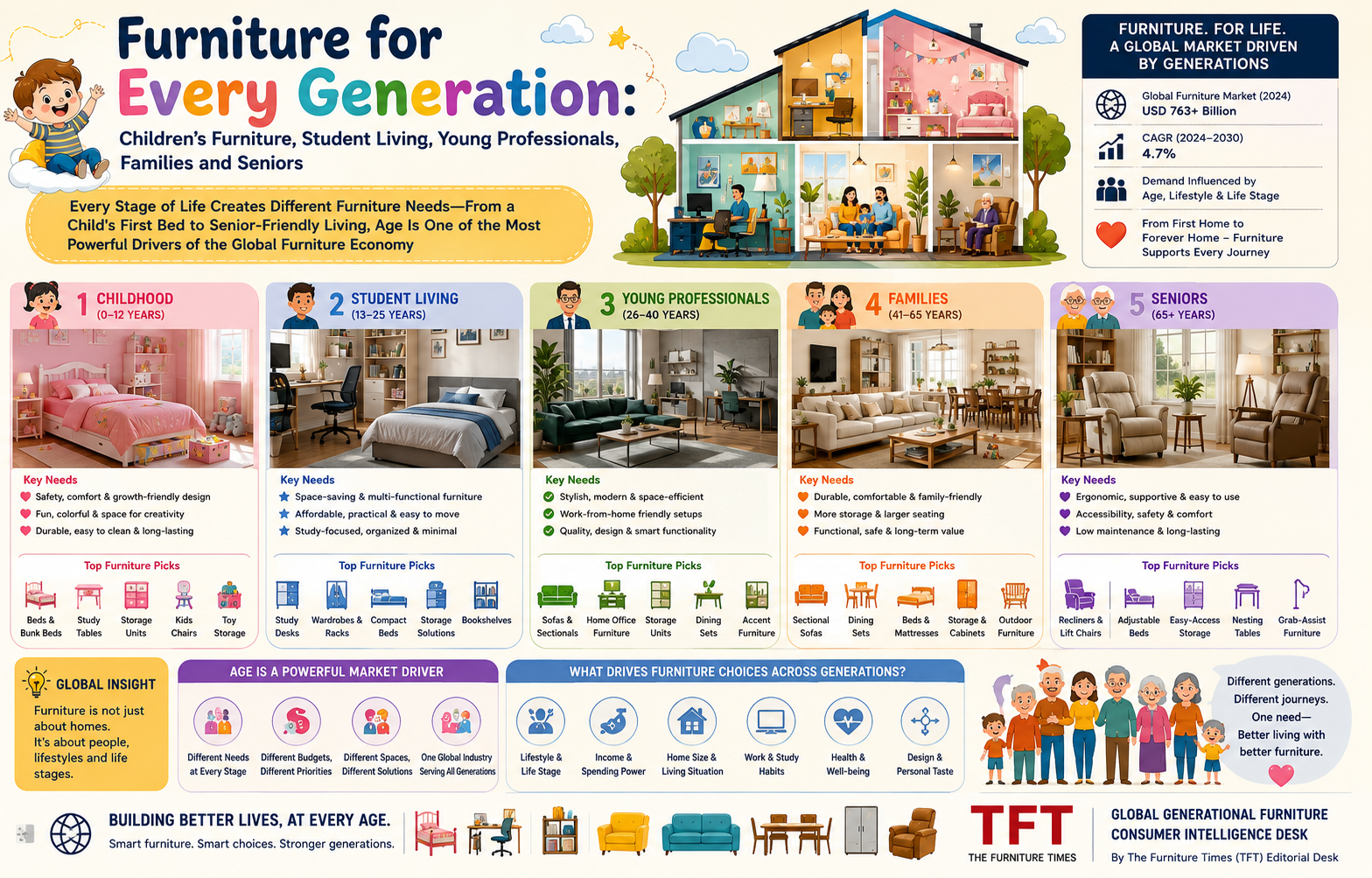
Furniture for Every Generation: Children’s Furniture, Student Living, Young Professionals, Families and Seniors
Every Stage of Life Creates Different Furniture Needs—From a Child’s First Bed to Senior-Friendly Living, Age Is One of the Most Powerful Drivers of the Global Furniture Economy
Global Generational Furniture Consumer Intelligence Desk
By The Furniture Times (TFT) Editorial Desk
Furniture is one of the few industries that serves people throughout their entire lives.
A person’s relationship with furniture begins with a crib, continues through childhood bedrooms, student accommodation, first apartments, family homes, home offices, retirement living and, eventually, senior-friendly environments.
Every major life stage creates new furniture requirements.
Children require furniture that supports growth, safety and learning.
Students prioritise affordability, portability and compact living.
Young professionals seek multifunctional furniture for apartments and hybrid work.
Families demand durability, storage and flexibility.
Older adults increasingly value comfort, accessibility, ergonomics and independent living.
For furniture manufacturers, retailers, designers and investors, understanding these changing needs is essential because age is one of the strongest predictors of purchasing behaviour.
The furniture industry should no longer design products only around rooms such as bedrooms or living rooms.
It should also design around people.
The global population is becoming increasingly diverse in age structure. According to the United Nations, the number of people aged 65 years and older is expected to more than double worldwide by 2050, while urbanisation, changing family structures and longer life expectancy continue to reshape housing and furniture demand.
This demographic transformation will redefine the furniture industry over the coming decades.
Furniture Is a Lifetime Economy
Every person passes through multiple furniture ownership phases.
Typical lifecycle stages include:
- Nursery
- Early childhood
- School years
- Student living
- First employment
- First apartment
- Marriage
- Family expansion
- Home upgrading
- Empty nest
- Retirement
- Senior living
Each transition generates new purchasing opportunities.
Rather than viewing furniture sales as isolated transactions, companies should see them as a continuous lifetime relationship.
The Children’s Furniture Economy
Children’s furniture is one of the fastest-changing product categories because children grow rapidly.
Products include:
- Cribs
- Toddler beds
- Children’s beds
- Study desks
- Chairs
- Bookshelves
- Toy storage
- Wardrobes
- Bunk beds
- Play furniture
Parents evaluate children’s furniture differently from adult furniture.
Key priorities include:
- Safety
- Stability
- Rounded edges
- Non-toxic finishes
- Durability
- Easy cleaning
- Adaptability
- Storage
- Educational value
Children rarely influence purchasing through income.
However, they often influence design, colour and theme preferences.
Furniture That Grows With the Child
One of the strongest opportunities in children’s furniture is adaptability.
Products that evolve with growth include:
- Convertible cribs
- Adjustable desks
- Height-adjustable chairs
- Expandable beds
- Modular storage
- Adjustable shelving
These products provide better long-term value and reduce replacement frequency.
Student Living: Small Spaces, Small Budgets
Students represent one of the world’s largest furniture markets.
Demand is driven by:
- University accommodation
- Rental housing
- Shared apartments
- Hostels
- International education
- Frequent relocation
Students generally prioritise:
- Affordable pricing
- Lightweight furniture
- Easy assembly
- Compact dimensions
- Multifunctionality
- Portability
Popular products include:
- Study desks
- Ergonomic chairs
- Single beds
- Foldable tables
- Clothing storage
- Bookshelves
- Portable wardrobes
Student furniture often has a shorter ownership cycle because of relocation after graduation.
Digital Learning Is Changing Student Furniture
Modern students increasingly require:
- Laptop-friendly desks
- Cable management
- Device charging
- Good lighting
- Video conferencing backgrounds
- Compact storage
The study desk has become a productivity workstation rather than simply a writing table.
Young Professionals: The First Independent Furniture Market
Young professionals usually begin furnishing homes independently.
Their purchasing decisions are influenced by:
- Income growth
- Rental apartments
- Urban living
- Remote work
- Social identity
- Lifestyle
Popular purchases include:
- Sofas
- Dining sets
- Storage beds
- Wardrobes
- Coffee tables
- Home office furniture
Young professionals typically balance:
- Price
- Design
- Functionality
- Brand reputation
- Sustainability
Apartment Living Creates Different Demand
Young professionals frequently occupy:
- Studios
- Small apartments
- Condominiums
- Shared housing
This encourages demand for:
- Modular sofas
- Folding tables
- Storage beds
- Compact dining furniture
- Wall-mounted storage
- Multi-purpose furniture
Every square metre becomes valuable.
The Family Furniture Economy
Family households generate the highest overall furniture expenditure.
Furniture demand expands because of:
- Marriage
- Children
- Home ownership
- Larger homes
- Renovation
- Outdoor living
Families purchase across multiple rooms simultaneously.
Typical categories include:
- Living room
- Dining room
- Children’s bedrooms
- Home office
- Outdoor furniture
- Storage
- Kitchen furniture
Replacement demand also increases because furniture experiences heavier daily use.
Family Furniture Must Balance Durability and Style
Parents frequently evaluate:
- Stain resistance
- Scratch resistance
- Easy maintenance
- Safety
- Comfort
- Longevity
A stylish sofa may be rejected if it cannot withstand children or pets.
Performance materials increasingly influence purchasing decisions.
Home Offices Remain Important
Many households continue to require dedicated workspaces.
Family home office demand includes:
- Ergonomic chairs
- Adjustable desks
- Storage cabinets
- Cable management
- Lighting
- Video meeting backgrounds
Home office furniture is increasingly becoming permanent rather than temporary.
Outdoor Family Living
Families increasingly invest in:
- Dining sets
- Outdoor lounges
- BBQ furniture
- Garden seating
- Pool furniture
- Balcony furniture
Outdoor living has become an extension of indoor living.
Empty Nest Households
When children leave home, furniture priorities change.
Consumers often:
- Renovate
- Downsize
- Upgrade
- Replace older furniture
- Convert children’s rooms
Demand shifts toward:
- Premium comfort
- Home offices
- Guest bedrooms
- Hobby rooms
- Outdoor relaxation
This stage frequently generates significant replacement spending.
The Senior Furniture Economy
Population ageing is becoming one of the most important long-term drivers of furniture demand.
Older consumers increasingly seek furniture that supports:
- Comfort
- Independence
- Accessibility
- Safety
- Simplicity
Popular products include:
- Adjustable beds
- Recliners
- Supportive dining chairs
- Lift chairs
- Accessible wardrobes
- Stable tables
The World Health Organization notes that healthy ageing depends heavily on maintaining functional ability and creating supportive living environments. Furniture plays a practical role in enabling independence at home.
Age-Friendly Furniture
Senior-friendly furniture often incorporates:
- Higher seat heights
- Firm cushions
- Easy-to-grip handles
- Rounded corners
- Stable construction
- Easy-to-clean surfaces
Good design improves confidence rather than emphasising age.
Universal Design Benefits Everyone
Furniture designed using universal design principles often benefits:
- Children
- Adults
- Seniors
- People with temporary injuries
- Pregnant women
Features include:
- Easy access
- Simple operation
- Comfortable reach
- Stable support
- Clear functionality
Universal design expands market opportunities.
Multi-Generational Homes
Many countries are experiencing growth in multi-generational households.
These homes require furniture that accommodates:
- Grandparents
- Parents
- Children
- Guests
Demand includes:
- Larger dining tables
- Multiple bedrooms
- Shared living spaces
- Flexible storage
- Bunk beds
- Guest furniture
Furniture companies should increasingly consider households rather than individuals.
Generational Material Preferences
Children
Preferred features:
- Non-toxic finishes
- Easy-clean laminates
- Rounded timber
- Lightweight furniture
Students
Preferred materials:
- Engineered wood
- Steel
- Affordable laminates
- Lightweight panels
Young Professionals
Preferred materials:
- Engineered wood
- Upholstery
- Glass
- Metal
- Compact composites
Families
Preferred materials:
- Performance fabrics
- Solid timber
- Moisture-resistant panels
- Durable upholstery
Seniors
Preferred materials:
- Comfortable upholstery
- Stable timber
- Easy-clean finishes
- Non-slip surfaces
Buying Behaviour by Generation
Children
Decision-makers:
Parents
Key factors:
Safety, durability, education.
Students
Decision-makers:
Students and parents.
Key factors:
Price, portability, functionality.
Young Professionals
Decision-makers:
Individuals.
Key factors:
Design, affordability, digital research.
Families
Decision-makers:
Couples and households.
Key factors:
Value, durability, storage.
Seniors
Decision-makers:
Individuals, families and caregivers.
Key factors:
Comfort, accessibility, trust.
Search Behaviour Changes With Age
Parents Search
- Best children’s study desk
- Safe bunk bed
- Kids wardrobe
- Montessori furniture
Students Search
- Affordable desk
- Small apartment furniture
- Dorm furniture
- Budget wardrobe
Young Professionals Search
- Modern sofa
- Home office setup
- Apartment furniture
- Modular furniture
Families Search
- Durable sofa
- Dining table for family
- Outdoor dining
- Pet-friendly furniture
Seniors Search
- Adjustable bed
- Comfortable recliner
- Easy-to-use wardrobe
- Ergonomic dining chair
AI search will increasingly personalise recommendations according to life stage rather than age alone.
Retail Strategies by Generation
Retailers should personalise showrooms and online experiences.
Children’s areas should demonstrate:
- Safety
- Storage
- Learning
Student sections should focus on:
- Compact living
- Affordability
Young professional collections should emphasise:
- Design
- Flexibility
Family showrooms should demonstrate:
- Durability
- Real-life use
Senior sections should highlight:
- Comfort
- Accessibility
- Ease of use
Manufacturers Should Design for Life Stages
Instead of creating isolated products, manufacturers should build connected collections that support customers throughout life.
Examples include:
- Children’s collection
- Teen collection
- Student collection
- Apartment collection
- Family collection
- Senior collection
Brand loyalty becomes easier when customers remain within the same ecosystem.
Sustainability Across Generations
Different generations value sustainability differently.
Parents seek healthier materials.
Young adults often evaluate environmental impact.
Families value long product life.
Older adults appreciate repairability and durability.
The strongest sustainable furniture combines:
- Long lifespan
- Repairability
- Replaceable components
- Responsible materials
Business Opportunities
Furniture companies can create specialised programmes for:
- New parents
- University students
- First-home buyers
- Newly married couples
- Growing families
- Empty nesters
- Retirees
- Assisted living providers
Each life stage represents a distinct commercial opportunity.
Future Trends
By 2035, generational furniture demand will increasingly be influenced by:
- AI-powered room planning
- Smart furniture
- Universal design
- Modular products
- Hybrid living
- Home healthcare
- Multi-generational housing
- Sustainable materials
- Subscription furniture
- Circular economy
Strategic Recommendations
Furniture companies should:
- Segment products by life stage rather than room alone.
- Design adaptable furniture.
- Build long-term customer relationships.
- Improve ergonomics across all age groups.
- Invest in universal design.
- Develop compact collections for urban living.
- Expand family-friendly products.
- Strengthen senior living collections.
- Use AI to personalise recommendations.
- Measure customer lifetime value instead of single transactions.
Furniture Evolves With People
The furniture industry does not simply manufacture products.
It supports every stage of human life.
From the first crib to the final retirement chair, furniture shapes how people sleep, study, work, gather, celebrate, recover and age.
Companies that understand these changing needs will not only sell more furniture—they will build lifelong relationships with generations of customers.
The future of the global furniture industry belongs to brands that recognise one simple truth:
People change. Homes change. Families change. Furniture must evolve with every generation.
