Current Update of the Global Furniture Industry 2026
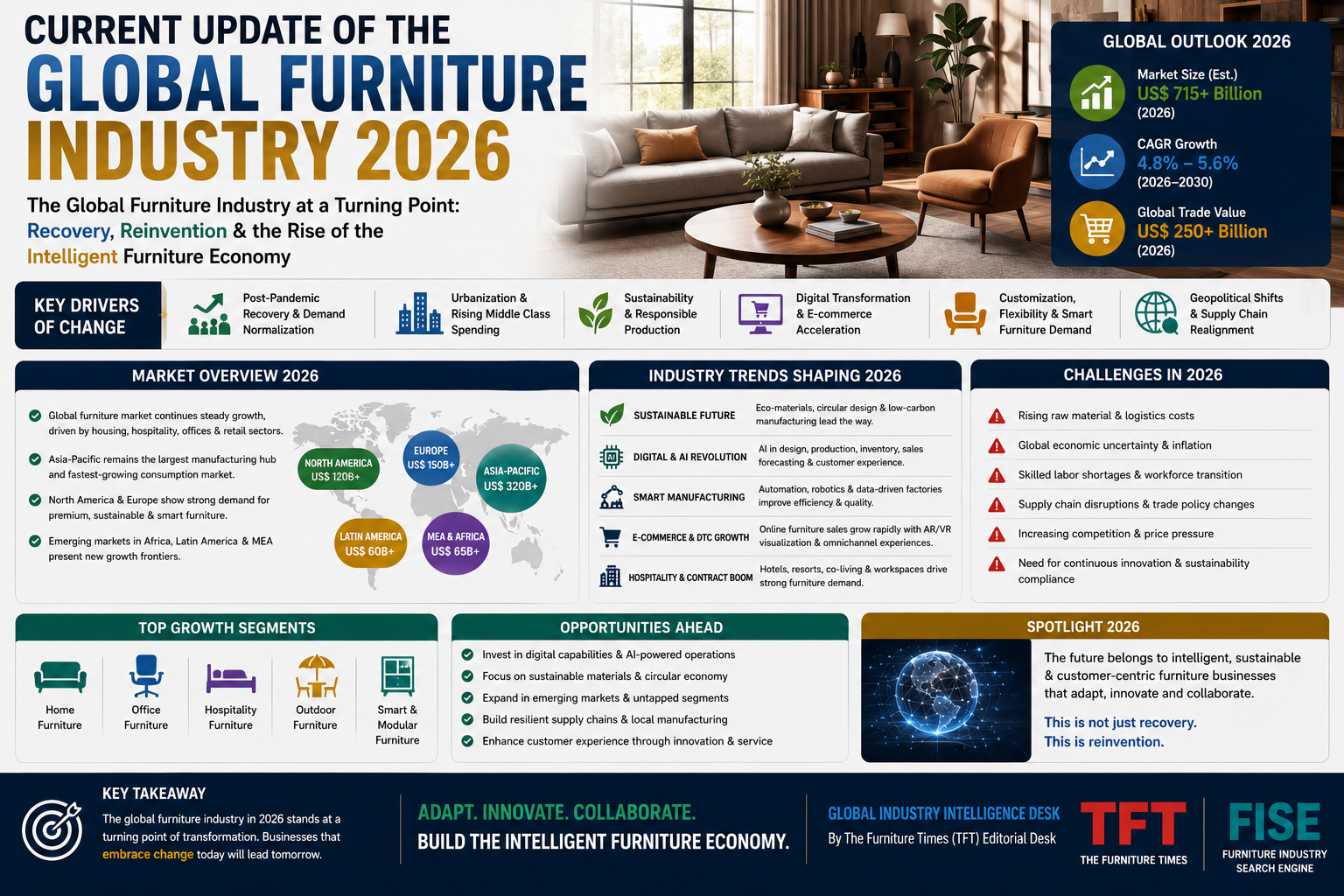
The Global Furniture Industry at a Turning Point: Recovery, Reinvention & the Rise of the Intelligent Furniture Economy
Global Industry Intelligence Desk
By The Furniture Times (TFT) Editorial Desk
Executive Summary
The global furniture industry is entering one of the most transformative periods in its history.
After navigating years of supply chain disruptions, inflationary pressures, changing consumer behaviour and geopolitical uncertainty, the industry is now showing signs of recovery—but not in a uniform way. Growth is returning across many regions, yet manufacturers, retailers and suppliers continue to face higher costs, shifting trade patterns, labour shortages and rapidly changing customer expectations.
At the same time, Artificial Intelligence, digital commerce, sustainability, modular design and data-driven manufacturing are reshaping how furniture is designed, produced, marketed and sold.
According to The Furniture Times (TFT), the industry is no longer simply experiencing a market recovery.
It is entering the beginning of an Intelligent Furniture Economy, where technology, digital visibility, sustainability and customer trust become as important as manufacturing capacity.
The Global Market Is Growing Again
After several challenging years, global furniture demand is gradually improving.
Industry forecasts indicate that the global furniture market is expected to continue expanding through the remainder of the decade, supported by residential demand, commercial projects, urbanisation, hospitality investment and digital commerce. Several forecasts estimate the market could exceed USD 800 billion in the near term and continue growing toward USD 1 trillion and beyond over the next decade.
However, recovery is not identical across every region.
Some countries are experiencing stronger domestic demand.
Others depend heavily on exports.
Many businesses continue operating in an environment of cautious consumer spending.
Regional Performance
Asia-Pacific
Asia-Pacific continues to dominate global furniture manufacturing.
China remains a manufacturing powerhouse while countries such as Vietnam, Malaysia, Indonesia and India continue strengthening their positions in global supply chains.
Investment in automation, digital manufacturing and export capability continues throughout the region.
Europe
European manufacturers continue focusing on:
Sustainability.
Premium craftsmanship.
Circular manufacturing.
Design innovation.
Energy efficiency.
However, many companies continue balancing export growth with uneven domestic demand and higher production costs.
North America
North American markets continue recovering gradually.
Commercial furnishing, office redesign, hospitality refurbishment and home renovation remain important demand drivers.
Consumers increasingly prioritise:
Quality.
Durability.
Personalisation.
Wellness.
Sustainable products.
Middle East
The Middle East remains one of the fastest-growing commercial furniture markets.
Major investments include:
Luxury hospitality.
Tourism.
Mixed-use developments.
Healthcare.
Commercial real estate.
Smart cities.
Furniture suppliers serving hospitality and premium residential projects continue benefiting from these investments.
Africa
Africa represents one of the industry’s long-term growth frontiers.
Rapid urbanisation, housing development, population growth and increasing entrepreneurship are creating opportunities for local manufacturers and international partnerships.
Latin America
Countries across Latin America continue expanding domestic furniture production while strengthening regional trade.
Affordable housing, middle-income growth and digital retail continue supporting demand.
Sustainability Has Become a Business Strategy
Sustainability is no longer viewed as an optional marketing message.
Customers increasingly expect:
Responsible sourcing.
Recyclable materials.
Reduced waste.
Lower emissions.
Longer product life.
Circular economy initiatives.
Manufacturers are integrating sustainability directly into production processes because efficient use of materials often improves both environmental performance and profitability.
AI Is Reshaping the Industry
Artificial Intelligence is moving beyond experimentation.
Furniture companies are using AI to support:
Product recommendations.
Demand forecasting.
Production planning.
Inventory optimisation.
Customer service.
Marketing.
Content creation.
Product visualisation.
Future growth will increasingly depend on how effectively businesses combine human expertise with AI-powered decision support.
Digital Commerce Continues Expanding
Online furniture sales continue growing.
Consumers increasingly expect:
Virtual showrooms.
Augmented Reality.
Room visualisation.
Product videos.
Customer reviews.
Fast delivery.
Flexible payment options.
The distinction between physical retail and digital commerce continues to narrow.
Manufacturing Is Becoming Smarter
Factories are investing in:
Automation.
Digital production planning.
CNC technology.
Robotics.
Data analytics.
Predictive maintenance.
Material optimisation.
The goal is no longer simply producing more furniture.
It is producing furniture more efficiently.
Customisation Is Becoming the Standard
Consumers increasingly expect products designed around their needs.
Demand continues rising for:
Custom dimensions.
Personalised finishes.
Modular furniture.
Flexible storage.
Multi-functional furniture.
Smaller production runs.
Manufacturers capable of producing customised products efficiently are gaining competitive advantages.
Labour Challenges Continue
Many furniture manufacturers continue facing workforce shortages.
Challenges include:
Skilled craftsmanship.
Machine operators.
CNC technicians.
Digital specialists.
Production managers.
As experienced workers retire, workforce development becomes increasingly important.
Training, education and automation are becoming strategic priorities.
Supply Chains Continue Evolving
Supply chains remain more resilient than during the peak disruption years.
However, businesses continue monitoring:
Freight costs.
Raw material prices.
Geopolitical developments.
Trade regulations.
Inventory management.
Supplier diversification.
Companies increasingly favour more flexible and diversified sourcing strategies.
Trade Policies Influence Global Competition
International trade policies, tariffs and changing regulations continue influencing sourcing decisions and manufacturing strategies.
Many businesses are reviewing where they manufacture, source materials and distribute products in response to changing trade conditions.
Hospitality Continues Driving Demand
Hotels, resorts, serviced apartments and tourism projects remain major furniture buyers.
Growing tourism investment creates opportunities across:
Hotel furniture.
Outdoor furniture.
Restaurant furniture.
Lobby furniture.
Healthcare hospitality.
Luxury residential developments.
Health & Wellness Are Becoming Important
Consumers increasingly associate furniture with wellbeing.
Growth areas include:
Ergonomic seating.
Sleep products.
Healthcare furniture.
Senior living.
Home office solutions.
Wellness-oriented design.
Furniture is increasingly viewed as contributing to healthier lifestyles.
The Rise of the Circular Furniture Economy
Businesses are investing more in:
Furniture refurbishment.
Repair services.
Recycling.
Second-hand marketplaces.
Rental models.
Material recovery.
Circular economy initiatives are becoming part of mainstream business strategies.
Searchability Is Becoming a Competitive Advantage
Customers now begin purchasing journeys through search.
Businesses increasingly invest in:
SEO.
Google Business Profiles.
Educational content.
Structured product data.
AI-ready websites.
Search visibility has become an important commercial asset.
Why the Industry Needs Better Digital Infrastructure
Despite its global scale, much of the furniture industry remains fragmented.
Manufacturers.
Retailers.
Suppliers.
Designers.
Service providers.
Educational institutions.
Industry associations.
Often operate across disconnected platforms.
This fragmentation limits discoverability and collaboration.
According to The Furniture Times, future growth will increasingly depend on stronger digital infrastructure that improves industry knowledge, business visibility, professional networking and trusted supplier discovery.
Emerging Opportunities
Several sectors continue offering strong growth potential.
These include:
Smart furniture.
Healthcare furniture.
Hospitality projects.
Sleep technology.
Senior living.
Education furniture.
Digital manufacturing.
Artificial Intelligence.
Circular economy.
Industry-specific digital platforms.
Challenges That Still Require Attention
Despite positive momentum, important challenges remain.
These include:
Rising production costs.
Energy prices.
Labour shortages.
Market volatility.
Global competition.
Trade uncertainty.
Digital transformation.
SME visibility.
Businesses that adapt quickly will be better positioned to manage these challenges.
TFT Analysis
The global furniture industry has entered a new chapter.
The next decade will not be defined solely by:
Factory size.
Production volume.
Export capacity.
Instead, success will increasingly depend upon:
Innovation.
Digital transformation.
Artificial Intelligence.
Sustainability.
Customer trust.
Operational flexibility.
Global discoverability.
The industry is becoming more intelligent, more connected and more customer-centric than ever before.
Final Verdict
The current state of the global furniture industry can best be described as a period of recovery combined with reinvention.
Growth has returned.
Investment is increasing.
Technology is accelerating.
Customer expectations continue rising.
Businesses that continue operating with yesterday’s strategies may struggle.
Those that embrace innovation, sustainability, AI, digital visibility and stronger customer relationships will shape the next generation of global furniture leadership.
The future of the furniture industry is no longer defined only by what companies manufacture.
It is defined by how intelligently they innovate…
How responsibly they produce…
How effectively they connect with customers…
And how successfully they adapt to an increasingly digital and interconnected global marketplace.
By The Furniture Times (TFT) Editorial Desk
Global Industry Intelligence Desk | July 2026
“TFT tells their story. FISE helps the world find them.”
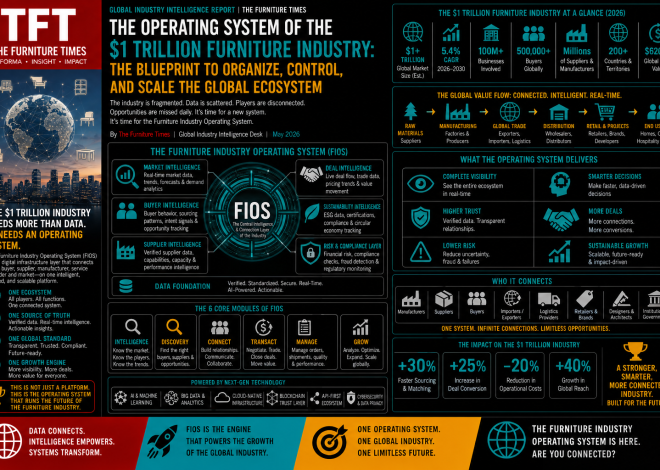
The furniture industry ecosystem is a $1 Trillion Dollar Industry.