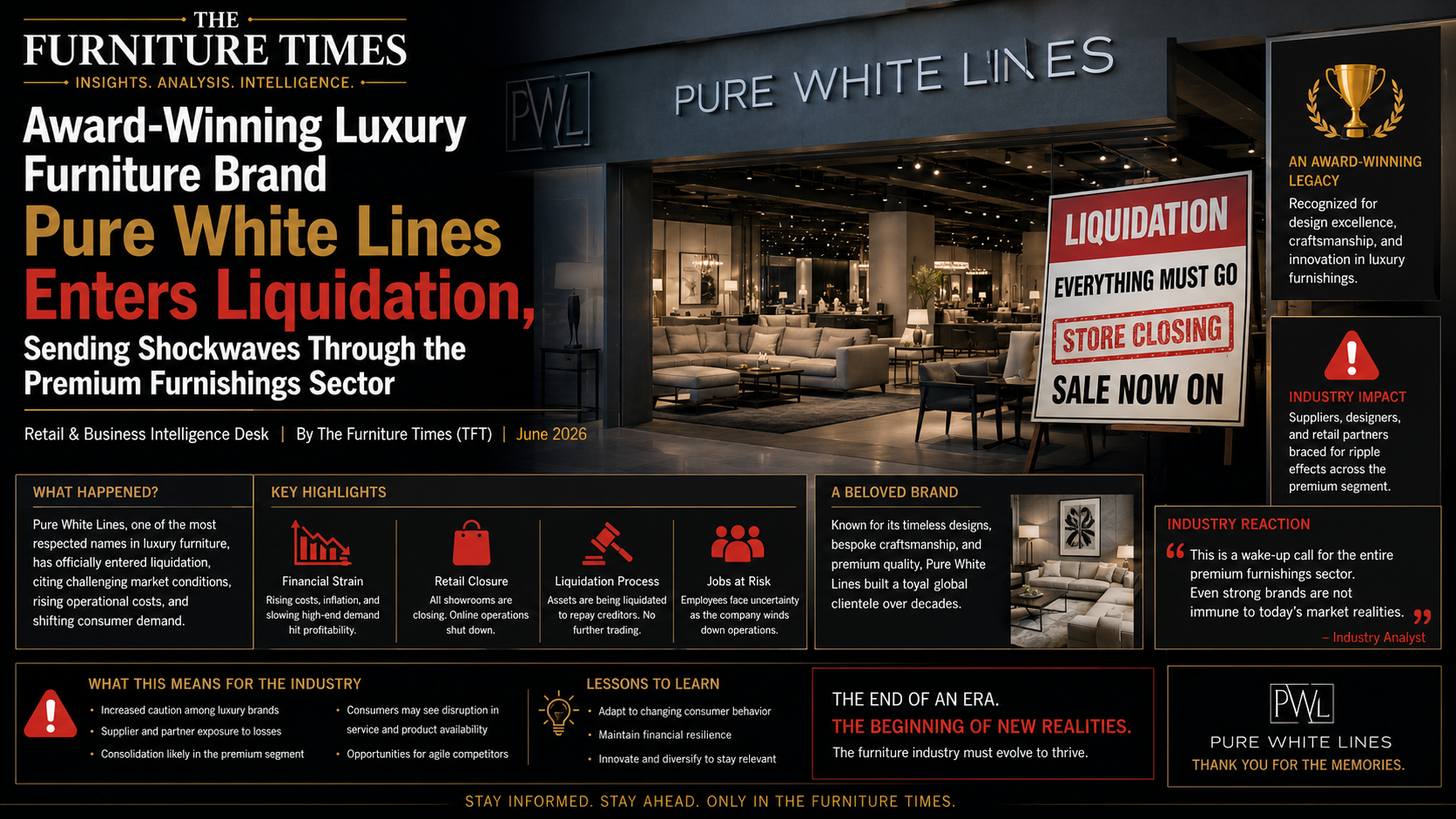
Award-Winning Luxury Furniture Brand Pure White Lines Enters Liquidation, Sending Shockwaves Through the Premium Furnishings Sector
Retail & Business Intelligence Desk | By The Furniture Times (TFT) | June 2026
The global furniture industry is facing another significant setback as British luxury furniture brand Pure White Lines Ltd has officially entered creditors’ voluntary liquidation, bringing an abrupt end to a business that had become synonymous with high-end interiors, bespoke furnishings, and luxury décor across the United Kingdom and Europe.
The Sussex-based company, which operated for approximately 14 years, reportedly accumulated debts exceeding £1.4 million, leaving creditors facing substantial losses and raising fresh concerns about the challenges confronting furniture retailers in an increasingly volatile economic environment.
The collapse comes despite the company maintaining a strong reputation within the luxury interiors sector and earning recognition for its design-led approach to furniture and home décor.
A Brand Built on Luxury and Design
Pure White Lines established itself as a premium furniture and interiors company specializing in:
Luxury furniture collections
Decorative lighting
Bespoke interior solutions
Antique furnishings
Vintage European pieces
Statement chandeliers
High-end dining and living room furniture
The company developed a loyal customer base among affluent homeowners, interior designers, hospitality operators, and luxury property developers.
Its product portfolio reflected an elegant blend of contemporary sophistication and classic European craftsmanship, positioning the brand firmly within the premium segment of the market. The business operated a London showroom and maintained a distribution warehouse in Belgium, supporting customers throughout Europe.
Industry observers viewed the company as one of the UK’s emerging luxury furniture success stories.
Recognition Could Not Prevent Collapse
The liquidation has surprised many within the interior design and furniture sectors because Pure White Lines was not an unknown brand struggling for relevance.
The company received industry recognition and was awarded Best Stand at Decorex 2022, one of the most respected interior design exhibitions in the United Kingdom. Such recognition demonstrated the company’s strong brand positioning and design credentials.
Yet the reality facing many furniture businesses today is that strong branding and excellent products alone are no longer enough to guarantee survival.
The modern furniture market has become increasingly complex, requiring businesses to balance product innovation, operational efficiency, inventory management, digital marketing, customer acquisition costs, logistics, and international supply chain challenges simultaneously.
The Financial Reality
According to liquidation filings, the company entered creditors’ voluntary liquidation with unsecured debts reportedly totaling more than £1.419 million. Available asset recoveries were estimated at only a fraction of that amount, meaning many creditors are unlikely to recover what they are owed.
The reported liabilities include obligations to:
Tax authorities
Suppliers
Service providers
Associated businesses
Local authorities
This illustrates how a furniture company’s collapse extends far beyond a single business, creating ripple effects throughout the wider economic ecosystem.
Why Furniture Businesses Are Under Pressure
The collapse of Pure White Lines reflects broader challenges facing furniture businesses across the globe.
1. Consumer Spending Slowdown
Furniture purchases are often discretionary expenditures. During periods of economic uncertainty, consumers tend to postpone major home furnishing investments.
Luxury furniture businesses are particularly vulnerable because their products are generally positioned within premium spending categories.
2. Housing Market Challenges
Furniture sales are closely linked to:
New home purchases
Renovation activity
Property development
Hospitality expansion
Commercial interior projects
Any slowdown within these sectors directly impacts furniture demand.
3. Rising Costs Across the Supply Chain
Furniture companies worldwide continue to experience pressure from:
Freight costs
Warehouse expenses
Labour costs
Material inflation
Energy prices
Import and export expenses
For luxury furniture businesses, maintaining quality while absorbing these costs becomes increasingly difficult.
4. Digital Disruption
Today’s consumers discover furniture differently than they did a decade ago.
Instead of visiting physical showrooms first, buyers now begin their journey through:
Search engines
Social media platforms
AI assistants
Online marketplaces
Review websites
Interior design platforms
Businesses that fail to adapt to digital discovery models often struggle to maintain growth.
What This Means for the Furniture Industry
The liquidation of Pure White Lines is not simply the story of one company.
It reflects a larger transformation occurring throughout the furniture industry.
Traditional advantages such as:
Premium showrooms
Strong craftsmanship
Product quality
Brand reputation
remain important, but they are increasingly being supplemented by:
Digital visibility
AI discoverability
Customer reviews
Search engine authority
Omnichannel sales strategies
Data-driven marketing
The furniture businesses that thrive during the next decade will likely be those that successfully combine traditional strengths with modern technology and customer engagement systems.
Lessons for Furniture Retailers
The Pure White Lines case provides important lessons for furniture retailers worldwide.
Visibility Matters
Many furniture companies continue investing heavily in products while underinvesting in discoverability.
Modern consumers cannot buy what they cannot find.
Diversification Matters
Businesses dependent on a limited customer segment may face greater risk during economic downturns.
Operational Efficiency Matters
Inventory management, logistics, cash flow, and cost controls are becoming as important as design and merchandising.
Adaptability Matters
Consumer behaviour continues evolving rapidly. Businesses must adapt to new purchasing habits, technologies, and communication channels.
The Future of Furniture Retail
The liquidation of Pure White Lines highlights an uncomfortable reality facing the furniture industry.
The future will not be determined solely by who manufactures the best furniture.
It will increasingly be determined by who:
Builds trust fastest
Achieves visibility first
Creates stronger digital authority
Adapts quickest to changing consumer behaviour
Utilizes data more effectively
Leverages AI-driven discovery platforms
In many ways, the furniture industry is transforming from a product-driven economy into a visibility-driven economy.
TFT Analysis
At The Furniture Times (TFT), we believe the collapse of Pure White Lines is another reminder that the furniture industry is entering a new era.
Beautiful products remain essential.
Exceptional craftsmanship remains valuable.
Strong brand identity remains critical.
However, these elements alone no longer guarantee sustainability.
Furniture businesses must now compete in a world where discoverability, searchability, trust, digital presence, and customer engagement increasingly determine commercial success.
The closure of Pure White Lines marks the loss of a respected luxury furniture brand, but it also serves as a valuable case study for furniture retailers, manufacturers, and interior brands worldwide seeking to navigate the next chapter of industry evolution.
By The Furniture Times (TFT)
Retail & Business Intelligence Desk
Bringing Furniture Brands Into Global Spotlight

Related Posts

Global Furniture Industry Faces a Conflict-Economy Test as Wars Disrupt Energy

Ireland’s €53 Million Government Jet Ignites Debate on Cost, Capability and National Priorities