
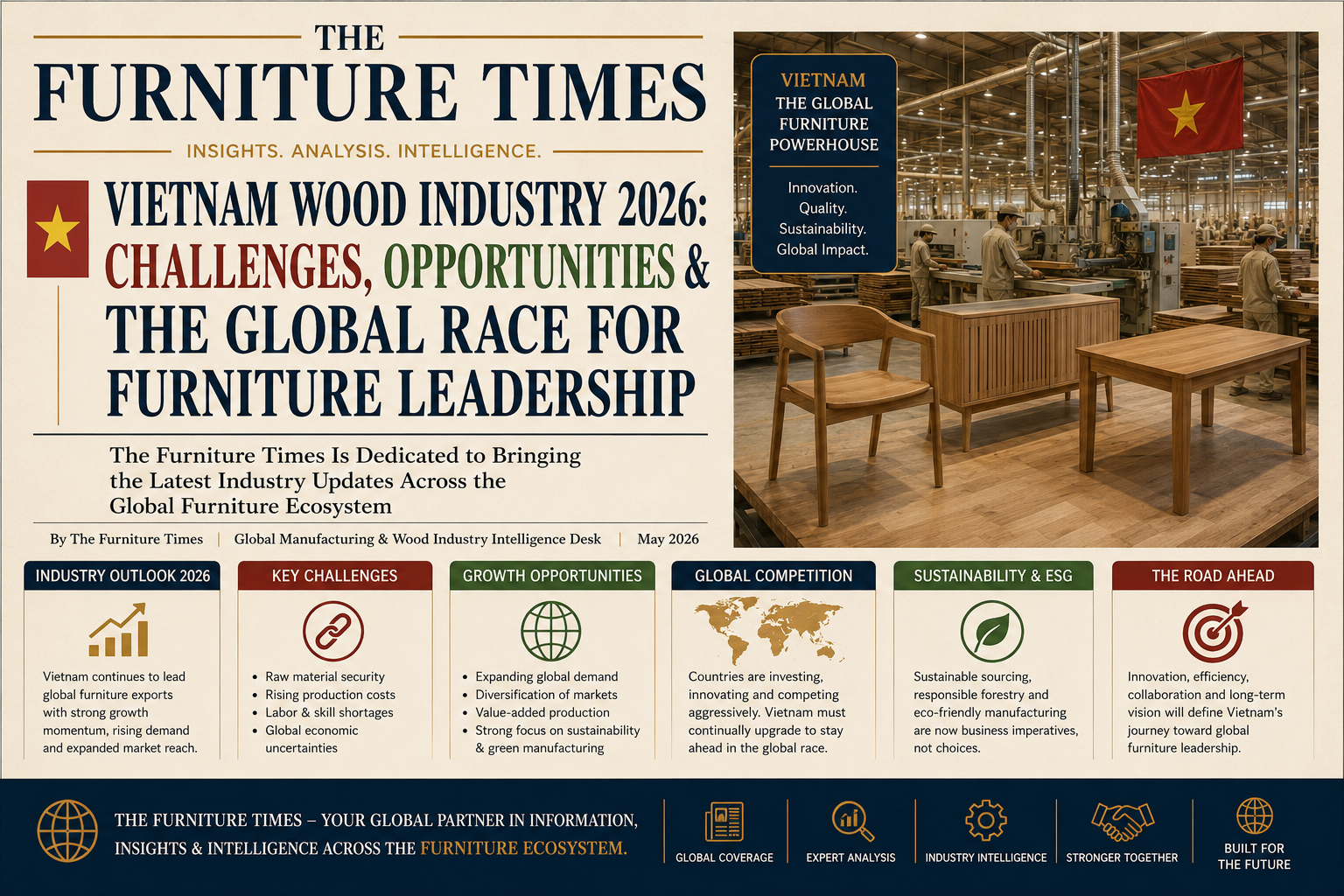
Vietnam Wood Industry 2026: Challenges, Opportunities & the Global Race for Furniture Leadership
The Furniture Times Is Dedicated to Bringing the Latest Industry Updates Across the Global Furniture Ecosystem
By The Furniture Times | Global Manufacturing & Wood Industry Intelligence Desk | May 2026
Vietnam’s wood and furniture industry is entering a defining period.
For more than a decade, Vietnam has transformed itself from a growing manufacturing destination into one of the world’s most important furniture production and export hubs. Today, the country stands among the leading global exporters of wood products and furniture, supplying major markets including the United States, Europe, Japan, South Korea, Australia, and the Middle East.
However, 2026 is proving to be both a year of opportunity and uncertainty.
As global supply chains shift, sustainability regulations tighten, tariffs evolve, and buyers seek alternative sourcing destinations, Vietnam’s wood industry is being forced to adapt faster than ever before.
Vietnam Remains a Global Furniture Powerhouse
Vietnam’s wood sector continues to be one of the strongest pillars of the country’s export economy.
Industry data shows that timber and wood product exports reached approximately US$17.2 billion, maintaining Vietnam’s position among the world’s leading furniture-exporting nations. Vietnamese wood and furniture products are now exported to more than 160 countries and territories worldwide.
The country has built a reputation for:
competitive manufacturing
skilled labor
export capability
flexible production systems
growing design sophistication
Vietnam is no longer viewed simply as a low-cost manufacturing destination.
It is increasingly becoming:
a global furniture manufacturing ecosystem.
New Challenges Are Emerging
Despite strong export performance, the industry faces growing pressure.
One of the largest concerns remains international trade uncertainty.
Vietnamese exporters continue navigating:
tariff risks
trade investigations
stricter compliance requirements
origin verification scrutiny
global geopolitical instability
Industry experts warn that exporters must become increasingly transparent and traceable to satisfy international buyers and regulators.
The era of simple export manufacturing is ending.
The era of accountable manufacturing is beginning.
Sustainability Is Becoming a Competitive Requirement
One of the most important themes shaping Vietnam’s wood industry is sustainability.
Global buyers increasingly demand:
legally sourced timber
responsible forestry
environmental certifications
supply chain transparency
carbon-conscious production
Vietnam’s wood industry is actively transitioning toward greener production models and sustainable growth strategies. Industry leaders increasingly view sustainability not as a marketing tool but as a long-term survival strategy.
This transition is expected to reshape how factories operate across the country.
Technology Is Reshaping Production
Vietnam’s furniture manufacturers are investing more heavily in:
automation
CNC systems
digital production management
smart manufacturing
advanced woodworking technologies
Industry reports indicate that technology adoption is becoming essential for improving productivity, quality control, and international competitiveness.
Factories that modernize quickly may gain significant advantages in global markets.
Design Is Becoming More Important
Historically, Vietnam was known primarily as a manufacturing center.
Today, industry leaders increasingly emphasize:
design capability.
Companies are investing in:
product development
design innovation
branding
higher-value product categories
This shift allows manufacturers to move beyond pure production and capture more value throughout the supply chain.
The future of Vietnam’s furniture industry may depend not only on making products but on creating ideas.
Diversifying Export Markets
The industry is also working to reduce dependence on a limited number of export destinations.
While the United States remains one of Vietnam’s largest furniture markets, exporters are increasingly exploring:
Europe
Middle East
India
Southeast Asia
emerging international markets
Market diversification is becoming a strategic necessity amid changing trade conditions and tariff uncertainty.
Infrastructure Continues Supporting Growth
Vietnam’s manufacturing infrastructure continues expanding rapidly.
Major investments in:
industrial parks
ports
logistics corridors
airports
transportation networks
are strengthening the country’s attractiveness as a manufacturing hub.
Projects such as Long Thanh International Airport and expanding industrial corridors are expected to improve logistics efficiency and export competitiveness in the coming years.
Regional Manufacturing Clusters Are Growing
Vietnam is no longer a single manufacturing story.
Different regions are developing specialized industrial strengths.
Northern Vietnam
Strong integration with Asian supply chains and proximity to China.
Central Vietnam
Emerging as a lower-cost manufacturing region with long-term expansion potential.
Southern Vietnam
Maintains strong supplier networks, export infrastructure, and manufacturing ecosystems.
These regional clusters are creating a more diversified and resilient furniture production landscape.
Labor Remains a Critical Strength
Vietnam continues benefiting from a large manufacturing workforce.
Employment in industrial enterprises continues growing, while the country is gradually increasing the percentage of formally trained workers.
However, skill development remains a major priority.
The future industry increasingly requires:
machine operators
CNC specialists
production planners
digital manufacturing technicians
design professionals
The workforce itself is becoming part of the competitive advantage.
Green Standards Are Reshaping the Industry
Environmental regulations are becoming stricter across global markets.
Exporters increasingly face:
sustainability audits
environmental compliance checks
legal timber verification requirements
green manufacturing expectations
Industry experts believe companies that adapt early to these standards will be better positioned for long-term success.
The future export market may increasingly reward:
responsible manufacturers.
Vietnam’s Long-Term Opportunity
Despite challenges, the long-term outlook remains positive.
Industry targets indicate ambitions to increase exports further, with some forecasts suggesting the sector could target US$18.5 billion in exports and potentially move toward even larger milestones in the coming years.
Several global sourcing trends continue favoring Vietnam:
supply chain diversification
manufacturing relocation
stable industrial growth
expanding infrastructure
improving production capabilities
The global furniture industry continues looking toward Vietnam as a strategic sourcing destination.
The Furniture Times Industry Insight
Vietnam’s wood industry is no longer competing solely on cost.
The next phase of growth will increasingly depend on:
sustainability
innovation
technology
transparency
branding
discoverability
The winners of the next decade may not necessarily be the biggest factories.
They may become the most adaptable factories.
The most efficient factories.
The most visible factories.
The most trusted factories.
Final Thought
Vietnam’s wood industry stands at a historic crossroads.
It faces:
tariff uncertainty
global trade shifts
sustainability pressure
technological disruption
Yet it also faces enormous opportunities.
The industry is evolving from a manufacturing story into a global value-creation story.
The world is watching Vietnam.
Not simply because it manufactures furniture.
But because it is increasingly helping shape the future of the global furniture ecosystem itself.
And that transformation is only beginning.
