
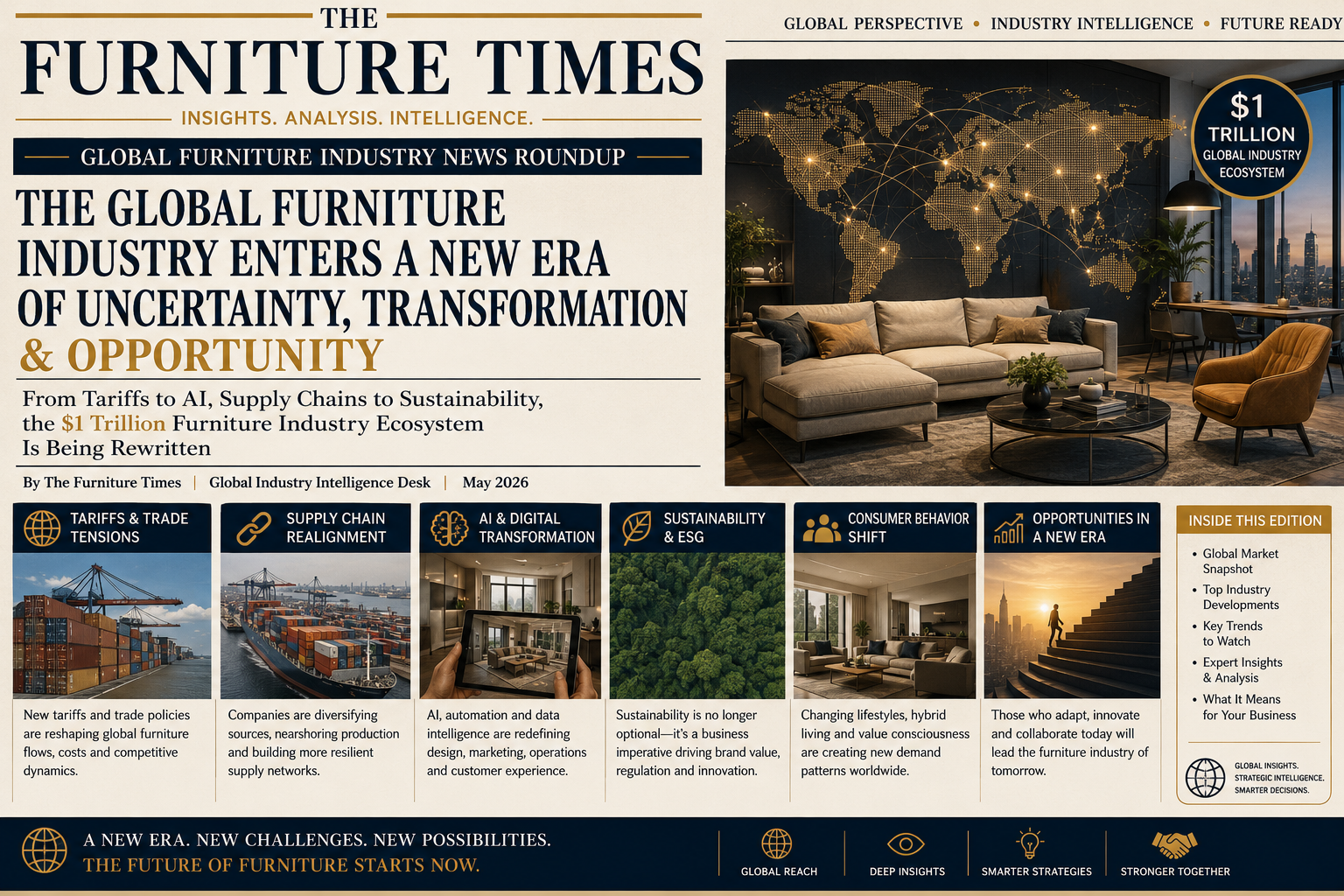
The Global Furniture Industry Enters a New Era of Uncertainty, Transformation & Opportunity
From Tariffs to AI, Supply Chains to Sustainability, the $1 Trillion Furniture Industry Ecosystem Is Being Rewritten
By The Furniture Times | Global Furniture Industry News Roundup | Global Industry Intelligence Desk | May 2026
The global furniture industry is currently moving through one of the most complex periods in its modern history.
Across continents, furniture manufacturers, retailers, suppliers, designers, logistics providers, and exporters are simultaneously facing:
tariff uncertainty
geopolitical tensions
rising costs
changing consumer behavior
digital transformation
AI disruption
sustainability pressure
Yet despite these challenges, the industry continues evolving and discovering new growth opportunities. Multiple market reports indicate that the global furniture market is expected to continue expanding over the coming decade, with long-term projections approaching or exceeding the trillion-dollar level.
The industry is not standing still.
It is transforming.
Tariffs Continue to Reshape the Global Furniture Ecosystem
One of the biggest stories affecting the furniture sector in 2026 remains global trade uncertainty.
Furniture manufacturers across various regions continue adjusting sourcing and production strategies due to tariff pressures, changing trade policies, and shifting supply chains. Industry analysts note that tariffs are influencing margins, sourcing decisions, and long-term investment planning.
Many companies are now actively diversifying supplier networks to reduce dependence on single-country sourcing models.
The furniture industry is increasingly becoming:
a geopolitical industry.
Global Supply Chains Are Being Reorganized
The traditional furniture supply chain model is changing rapidly.
Ongoing shipping disruptions, geopolitical risks, and rerouting of cargo routes have increased logistics costs and delivery uncertainty. Industry reports indicate that some conflict-related shipping disruptions have significantly increased landed costs and extended delivery timelines.
As a result, manufacturers are exploring:
regional production hubs
nearshoring strategies
multi-country sourcing systems
inventory restructuring
Supply chain flexibility is becoming a competitive advantage.
Vietnam & Indonesia Continue Rising
Vietnam remains one of the strongest furniture export growth stories globally.
Industry reports suggest Vietnam’s furniture exports could surpass USD 20 billion by the end of 2026, supported by trade agreements, manufacturing scale, and increasing global sourcing demand.
Indonesia is also attracting growing attention as international retailers diversify sourcing strategies and seek alternatives within Southeast Asia.
The global furniture sourcing map is gradually expanding beyond traditional manufacturing centers.
China Remains a Global Manufacturing Powerhouse
Despite supply chain diversification efforts, China remains one of the most influential furniture manufacturing ecosystems in the world.
However, industry observers note that the Chinese furniture sector is navigating increasing complexity, including shifting export markets, geopolitical pressure, and changing competitive dynamics.
China is no longer competing only on:
production scale
It is increasingly competing through:
manufacturing sophistication
automation
industrial infrastructure
Retailers Continue Facing Consumer Pressure
Retail demand remains mixed across many global markets.
Several reports show furniture retailers facing:
weaker housing activity
cautious consumer spending
elevated interest rates
margin pressure
Some analysts warn that weaker retail players may struggle in the current environment if consumer confidence remains subdued.
Consumers are increasingly delaying large discretionary purchases such as:
sofas
home upgrades
This creates ongoing pressure throughout the retail ecosystem.
Sustainability Is No Longer Optional
One of the strongest long-term trends remains sustainability.
Furniture buyers increasingly prioritize:
durability
sustainable materials
environmentally responsible manufacturing
longer product lifecycles
Industry reports indicate that sustainability is moving from a marketing message toward becoming a core purchasing consideration.
The future furniture brand may increasingly be judged not only by design quality but by environmental responsibility.
Hospitality Furniture Is Growing Again
The recovery of tourism and hospitality markets is creating renewed demand for:
resort furniture
commercial seating
hospitality interiors
Market reports show continued growth expectations for hospitality furniture as travel activity supports renovation and new hospitality projects worldwide.
For many manufacturers, hospitality projects are becoming an important growth segment.
AI Is Entering the Furniture Industry
Artificial Intelligence is becoming one of the most important conversations in the industry.
Furniture companies increasingly explore AI for:
product visualization
design generation
customer support
marketing automation
supply chain optimization
discoverability
Industry observers believe AI will increasingly influence how furniture businesses are found, compared, marketed, and purchased.
The future furniture company may need to compete not only in showrooms,
but also inside:
AI search environments.
Trade Shows Are Driving Industry Optimism
Global trade fairs continue serving as major engines of industry confidence.
Events such as CIFF Guangzhou remain important meeting points where manufacturers, buyers, designers, and suppliers evaluate future opportunities and market direction.
Trade fairs increasingly function as:
business platforms
innovation showcases
trend forecasting centers
The industry still values face-to-face relationships.
The Rise of the Visibility Economy
One of the biggest transformations happening quietly across the industry is:
digital visibility.
Furniture companies increasingly compete through:
searchability
discoverability
content authority
digital presence
AI visibility
The businesses that are easiest to find often gain a major advantage over those that remain digitally invisible.
This is reshaping how furniture brands think about:
websites
content
media
search engines
industry platforms
The Industry Is Becoming More Connected
The furniture industry is no longer operating as isolated sectors.
Manufacturing, logistics, design, retail, media, AI, hospitality, architecture, and technology are becoming increasingly interconnected.
The future furniture ecosystem may depend less on individual companies and more on:
connected industry networks.
Final Thought
The global furniture industry in 2026 is not experiencing a simple recovery or decline.
It is experiencing:
transformation.
The industry faces:
tariffs
supply chain restructuring
geopolitical uncertainty
changing consumer behavior
sustainability expectations
AI disruption
Yet it also faces enormous opportunities.
The businesses that survive and thrive may not necessarily be the biggest.
They may become the most:
adaptable
visible
discoverable
connected
resilient
Because the future furniture industry is no longer only about making products.
It is increasingly about building ecosystems.
And that transformation is already underway.
