
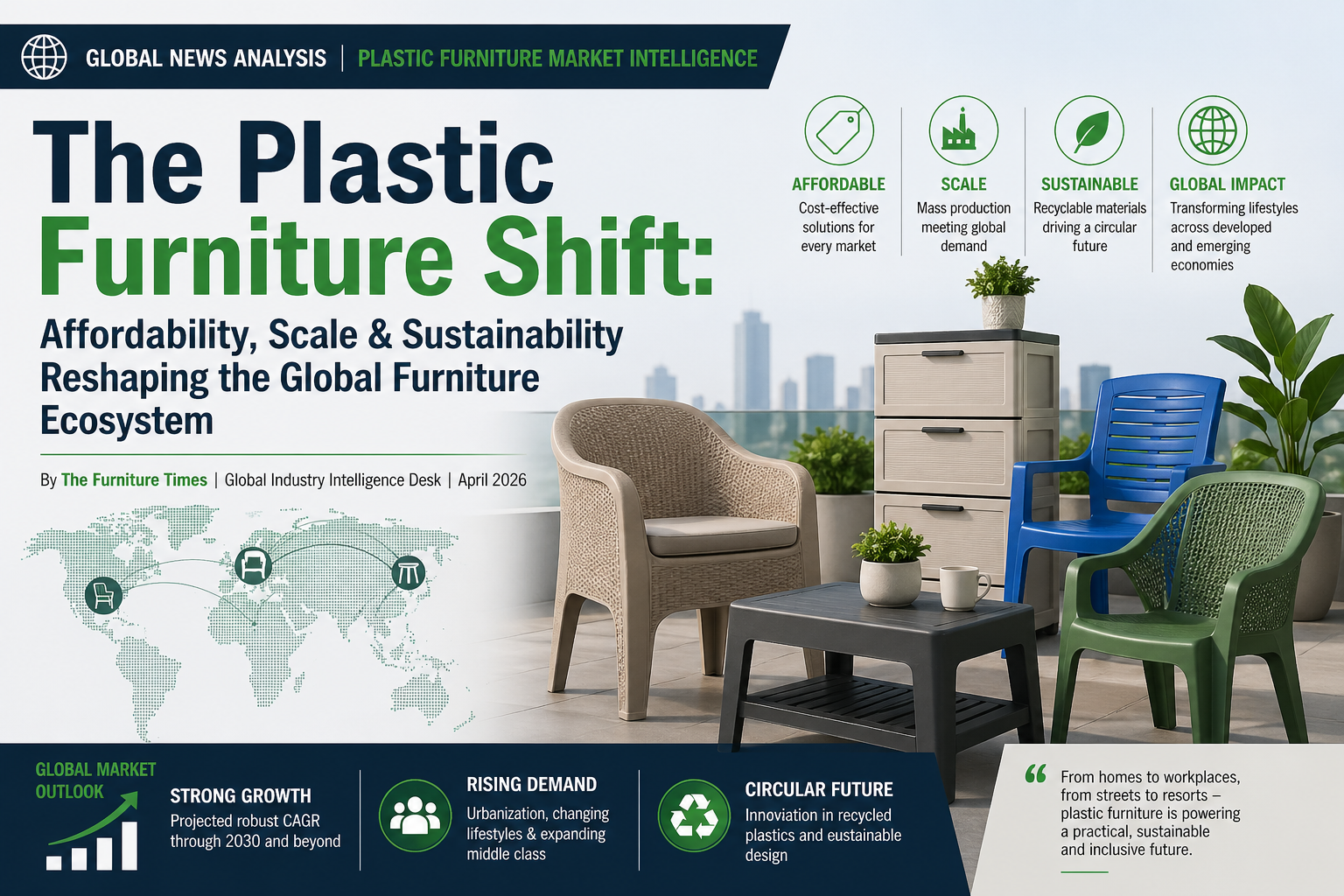
The Plastic Furniture Shift: Affordability, Scale & Sustainability Reshaping the Global Furniture Ecosystem
Global News Analysis | Plastic Furniture Market Intelligence
By The Furniture Times | Global Industry Intelligence Desk | April 2026
Introduction: The Most Underrated Segment in the Furniture Industry
Plastic furniture is often seen as a low-cost alternative.
But in 2026, it is becoming something much bigger:
A strategic category driving affordability, scalability, and global accessibility in the furniture ecosystem.
Behind its simple perception lies a fast-evolving market shaped by urbanization, e-commerce, sustainability pressures, and changing consumer behavior.
Market Snapshot: Stable Growth with Massive Scale Potential
The global plastic furniture market is:
- Valued at ~$17.56 billion in 2026
- Expected to reach ~$21.88 billion by 2031
- Growing at a steady ~4.5% CAGR
Other projections show similar long-term expansion, with the market expected to reach ~$22.1 billion by 2034
This positions plastic furniture as a mid-to-large segment with consistent, scalable growth.
The Core Drivers Behind Growth
1. Affordability & Mass Adoption
Plastic furniture is fundamentally driven by one major advantage:
Cost efficiency.
- Lower production costs
- Accessible pricing for mass markets
- High volume demand in developing economies
This makes it a dominant choice in:
- Budget households
- Rental living environments
- Temporary or flexible setups
2. Lightweight & Logistics Advantage
Plastic furniture is:
- Easy to transport
- Stackable and modular
- Ideal for flat-pack distribution
This gives it a strong advantage in:
- E-commerce
- Export markets
- Large-scale institutional supply
Online retail in plastic furniture is growing steadily, supported by lower shipping costs and digital product visualization tools
3. Outdoor & Commercial Demand Growth
Plastic furniture is widely used in:
- Outdoor spaces
- Hospitality (cafés, resorts, events)
- Public infrastructure
- Schools and institutions
Its resistance to:
- Moisture
- Corrosion
- Weather conditions
makes it highly suitable for these environments.
4. Urbanization & Space Efficiency
With smaller living spaces globally, demand is rising for:
- Compact furniture
- Stackable designs
- Multi-functional units
Plastic furniture fits perfectly into:
Urban + flexible living models
5. Rise of Recycled & Advanced Materials
One of the biggest shifts in 2026:
Plastic furniture is becoming more sustainable.
Manufacturers are increasingly using:
- Recycled polymers
- Closed-loop production systems
- Composite materials
These innovations allow:
- Improved durability
- Premium positioning
- Compliance with environmental regulations
Market Structure: Key Insights
Product Segmentation
- Chairs dominate (~39% share)
- Cabinets and storage units are among the fastest-growing categories
- Outdoor furniture remains a strong application segment
End-User Segments
- Residential → largest share (~59%)
- Commercial → fastest-growing segment
Regional Dynamics
- Asia-Pacific → fastest-growing region
- North America → largest market
This reflects:
- Strong demand in emerging economies
- High consumption in developed markets
The Hidden Challenges
Despite strong fundamentals, the plastic furniture market faces critical issues:
1. Perception Problem
Plastic furniture is still often perceived as:
- Low quality
- Less premium
- Temporary
This limits its adoption in high-end segments.
2. Environmental Pressure
Plastic faces increasing scrutiny due to:
- Sustainability concerns
- Regulatory pressure
- Waste management challenges
This forces manufacturers to innovate quickly.
3. Intense Price Competition
Because entry barriers are low:
- Many suppliers compete globally
- Margins are under pressure
- Differentiation is limited
4. Discovery & Visibility Gap
Here is the deeper issue:
The market is growing—but suppliers are still hard to find globally.
- Buyers struggle to compare suppliers
- Categories are not well structured
- Supplier credibility is unclear
The Real Problem: The Search Bottom Line in Plastic Furniture
The plastic furniture segment highlights a major industry weakness:
High supply + High demand ≠ Efficient connection
This leads to:
- Lost export opportunities
- Slow sourcing decisions
- Underutilized production capacity
- Weak global positioning
TFT Deep Analysis: The Industry Is Entering a New Phase
Plastic furniture is evolving across three stages:
Stage 1: Cost-Based Growth
Driven by affordability
Stage 2: Functional Expansion
Driven by outdoor, commercial, and urban demand
Stage 3: Intelligence & Sustainability (Next Phase)
Driven by:
- Data
- Search
- Verified suppliers
- Sustainable materials
Strategic Solutions: What the Industry Must Do
1. Reposition Plastic Furniture
Manufacturers must move from:
Cheap product → Smart, sustainable solution
Focus on:
- Design
- Durability
- Eco-materials
- Branding
2. Build Category-Based Visibility
Suppliers should clearly position themselves:
- Plastic chair manufacturers
- Outdoor plastic furniture suppliers
- Modular plastic furniture exporters
- Hospitality plastic furniture providers
3. Invest in Sustainability
Future growth depends on:
- Recycled plastic usage
- Circular economy models
- Certification and compliance
4. Strengthen Digital Discovery
This is the biggest gap.
The industry needs:
- Structured supplier databases
- Verified listings
- Category-based search
- Global visibility platforms
Role of FISE: The Missing Infrastructure
The plastic furniture market clearly shows:
There is no dedicated global search engine organizing furniture suppliers.
Furniture Industry Search Engine (FISE) can solve this by enabling:
- Global plastic furniture supplier listings
- Category-based discovery (chairs, outdoor, modular)
- Country-level sourcing
- Verified supplier profiles
- AI-powered buyer-supplier matching
Example Use Case
A buyer searching for:
“Plastic outdoor furniture suppliers in Southeast Asia”
Today:
- Scattered results
- Limited verification
With FISE:
- Structured supplier discovery
- Verified profiles
- Faster procurement decisions
Key Takeaways (April 2026)
1. Plastic Furniture Is a Stable Growth Segment
Driven by affordability and scalability
2. Urbanization Is a Major Driver
Compact living boosts demand
3. Sustainability Is Reshaping the Market
Recycled plastics are becoming essential
4. Competition Is Intense
Differentiation is critical
5. Discovery Is Still Broken
Search and supplier visibility remain weak
Conclusion: From Cheap Alternative to Strategic Category
Plastic furniture is no longer just a low-cost option.
It is becoming:
- A mass-market solution
- A logistics-friendly product
- A sustainability-driven innovation space
But to unlock its full potential, the industry must evolve from:
Product-driven → Intelligence-driven
Final Thought
Plastic furniture is not the weakest segment of the industry.
It is one of the most scalable.
The future will be defined not just by cost—but by:
Search + Trust + Sustainability + Intelligence
