The Kitchen Economy: Why the Heart of the Home Is Becoming the Core of the $1 Trillion Furniture Ecosystem
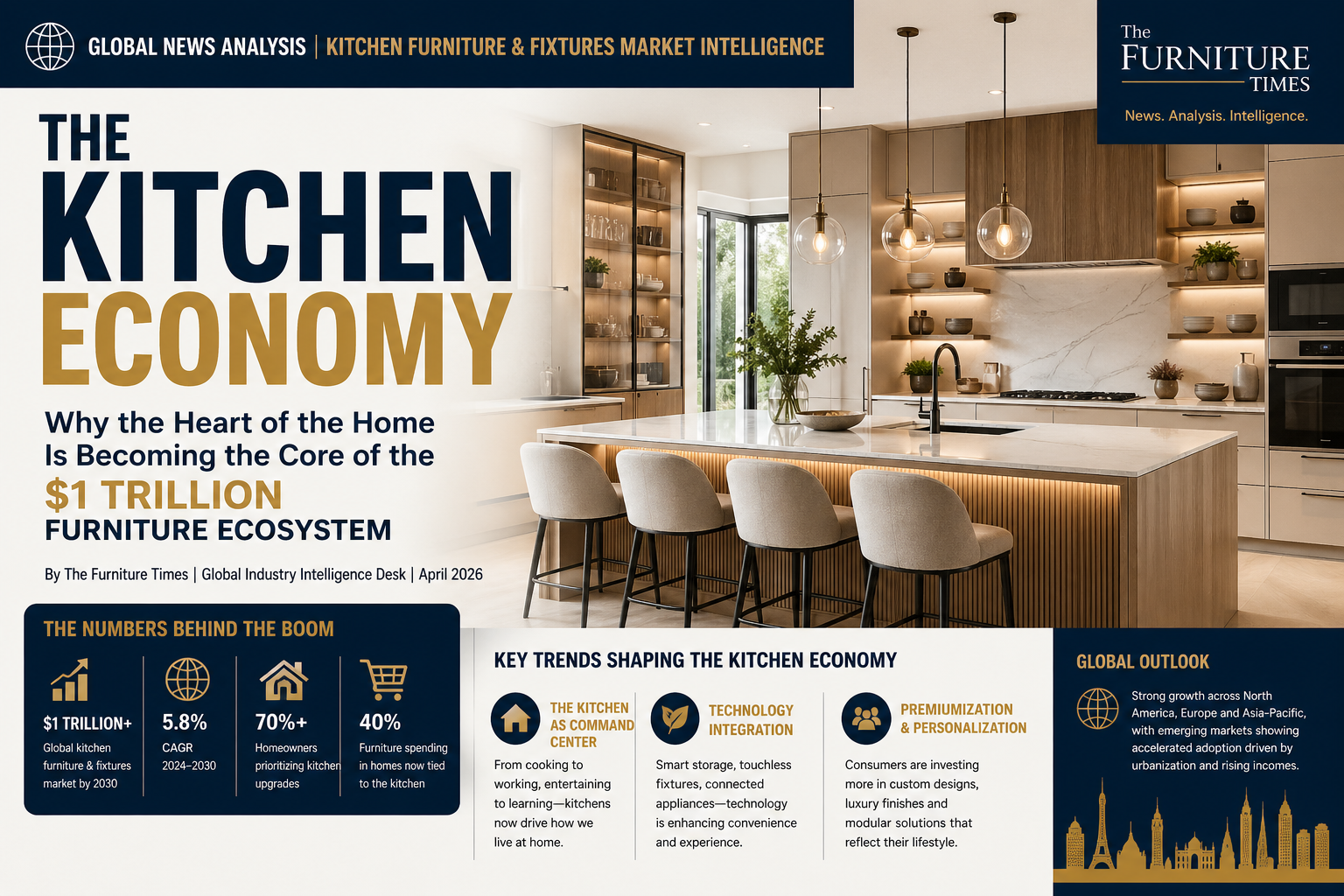
Global News Analysis | Kitchen Furniture & Fixtures Market Intelligence
The Kitchen Economy: Why the Heart of the Home Is Becoming the Core of the $1 Trillion Furniture Ecosystem
By The Furniture Times | Global Industry Intelligence Desk | April 2026
Introduction: The Most Strategic Room in the Furniture Industry
The kitchen is no longer just a functional space.
It is becoming the center of lifestyle, design, technology, and real estate value—and that is transforming the global furniture ecosystem.
The latest industry analysis reveals that the global kitchen furniture and fixtures market was valued at ~$196.7 billion in 2024 and is projected to reach ~$242.5 billion by 2030, growing at a steady ~3.5% CAGR.
This makes it one of the largest and most strategically important segments in the entire furniture industry.
The Big Picture: Why Kitchen Furniture Matters More Than Ever
1. The Kitchen Has Become a Lifestyle Hub
Modern homes are evolving:
- Open-plan living is dominating
- Kitchens are becoming social spaces
- Cooking, dining, working, and entertaining are merging
This shift is driving demand for:
- Modular kitchens
- Kitchen islands
- Storage-integrated furniture
- Aesthetic + functional design
The kitchen is no longer hidden—it is on display.
2. Renovation Is Driving Demand
Unlike other furniture categories, kitchen furniture benefits from:
- Home renovation cycles
- Property upgrades
- Real estate value enhancement
Aging housing stock and remodelling demand are major growth drivers globally.
Key Insight:
The kitchen market grows not only when homes are built—but when homes are improved.
3. Urbanization & Space Optimization
Urban living is pushing:
- Smaller kitchens
- Higher efficiency design
- Multi-functional furniture
Demand is rising for:
- Space-saving cabinets
- Foldable kitchen systems
- Integrated storage solutions
4. Technology Is Entering the Kitchen
The kitchen is becoming a smart environment:
- Integrated appliances
- Sensor-based storage
- Smart lighting and fittings
Furniture is no longer static—it is becoming interactive and connected.
Market Structure: Where the Growth Is Happening
Segmentation Insights
By Product:
- Kitchen cabinets dominate
- Fixtures (sinks, fittings) growing steadily
- Modular systems gaining traction
By Material:
- Wood remains dominant
- Stainless steel growing in premium kitchens
- Composite and engineered materials rising
By End-User:
- Residential segment leads
- Commercial kitchens (restaurants, hospitality) expanding
By Distribution:
- Offline still strong
- Online fastest-growing channel
Regional Power Dynamics
Key Markets
- United States → largest single market (~$53B)
- China → fastest growth (~6.8% CAGR)
- Europe → design-driven, premium demand
- Asia-Pacific → strongest long-term expansion
The Hidden Challenges
Despite its size, the kitchen furniture market faces structural issues:
1. High Competition & Standardization
Thousands of manufacturers produce similar modular systems → price pressure.
2. Complex Installation Ecosystem
Kitchen furniture is not plug-and-play:
- Requires measurement
- Customization
- Installation expertise
3. Supply Chain Pressure
- Material cost volatility
- Tariffs affecting imports
- Logistics complexity
4. Decision Complexity for Buyers
Kitchen purchases involve:
- Design
- Budget
- Functionality
- Durability
This slows decision-making.
The Real Problem: The Search & Decision Gap
Here is the deeper issue:
The kitchen furniture market is large, but discovery is still inefficient.
Buyers struggle to:
- Find the right suppliers
- Compare global options
- Verify capabilities
- Understand pricing and customization
Suppliers struggle to:
- Stand out
- Reach international buyers
- Position themselves by category
TFT Deep Analysis: The Kitchen Industry Is Entering a New Phase
The kitchen furniture market is evolving across three stages:
Stage 1: Product Expansion
Driven by housing and renovation
Stage 2: Design Differentiation
Driven by lifestyle and aesthetics
Stage 3: Intelligence & Discovery (Next Phase)
Driven by:
- Data
- Search
- AI matching
- Faster decisions
The Strategic Shift: From Cabinets to Ecosystems
The kitchen industry is no longer about selling cabinets.
It is about delivering:
- Complete kitchen solutions
- Design + functionality
- Integrated systems
- End-to-end customer experience
Solution: What the Industry Must Do
1. Build Category-Based Digital Presence
Companies must clearly define:
- Modular kitchen manufacturers
- Kitchen cabinet specialists
- Kitchen fixture suppliers
- Commercial kitchen providers
Without this → lost visibility.
2. Move Toward Solution Selling
Instead of selling products, businesses must offer:
- Complete kitchen packages
- Design + installation
- Custom solutions
3. Strengthen Digital Discovery
This is the biggest gap.
The industry needs:
- Structured supplier databases
- Category-based search
- Verified profiles
- Global visibility systems
Role of FISE: The Missing Infrastructure
The kitchen furniture market highlights a critical issue:
There is no dedicated global search engine for kitchen furniture discovery.
Furniture Industry Search Engine (FISE) can solve this by enabling:
- Global kitchen furniture supplier listings
- Category-based search (cabinets, fixtures, modular kitchens)
- Country-level discovery
- Verified business profiles
- AI-powered supplier matching
Example Use Case
A developer searching for:
“Modular kitchen suppliers for 200 apartments in Dubai”
Today:
- Complex sourcing
- Multiple intermediaries
With FISE:
- Direct supplier discovery
- Verified profiles
- Faster decisions
Key Takeaways (April 2026)
1. Kitchen Furniture Is One of the Largest Segments
Over $240B market by 2030
2. Growth Is Stable but Competitive
Driven by renovation and lifestyle trends
3. Urbanization Is Reshaping Design
Compact, modular solutions are rising
4. Technology Is Transforming Kitchens
Smart, connected environments emerging
5. Discovery & Decision-Making Remain Weak
Search and supplier matching are inefficient
Conclusion: The Kitchen Is the New Growth Engine
The kitchen furniture market is not just growing—it is evolving.
It represents:
- Lifestyle transformation
- Real estate value
- Design innovation
- Technology integration
But to unlock its full potential, the industry must evolve from:
Product-driven → Intelligence-driven
Final Thought
The kitchen is the heart of the home.
And it is becoming the heart of the furniture industry.
The next phase will not be defined only by design or production.
It will be defined by:
Search + Trust + Intelligence