
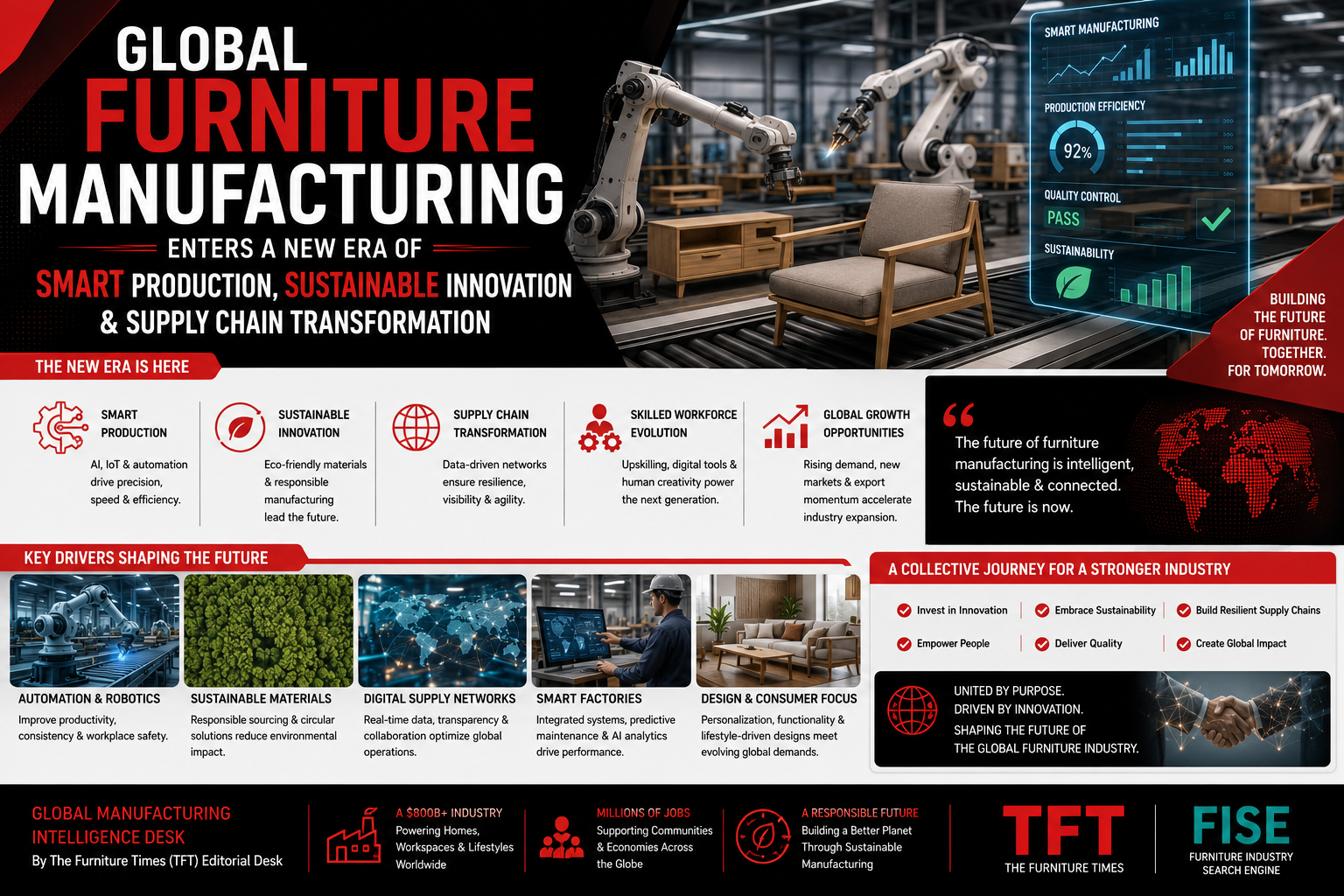
Global Furniture Manufacturing Enters a New Era of Smart Production, Sustainable Innovation & Supply Chain Transformation
Global Manufacturing Intelligence Desk
By The Furniture Times (TFT) Editorial Desk
Executive Summary
Global furniture manufacturing is undergoing one of its most significant transformations in decades.
Factories are no longer competing solely on production volume. Instead, they are investing in smart manufacturing, automation, digital technologies, sustainability and resilient supply chains to remain competitive in an increasingly demanding global market.
Manufacturers across Asia, Europe, North America and emerging production hubs are responding to changing customer expectations, labour shortages and rising operational costs by modernising production facilities and adopting advanced manufacturing technologies. Industry experts note that recovery is underway, although it remains uneven across regions and product segments.
According to The Furniture Times (TFT), the future of furniture manufacturing will belong to businesses that combine craftsmanship with technology, operational efficiency with sustainability and production excellence with digital intelligence.
Manufacturing Is Moving Beyond Mass Production
For decades, furniture manufacturing focused primarily on increasing production capacity.
Today’s priorities are different.
Manufacturers now compete through:
- Smart factories
- Flexible production
- Faster delivery
- Product customisation
- Digital integration
- Sustainability
- Artificial Intelligence
- Supply chain resilience
Modern factories are becoming knowledge-driven production environments rather than simply assembly operations.
Smart Manufacturing Is Becoming the Standard
Furniture manufacturers are investing in:
- CNC machining
- Robotics
- Automated material handling
- Digital production planning
- Predictive maintenance
- Manufacturing execution systems
- Factory analytics
International industry exhibitions continue to showcase smart production technologies that improve efficiency while supporting flexible manufacturing.
Recovery Continues Across Global Manufacturing
While global demand is improving, manufacturers continue operating in a challenging environment.
Current priorities include:
Managing costs.
Improving productivity.
Reducing waste.
Responding faster to customer orders.
Building more resilient supply chains.
Industry analysts observe that manufacturers capable of producing smaller batches with greater flexibility are gaining competitive advantages.
Asia Remains the Manufacturing Powerhouse
Asia continues leading global furniture production.
Major manufacturing countries include:
- China
- Vietnam
- Malaysia
- Indonesia
- India
Vietnam, in particular, continues strengthening its manufacturing sector through investment, export growth and industrial development while expanding higher-value production capabilities.
New Manufacturing Hubs Continue Emerging
Global production capacity continues expanding into new industrial zones.
For example, Cambodia’s Koh Kong Zhejiang Special Economic Zone has attracted more than US$567 million in investment across dozens of industrial projects, with furniture manufacturing identified as one of its strategic sectors.
These developments demonstrate how countries are competing to attract manufacturing investment through industrial infrastructure and export-oriented production.
Sustainability Is Reshaping Production
Manufacturers increasingly invest in:
- Sustainable timber
- Bio-based materials
- Low-emission production
- Waste reduction
- Recycling
- Circular manufacturing
Innovation is also accelerating in manufacturing materials. For example, companies are scaling formaldehyde-free, bio-based adhesive technologies that support lower-emission furniture production.
Manufacturing Technology Is Advancing Rapidly
Production facilities increasingly integrate:
Artificial Intelligence.
Machine learning.
Industrial automation.
IoT sensors.
Digital twins.
Real-time quality monitoring.
These technologies improve:
Production planning.
Quality consistency.
Machine utilisation.
Energy efficiency.
Inventory management.
Quality Is Becoming the Competitive Advantage
Global buyers increasingly evaluate suppliers based on:
Manufacturing capability.
Quality systems.
Consistency.
Delivery performance.
Technical expertise.
Compliance.
The future will reward factories that consistently produce high-quality products while maintaining operational excellence.
Customisation Is Driving Production Changes
Consumers increasingly demand:
Personalised furniture.
Flexible dimensions.
Custom finishes.
Made-to-order products.
Modular systems.
Manufacturers are redesigning production processes to support mass customisation without sacrificing efficiency.
Labour Challenges Continue
Many manufacturing regions continue facing shortages of:
Skilled carpenters.
Machine operators.
CNC programmers.
Engineers.
Production supervisors.
As automation expands, workforce development becomes equally important.
Training and technology must evolve together.
Supply Chains Continue Adapting
Manufacturers are strengthening supply chains through:
Supplier diversification.
Regional sourcing.
Digital tracking.
Inventory optimisation.
Long-term supplier partnerships.
Businesses increasingly prioritise resilience alongside cost efficiency.
Malaysia Seeks Stronger Manufacturing Support
Malaysia’s furniture industry has recently renewed calls for stronger policy support as manufacturers manage global economic uncertainty, rising operating costs and softer export demand. Industry representatives have highlighted the importance of strengthening competitiveness, supporting SMEs and encouraging long-term manufacturing investment.
The Role of Digital Manufacturing
Manufacturing no longer ends at the factory.
Digital technologies now support:
Sales forecasting.
Customer communication.
Production scheduling.
After-sales service.
Quality documentation.
Export readiness.
Manufacturing is becoming connected across the entire business.
Artificial Intelligence Is Supporting Decision-Making
AI is increasingly helping manufacturers:
Predict demand.
Optimise production.
Reduce waste.
Improve maintenance scheduling.
Enhance quality inspection.
Support inventory planning.
AI complements human expertise by providing faster analysis and operational insights.
Manufacturing Must Also Become Discoverable
Outstanding factories often remain unknown internationally.
Digital visibility has become an important manufacturing asset.
Manufacturers increasingly benefit from:
Professional websites.
Search visibility.
Educational content.
Product catalogues.
Industry listings.
Customer reviews.
Global discoverability now supports export competitiveness.
Opportunities Ahead
Strong opportunities continue emerging across:
Hospitality furniture.
Healthcare furniture.
Outdoor furniture.
Smart furniture.
Sustainable furniture.
Office furniture.
Educational furniture.
Custom manufacturing.
Engineered wood products.
Furniture components.
The Furniture Times Analysis
Furniture manufacturing is entering a new industrial era.
Success will increasingly depend upon:
Technology.
Innovation.
People.
Quality.
Sustainability.
Digital intelligence.
Operational flexibility.
Factories that embrace continuous improvement rather than relying solely on production scale will be better positioned for long-term growth.
Final Verdict
The future of furniture manufacturing is no longer defined only by how many products a factory can produce.
It is defined by how intelligently it produces them.
Manufacturers that invest in:
Smart technology.
Skilled people.
Sustainable production.
Digital transformation.
Quality systems.
Global partnerships.
Will become the industry’s next generation of leaders.
The world’s factories are evolving.
The businesses that evolve with them will shape the future of the global furniture industry.
By The Furniture Times (TFT) Editorial Desk
Global Manufacturing Intelligence Desk | July 2026
“TFT tells their story. FISE helps the world find them.”
The furniture industry ecosystem is a $1 Trillion Dollar Industry.
