Furniture Search vs Apparel Search: Why Buyers Behave Completely Differently
The Hidden Psychology Behind How People Search, Discover, Compare & Buy Furniture Compared to Fashion Products
Global Search Intelligence Report
By The Furniture Times (TFT) & Furniture Industry Search Engine (FISE)
June 2026
One of the biggest mistakes digital marketers, website developers, search engines, e-commerce platforms, and even business owners make is assuming that all online search behavior is the same.
It is not.
A person searching for a sofa behaves differently from a person searching for a shirt.
A customer searching for a dining table follows a completely different decision-making process compared to someone searching for shoes.
A hotel owner sourcing outdoor furniture does not think like a teenager buying a jacket.
Yet many businesses continue to apply apparel-industry marketing strategies to furniture businesses.
The result?
Poor conversions.
Wrong website designs.
Ineffective advertising.
Weak customer experiences.
And missed opportunities.
The truth is simple:
Furniture search and apparel search belong to two completely different consumer behavior categories.
Understanding this difference may become one of the most important competitive advantages in the future of digital commerce. Consumer behavior research consistently shows that purchase decisions vary significantly depending on product category, perceived risk, emotional involvement, and information requirements.
The First Fundamental Difference: Risk
When someone buys a T-shirt online, the perceived risk is relatively low.
If the customer makes a mistake:
- The financial loss is small.
- The replacement process is easy.
- The product is lightweight.
- The buying cycle is short.
Furniture is different.
A mistake can cost:
- Hundreds or thousands of dollars.
- Shipping costs.
- Installation costs.
- Time.
- Customer frustration.
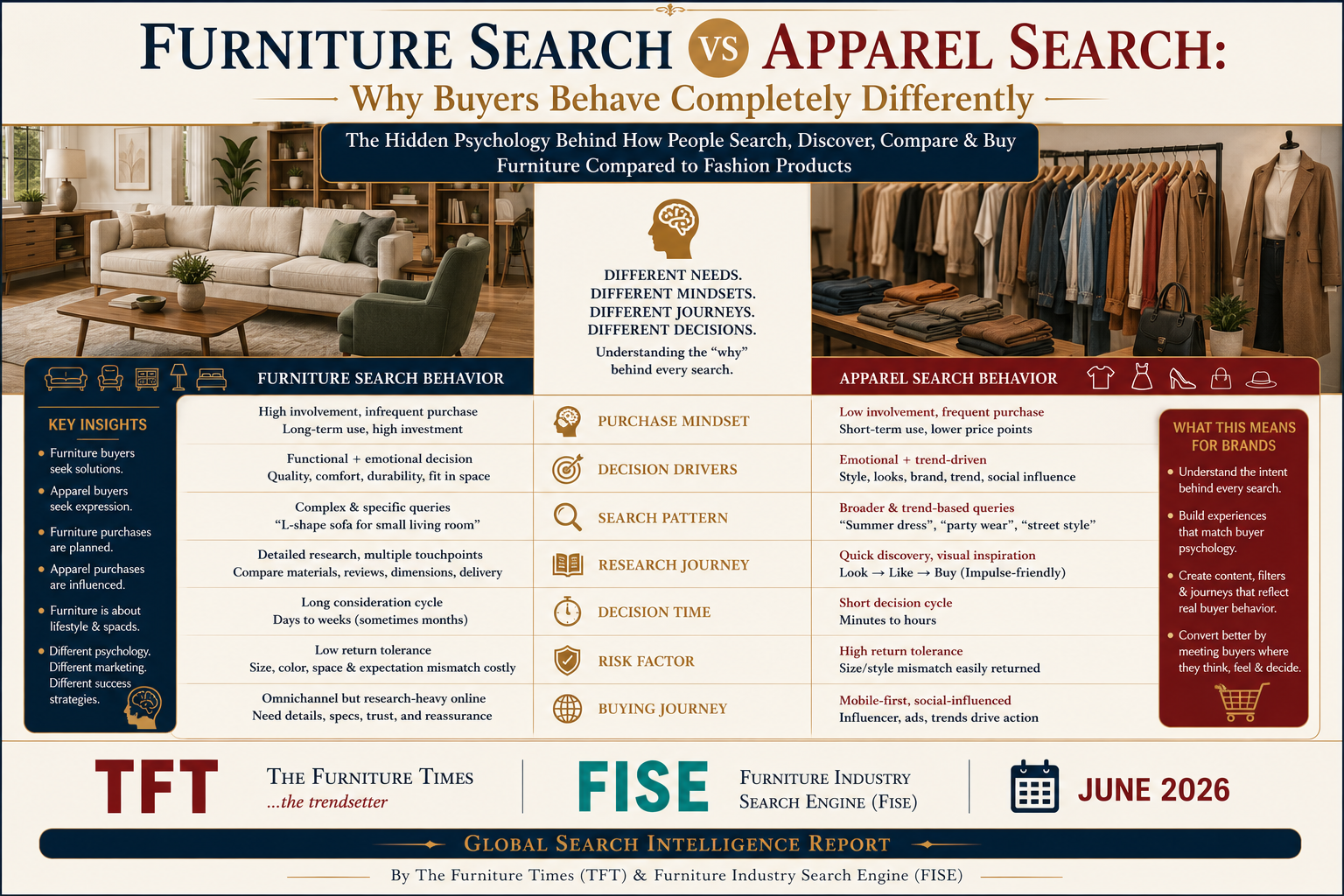
Furniture consumers perceive much higher risk before making decisions. Research on furniture purchasing behavior shows that consumers engage in more extensive evaluation and risk assessment because furniture purchases are often considered high-value and high-involvement decisions.
Apparel Search Is Fast
Fashion buyers often search with speed.
Examples:
- Black T-shirt
- White sneakers
- Summer dress
- Men’s jacket
The customer often knows exactly what they want.
The buying process may take minutes.
Sometimes seconds.
The search is direct.
The decision is emotional.
The purchase is immediate.
Fashion frequently operates within impulse-buying behavior.
Consumers see.
Like.
Buy.
Furniture Search Is Slow
Furniture buyers rarely purchase immediately.
Instead, they search:
- Compare
- Research
- Evaluate
- Measure
- Reconsider
- Validate
A furniture search journey may last:
- Days
- Weeks
- Months
Customers often return multiple times before making a final decision.
Research on furniture retail shows consumers increasingly follow extended omnichannel journeys that combine online research with offline evaluation before purchasing.
Apparel Search Focuses on Style
Fashion searches are often centered around:
- Trends
- Brands
- Color
- Appearance
- Celebrity influence
- Seasonal demand
Examples:
- Trending sneakers
- Summer fashion
- Luxury handbag
- Streetwear hoodie
Fashion consumers frequently search for self-expression.
The search is identity-driven.
Furniture Search Focuses on Function + Lifestyle
Furniture consumers search differently.
Examples:
- Sofa for small apartment
- Outdoor furniture for hotel
- Dining table for 8 people
- Kitchen cabinet for condominium
- Ergonomic office chair
Furniture buyers are solving problems.
The search is functional before it becomes emotional.
The customer asks:
“Will this fit?”
“Will this last?”
“Will this work in my space?”
Only after those questions are answered does style become important.
Furniture Buyers Need More Information
Fashion customers usually need:
- Size
- Color
- Price
- Brand
Furniture customers need:
- Dimensions
- Materials
- Construction
- Durability
- Warranty
- Delivery information
- Assembly details
- Maintenance requirements
Furniture purchasing requires a much deeper information search process because buyers seek to reduce uncertainty before committing to a large purchase.
Visual Search Behaves Differently
Both industries rely heavily on visuals.
However, the purpose differs.
Apparel
Customers want to see:
- How it looks on people
- How it fits
- Current trends
Furniture
Customers want to see:
- Room placement
- Scale
- Dimensions
- Context
- Interior compatibility
Furniture buyers increasingly rely on visualization tools, room settings, and interactive experiences to reduce purchase risk and improve confidence.
Return Behavior Is Completely Different
Fashion has normalized returns.
Many apparel customers buy multiple sizes and return unwanted items.
Furniture does not work this way.
Returns are:
- Expensive
- Complex
- Logistically challenging
As a result, furniture customers spend significantly more time evaluating products before purchasing.
This changes search behavior dramatically.
Fashion Is Trend Driven
The apparel industry operates on rapid trend cycles.
Fashion changes:
- Seasonally
- Monthly
- Sometimes weekly
Consumers constantly search for:
- What’s new
- What’s trending
- What’s popular
Searches are heavily influenced by trend culture.
Furniture Is Longevity Driven
Furniture buyers think long term.
A sofa may remain in a home for:
- 5 years
- 10 years
- 15 years
A dining table may stay for decades.
Therefore furniture buyers search for:
- Durability
- Quality
- Materials
- Value
The decision process is slower and more deliberate.
Search Keywords Are Different
Apparel Search
Examples:
- Red dress
- Designer shoes
- Summer collection
- Fashion trends
These searches are usually short.
Furniture Search
Examples:
- Best outdoor furniture for tropical climate
- Kitchen cabinets for small apartments
- Hospitality furniture supplier Malaysia
- Waterproof patio furniture
Furniture searches are often longer, more descriptive, and more solution-oriented.
The Trust Factor Is Much Bigger in Furniture
A customer buying a $30 shirt behaves differently from a customer buying a $3,000 sofa.
Furniture buyers require:
- Reviews
- Certifications
- Company credibility
- Project references
- Customer testimonials
Trust becomes a critical part of the search journey.
Studies on furniture e-commerce consistently identify trust and perceived risk as major factors influencing purchase intentions.
AI Search Will Impact Furniture More Deeply
Artificial intelligence is changing both industries.
However, furniture may experience a bigger transformation.
Why?
Because furniture purchases involve complexity.
Consumers increasingly ask AI:
- Which sofa is best for small apartments?
- What furniture material lasts longest?
- Which outdoor furniture survives tropical weather?
- What dining table suits a modern interior?
AI thrives on complex questions.
Furniture search naturally generates those questions.
Fashion search often remains simpler and more visual.
AI-powered discovery and new search behaviors are already reshaping furniture shopping journeys.
What This Means for Furniture Websites
Furniture websites should not copy fashion websites.
Many businesses make this mistake.
Furniture websites should prioritize:
Searchability
Product Information
Visualization
Room Inspiration
Material Education
Buying Guides
Trust Signals
Project References
The objective is not merely inspiration.
The objective is confidence.
What This Means for FISE
This is exactly why the furniture industry needs specialized search systems.
Furniture search is fundamentally different from apparel search.
Furniture buyers search by:
- Problems
- Spaces
- Projects
- Materials
- Applications
- Industries
A furniture-specific search engine can understand these intentions more effectively than generic search environments.
The future belongs to industry-specific discoverability.
TFT & FISE Analysis
The biggest difference between furniture search and apparel search is simple:
Fashion buyers search for identity.
Furniture buyers search for solutions.
Fashion is often about expression.
Furniture is often about transformation.
Fashion is frequently impulse-driven.
Furniture is typically research-driven.
Fashion focuses on trends.
Furniture focuses on trust.
Businesses that understand these differences can build better websites, stronger search strategies, better customer experiences, and higher conversion rates.
Final Verdict
Not all search behavior is equal.
A furniture buyer and a fashion buyer may both use Google, AI, marketplaces, and social media.
But they think differently.
They evaluate differently.
They compare differently.
And they purchase differently.
The future of digital commerce belongs to businesses that understand buyer psychology.
Because in the end:
Fashion search asks: “How do I look?”
Furniture search asks: “How do I live?”
And those two questions create completely different buying journeys.
By The Furniture Times (TFT) & Furniture Industry Search Engine (FISE)
Global Search Intelligence Report | June 2026
“TFT tells their story. FISE helps the world find them.”
The furniture industry ecosystem is a $1 Trillion Dollar Industry.