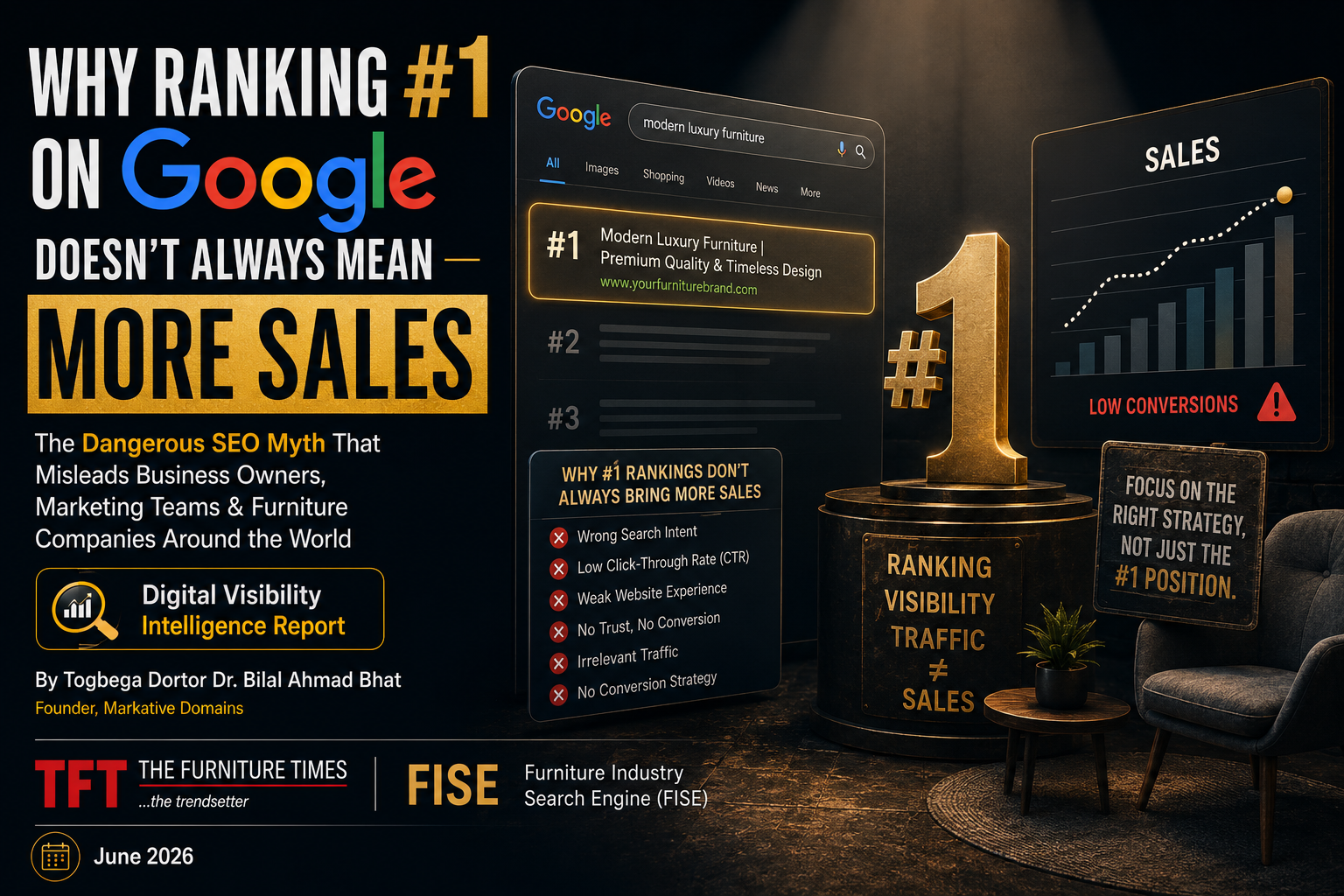
Why Ranking #1 on Google Doesn’t Always Mean More Sales
The Dangerous SEO Myth That Misleads Business Owners, Marketing Teams & Furniture Companies Around the World
Digital Visibility Intelligence Report / By Togbega Dortor Dr. Bilal Ahmad Bhat
Founder, Markative Domains
The Furniture Times (TFT) & Furniture Industry Search Engine (FISE)
June 2026
One of the most common conversations in the digital marketing world sounds like this:
“We want to rank #1 on Google.”
Business owners say it.
Marketing managers say it.
SEO agencies hear it every day.
And while there is nothing wrong with wanting top rankings, one of the biggest misunderstandings in modern business is the belief that ranking #1 automatically leads to more sales.
It doesn’t.
In fact, some businesses rank #1 and struggle to generate revenue.
Others rank lower and generate millions.
How is that possible?
Because rankings and sales are not the same thing.
And understanding the difference may save businesses years of frustration, unrealistic expectations, and wasted investment.
The Ranking Obsession
Many companies have become obsessed with rankings.
Every SEO report begins with:
- Keyword rankings
- Traffic increases
- Position improvements
- Search visibility
These metrics matter.
But they are not the final goal.
The real goal is:
Business growth.
Revenue.
Profitability.
Customer acquisition.
Long-term brand value.
Unfortunately, many businesses confuse visibility metrics with business outcomes.
Ranking Is Visibility, Not Revenue
A Google ranking is simply a position.
Nothing more.
Nothing less.
Ranking #1 means:
Google considers your page highly relevant for a specific search query.
It does not mean:
- People will buy
- People will trust you
- People will contact you
- People will become customers
Ranking creates opportunity.
It does not guarantee results.
The Wrong Keyword Problem
One of the biggest reasons top rankings fail to generate sales is because businesses rank for the wrong keywords.
For example:
A furniture company ranks #1 for:
“History of furniture”
Thousands of visitors arrive.
But very few purchase.
Why?
Because the search intent is educational.
Not commercial.
Compare that to:
“Hotel furniture supplier Malaysia”
The traffic may be smaller.
But the buying intent is significantly higher.
The value of a keyword matters more than its ranking.
Traffic Does Not Equal Customers
Many businesses celebrate traffic growth.
Traffic is exciting.
Traffic feels measurable.
Traffic creates impressive reports.
But traffic alone pays no bills.
A website can receive:
10,000 visitors
And generate no meaningful inquiries.
Another website can receive:
500 visitors
And generate substantial business.
The difference is quality.
Not quantity.
The best traffic is relevant traffic.
The Conversion Problem
Let’s assume your website ranks #1.
Visitors arrive.
Then what?
Many websites fail because they cannot convert attention into action.
Common issues include:
- Poor website design
- Slow loading speed
- Weak product information
- No trust signals
- No clear call-to-action
- Poor user experience
SEO may bring people to your door.
Your website determines whether they enter.
Ranking Without Trust Is Useless
Trust has become one of the most important factors in buying decisions.
Especially in industries such as furniture.
A customer searching for:
“Outdoor furniture supplier”
wants more than rankings.
They want confidence.
They want proof.
They want reassurance.
They evaluate:
- Reviews
- Testimonials
- Portfolios
- Experience
- Brand reputation
If trust is missing, rankings alone rarely produce sales.
Furniture Buyers Are Different
This is especially important in the furniture industry.
Furniture purchases are not impulse purchases.
People often spend:
Days researching.
Weeks comparing.
Months evaluating.
In commercial projects, decisions may take even longer.
A hospitality buyer selecting furniture for a resort may evaluate suppliers for months before making contact.
Ranking is merely one step in a much longer decision-making journey.
SEO Is Not a Sales Department
This is perhaps the most important lesson.
SEO creates visibility.
Sales creates revenue.
The two work together.
But they are not the same thing.
Businesses often expect SEO agencies to deliver sales.
However, sales depend on:
- Pricing
- Product quality
- Customer service
- Follow-up systems
- Trust
- Market demand
SEO opens the door.
Your business must walk through it.
Branding Often Matters More Than Rankings
Imagine two companies.
Both rank on Google.
One is well known.
One is unknown.
Which one receives more clicks?
Usually the trusted brand.
Brand familiarity influences behavior.
This means:
Branding improves SEO performance.
And SEO improves branding.
The relationship works both ways.
Why Some Lower-Ranked Companies Win
One of the most surprising realities in digital marketing is that lower-ranked companies often outperform higher-ranked competitors.
Why?
Because they have:
- Better products
- Better websites
- Better customer service
- Better follow-up systems
- Better offers
- Better trust signals
A #3 ranking with strong business fundamentals can outperform a #1 ranking with weak fundamentals.
The AI Search Era Changes Everything
The future of search is evolving.
AI systems increasingly influence discovery.
People now ask:
- Best furniture suppliers?
- Trusted manufacturers?
- Recommended companies?
The future belongs not only to businesses that rank.
But to businesses that demonstrate expertise, authority, trust, and credibility.
SEO is becoming larger than rankings.
It is becoming discoverability.
What Businesses Should Measure Instead
Instead of obsessing over rankings alone, businesses should track:
Qualified Leads
Are inquiries increasing?
Brand Visibility
Are more people discovering the company?
Trust Signals
Are reviews and reputation improving?
Conversion Rates
Are visitors taking action?
Revenue Impact
Is business growth occurring?
These metrics matter more than rankings alone.
The Furniture Industry’s Biggest SEO Mistake
Many furniture companies believe:
“Get us to number one and everything will be solved.”
Unfortunately, business is more complex.
Visibility is important.
But visibility alone is not enough.
The complete equation includes:
- Visibility
- Trust
- Branding
- User experience
- Product quality
- Customer service
- Sales effectiveness
When these elements work together, growth happens.
TFT & FISE Analysis
The obsession with rankings has created unrealistic expectations throughout the business world.
SEO agencies are often judged by rankings.
Businesses are often disappointed by rankings.
Yet rankings were never intended to be the final destination.
They are only part of the journey.
The businesses achieving sustainable growth understand that SEO is a visibility strategy.
Not a sales guarantee.
Final Verdict
Ranking #1 on Google is valuable.
But it is not the finish line.
It is the starting line.
The businesses that win in the future will understand that rankings create visibility.
Visibility creates opportunities.
Opportunities create conversations.
Conversations create trust.
Trust creates customers.
And customers create revenue.
The real objective is not ranking #1.
The real objective is becoming the company buyers choose after they find you.
Because being found is important.
But being chosen is what truly matters.
By Togbega Dortor Dr. Bilal Ahmad Bhat
Founder, Markative Domains
The Furniture Times (TFT) & Furniture Industry Search Engine (FISE)
“If you’re not searchable, you don’t exist. If you’re searchable but not trusted, you still won’t be chosen.”
The furniture industry ecosystem is a $1 Trillion Dollar Industry.