
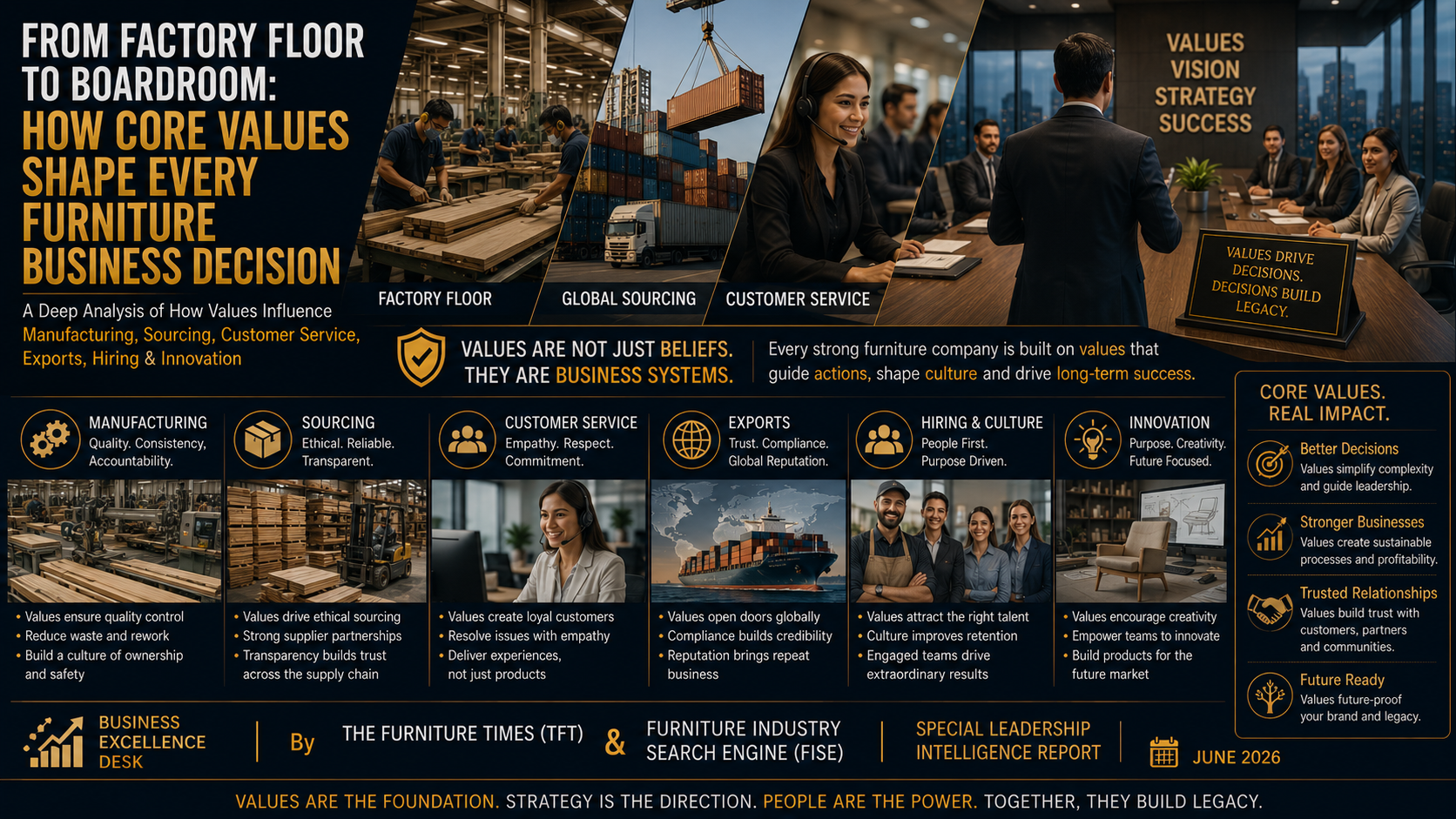
From Factory Floor to Boardroom: How Core Values Shape Every Furniture Business Decision
A Deep Analysis of How Values Influence Manufacturing, Sourcing, Customer Service, Exports, Hiring & Innovation
Business Excellence Desk
By The Furniture Times (TFT) & Furniture Industry Search Engine (FISE)
Special Leadership Intelligence Report | June 2026
The furniture industry is often viewed through the lens of products.
People see sofas.
Dining tables.
Kitchen cabinets.
Wardrobes.
Office furniture.
Hospitality projects.
Outdoor living collections.
But behind every product lies a series of decisions.
Thousands of decisions.
Every day.
Decisions made by factory workers, supervisors, purchasing managers, designers, logistics coordinators, sales teams, executives, and board members.
The quality of those decisions ultimately determines the success or failure of a business.
And what shapes those decisions?
Many leaders believe the answer is technology.
Others point to experience.
Some focus on systems and processes.
While all these factors matter, the strongest influence is often overlooked:
From the factory floor to the boardroom, values influence every action, every decision, every relationship, and every outcome.
In the modern furniture industry, values are not soft concepts.
They are operational assets.
They are strategic assets.
They are competitive assets.
Every Furniture Business Is a Reflection of Its Values
Whether consciously defined or not, every organization operates according to a set of values.
Some companies are guided by:
- Integrity
- Accountability
- Excellence
- Respect
- Service
- Leadership
Others operate without a clear value framework.
The difference eventually becomes visible.
In product quality.
In customer relationships.
In employee engagement.
In supplier partnerships.
In business reputation.
Values shape behavior.
Behavior shapes culture.
Culture shapes performance.
Performance shapes growth.
Manufacturing: Values Determine Quality
Manufacturing is often viewed as a technical process.
Machinery.
Materials.
Production schedules.
Quality control.
But manufacturing is fundamentally a human process.
Every product reflects the values of the people who created it.
Consider two factories using identical machinery.
One prioritizes excellence.
The other prioritizes shortcuts.
The results will be dramatically different.
Values such as:
- Discipline
- Excellence
- Accountability
- Commitment
directly influence:
- Product quality
- Waste reduction
- Production consistency
- Customer satisfaction
A commitment to values creates a commitment to quality.
Sourcing: Integrity Shapes Supply Chains
The global furniture industry depends on complex sourcing networks.
Companies source:
- Timber
- Hardware
- Fabrics
- Foam
- Glass
- Stone
- Packaging
- Components
The sourcing process involves countless decisions.
Questions such as:
- Which supplier should we choose?
- How do we verify quality?
- How do we ensure ethical sourcing?
- How do we manage sustainability?
Without values, sourcing becomes transactional.
With values, sourcing becomes strategic.
Integrity influences supplier selection.
Transparency improves supplier relationships.
Accountability strengthens trust.
In today’s global market, responsible sourcing is becoming a direct reflection of organizational values.
Customer Service: Where Values Become Visible
Customers rarely see internal processes.
They rarely see production meetings.
They rarely see management discussions.
What they do experience is service.
Customer service is where values become visible.
Every interaction communicates something about the organization.
Companies that prioritize:
- Respect
- Empathy
- Service
- Reliability
create stronger customer experiences.
The result is:
- Higher satisfaction
- Repeat purchases
- Referrals
- Long-term loyalty
Products may attract customers.
Values keep them.
Exports: Trust Travels Further Than Products
Export markets operate on trust.
International buyers often make decisions before ever visiting a factory.
They evaluate:
- Reputation
- Communication
- Reliability
- Transparency
- Professionalism
These qualities are deeply connected to values.
Export success depends on more than competitive pricing.
It depends on confidence.
Buyers want to know:
Can this company deliver?
Can this company be trusted?
Will this company honor its commitments?
Trust becomes the bridge between countries.
And trust is built through values.
Hiring: Values Attract Better Talent
The furniture industry faces a growing workforce challenge.
Across the world, companies struggle to attract and retain skilled professionals.
Many organizations focus on compensation.
Compensation matters.
But today’s workforce increasingly seeks something more.
They seek:
- Purpose
- Growth
- Respect
- Meaning
- Culture
Talented individuals are drawn to organizations whose values align with their own.
Companies with strong values often attract stronger people.
Strong people create stronger businesses.
The relationship is direct.
Innovation Requires More Than Creativity
Many companies view innovation as a product development activity.
In reality, innovation begins with culture.
Innovation thrives in environments where values encourage:
- Curiosity
- Learning
- Courage
- Collaboration
- Accountability
Employees innovate when they feel safe sharing ideas.
Teams innovate when trust exists.
Organizations innovate when leaders encourage growth rather than fear failure.
Innovation is not simply a process.
It is a cultural outcome.
Leadership: Values Guide Decisions During Uncertainty
The true strength of values becomes visible during difficult times.
Economic downturns.
Supply chain disruptions.
Market volatility.
Industry crises.
During uncertainty, organizations face difficult decisions.
Values provide guidance.
Values create consistency.
Values reduce confusion.
Leaders who operate with integrity, accountability, and purpose make decisions that strengthen long-term trust.
And trust becomes invaluable during periods of disruption.
Sustainability Begins With Values
The furniture industry increasingly discusses sustainability.
Environmental responsibility.
Responsible forestry.
Waste reduction.
Circular economies.
But sustainability is not merely a technical challenge.
It is a values challenge.
Companies that value responsibility naturally make better environmental decisions.
Companies that value transparency communicate more honestly.
Companies that value stewardship think beyond quarterly profits.
Sustainability starts with mindset.
Mindset starts with values.
The 28 Core Values and Business Excellence
The 28 Core Values framework provides a foundation for organizational excellence.
Values such as:
- Vision
- Integrity
- Accountability
- Excellence
- Leadership
- Respect
- Commitment
- Sustainability
- Service
- Trust
- Purpose
- Legacy
are not abstract concepts.
They influence measurable outcomes.
They improve decision quality.
They strengthen relationships.
They build stronger cultures.
And stronger cultures create stronger businesses.
The Boardroom Often Reflects the Factory Floor
One of the most overlooked truths in business is that culture flows in both directions.
Leadership influences employees.
Employees influence outcomes.
Outcomes influence reputation.
Reputation influences growth.
The boardroom may set the vision.
But the factory floor delivers the promise.
When values are aligned throughout the organization, execution improves.
This alignment becomes a powerful competitive advantage.
The Future Furniture Company
The future furniture company will not be defined solely by:
- Production capacity
- Technology
- Factory size
- Revenue
It will also be defined by:
- Trust
- Leadership
- Purpose
- Culture
- Values
These elements increasingly influence customer decisions, employee engagement, and long-term growth.
The companies that understand this shift will outperform those focused solely on operational metrics.
TFT & FISE Analysis
The furniture industry is entering an era where values are becoming measurable business drivers.
Values influence:
- Quality
- Innovation
- Recruitment
- Customer service
- Exports
- Sustainability
- Leadership
Organizations that embed values into daily operations create stronger cultures.
Stronger cultures create stronger performance.
And stronger performance creates sustainable growth.
Final Verdict
Every furniture company makes thousands of decisions every day.
Some decisions improve quality.
Some strengthen relationships.
Some create innovation.
Some build trust.
The common thread behind all these outcomes is values.
Core values influence far more than organizational culture.
They influence business results.
From factory floor to boardroom, values shape how companies think, act, compete, and grow.
Because in the end:
Machines manufacture products.
People create experiences.
Values shape people.
And the businesses that understand this reality will become the most respected companies in the global furniture industry.
By The Furniture Times (TFT) & Furniture Industry Search Engine (FISE)
Business Excellence Desk | June 2026
“TFT tells their story. FISE helps the world find them.”
The furniture industry ecosystem is a $1 Trillion Dollar Industry.
