
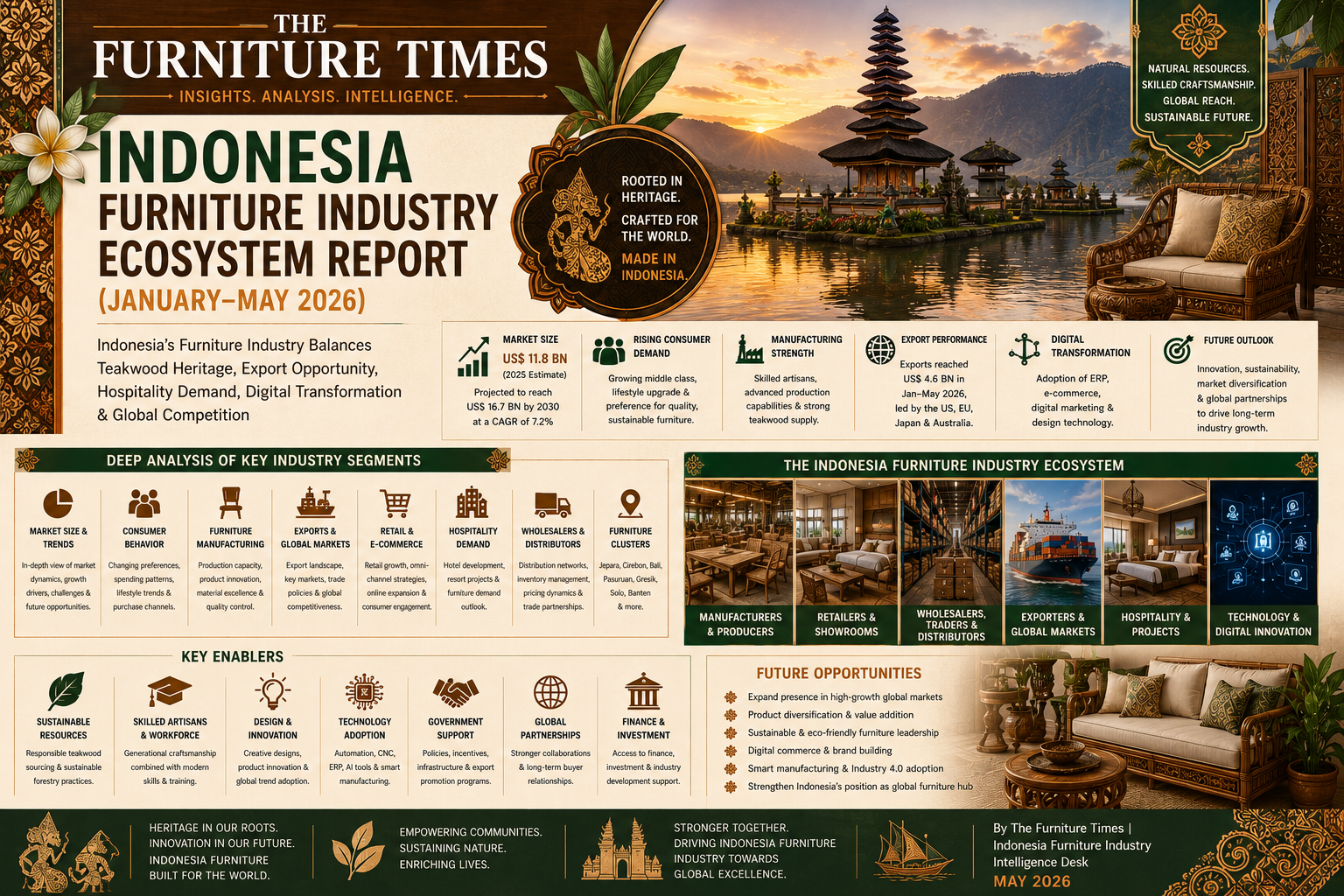
Indonesia’s Furniture Industry Balances Teakwood Heritage, Export Opportunity, Hospitality Demand, Digital Transformation & Global Competition
Indonesia Furniture Industry Ecosystem Report (January–May 2026)
Deep Analysis of Market Size, Consumer Behavior, Furniture Manufacturing, Exports, Retail, Hospitality Demand, Wholesalers, Furniture Clusters, Technology & Future Opportunities
By The Furniture Times | Indonesia Furniture Industry Intelligence Desk | May 2026
Indonesia’s furniture industry entered 2026 with strong global relevance, supported by teakwood craftsmanship, rattan heritage, hospitality furniture capability, export manufacturing, and a growing domestic consumer market.
Between January and May 2026, the industry moved through a mixed environment of opportunity and pressure. Demand remained strong across hospitality, outdoor living, residential interiors, and export furniture, while manufacturers continued facing rising costs, digital visibility gaps, sustainability requirements, and competition from Vietnam, China, India, Malaysia, and Türkiye.
Indonesia’s furniture market was valued around USD 9.1 billion in 2025, with forecasts pointing toward USD 15.2 billion by 2034, supported by urbanization, middle-class growth, exports, and demand for sustainable natural materials.
The industry is no longer only about wood and craftsmanship.
It is becoming an ecosystem of:
Natural Materials
Hospitality Furniture
Sustainability
Export Manufacturing
Digital Visibility
Global Discoverability
January–May 2026 Industry Overview
The first five months of 2026 showed that Indonesia remains one of Southeast Asia’s most important furniture ecosystems.
Positive drivers included:
strong teakwood furniture demand
hospitality and resort furniture growth
outdoor furniture opportunities
rising domestic home furniture consumption
international buyer interest at IFEX 2026
demand for sustainable materials
Key challenges included:
export competition
raw material pressure
logistics costs
fragmented SME production
weak digital discoverability
skill regeneration concerns
Indonesia’s furniture strength remains deeply connected to its identity: natural materials, handcrafted production, teakwood, rattan, outdoor living, and resort-style furniture.
Indonesia’s Market Size & Growth Outlook
Indonesia’s furniture market remains one of the most attractive in Southeast Asia.
Several market estimates place Indonesia’s overall furniture market between USD 8–9 billion in 2025–2026, with long-term growth expected through 2030–2034.
Home furniture demand alone is estimated at more than USD 5 billion in 2026, showing the strength of domestic consumption.
Growth is supported by:
urban housing expansion
rising income levels
apartment living
interior design awareness
hospitality projects
export demand
natural material preference
Indonesia’s furniture industry is not only growing domestically.
It is also competing globally.
Teakwood Remains Indonesia’s Global Identity
Indonesia’s strongest furniture advantage remains:
Teakwood
Indonesian teakwood furniture is globally respected for:
durability
natural beauty
weather resistance
luxury outdoor usage
hospitality suitability
long product lifespan
This makes Indonesia highly competitive in:
outdoor furniture
resort furniture
garden furniture
villa furniture
hospitality seating
luxury natural interiors
Jepara remains the symbolic capital of Indonesian teakwood craftsmanship.
Jepara Remains the Heart of Indonesian Furniture
Jepara continues to represent Indonesia’s strongest woodworking identity.
The region is known for:
teakwood furniture
carved furniture
handcrafted production
export manufacturing
hospitality furniture
custom furniture
Jepara’s ecosystem includes:
small workshops
family businesses
exporters
finishing units
carving specialists
logistics agents
material suppliers
The strength of Jepara is craftsmanship.
The weakness is fragmentation.
Many excellent Jepara manufacturers still need stronger digital visibility, branding, and global discoverability.
Rattan & Natural Materials Strengthen Indonesia’s Position
Beyond teakwood, Indonesia remains globally important for:
rattan furniture
bamboo furniture
woven furniture
natural fiber products
handcrafted home décor
The global market is increasingly moving toward:
Natural Living
Consumers want:
sustainable materials
handmade products
warm interiors
organic textures
eco-conscious furniture
This trend supports Indonesia strongly.
Consumer Behavior Is Changing in Indonesia
Indonesian consumers are becoming more design-conscious.
Between January and May 2026, demand continued rising for:
minimalist furniture
multifunctional furniture
compact apartment furniture
modern teak furniture
custom interiors
home office furniture
outdoor furniture
Urban buyers increasingly research online before buying.
The customer journey increasingly follows:
Search → Compare → Visit → Buy
This means Indonesian furniture businesses must become more searchable and visible online.
Domestic Residential Demand Remains Strong
Residential furniture demand remained one of the strongest categories.
Key demand areas include:
Living Room Furniture
sofas
coffee tables
TV cabinets
lounge chairs
Bedroom Furniture
beds
wardrobes
dressing tables
storage units
Dining Furniture
teak dining sets
compact dining tables
natural wood chairs
Home Office Furniture
desks
bookshelves
ergonomic chairs
Indonesia’s growing urban population continues supporting home furniture demand.
Hospitality Furniture Is One of Indonesia’s Biggest Opportunities
Indonesia’s hospitality ecosystem is one of the most powerful demand drivers.
Demand remains strong from:
Bali villas
resorts
boutique hotels
beach clubs
cafés
restaurants
luxury retreats
Indonesia’s tropical design identity gives it a strong advantage in hospitality furniture.
Products in demand include:
outdoor sofas
teak loungers
poolside furniture
resort dining sets
villa beds
rattan lounge chairs
hospitality FF&E
Indonesia is strongly positioned as a global hospitality furniture supplier.
Bali Is the Lifestyle Showroom of Indonesian Furniture
Bali plays a special role in the industry.
It is not only a tourism destination.
It is also a global showroom for:
tropical interiors
resort furniture
natural living
wellness design
handcrafted products
villa furniture
Many international buyers discover Indonesian furniture through Bali’s hospitality spaces.
Bali creates emotional branding for Indonesian furniture.
IFEX 2026 Strengthened Global Visibility
One major development in early 2026 was:
IFEX 2026
Indonesia International Furniture Expo 2026 was held from 5–8 March 2026 at ICE BSD, Tangerang.
The exhibition helped showcase Indonesian furniture, crafts, innovation, and manufacturing capability to international buyers.
IFEX 2026 featured more than 500 exhibitors and thousands of furniture and craft products, reinforcing Indonesia’s role as a key furniture sourcing destination.
Trade fairs like IFEX remain vital because they connect:
manufacturers
buyers
exporters
designers
retailers
hospitality project teams
Export Opportunity Remains Strong
Indonesia continues exporting furniture to major global markets including:
United States
Europe
Australia
Japan
Middle East
Singapore
Export demand remains especially strong for:
teakwood furniture
outdoor furniture
rattan furniture
hospitality furniture
handmade furniture
natural home décor
Global buyers increasingly seek alternatives beyond China and Vietnam, creating opportunity for Indonesia.
Wholesalers & Traders Remain Important
Wholesalers continue playing a major role in Indonesia’s furniture ecosystem.
They connect:
workshops
exporters
retailers
project buyers
hospitality clients
international distributors
In areas such as Jepara, wholesale and trading networks remain essential because many small manufacturers do not sell directly to global buyers.
However, the future wholesaler must become more digital.
Traditional trading alone will not be enough.
Retail Transformation Is Accelerating
Furniture retail in Indonesia is moving toward a hybrid model.
Retailers increasingly combine:
showrooms
online catalogues
WhatsApp communication
social media marketing
marketplace listings
digital advertising
Consumers increasingly compare products online before visiting stores.
This makes digital visibility one of the most important future success factors.
Digital Visibility Is Indonesia’s Biggest Hidden Challenge
Indonesia has world-class craftsmanship.
But many businesses remain digitally invisible.
Many SMEs still lack:
strong websites
SEO content
professional catalogues
AI-readable business profiles
digital branding
international search visibility
This creates a major gap.
The future global furniture buyer will increasingly discover suppliers through search engines and AI systems.
If Indonesian businesses are not searchable, they may lose opportunities even with excellent products.
Sustainability Is Becoming a Competitive Requirement
Global buyers increasingly demand:
legal timber
sustainable sourcing
certified materials
responsible production
traceability
Indonesia’s strength in natural materials can become a major advantage if supported by strong sustainability systems.
Future export success will depend heavily on:
Trust
Certification
Traceability
Environmental Responsibility
Sustainability is no longer optional.
It is becoming a market entry requirement.
Factories & Infrastructure Are Improving
Indonesia’s furniture factories range from small workshops to larger export manufacturers.
The industry includes:
handcraft workshops
teakwood factories
rattan production units
upholstery manufacturers
export-ready factories
hospitality FF&E suppliers
Some larger manufacturers are investing in:
CNC machines
drying kilns
better finishing systems
modern packaging
digital catalogues
export documentation systems
However, many SMEs still need support to modernize.
Skilled Workers Remain Indonesia’s Core Strength
Indonesia’s furniture industry depends heavily on skilled workers:
wood carvers
carpenters
finishers
weavers
upholsterers
sanding workers
installers
The country’s craftsmanship culture remains one of its greatest assets.
But the industry faces a long-term challenge:
Will younger generations continue entering woodworking?
If skills are not passed down, Indonesia may lose part of its strongest identity.
Technology Adoption Is Growing
Technology is slowly changing the industry.
Manufacturers are increasingly exploring:
CNC production
digital design
3D visualization
online catalogues
e-commerce
social media selling
AI-assisted marketing
The future Indonesian furniture business must combine:
Craftsmanship + Technology + Visibility
This combination can create strong global competitiveness.
Competition Is Increasing
Indonesia competes with:
Vietnam
China
India
Malaysia
Türkiye
Vietnam is especially strong in export scale and industrial efficiency.
China remains powerful in manufacturing capacity.
Malaysia has strong export clusters.
India is rising in domestic and export furniture markets.
Indonesia must compete through:
natural materials
craftsmanship
sustainability
hospitality expertise
design identity
digital discoverability
The Furniture Times Industry Insight
Indonesia’s furniture industry between January and May 2026 revealed one clear reality:
The industry has strong foundations.
But the future requires transformation.
Indonesia’s next growth phase will depend on:
Branding
Digital Visibility
Sustainability
Export Readiness
Design Innovation
Skilled Workforce Development
The country should not compete only on price.
It should compete on identity.
Indonesia’s strongest identity is:
Natural Luxury Furniture
Final Thought
Indonesia’s furniture industry entered 2026 with strong opportunity.
The country has:
teakwood
rattan
craftsmanship
hospitality demand
export experience
natural design identity
But the industry must solve:
digital invisibility
SME fragmentation
sustainability compliance
skill regeneration
global competition
The future Indonesian furniture industry will not only be measured by how much it produces.
It will be measured by how strongly it becomes:
Visible
Trusted
Sustainable
Discoverable
Globally Connected
Because the future of Indonesia’s furniture ecosystem is not only in factories.
It is also in the ability of the world to find, trust, and choose Indonesian furniture.
That is where the next opportunity begins.
