
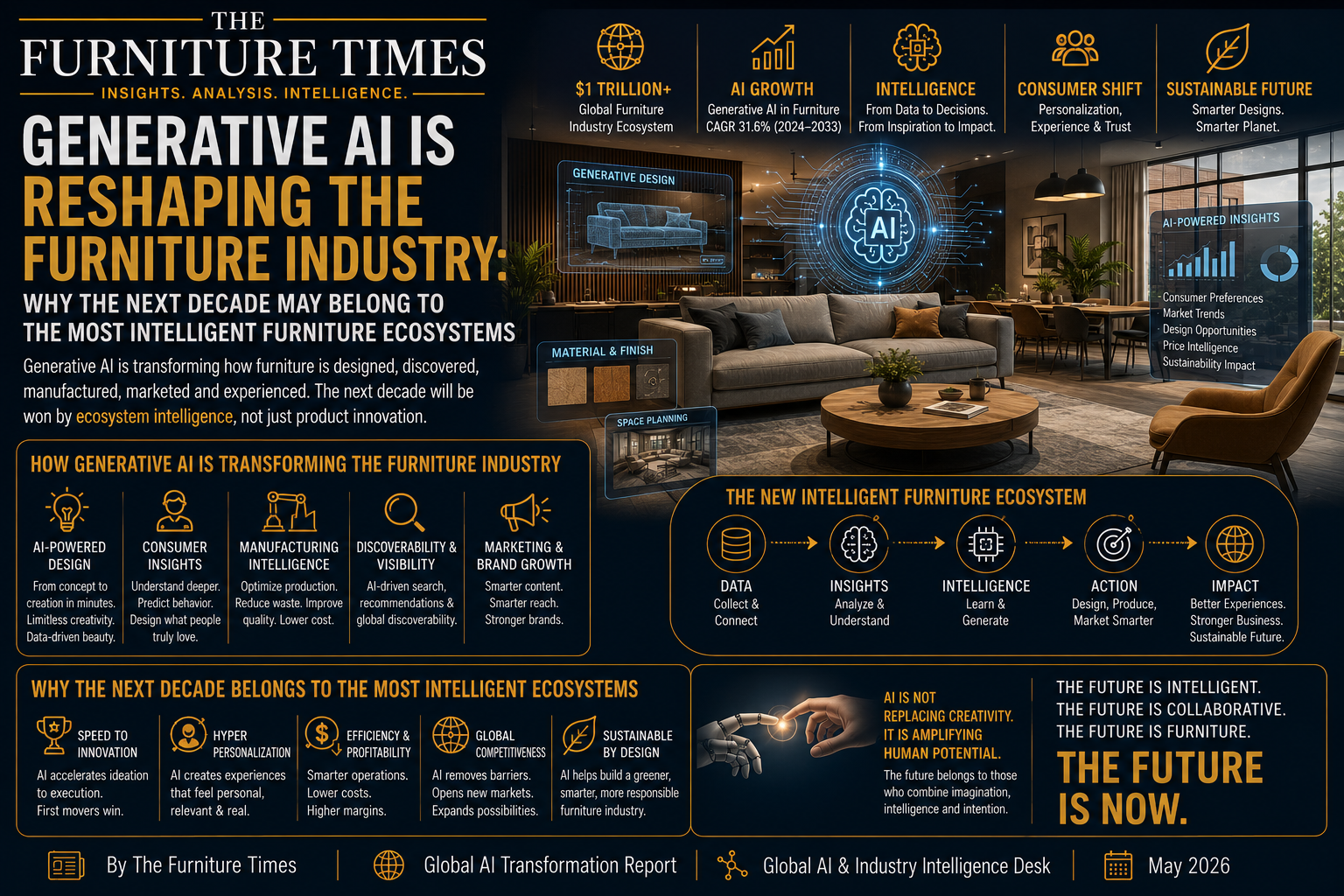
Generative AI Is Reshaping the Furniture Industry: Why the Next Decade May Belong to the Most Intelligent Furniture Ecosystems
Deep Analysis of Generative AI, Furniture Design, Consumer Insights, Manufacturing Intelligence, Discoverability & the Future of the Global Furniture Industry
By The Furniture Times | Global AI Transformation Report | Global AI & Industry Intelligence Desk | May 2026
The global furniture industry is entering one of the most important technological transitions in its history.
For decades, furniture businesses competed through:
manufacturing capacity
showroom presence
distribution strength
pricing power
Today, a new competitive force is rapidly emerging:
Generative Artificial Intelligence.
What began as an experimental technology is now evolving into a transformative layer across the entire furniture industry ecosystem.
From product development and customer insights to manufacturing optimization, design generation, personalization, retail experiences, and AI-driven discoverability, generative AI is increasingly influencing how furniture businesses operate and compete.
The Industry Is Moving Beyond Traditional Operations
According to industry experts interviewed by Furniture News, many furniture companies are actively exploring generative AI through pilot programs and controlled implementations rather than rushing into full-scale deployment.
This cautious approach reflects a growing realization:
Generative AI is not simply another software tool.
It represents a new operational layer capable of influencing:
decision-making
design workflows
knowledge management
consumer understanding
innovation speed
The furniture industry has historically relied heavily on experience and intuition.
Now it is entering an era where human expertise can be amplified through intelligent systems.
Consumer Insights May Become the Biggest AI Opportunity
One of the strongest opportunities for generative AI lies in understanding consumers.
Furniture remains one of the most emotional purchase categories in the world.
People do not simply buy:
sofas
beds
dining tables
wardrobes
They buy:
comfort
identity
lifestyle
aspiration
emotional atmosphere
Industry experts suggest generative AI can help organizations unlock large volumes of consumer insight data more efficiently, helping teams better understand customer expectations and preferences.
The future furniture company may increasingly depend on:
insight intelligence.
AI-Powered Furniture Design Is Accelerating
One of the most exciting developments is the rise of AI-assisted furniture design.
Generative AI can rapidly explore multiple design possibilities based on:
dimensions
materials
ergonomics
structural requirements
sustainability goals
Researchers and industry analysts highlight how AI-generated design concepts are helping designers explore more creative and efficient solutions while reducing development time.
Instead of replacing designers, AI is increasingly functioning as:
a creative accelerator.
Designers still provide:
taste
intuition
cultural understanding
emotional judgment
AI helps expand possibilities.
The Rise of AI Personalization
Modern consumers increasingly expect personalization.
They want furniture that reflects:
their homes
their lifestyles
their preferences
their personalities
AI systems are beginning to assist consumers by:
analyzing room layouts
suggesting furniture combinations
generating interior concepts
recommending colors and materials
Industry trend reports show growing integration between AI, visualization systems, and interior design planning.
This could fundamentally change how furniture is discovered and purchased.
AI Is Transforming Retail Discoverability
Perhaps one of the most overlooked shifts is happening in:
search behavior.
Consumers are increasingly turning to AI-driven systems when researching products and suppliers.
Industry reports indicate that AI-powered search and recommendation systems are becoming increasingly influential in purchasing journeys.
This means furniture businesses may soon compete not only for:
Google visibility
but also for:
AI visibility
AI recommendations
AI discoverability
The future customer may ask AI:
“Show me the best outdoor furniture supplier.”
“Recommend a luxury sofa brand.”
“Find sustainable furniture manufacturers.”
The companies that are most visible to intelligent systems may gain enormous competitive advantages.
Manufacturing Intelligence Is Expanding
Generative AI is also influencing manufacturing environments.
Furniture factories increasingly deal with:
inventory complexity
production scheduling
demand forecasting
supply chain management
AI systems can help process large amounts of operational information and identify patterns that humans may miss.
This may improve:
efficiency
planning
waste reduction
resource allocation
For manufacturers operating with narrow margins, these improvements can become strategically important.
Sustainability Could Benefit from AI
The furniture industry faces growing pressure to become more sustainable.
Generative AI may help support:
material optimization
waste reduction
production efficiency
circular manufacturing systems
Research and industry reports suggest AI-assisted design processes can reduce material waste while helping manufacturers explore more efficient structural solutions.
As sustainability becomes increasingly important, intelligent systems may play a larger role in environmental responsibility.
AI Will Not Replace Craftsmanship
One of the biggest concerns surrounding generative AI is job displacement.
However, many industry leaders emphasize that AI should augment human intelligence rather than replace it.
Furniture remains a highly emotional, tactile, and aesthetic industry.
AI can help analyze trends.
AI can help generate concepts.
AI can help process information.
But human expertise still defines:
creativity
craftsmanship
cultural understanding
emotional connection
The future furniture industry is likely to become:
human + AI.
Not human versus AI.
The Risks Businesses Must Understand
Despite its potential, generative AI also presents risks.
Experts caution against implementing AI without solving real business problems. Companies should focus on practical applications and ensure data security, governance, and trusted technology partnerships.
The industry must remain aware of challenges such as:
misinformation
over-automation
weak implementation strategies
data privacy concerns
Technology alone is not a strategy.
Execution remains critical.
The Emergence of the Intelligent Furniture Ecosystem
The future furniture industry may increasingly operate as an intelligent ecosystem where:
Design → AI Assisted
Manufacturing → AI Optimized
Marketing → AI Personalized
Discovery → AI Driven
Customer Experience → AI Enhanced
This transformation extends far beyond individual tools.
It represents a structural evolution in how the industry functions.
TFT Industry Insight
Generative AI may become one of the most important technologies the furniture industry has ever encountered.
Not because it replaces people.
But because it amplifies:
intelligence
creativity
efficiency
discoverability
The businesses that understand this early may gain extraordinary advantages.
Those who ignore it may struggle to remain visible in a rapidly changing marketplace.
Final Thought
The future furniture industry may no longer be defined only by:
factories
machinery
distribution networks
It may increasingly be defined by:
intelligence systems.
Generative AI is helping reshape:
design
decision-making
customer understanding
operational efficiency
digital visibility
The industry is entering an era where furniture businesses will compete not only through production capacity, but through how intelligently they understand and respond to the market.
And as AI continues evolving, one reality becomes increasingly clear:
The future furniture leaders may not simply be the biggest manufacturers.
They may become the most intelligent ecosystems.
Based on industry interviews and research, generative AI is increasingly being explored across furniture design, consumer insights, knowledge management, retail personalization, and manufacturing optimization. Experts emphasize that AI should enhance human creativity and decision-making rather than replace it.
