
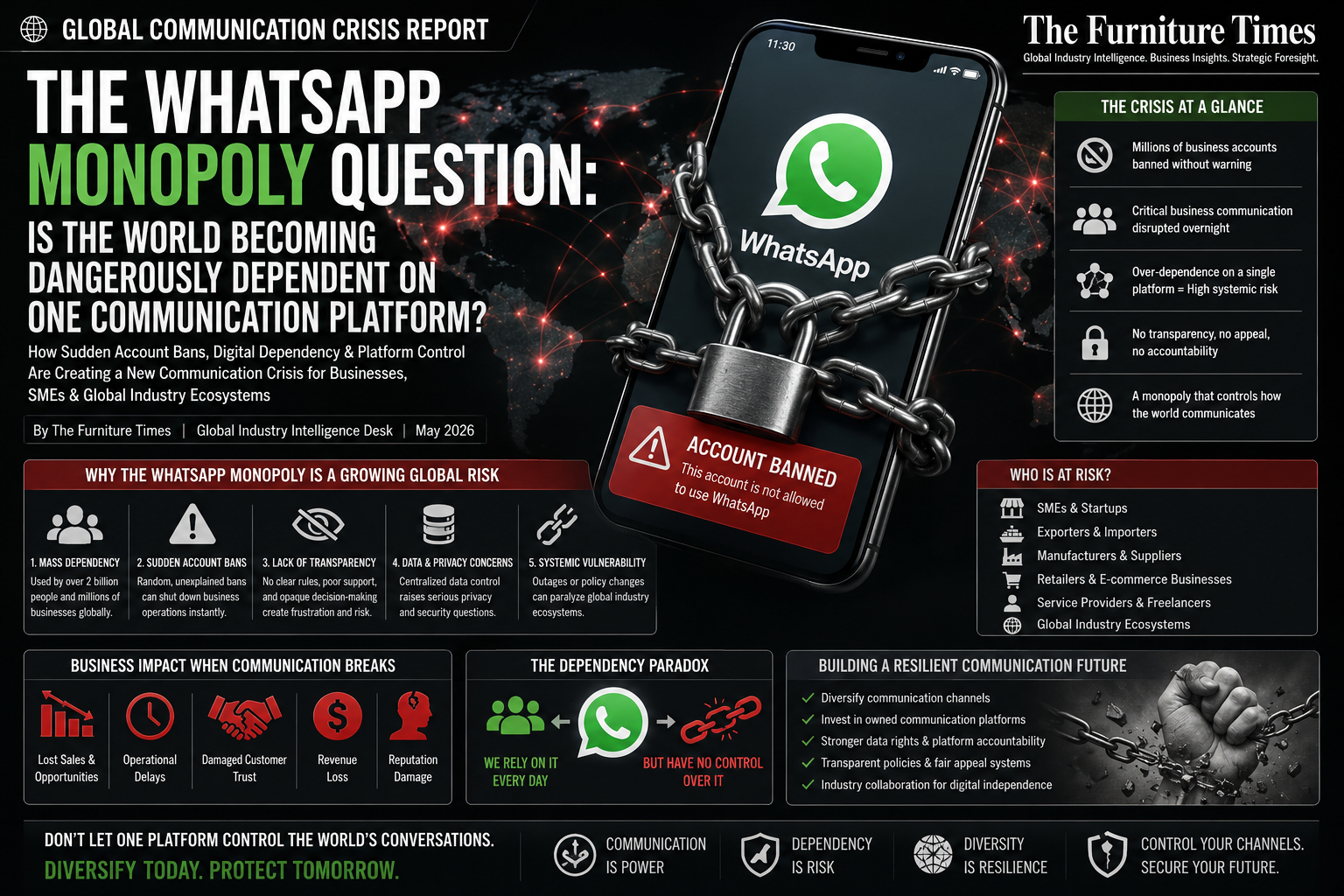
The WhatsApp Monopoly Question: Is the World Becoming Dangerously Dependent on One Communication Platform
Global Communication Crisis Report | The Furniture Times
How Sudden Account Bans, Digital Dependency & Platform Control Are Creating a New Communication Crisis for Businesses, SMEs & Global Industry Ecosystems
By The Furniture Times | Global Industry Intelligence Desk | May 2026
The modern business world has entered a dangerous and uncomfortable reality:
billions of people now depend heavily on a few communication platforms to survive economically.
Among them, one platform dominates global daily communication more than almost any other:
WhatsApp.
Across:
businesses
SMEs
furniture factories
exporters
suppliers
contractors
freelancers
families
industry ecosystems
WhatsApp has become:
the sales office
the customer support desk
the communication channel
the negotiation room
the deal-making platform
the emergency contact system
for millions of people worldwide.
But now, a growing number of users are reporting:
sudden account bans
blocked numbers
restricted access
verification failures
unexplained suspensions
including:
old numbers
new numbers
business accounts
personal accounts
And the growing concern is becoming impossible to ignore:
Has the world become too dependent on one communication ecosystem?
Communication Has Become Economic Infrastructure
In previous generations:
communication was:
distributed
diversified
decentralized
Businesses used:
offices
landlines
fax systems
emails
multiple communication channels
Today, however, communication has become highly concentrated.
Many businesses now operate almost entirely through:
WhatsApp.
Especially across:
Asia
Africa
Middle East
Latin America
WhatsApp became the default infrastructure for:
business inquiries
customer relationships
supplier communication
international trade
sales negotiation
project coordination
The platform quietly evolved from:
messaging app
to:
economic infrastructure.
The Growing Fear Among Businesses
One of the biggest fears now spreading globally is:
sudden communication collapse.
Imagine:
years of customer contacts
supplier networks
business relationships
ongoing deals
project communications
all connected to one number.
Then suddenly:
the account is banned.
For many businesses, this creates:
operational chaos
lost clients
financial damage
communication paralysis
emotional stress
reputational risk
The fear is no longer theoretical.
Many businesses now discuss this issue daily.
SMEs Are the Most Vulnerable
Large corporations often have:
multiple communication systems
CRM infrastructure
internal platforms
backup communication channels
But SMEs heavily depend on:
WhatsApp alone.
This creates dangerous dependency.
Small businesses may lose:
customer access
sales pipelines
supplier coordination
support communication
within seconds if access disappears.
The Monopoly Question
One major philosophical and economic question is now emerging:
Has WhatsApp become too powerful?
When one platform controls communication for billions of people,
that platform effectively influences:
commerce
relationships
trade
networking
business continuity
This creates concerns about:
monopoly power
communication centralization
digital dependency
platform dominance
The Psychological Dependence Is Massive
Many people no longer memorize:
phone numbers
email systems
alternative communication methods
Entire business ecosystems now operate through:
chat histories
WhatsApp groups
contact lists
business catalogs
messaging networks
This creates:
digital dependency psychology.
People increasingly feel:
vulnerable
anxious
trapped
when communication access becomes uncertain.
Are Users Being Slowly Prepared for Paid Ecosystems?
Some people increasingly speculate:
Are communication platforms preparing users for future monetization systems?
Because when dependency becomes extreme,
users become:
less flexible
less mobile
more controllable
The concern is not necessarily whether services become paid.
The deeper concern is:
centralized communication control.
When billions depend on one platform,
even small policy changes can affect:
economies
industries
SMEs
entrepreneurs
global trade ecosystems
The Furniture Industry Is Highly Exposed
The global furniture ecosystem depends heavily on:
supplier coordination
logistics communication
RFQs
hospitality projects
factory discussions
export documentation
buyer negotiations
Across:
China
Vietnam
Malaysia
Indonesia
India
Middle East
WhatsApp became one of the primary communication layers of the furniture industry.
Factories coordinate:
shipments
samples
designs
production timelines
installation systems
through messaging platforms daily.
One Ban Can Create Industrial Damage
Imagine:
a furniture exporter loses communication access during shipment coordination
a hospitality supplier loses contact with hotel contractors
an installer loses project communication
a buyer cannot reach factories
The impact becomes:
delayed projects
lost trust
operational disruption
financial damage
Communication failure becomes:
business failure.
Communication Monopoly Is Becoming a Global Risk
The deeper issue is not only WhatsApp itself.
The broader issue is:
centralized communication dependency.
Modern economies increasingly rely on:
few platforms
few cloud systems
few communication ecosystems
This creates:
systemic vulnerability.
If one system fails:
millions are affected simultaneously.
The Hidden Economic Power of Communication Platforms
Communication platforms are no longer merely:
apps
social systems
messaging tools
They are now:
economic gateways
data ecosystems
behavioural infrastructures
digital business layers
This gives enormous influence to:
platform operators.
Why Sudden Bans Feel So Devastating
The emotional impact becomes severe because:
communication is deeply personal and professional.
When accounts disappear suddenly:
people feel:
disconnected
isolated
economically threatened
digitally erased
Especially entrepreneurs and SMEs experience:
communication insecurity.
The Need for Communication Diversification
One major lesson emerging globally:
businesses must diversify communication infrastructure.
Depending entirely on one platform creates:
operational risk
economic fragility
communication instability
Future businesses may increasingly need:
backup systems
industry-specific communication networks
CRM integration
email systems
platform independence
Industry Ecosystems Need Their Own Communication Infrastructure
This is where specialized industry ecosystems become important.
Industries increasingly need:
private communication layers
secure networking systems
supplier ecosystems
RFQ infrastructure
internal communication platforms
especially for:
B2B ecosystems
global trade
manufacturing coordination
Why FISE Connect Becomes Important
The growing communication crisis is exactly why:
FISE Connect matters.
The global furniture industry increasingly needs:
independent communication systems
business continuity infrastructure
supplier connectivity
ecosystem networking
private industry discussions
FISE Connect can eventually help create:
industry-owned communication ecosystems
controlled business networking layers
communication stability for furniture businesses
This is not simply about messaging.
It is about:
industrial resilience.
The Future of Communication May Become Decentralized
The next generation of communication systems may increasingly move toward:
decentralized ecosystems
industry-owned networks
private business infrastructure
integrated CRM systems
ecosystem communication platforms
Businesses may increasingly avoid depending entirely on:
one global platform.
AI, Verification & Automation Concerns
As platforms increasingly use:
AI moderation
automated systems
behavioural detection
false bans and automated restrictions may become more common concerns.
This creates fear because:
users often feel:
powerless
unheard
dependent on automated systems
Digital Identity Is Becoming Fragile
Modern businesses increasingly store:
communication history
customer relationships
project coordination
business identity
inside digital platforms.
But digital identity controlled externally can become:
fragile.
This is one of the biggest lessons emerging globally.
The Philosophical Crisis Behind the Situation
The deeper issue is not only technology.
It is:
control.
Modern society increasingly depends on:
external digital infrastructure
centralized communication systems
platform-controlled ecosystems
The more dependent people become,
the more vulnerable they become.
TFT Philosophical Industry Insight
The modern business world mistakenly assumed:
communication platforms would always remain:
stable
permanent
universally accessible
But reality is proving otherwise.
When communication becomes centralized, dependence becomes risk.
The future global economy may increasingly require:
diversified communication systems
ecosystem-owned infrastructure
decentralized networking layers
independent industry communication platforms
because communication itself has now become:
economic survival infrastructure.
Final Thought
The WhatsApp communication issue is not merely about:
bans
accounts
verification problems
It represents something much bigger:
the global communication dependency crisis.
Businesses, industries, SMEs, and entrepreneurs now face an important question:
What happens when the platform controlling your communication suddenly controls your business continuity?
The future may belong to ecosystems that build:
resilient communication layers
industry-owned networks
diversified connectivity systems
independent digital infrastructure
Because in the modern economy:
communication is no longer optional.
It is survival.
Closing Insight
“The world once believed communication platforms were tools.
But today, they have become economic infrastructure.
And when infrastructure becomes centralized, dependence quietly becomes vulnerability.”
