
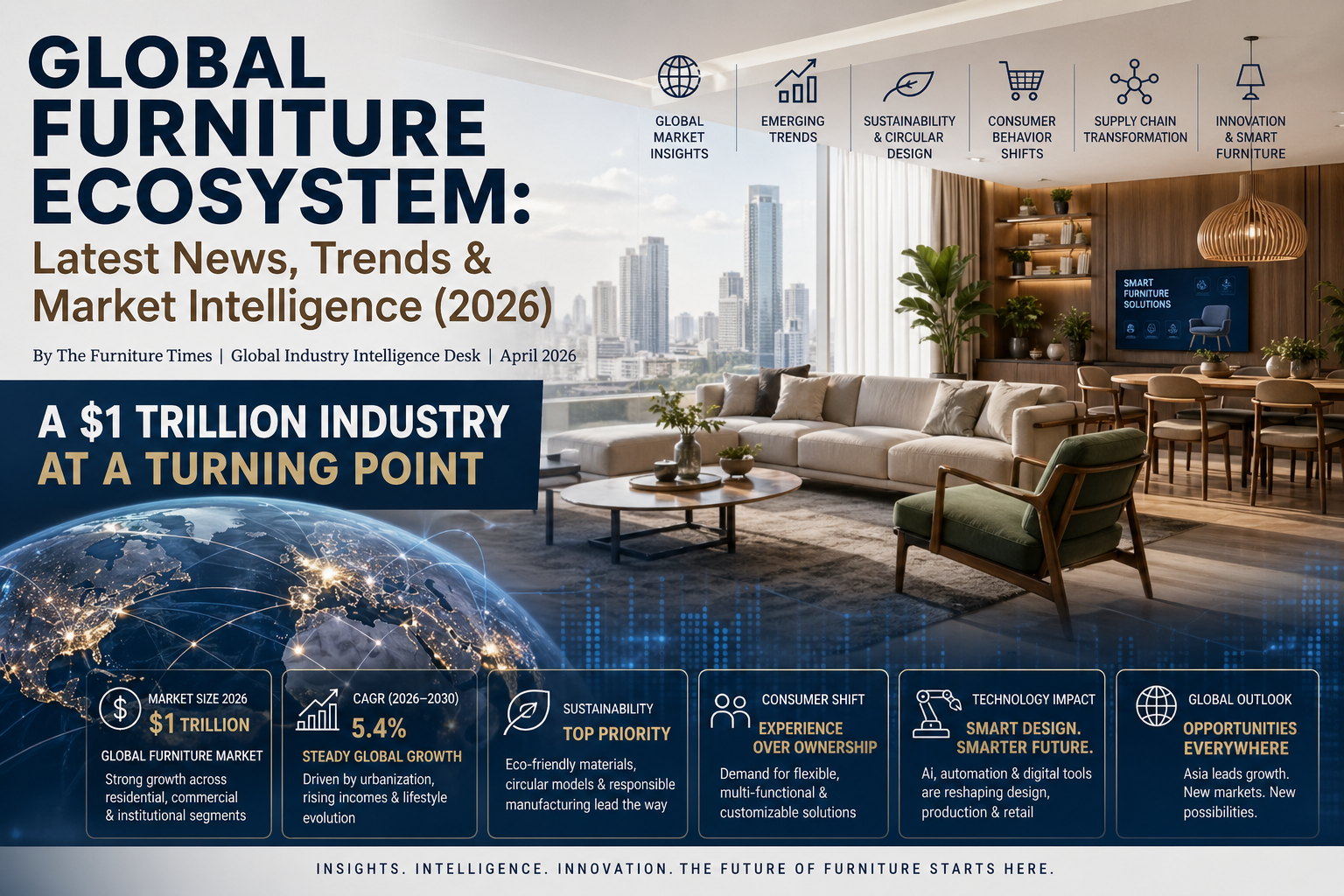
Global Furniture Ecosystem: Latest News, Trends & Market Intelligence (2026)
By The Furniture Times | Global Industry Intelligence Desk | April 2026
Introduction: A $1 Trillion Industry at a Turning Point
The global furniture ecosystem in 2026 is no longer moving in a straight line. It is navigating tariffs, supply chain restructuring, premiumization, and digital transformation—all at once.
Valued at over $700+ billion and moving toward $950+ billion by 2031, the industry remains one of the world’s largest economic ecosystems, but also one of the most volatile today.
From Asia’s export powerhouses to Western retail giants, the industry is undergoing a structural reset.
1. Tariffs Are Reshaping Global Trade
One of the biggest current disruptions is the impact of U.S. tariffs on imported furniture.
- Tariffs of up to 25% on sofas, cabinets, and wood products are now in effect
- Furniture stocks dropped as investors anticipated higher costs and reduced margins
What This Means:
- Import-dependent retailers are under pressure
- Export countries like Vietnam and Malaysia face margin compression
- Supply chains are being redesigned
This is not just a trade policy—it is a global industry shift.
2. Supply Chains Are Moving Closer to the Market
Global giants like IKEA are rethinking sourcing strategies.
- Increasing focus on local production in the U.S.
- Reducing reliance on long-distance imports
- Building regional supply hubs
Emerging Trend:
“Nearshoring + Regionalization” is replacing global-only supply chains.
3. Vietnam Continues to Rise as a Global Manufacturing Power
Despite tariffs, Vietnam remains a dominant player:
- Exports reached $17.3 billion in 2025
- Strong growth in e-commerce-driven furniture sales
- Shift from OEM → ODM (design-driven manufacturing)
Key Insight:
Vietnam is no longer just a low-cost producer—
it is becoming a design + manufacturing powerhouse.
4. Premiumization Is Driving Product Innovation
Across the value chain, demand is shifting toward:
- High-quality finishes
- Corrosion-resistant materials
- Design-forward components
Hardware and components markets (like hinge systems and structural elements) are seeing strong long-term growth driven by premium furniture demand
At the same time, advanced materials such as nonwoven construction layers are gaining traction due to performance and sustainability needs
Industry Shift:
From mass production → value-driven innovation
5. Construction & Furniture Demand Are Interlinked
Furniture demand is closely tied to:
- Real estate development
- Infrastructure growth
- Urbanization
Markets like architectural components and decorative structures (e.g., twist tubes) are expanding due to construction + furniture demand synergy
Big Picture:
Furniture is no longer standalone—it is part of a larger built-environment ecosystem.
6. Consumer Behavior Is Splitting the Market
A major divide is emerging:
Budget Segment
- Pressure from inflation
- Shift toward affordability and flat-pack models
- Companies like Nitori Holdings thrive on low-cost efficiency
Premium Segment
- Growth driven by design, lifestyle, and branding
- Less price-sensitive customers
Result:
The mid-market is under the most pressure globally.
7. Trade Growth Slowing, Uncertainty Rising
Industry analysts highlight:
- Global trade growth expected to slow in 2026 due to tariffs
- Companies front-loaded orders earlier but are now entering a cautious phase
Market Reality:
The industry is moving from growth optimism → strategic caution
8. Digital Transformation & E-Commerce Acceleration
A major silent shift:
- Rise of B2C global platforms (Amazon, e-commerce marketplaces)
- Direct-to-consumer (D2C) furniture models
- Digital catalogs replacing physical showrooms
Vietnam and other exporters are actively adapting to this shift by building global online sales channels
9. Market Growth Continues—But Differently
Despite challenges, the industry is still growing:
- Driven by urbanization, hybrid work, and smaller living spaces
- Office furniture expected to grow steadily with hybrid work demand
Key Insight:
Growth is not disappearing—
it is changing direction.
TFT Global Analysis: The 5 Defining Forces of 2026
The entire furniture ecosystem today is being shaped by five powerful forces:
1. Trade & Tariffs
Reshaping global supply chains
2. Regional Manufacturing
Rise of localized production hubs
3. Premiumization
Higher-value, design-led products
4. Digital Discovery
Search, e-commerce, and visibility
5. Consumer Polarization
Budget vs premium divide
Conclusion: A New Global Furniture Order
The global furniture ecosystem is no longer defined by:
- Cheap labor
- Mass production
- Single-market dependence
It is now defined by:
- Data
- Visibility
- Speed
- Design
- Global positioning
This is not just a cycle—it is a structural transformation.
