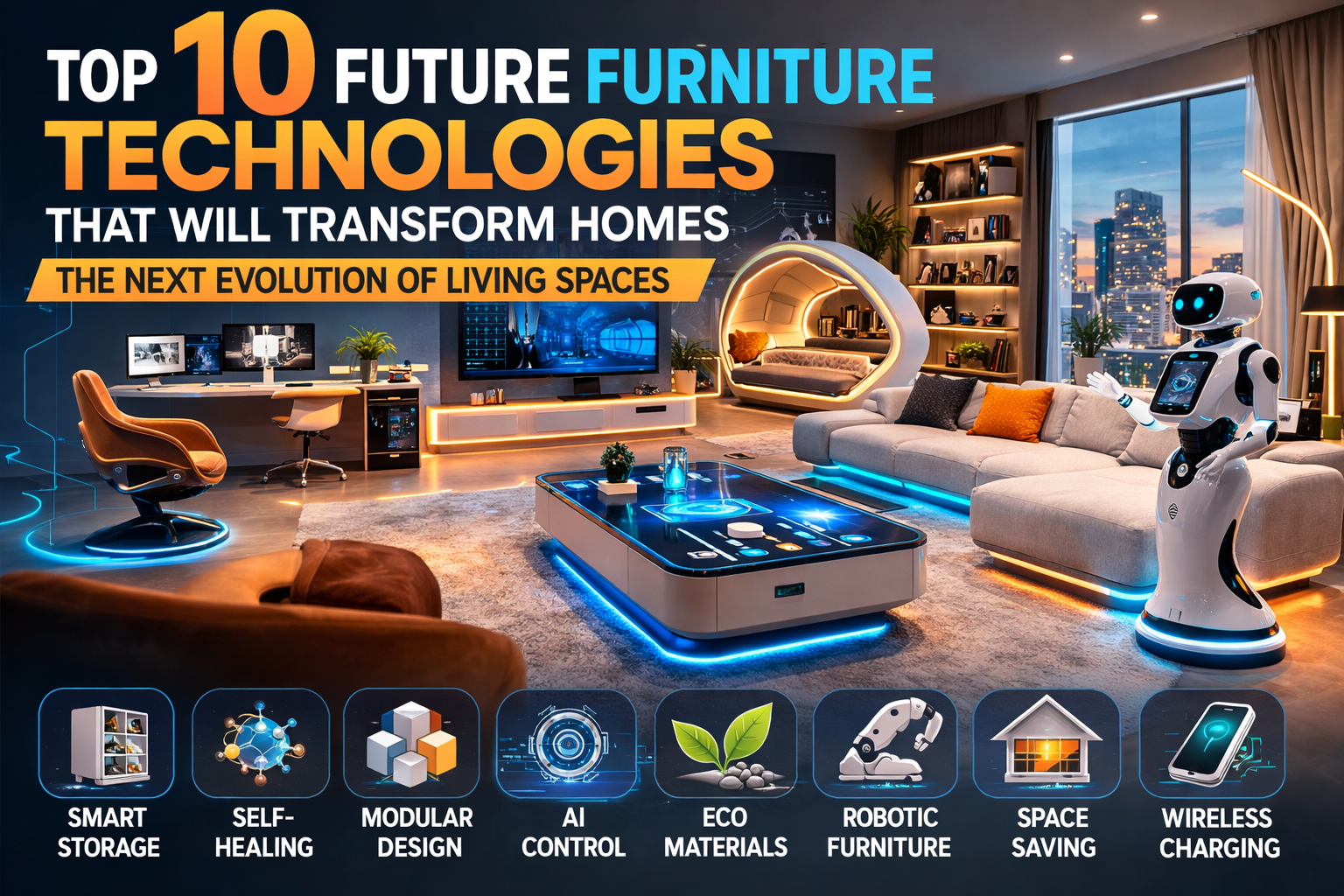
Top 10 Future Furniture Technologies That Will Transform Homes
The Next Evolution of Living Spaces
Furniture is no longer just about comfort and aesthetics. Across the world, the furniture industry is entering a technological revolution where digital intelligence, automation, and connected devices are transforming everyday home environments.
Industry experts believe that the next generation of furniture will function as part of a smart living ecosystem, where homes become more responsive, personalized, and efficient.
Here are the 10 technologies expected to transform furniture design and home interiors over the coming decade.
1. Smart Furniture Integration
Smart furniture integrates technology directly into everyday household items. Sofas, tables, and beds are increasingly being designed with features such as:
• wireless charging stations
• integrated speakers
• voice-controlled lighting
• device connectivity
These innovations allow furniture to interact with other smart home systems, making homes more connected than ever.
2. AI-Driven Furniture Personalization
Artificial intelligence will enable furniture to adapt to individual preferences.
AI algorithms can analyze user behavior, comfort patterns, and lifestyle needs to recommend or automatically adjust furniture settings.
For example:
• desks adjusting to posture patterns
• beds optimizing sleep comfort
• chairs responding to body pressure distribution
3. Modular and Transformable Furniture
Urban living spaces are becoming smaller, and furniture designers are responding with highly adaptable solutions.
Future furniture will feature:
• foldable walls
• expandable tables
• modular sofa systems
• convertible beds and workspaces
These designs allow one room to perform multiple functions.
4. Augmented Reality Furniture Shopping
AR technology will revolutionize how consumers buy furniture.
Using smartphones or smart glasses, buyers will be able to:
• visualize furniture in their homes
• experiment with materials and colors
• customize size and configuration
This reduces uncertainty and improves online purchasing decisions.
5. Sustainable Material Innovation
New materials are transforming furniture production.
Examples include:
• recycled plastics
• bamboo composites
• bio-based foams
• mushroom-based packaging
Sustainable material innovation is expected to become one of the strongest drivers of furniture design.
6. Self-Assembling Furniture
Future furniture may assemble itself using mechanical systems or robotic guidance.
This innovation could simplify logistics and reduce installation challenges for consumers.
7. Energy-Generating Furniture
Researchers are exploring furniture that can generate electricity through kinetic movement or solar integration.
Tables, desks, or chairs could potentially power small devices while being used.
8. Smart Health Furniture
Furniture may soon monitor health indicators such as posture, heart rate, or sleep quality.
Smart beds and ergonomic chairs already incorporate some of these capabilities.
9. Robotics in Furniture Manufacturing
Automation and robotics will dramatically improve manufacturing precision and production speed.
Robotic systems can cut materials, assemble components, and inspect products with high accuracy.
10. Digital Manufacturing and 3D Printing
3D printing may revolutionize custom furniture production.
Instead of mass-producing identical products, manufacturers will be able to create customized pieces on demand, reducing inventory and waste.
The Future Living Experience
The future of furniture lies at the intersection of technology, sustainability, and human comfort. Homes will increasingly be designed as integrated ecosystems where furniture plays a central role in enhancing lifestyle and wellbeing.