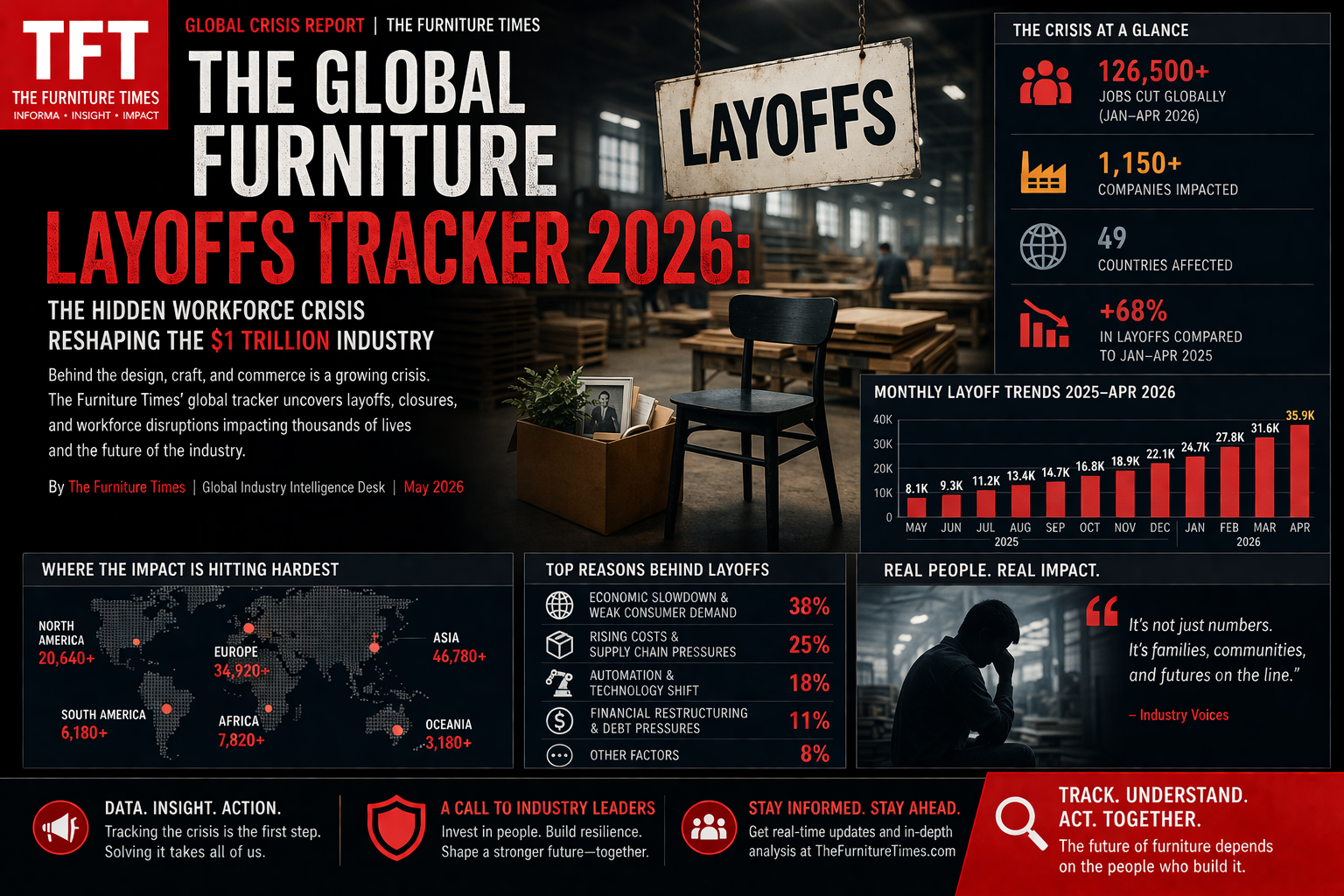
The Global Furniture Layoffs Tracker 2026: The Hidden Workforce Crisis Reshaping the $1 Trillion Industry
Global Crisis Report | The Furniture Times
By The Furniture Times | Global Industry Intelligence Desk | May 2026
Introduction: The Signal Behind the Silence
Layoffs don’t usually make front-page headlines in the furniture industry.
Factories slow down quietly.
Shifts get reduced.
Contracts aren’t renewed.
Small workshops shut their doors without announcements.
But in 2026, the signals are too strong to ignore.
A workforce correction is underway across the global furniture ecosystem.
This is not just a labour story.
This is an economic warning signal.
The Big Picture: A Workforce Under Pressure
The global furniture industry employs millions of workers across:
Manufacturing
Upholstery
Carpentry
Logistics
Installation
Retail
But across regions, companies are now facing:
Rising costs
Weak demand in key markets
Supply chain instability
Margin compression
Result:
Layoffs, downsizing, and silent workforce reductions
The Global Layoffs Trend
1. Europe & UK: Demand Slowdown + Cost Pressure
Recent developments show:
Factory closures
Workforce reductions
Production consolidation
Large manufacturers are restructuring due to:
Reduced consumer spending
Housing market slowdown
Energy cost increases
2. North America: Retail & Housing Impact
The furniture industry is closely tied to:
Housing activity
Consumer confidence
When these slow down:
Orders drop
Inventory rises
Companies cut costs
3. Asia: Manufacturing Adjustment Phase
Asia remains the manufacturing hub—but faces:
Export uncertainty
Price competition
Labour cost increases
Strategic Response:
Automation
Workforce optimization
Relocation of production
4. Informal Sector: The Invisible Impact
The biggest layoffs are not recorded.
They happen in:
Small workshops
Home-based production
Artisan networks
These workers disappear from the market without data.
The Core Problem: Demand vs Capacity Imbalance
The industry is facing a critical imbalance:
Supply Side:
High production capacity
Established manufacturing networks
Demand Side:
Slowing consumer spending
Delayed projects
Reduced confidence
Result:
Excess capacity → Workforce reduction
The Hidden Crisis: Not Just Jobs, But Structure
This is not only about layoffs.
It reveals a deeper issue:
The industry lacks a system to absorb shocks
TFT Deep Analysis: The Industry Is Entering the Workforce Correction Phase
The furniture industry is moving through:
Phase 1: Growth Expansion
High demand, increased hiring
Phase 2: Market Correction (NOW)
Cost pressure, layoffs, restructuring
Phase 3: Intelligent Workforce Economy (Next)
Data-driven employment, skill visibility
Why Layoffs Are Increasing
1. Cost Pressure
Raw materials rising
Logistics expensive
Energy costs high
2. Demand Uncertainty
Consumers delaying purchases
Real estate slowdown
Economic caution
3. Inefficient Discovery
Here is the overlooked issue:
Factories have capacity—but cannot find enough demand
4. Fragmentation
No centralized system
No structured demand-supply matching
The Real Problem: Idle Capacity
Many manufacturers today have:
Machines ready
Workers available
But:
No consistent order flow
Result:
Layoffs
Reduced shifts
Business closures
The Opportunity Hidden Inside the Crisis
This crisis reveals a powerful truth:
The problem is not only demand.
It is connection.
Role of FISE: Reducing Layoffs Through Visibility
The Furniture Industry Search Engine (FISE) can help:
Increase visibility of manufacturers
Connect idle capacity with global demand
Enable faster sourcing
Reduce dependency on limited networks
The Power Statement
Visibility creates orders.
Orders create jobs.
Example Scenario
Without System:
Factory not visible
Orders limited
Workers laid off
With System:
Factory discoverable
Global buyers connect
Orders increase
Jobs protected
Strategic Recommendations
1. Increase Global Visibility
Manufacturers must be searchable
2. Diversify Demand Sources
Do not depend on one market
3. Adopt Intelligent Sourcing
Use structured systems
4. Protect Skilled Workforce
Labour is a long-term asset
5. Build Industry Systems
Reduce fragmentation
Key Takeaways
1. Layoffs Are Rising Globally
Across regions and segments
2. The Crisis Is Structural
Not just economic
3. Idle Capacity Is the Core Issue
Factories cannot find enough demand
4. Visibility Can Reduce Job Losses
Discovery drives orders
5. The Future Is Workforce Intelligence
Connecting skills with demand
Conclusion: A Warning and an Opportunity
The layoffs in the furniture industry are not just a temporary slowdown.
They are a signal:
The industry must evolve—or face deeper disruption
Final Thought
Behind every layoff is a lost opportunity.
Behind every idle factory is a missing connection.
If the industry becomes visible,
jobs can be saved.

Related Posts

Global Furniture Industry Shows Signs of Strategic Transformation Amid Economic Uncertainty

Why Core Values Will Become the New Competitive Advantage in the Furniture Industry