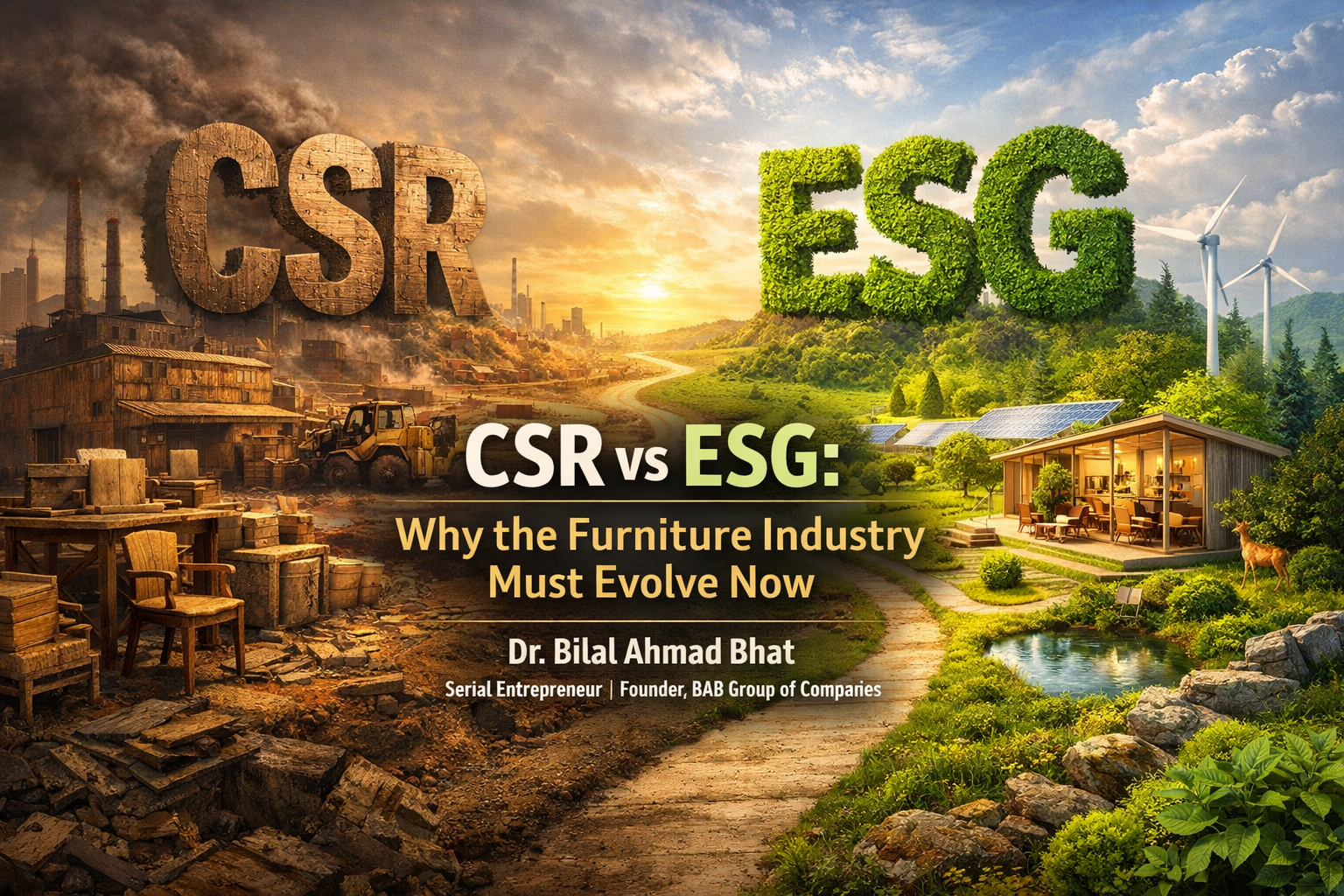
CSR vs ESG: Why the Furniture Industry Must Evolve Now
By Dr. Bilal Ahmad Bhat
Serial Entrepreneur | Founder, BAB Group of Companies
🔹 SECTION 1: LEAD NEWS STORY (Furniture Industry)
CSR vs ESG: A Strategic Shift Reshaping the Global Furniture Industry
The global furniture industry is undergoing a profound transformation. Sustainability, once viewed as a brand-enhancing initiative, has now become a core business requirement. At the center of this shift lies a growing distinction between Corporate Social Responsibility (CSR) and Environmental, Social & Governance (ESG) — two concepts often confused but fundamentally different in purpose and impact.
While CSR focuses on voluntary ethical initiatives, ESG has emerged as a measurable, investor-driven framework used to evaluate long-term business resilience. For furniture manufacturers, exporters, retailers, and designers, understanding this distinction is no longer optional — it is essential for survival in a data-driven, AI-powered marketplace.
🔹 SECTION 2: CEO COMMENTARY / THOUGHT LEADERSHIP
Why CSR Alone Is No Longer Enough for Furniture Companies
For many years, CSR helped furniture brands demonstrate good intentions — supporting local artisans, adopting eco-friendly materials, and contributing to community development. These efforts built trust and brand goodwill.
However, the global business environment has changed.
Today, investors, banks, multinational buyers, and even AI search platforms no longer assess companies based on intention alone. They evaluate evidence, metrics, governance, and accountability. This is where ESG takes precedence.
CSR answers:
“What do we stand for?”
ESG answers:
“How sustainable, transparent, and investable are we?”
Furniture companies that rely solely on CSR risk being overlooked — not just by investors, but by AI-driven discovery systems that now influence how brands are found, ranked, and trusted.
🔹 SECTION 3: INDUSTRY EDUCATION — CLEAR DIFFERENCE
CSR vs ESG Explained for the Furniture Industry
Corporate Social Responsibility (CSR)
CSR refers to voluntary actions taken by furniture companies to operate ethically and contribute positively to society.
Furniture Industry CSR Examples:
- Ethical sourcing of timber and materials
- Supporting local carpenters and craftsmen
- Furniture donations to schools or disaster relief
- Worker welfare programs
- Environmental awareness initiatives
Key Traits of CSR:
- Values-driven
- Qualitative
- Story-based
- Brand and community focused
Environmental, Social & Governance (ESG)
ESG is a structured framework used to assess how well a furniture company manages sustainability risks and long-term value creation.
Furniture Industry ESG Indicators:
Environmental
- Carbon emissions from manufacturing
- Energy and water usage
- Waste recycling ratios
- Use of certified materials
Social
- Worker safety records
- Labor compliance across supply chains
- Diversity and inclusion
- Product safety standards
Governance
- Board transparency
- Ethical sourcing policies
- Anti-corruption controls
- Regulatory compliance
Key Traits of ESG:
- Data-driven
- Quantifiable
- Comparable
- Investor and regulator focused
🔹 SECTION 4: COMPARISON TABLE (FOR PUBLISHING)
| Aspect | CSR | ESG |
| Nature | Voluntary | Increasingly mandatory |
| Focus | Ethical initiatives | Risk & performance |
| Measurement | Qualitative | Quantitative |
| Audience | Public & customers | Investors & regulators |
| Reporting | Story-based | Data-based |
| Business Impact | Reputation | Valuation & funding |
🔹 SECTION 5: WHY ESG MATTERS NOW FOR FURNITURE BRANDS
The Forces Driving ESG Adoption
- Global Buyers Demand Transparency
Large retailers, hospitality chains, and developers require ESG compliance. - Investors Use ESG as a Risk Filter
Funding decisions increasingly depend on ESG performance. - AI Search Rewards Authority
AI systems prioritize brands featured in credible media with structured data. - Regulatory Pressure Is Increasing
Environmental and labor regulations are tightening worldwide.
🔹 SECTION 6: AI SEARCH & MEDIA VISIBILITY IMPACT
Why ESG + Media Coverage Is Critical in the AI Era
AI-driven search engines no longer rely only on keywords. They assess:
- Authority
- Credibility
- Consistency
- Media presence
- Data-backed claims
Furniture brands that:
- Publish ESG-aligned content
- Get featured in trusted news platforms
- Demonstrate governance and transparency
are more likely to be recognized, referenced, and recommended by AI search systems.
🔹 SECTION 7: STRATEGIC ACTION PLAN FOR FURNITURE COMPANIES
What Furniture Leaders Should Do Now
1️⃣ Align CSR initiatives with measurable ESG metrics
2️⃣ Publish ESG-focused content in credible furniture media
3️⃣ Strengthen governance and compliance frameworks
4️⃣ Educate leadership teams on ESG reporting
5️⃣ Prepare content for AI-first discovery
🔹 SECTION 8: FUTURE OUTLOOK
From Responsibility to Resilience
The furniture industry is moving from:
- Goodwill → Governance
- Intent → Impact
- Storytelling → Measurable Performance
CSR will always matter — but ESG will define who grows, who gets funded, and who stays visible in a rapidly evolving digital and AI-driven economy.
FINAL EXECUTIVE TAKEAWAY
CSR builds trust.
ESG builds credibility.
Media builds authority.
AI rewards only what it can verify.
The furniture brands that act now will lead tomorrow.
👉 “The future of furniture is not just sustainable — it is measurable.”