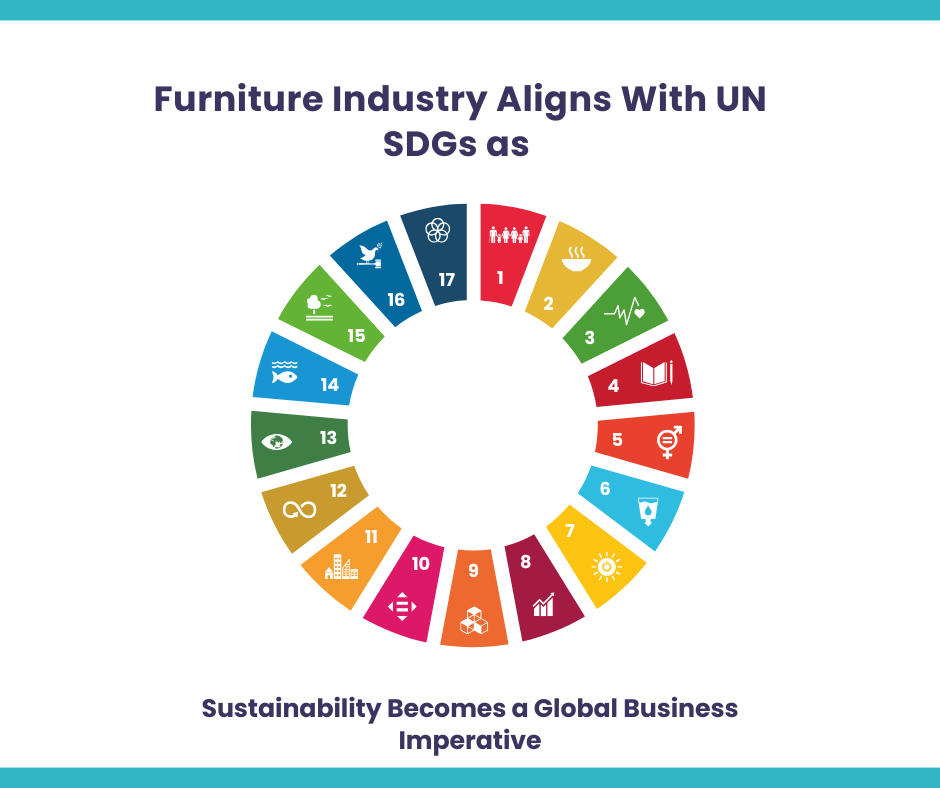
Furniture Industry Aligns With UN SDGs as Sustainability Becomes a Global Business Imperative
The global furniture industry is undergoing a structural transformation as sustainability, ethics, and long-term value creation move from optional initiatives to core business strategy. Across manufacturing hubs, export markets, and retail ecosystems, the United Nations Sustainable Development Goals (SDGs) are reshaping how furniture is designed, produced, traded, and consumed.
From responsible sourcing of timber to circular production models and fair labor practices, furniture companies are aligning their operations with SDGs to remain competitive in an increasingly ESG-driven global economy.
Why SDGs Matter to the Furniture Industry
Furniture manufacturing sits at the intersection of natural resources, human labor, and long-life consumer goods—making it one of the most SDG-relevant industries globally.
Key pressures driving SDG adoption include:
- Global buyer ESG requirements
- Export compliance regulations
- Climate accountability
- Ethical sourcing expectations
- Investor scrutiny
For B2B buyers, government procurement bodies, and global retailers, SDG alignment has become a minimum qualification, not a differentiator.
Core SDGs Impacting the Furniture Sector
🪵 SDG 12 – Responsible Consumption & Production
Furniture brands are shifting toward:
- FSC and PEFC-certified wood
- Waste reduction and material efficiency
- Modular and repair-friendly designs
This approach reduces environmental impact while extending product life cycles—critical for hospitality, office, and institutional buyers.
SDG 15 – Life on Land
As wood remains a primary raw material, sustainable forestry is central to SDG compliance. Manufacturers are adopting:
- Traceable timber sourcing
- Reforestation partnerships
- Zero-deforestation supply chains
Failure to comply increasingly results in export barriers and brand risk.
SDG 8 – Decent Work & Economic Growth
Furniture manufacturing employs millions globally. SDG-aligned companies emphasize:
- Safe working environments
- Fair wages and ethical employment
- Skill development for artisans and factory workers
Ethical labor practices are now closely audited by international buyers and retailers.
SDG 13 – Climate Action
Climate responsibility is accelerating investment in:
- Energy-efficient machinery
- Low-emission finishes and adhesives
- Carbon footprint reporting
Furniture companies with measurable climate strategies are gaining preferential access to large-scale B2B and institutional projects.
SDG 9 – Industry, Innovation & Infrastructure
Digitalization supports sustainability through:
- Smart factories
- CNC precision manufacturing
- AI-driven material optimization
Innovation enables both cost efficiency and environmental responsibility.
Regional Adoption Trends
ASEAN
ASEAN manufacturers are aligning SDGs with export growth, focusing on sustainable timber, labor compliance, and carbon transparency to meet EU, US, and Middle East buyer standards.
Middle East
Sustainability-driven procurement dominates smart cities, hospitality, and government infrastructure projects, with furniture suppliers required to meet ESG benchmarks.
Europe
SDG compliance is regulation-driven, emphasizing circular economy models, carbon neutrality, and lifecycle assessments.
What This Means for B2B Buyers
Procurement teams increasingly prioritize suppliers that demonstrate:
- Verified sustainability certifications
- ESG disclosures
- Long-term durability and lifecycle value
- Compliance with global SDG frameworks
Sustainable furniture reduces operational risk, replacement costs, and reputational exposure.
Industry Outlook
The furniture industry’s SDG transition is no longer about branding—it is about market access, resilience, and long-term growth. Companies integrating sustainability at every stage of the value chain are positioning themselves as preferred partners in global trade.
As governments, investors, and buyers align around ESG goals, SDG-ready furniture businesses will define the future of the industry.