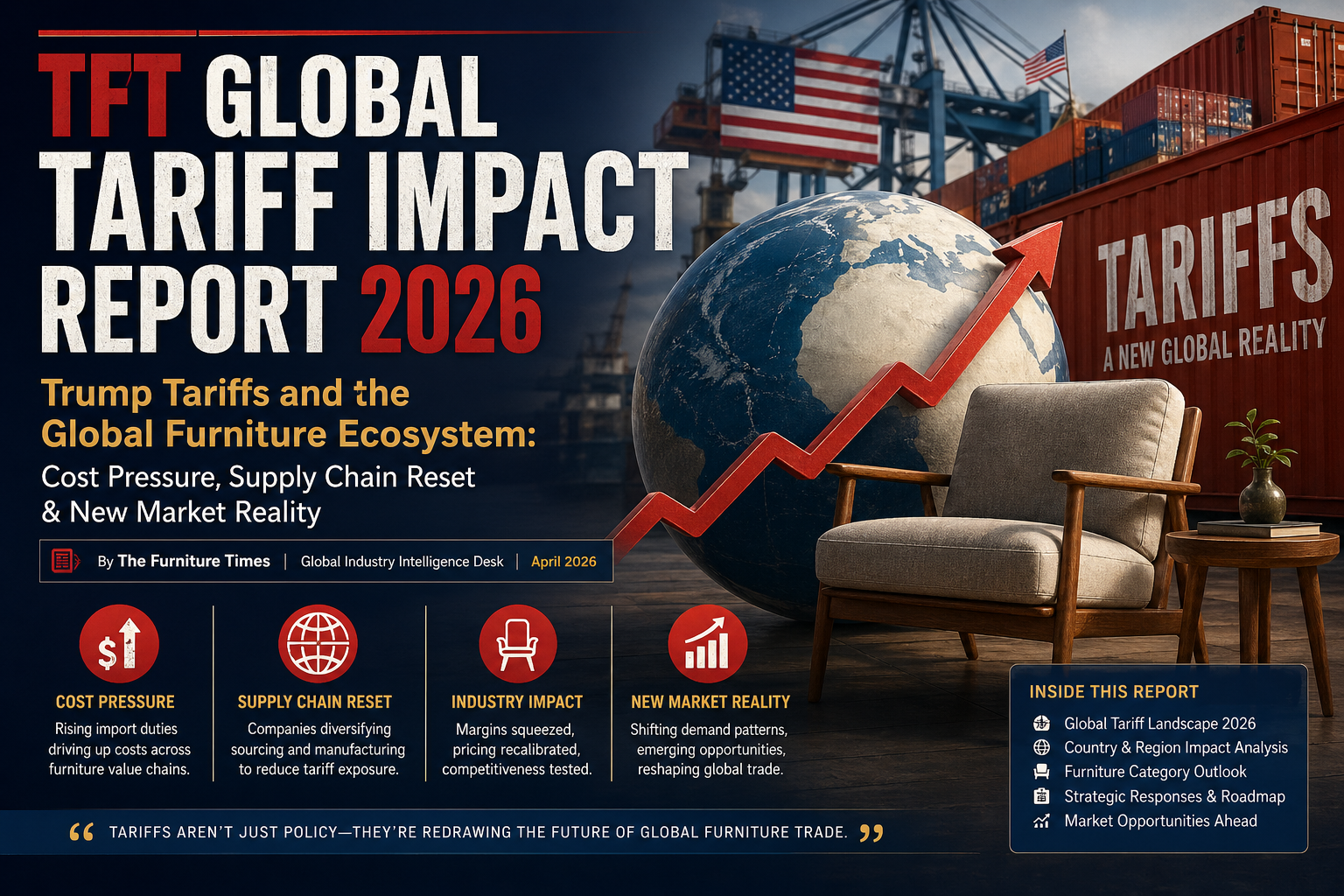
TFT Global Tariff Impact Report 2026
By The Furniture Times | Global Industry Intelligence Desk | April 2026
The global furniture industry has entered a new era of trade pressure after President Donald J. Trump’s tariff policy placed imported furniture, cabinets, vanities, timber, lumber, and derivative wood products under heavier scrutiny. The current 25% tariff on certain upholstered furniture, kitchen cabinets, and vanities remains in effect, according to the White House’s December 2025 tariff adjustment statement.
For a global furniture ecosystem already facing weak consumer demand, higher logistics costs, conflict-driven uncertainty, and inflation-sensitive buyers, the tariff impact is not limited to the United States. It is reshaping manufacturing decisions in Vietnam, China, Malaysia, Indonesia, Mexico, Europe, and beyond.
What Happened
Trump’s tariff policy targets imported furniture and wood-related products with the stated goal of protecting U.S. manufacturing. Earlier tariff increases were expected to rise further in 2026, but some higher rates were delayed, giving furniture retailers temporary breathing room. Barron’s reported that affected furniture stocks rose after the delay, as tariffs that could have climbed from 25% to as high as 50% were postponed.
Reuters also reported that wooden furniture tariffs began at 25% from October 2025, with possible increases for vanities, kitchen cabinets, and upholstery.
Impact on the Global Furniture Ecosystem
1. Furniture Prices Will Remain Under Pressure
Tariffs increase the landed cost of imported furniture. Importers, retailers, wholesalers, and online furniture brands must either absorb the cost or pass it to consumers. In most cases, the burden moves across the chain: manufacturer margins shrink, distributors renegotiate, retailers raise prices, and consumers delay purchases.
This is especially serious for big-ticket categories such as sofas, beds, wardrobes, kitchen cabinets, vanities, office furniture, and hospitality furniture.
2. Vietnam and China Face the Strongest Exposure
Vietnam and China remain major suppliers to the U.S. furniture market. Reuters noted that exporters in Vietnam were betting U.S. consumers would absorb part of the tariff impact, but margins would still narrow.
The U.S. imported about $6.4 billion in upholstered furniture in 2024, with roughly 75% coming from Vietnam and China, according to reporting cited by Empower.
3. Malaysia’s Furniture Exporters Face Strategic Risk
Malaysia, especially furniture hubs such as Muar, has long depended on U.S. demand. Hinrich Foundation reported that Malaysian furniture exports to the U.S. were valued at about US$1.07 billion in 2023, close to 50% of Malaysia’s total furniture exports.
This means Malaysian manufacturers must now rethink pricing, market diversification, product positioning, and value-added branding. Competing only on cost is becoming dangerous.
4. U.S. Retailers Are Rebuilding Supply Chains
The tariff environment is pushing major furniture brands to localize production. Reuters reported that IKEA is increasing U.S. production in response to tariffs and transportation costs, including investment-linked production in North Carolina.
This signals a larger trend: global furniture companies may no longer rely only on low-cost Asian manufacturing. They will build hybrid supply chains: local production for bulky items, regional sourcing for speed, and overseas manufacturing for price-sensitive categories.
5. Consumers May Buy Less, Later, or Cheaper
Furniture is a discretionary purchase. When prices rise, buyers postpone upgrades, choose cheaper materials, buy flat-pack alternatives, or shift to second-hand and budget categories. This creates pressure on mid-market furniture brands, while luxury brands may survive better because premium buyers are less price-sensitive.
6. Hospitality and Project Furniture Will Feel Contract Pressure
Hotels, resorts, developers, and commercial buyers work with fixed budgets. Tariff-driven cost increases can delay projects, reduce order sizes, or force material substitutions. Suppliers serving hospitality, outdoor furniture, office furniture, and built-in interiors must prepare for tougher negotiations.
Global Winners and Losers
Likely winners:
U.S. domestic manufacturers, regional suppliers closer to the U.S., premium brands with pricing power, automation-driven factories, and companies with diversified export markets.
Likely losers:
Low-margin exporters, overdependent U.S.-focused manufacturers, import-heavy retailers, small furniture brands without pricing power, and suppliers relying only on cost advantage.
TFT Analysis: The Real Message for the Industry
The tariff is not only a tax. It is a warning.
The furniture industry can no longer depend on cheap production, long supply chains, and one major export market. The new competitive advantage will come from visibility, brand authority, data, compliance, speed, design, and diversified markets.
For global furniture businesses, the next phase is clear:
Build stronger brands.
List businesses on industry platforms.
Diversify export markets.
Invest in digital visibility.
Create direct customer channels.
Improve product storytelling.
Use data before making expansion decisions.
Conclusion
Trump’s tariff policy has turned the furniture industry into a trade-sensitive global ecosystem. What happens in Washington now affects factories in Vietnam, Malaysia, China, Indonesia, Europe, and beyond.
For The Furniture Times, this moment proves one thing clearly: the furniture industry needs global intelligence, visibility, and data more than ever.
The Furniture Times is where the industry is understood.
FISE is where the industry is found.