
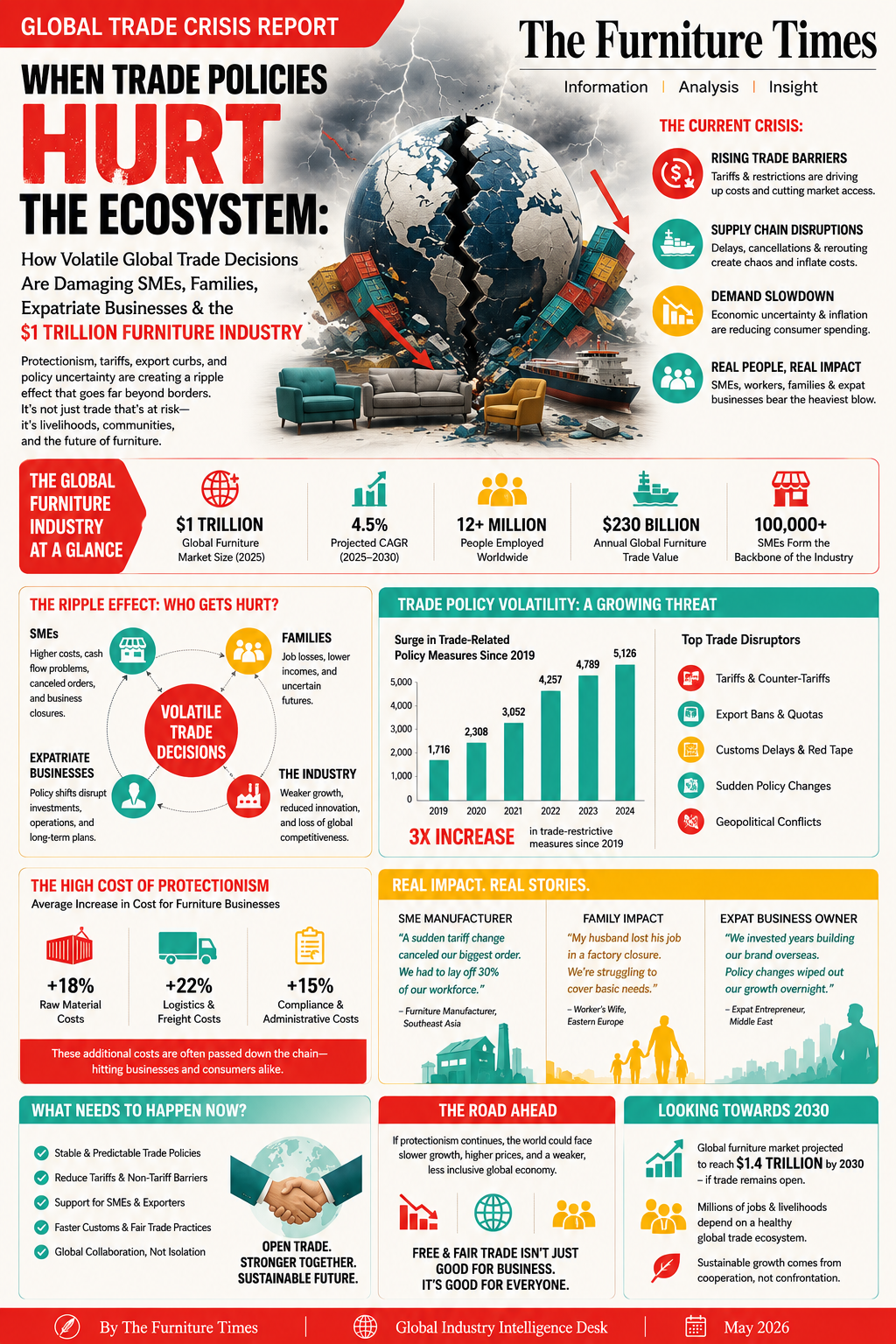
When Trade Policies Hurt the Ecosystem: How Volatile Global Trade Decisions Are Damaging SMEs, Families, Expatriate Businesses & the $1 Trillion Furniture Industry
Global Trade Crisis Report | The Furniture Times
By The Furniture Times | Global Industry Intelligence Desk | May 2026
Global trade has always been one of humanity’s greatest economic engines.
Trade connects:
countries
industries
manufacturers
suppliers
workers
families
cultures
economies
It creates:
jobs
innovation
infrastructure
industrial development
global relationships
economic mobility
Entire nations were built through trade.
Ports became cities.
Factories became ecosystems.
Entrepreneurs became employers.
And industries like the global furniture ecosystem expanded into trillion-dollar economic infrastructures because international trade made it possible.
But while trade can strengthen economies, unstable and poorly structured trade policies can also create deep economic damage.
And today, many industries — especially SMEs inside the global furniture ecosystem — are quietly entering one of the most uncertain periods in modern trade history.
The Global Trade System Is Becoming Increasingly Unpredictable
In theory, global trade should create:
balance
opportunity
competitiveness
industrial growth
But in reality, many businesses today are facing:
sudden tariff changes
import restrictions
export complications
freight volatility
currency instability
regulatory uncertainty
rising operational costs
This unpredictability creates fear.
And fear damages investment confidence.
SMEs Are the First Victims of Trade Volatility
Large corporations may survive unstable policies because they have:
reserves
diversified markets
financial leverage
legal teams
global operational flexibility
But SMEs operate differently.
Small and medium enterprises often survive through:
daily cash flow
customer relationships
supplier trust
shipment consistency
operational stability
When trade suddenly changes:
margins collapse
costs rise
orders slow
buyers hesitate
inventory becomes risky
And SMEs become extremely vulnerable.
The Furniture Industry Is Highly Sensitive to Trade Policies
The global furniture ecosystem depends heavily on international trade.
Furniture manufacturing relies on:
timber imports
foam supply
fabrics
machinery
hardware
logistics
export containers
hospitality demand
real estate cycles
A single trade policy change can affect:
raw material cost
manufacturing price
export competitiveness
freight rates
retail pricing
consumer demand
The furniture industry is deeply interconnected globally.
A disruption in one region can create consequences across:
Asia
Europe
the Middle East
Africa
the Americas
The Hidden Human Cost of Trade Instability
Trade discussions are often presented through:
GDP numbers
export figures
tariffs
policy documents
But behind these policies are:
business owners
factory workers
expatriates
families
craftsmen
retailers
logistics operators
When businesses collapse:
families become vulnerable.
Children’s education becomes uncertain.
Employees lose stability.
Entrepreneurs lose confidence.
Communities weaken economically.
The emotional impact is rarely discussed.
Expatriate Entrepreneurs Are Increasingly Losing Confidence
One of the growing global concerns is the rising disappointment among expatriate business owners.
Many expatriates move internationally to:
build businesses
create opportunities
support families
contribute to economies
invest long term
But unstable trade environments can create enormous pressure.
When entrepreneurs experience:
inconsistent regulations
rising operational risk
unpredictable policies
declining margins
difficult banking conditions
limited protection systems
many begin considering relocation.
This creates:
“Silent Economic Migration.”
Businesses quietly shift to countries perceived as:
more stable
more predictable
more business-friendly
more supportive toward SMEs
The Furniture Ecosystem Is Quietly Bleeding
The global furniture industry is already under pressure from:
COVID-19 recovery
freight instability
raw material inflation
labor shortages
rising energy costs
geopolitical tensions
digital disruption
affordability crises
Now volatile trade environments are adding another layer of uncertainty.
Factories are struggling to forecast.
Retailers are struggling to maintain pricing.
Exporters are struggling to protect margins.
SMEs are struggling to survive.
And many entrepreneurs are emotionally exhausted.
Trade Wars Create Chain Reactions
Modern trade conflicts do not remain local.
A tariff introduced between two countries can affect:
manufacturing hubs
shipping systems
container pricing
furniture sourcing
hospitality projects
global supply chains
The furniture industry especially suffers because it depends on:
international sourcing
container efficiency
affordable freight
stable cross-border operations
When trade becomes political, industries become unstable.
The Global Furniture Ecosystem Is Fragmented
One major problem is that the furniture industry still lacks:
unified global representation
connected communication infrastructure
coordinated SME protection systems
centralized trade intelligence
ecosystem-wide support mechanisms
Despite being worth over:
$1 trillion globally
the industry remains highly fragmented.
Many SMEs still operate with:
limited visibility
weak digital infrastructure
dependence on middlemen
poor global discoverability
This makes them even more vulnerable during trade uncertainty.
The Emotional Pressure on Entrepreneurs
The greatest damage of uncertainty is psychological.
Many entrepreneurs today silently carry:
payroll stress
shipment anxiety
delayed payments
customer instability
rising operational costs
uncertain policy environments
Unlike employees, entrepreneurs often cannot “pause.”
They carry responsibility for:
workers
suppliers
family income
business continuity
And this emotional exhaustion is becoming one of the hidden global business crises.
Why Some Businesses Are Relocating
Around the world, many SMEs are quietly exploring relocation because they seek:
policy stability
predictable trade systems
supportive business ecosystems
lower operational uncertainty
stronger digital infrastructure
easier international access
Countries competing for investment must understand:
Businesses no longer evaluate only tax structures.
They evaluate emotional and operational stability.
The Furniture Industry Needs Protection, Not Only Growth
For decades, global discussions focused heavily on:
expansion
exports
scaling
manufacturing growth
But the next era requires:
“Resilience Economics.”
The industry must now focus on:
stability
ecosystem protection
SME sustainability
communication independence
digital discoverability
operational continuity
Because unstable ecosystems eventually damage entire economies.
The Insurance & Financial Vulnerability Problem
Many furniture businesses globally remain:
underinsured
financially exposed
digitally weak
operationally vulnerable
When trade shocks happen:
many cannot absorb losses
banks become cautious
insurers hesitate
investors pause
This creates a dangerous cycle:
Uncertainty creates fear, and fear slows economic movement.
Why Visibility Matters More Than Ever
During uncertain times, discoverability becomes survival.
Businesses that are:
searchable
visible
categorized
digitally present
globally discoverable
have stronger chances of survival.
Invisible businesses suffer the most during unstable economic conditions.
This is why modern ecosystems increasingly require:
digital platforms
searchable infrastructure
communication systems
live commerce ecosystems
connected industry intelligence
The Rise of Ecosystem Thinking
The future furniture industry cannot survive through fragmentation alone.
It needs:
connected ecosystems
communication infrastructure
verified supplier systems
discoverability platforms
digital trade layers
live product discovery
industry intelligence systems
This is where ecosystems like:
become strategically important for future resilience.
The Real Global Issue
This is no longer only about:
tariffs
trade policy
exports
It is about:
economic human sustainability.
When SMEs suffer:
workers suffer
families suffer
local economies weaken
entrepreneurship declines
innovation slows
And when expatriates lose confidence:
Countries lose:
investment
expertise
diversity
International business strength
TFT Global Industry Insight
Trade should strengthen humanity.
Not destabilize ecosystems.
The furniture industry especially requires:
long-term predictability
stable trade corridors
SME protection
communication infrastructure
discoverability systems
resilient operational frameworks
Because furniture is not only about products.
Behind every product are:
factories
workers
logistics
families
entrepreneurs
human sacrifice
Final Thought
The global furniture ecosystem is quietly standing at a crossroads.
One direction leads toward:
fragmentation
instability
uncertainty
SME collapse
emotional exhaustion
The other leads toward:
connected ecosystems
resilient infrastructure
digital visibility
communication independence
collaborative global trade
The future of global trade should not only be measured by exports.
It should be measured by how safely industries, entrepreneurs, workers, and families can survive within it.
Closing Insight
“An economy grows through trade.
But when trade becomes unstable, entire ecosystems become emotionally and financially vulnerable.”
“And when SMEs begin losing hope, the foundation of the global economy begins weakening silently.”
