
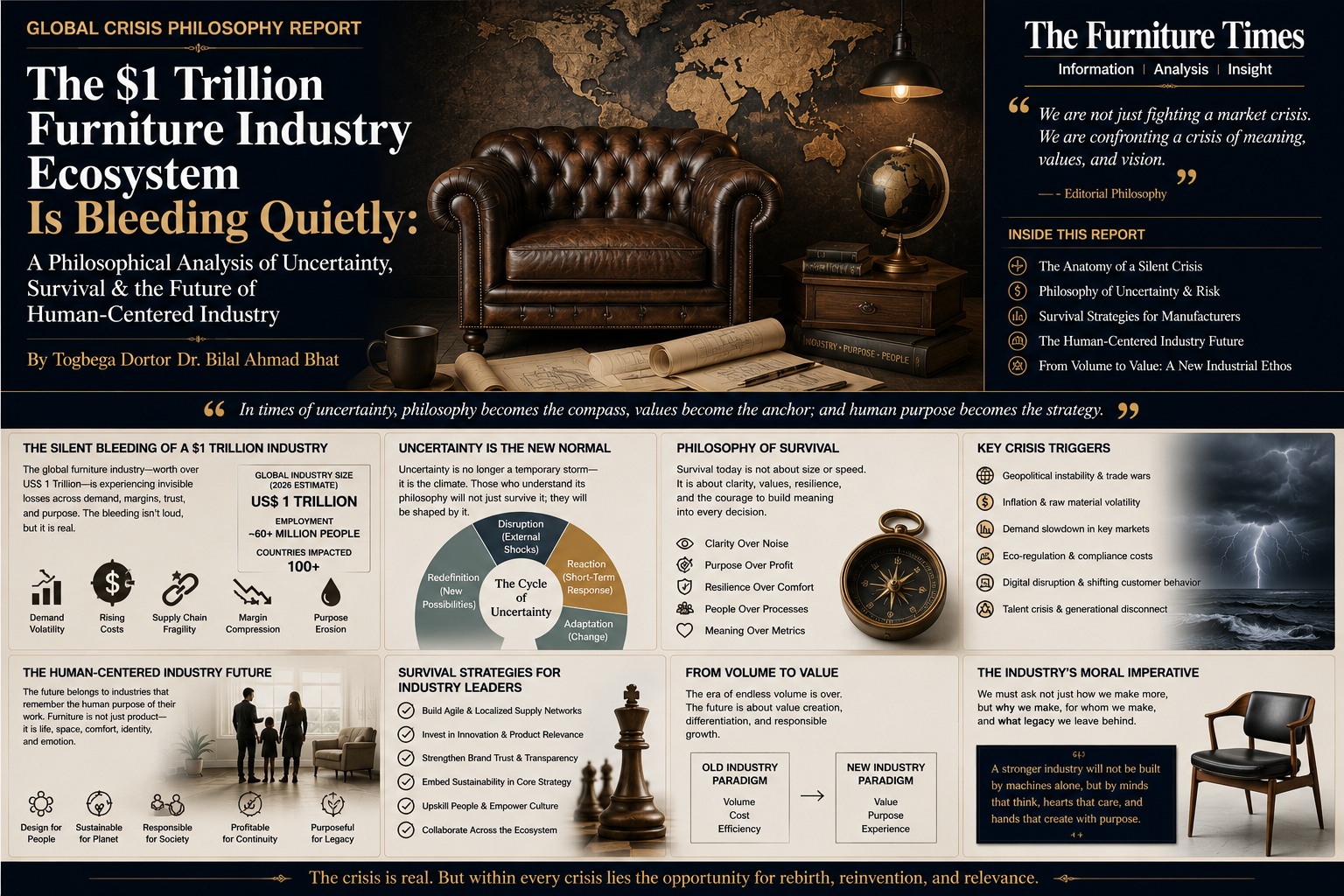
The $1 Trillion Furniture Industry Ecosystem Is Bleeding Quietly: A Philosophical Analysis of Uncertainty, Survival & the Future of Human-Centered Industry
Global Crisis Philosophy Report | The Furniture Times
By Togbega Dortor Dr. Bilal Ahmad Bhat
Founder & CEO, BAB Group of Companies
Founder of The Furniture Times & Furniture Industry Search Engine (FISE)
The global furniture industry is often described through numbers.
A:
- $1 trillion ecosystem
- global manufacturing giant
- export powerhouse
- employment engine
- trade infrastructure
But behind these massive numbers lies a silent reality few truly discuss:
The furniture industry is one of the world’s most emotionally exhausted industries.
Factories continue operating.
Containers continue moving.
Showrooms continue displaying products.
Trade fairs continue happening.
But internally, thousands of:
- SME owners
- factory operators
- retailers
- carpenters
- artisans
- exporters
- importers
- workers
are quietly carrying enormous uncertainty.
And uncertainty is far more dangerous than competition.
Because competition challenges your business.
But uncertainty attacks your psychology.
The Furniture Industry Was Never Built for Continuous Global Crisis
According to World Health Organization and global economic tracking bodies, the COVID-19 pandemic triggered one of the largest global economic disruptions in modern history, severely affecting supply chains, logistics, retail, labor systems, and manufacturing industries worldwide.
The furniture industry was among the sectors deeply affected because it depends heavily on:
- shipping
- raw materials
- logistics
- labor
- retail movement
- hospitality
- housing confidence
- global trade stability
Before COVID-19, many furniture businesses operated with:
- predictable supply chains
- stable buyer behavior
- manageable freight costs
- long-term dealer relationships
But after the pandemic, the industry entered:
“Permanent Uncertainty Mode.”
And many businesses have still not psychologically or financially recovered.
COVID-19 Did Not Only Damage Supply Chains
It Damaged Confidence
Factories closed.
Workers disappeared.
Containers froze.
Freight prices exploded.
Retail traffic collapsed.
Hotels stopped buying.
Restaurants stopped investing.
Projects paused.
Payments delayed.
And suddenly, thousands of furniture businesses realized something terrifying:
The furniture industry had scale… but not resilience.
Many SMEs survived only through:
- loans
- personal savings
- asset sales
- delayed salaries
- emotional sacrifice
Some lost:
- factories
- warehouses
- homes
- partnerships
- mental peace
And yet the industry rarely discusses the emotional cost of survival.
The Insurance Crisis Nobody Talks About
One of the biggest hidden crises inside the furniture industry is:
underinsurance and protection failure.
In countries like Malaysia, many furniture shops, warehouses, factories, and SMEs remain:
- underinsured
- partially insured
- improperly valued
- rejected by insurers
- exposed to operational risk
Many business owners feel trapped because:
- premiums are high
- claim approvals are difficult
- valuation disputes are common
- fire-risk categories affect coverage
- insurers often classify furniture operations as high-risk sectors
And after incidents happen:
- claims become delayed
- compensation disputes arise
- businesses collapse while waiting
This creates a dangerous environment where entrepreneurs continue operating under:
“invisible vulnerability.”
Why Insurance Companies Hesitate
From an insurer’s perspective, furniture businesses carry multiple risks:
- fire hazards
- wood dust exposure
- chemical finishes
- foam materials
- warehouse concentration risks
- export inventory exposure
- logistics vulnerability
- fluctuating valuation
Additionally, many SMEs:
- lack proper documentation
- lack valuation systems
- lack digital inventory records
- lack risk management infrastructure
This creates mistrust between:
- insurers
- manufacturers
- retailers
- financial institutions
And mistrust is expensive.
The Tariff Era Created Another Layer of Fear
Just as the industry tried recovering from COVID-19, another wave emerged:
global tariff instability.
Trade tensions disrupted:
- sourcing confidence
- manufacturing margins
- export planning
- procurement pricing
- long-term agreements
Furniture businesses already weakened by pandemic recovery suddenly faced:
- unpredictable material costs
- unstable container pricing
- currency pressure
- delayed investment decisions
Many SMEs operate on thin margins.
They cannot absorb continuous shocks forever.
Then Came Geopolitical Uncertainty Again
The Russia–Ukraine war already disrupted:
- timber supply
- energy prices
- European demand
- freight systems
Now rising tensions involving:
- Iran
- United States
- Israel
have further increased global business anxiety.
Energy markets react.
Shipping routes become uncertain.
Importers hesitate.
Investors pause.
Consumers delay purchases.
And furniture — often considered a discretionary purchase — becomes highly vulnerable.
Because when uncertainty rises:
people delay buying sofas before they delay buying food.
SMEs Are Carrying the Heaviest Burden
Large corporations may survive longer because they have:
- reserves
- legal teams
- insurance leverage
- diversified operations
- stronger banking access
But SMEs often survive through:
- trust
- relationships
- daily cash flow
- emotional endurance
And this endurance is now under pressure globally.
Many SMEs today are not growing.
They are:
“surviving professionally.”
The Furniture Industry Has a Structural Problem
The global furniture ecosystem remains:
- fragmented
- disconnected
- under-digitized
- underprotected
- undervalued
Despite being worth over $1 trillion globally, the industry still lacks:
- unified intelligence systems
- centralized communication infrastructure
- trusted verification ecosystems
- structured supplier discoverability
- real-time visibility systems
- connected SME support frameworks
This creates what Dr. Bilal calls:
“The Invisible Industry Crisis.”
Visibility Is Now Survival
Many furniture businesses remain digitally invisible.
And invisibility creates:
- lower trust
- fewer leads
- weaker pricing power
- limited discoverability
- dependence on middlemen
This is why modern ecosystems increasingly require:
- searchable business identity
- verified supplier profiles
- digital communication infrastructure
- live product ecosystems
- connected sourcing systems
Because:
In the new economy, invisible businesses become vulnerable businesses.
Why Emotional Stability Matters in Industry
One of the least discussed realities is:
entrepreneurial emotional exhaustion.
Many factory owners today silently carry:
- debt pressure
- payroll anxiety
- shipment uncertainty
- customer instability
- operational fatigue
And unlike employees, entrepreneurs often cannot “switch off.”
The furniture industry especially demands:
- patience
- endurance
- relationship management
- long-cycle trust
That is why Dr. Bilal says:
“Managers manage today. Entrepreneurs manage tomorrow.”
Because entrepreneurs must carry uncertainty before certainty exists.
So How Can the Industry Stabilize?
The solution is not one single policy.
It requires:
ecosystem restructuring.
1. Industry Insurance Reform
The furniture industry needs:
- sector-specific insurance frameworks
- SME-friendly protection systems
- inventory digitization
- fire-risk modernization
- transparent valuation systems
- simplified claims structures
Insurance companies and industry bodies must collaborate instead of operating in isolation.
2. Digital Visibility Infrastructure
Every furniture business should become:
- searchable
- discoverable
- categorized
- verified
- digitally indexed
This reduces dependency on random exposure.
3. Communication Independence
Businesses cannot depend entirely on third-party messaging systems.
The industry needs:
- sector communication infrastructure
- RFQ systems
- verified communication layers
- business continuity systems
This is one reason systems like FISE Connect become strategically important.
4. SME Protection Ecosystems
SMEs need:
- training
- digital onboarding
- export education
- risk management systems
- financing support
- visibility infrastructure
Without SMEs, the furniture industry loses:
- craftsmanship
- diversity
- local economies
- human creativity
5. Mental & Emotional Sustainability
The industry must stop discussing only:
- exports
- revenue
- manufacturing
and begin discussing:
- emotional resilience
- entrepreneur wellbeing
- leadership pressure
- psychological sustainability
Because:
exhausted industries eventually become unstable industries.
The Furniture Industry Is Not Only an Economic System
It Is a Human System
Behind every sofa:
there is a worker.
Behind every dining table:
there is a craftsman.
Behind every showroom:
there is a struggling entrepreneur.
Behind every export container:
there is risk.
And behind every SME:
there is usually a family carrying uncertainty silently.
TFT Philosophical Industry Insight
The greatest danger to the furniture industry is not competition.
It is:
- fragmentation
- invisibility
- disconnected systems
- emotional exhaustion
- structural uncertainty
The future winners will not simply manufacture furniture.
They will build:
- resilient ecosystems
- connected infrastructure
- discoverability systems
- communication independence
- trust networks
- industry intelligence layers
Final Thought by Togbega Dortor Dr. Bilal Ahmad Bhat
“The furniture industry does not only need growth anymore.
It needs stability.
It needs protection.
It needs visibility.
It needs connection.
And above all… it needs humanity.”
“Because an industry worth $1 trillion should not leave its SMEs fighting uncertainty alone.”
