
From Tree Core to Global Furniture Ecosystem: How One Log Can Become Tables, Chairs, Storage, Décor, Tools & Design Value
Wood Utilization Intelligence | The Furniture Times
By The Furniture Times | Global Industry Intelligence Desk | May 2026
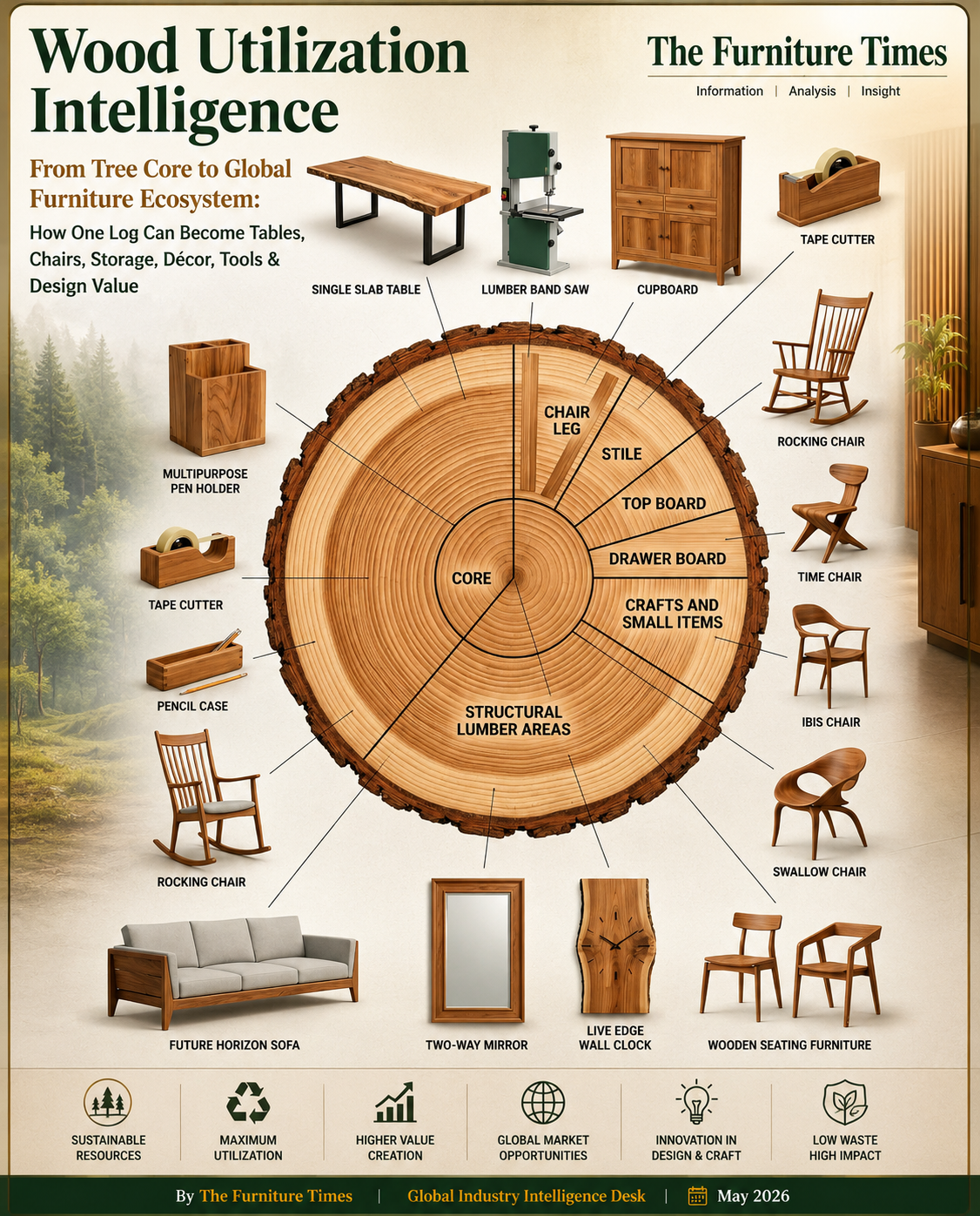
The image presents a powerful visual message for the furniture industry: one tree is not only a raw material — it is an ecosystem of possibilities.
At the center of the image is a large cross-section of a tree trunk, divided into functional zones such as core, structural lumber areas, top board, drawer board, stile, chair leg, and crafts and small items. Around the log are finished products including a single slab table, cupboard, rocking chair, pen holder, tape cutter, pencil case, mirror frame, wall clock, sofa frame, wooden chairs, and seating furniture.
This is more than a woodworking diagram.
It is a deep industry lesson about resource optimization, design thinking, waste reduction, craftsmanship, manufacturing efficiency, and value creation.
The Core Message of the Image
The image shows that every part of wood can carry value when it is understood properly.
A single log can become:
- structural furniture parts
- decorative objects
- household products
- seating systems
- storage units
- commercial furniture
- craft items
- design-led lifestyle products
The real message is:
The future of the furniture industry will not belong only to those who cut wood.
It will belong to those who understand how to transform every inch of wood into value.
The Tree as an Industrial Ecosystem
A tree trunk is not uniform. Different parts of the log have different strengths, appearances, grains, densities, and uses.
The image divides the log into usable zones, showing how wood can be allocated intelligently.
This is important because furniture manufacturing is not just about cutting lumber. It is about knowing:
- which section is suitable for strength
- which section is suitable for beauty
- which section is suitable for small products
- which section should become panels
- which section should become legs or frames
- which section can become décor
This is where traditional craftsmanship meets modern manufacturing science.
1. The Core: The Heart of the Tree
At the center of the image is the core.
The core represents the heart of the tree. In woodworking, the core area can vary in stability depending on the species, drying process, and cutting method.
It may not always be ideal for every furniture component, but it carries symbolic and practical importance.
In the furniture ecosystem, the core can represent:
- origin
- strength
- identity
- raw natural value
- the beginning of material transformation
Philosophically, the core reminds the industry that every product begins with nature before it becomes design.
2. Structural Lumber Areas: The Strength Zone
The image identifies a section called structural lumber areas.
This part can be used for products that require strength and reliability, such as:
- table frames
- chair frames
- sofa frames
- cabinet supports
- bed structures
- internal furniture skeletons
This is the hidden engineering side of furniture.
Consumers often admire the final design, but the real durability of furniture depends on the unseen structure.
A beautiful chair with weak structural lumber fails.
A sofa with poor internal framing loses shape.
A table with unstable support becomes unsafe.
So the structural area of wood is the silent backbone of the furniture industry.
3. Single Slab Table: Premium Natural Statement Furniture
The image shows a single slab table, made from a large natural wood slab.
This represents one of the most premium uses of timber.
Single slab tables are increasingly popular in:
- luxury homes
- executive offices
- premium restaurants
- boutique hotels
- boardrooms
- high-end design studios
Why?
Because they preserve the natural story of the tree.
Live edges, grain lines, knots, color variations, and organic shapes make each piece unique.
This category reflects a major global trend:
Consumers are moving from mass-produced sameness toward natural individuality.
Single slab tables are not just furniture. They are statement pieces.
4. Chair Legs: Small Components, Big Structural Importance
The image highlights chair legs as a specific output from the log.
Chair legs may look simple, but they carry major importance.
They require:
- strength
- correct grain direction
- precision cutting
- load-bearing capability
- stability
- finishing quality
A chair leg failure can damage brand trust immediately.
This shows why component manufacturing deserves more attention inside the furniture ecosystem.
Every furniture product depends on the quality of small parts.
5. Stiles and Frame Components: The Hidden Architecture of Furniture
The image includes stile, a vertical frame component commonly used in doors, cabinets, cupboards, and panel furniture.
Stiles are essential in:
- cupboard doors
- cabinet frames
- wardrobes
- kitchen units
- drawers
- panel systems
This part of the image highlights the importance of joinery.
Furniture is not only surface beauty. It is connection, alignment, measurement, and stability.
The strength of a cupboard is often determined by the quality of its frame components.
6. Top Boards and Drawer Boards: Panel-Based Furniture Value
The image identifies top board and drawer board areas.
These are suitable for furniture parts such as:
- tabletops
- cabinet tops
- drawer fronts
- shelves
- side panels
- wardrobe panels
This reflects the value of panel-based manufacturing.
Modern furniture markets depend heavily on:
- cabinets
- wardrobes
- kitchens
- drawers
- storage systems
- modular furniture
A single log can supply many visible and functional board components if processed intelligently.
7. Cupboard: Storage Furniture as Everyday Value
The cupboard shown in the image represents one of the most practical outputs of wood.
Storage furniture remains one of the strongest global furniture categories because every home, office, hotel, school, and commercial space needs organization.
Cupboards require:
- panels
- doors
- drawers
- hinges
- frames
- handles
- finishing
They combine wood usage with hardware, design, and functionality.
This proves that wood value increases when combined with good product design and usability.
8. Rocking Chair: Craftsmanship, Comfort & Emotional Furniture
The image shows rocking chairs on both sides.
Rocking chairs represent furniture with emotional value.
They are associated with:
- comfort
- heritage
- relaxation
- family spaces
- elderly care
- traditional craftsmanship
A rocking chair requires careful balance, curve design, joinery, and ergonomic understanding.
This product shows that furniture is not just utility.
Furniture also carries memory, culture, and human emotion.
9. Wooden Seating Furniture: Design Diversity from One Material
The image includes several chair designs such as wooden seating furniture, swallow chair, ibis chair, and other sculptural forms.
This demonstrates how one raw material can become many design languages.
Wood can produce:
- traditional chairs
- modern chairs
- sculptural chairs
- lounge chairs
- dining chairs
- designer statement pieces
The difference is not only the material.
The difference is creativity.
This is why design education, skilled carpentry, and innovation are critical for the future of the furniture industry.
10. Sofa Frame: Wood as the Skeleton of Upholstered Furniture
The image shows a sofa with wooden framing.
This is an important reminder that even upholstered furniture depends heavily on wood.
Behind fabric, foam, and cushions, most sofas require a strong frame.
Wooden sofa frames affect:
- durability
- comfort
- load capacity
- product lifespan
- customer satisfaction
This makes wood an essential hidden material inside upholstered furniture.
11. Crafts and Small Items: The Power of Waste-to-Value Thinking
The image includes small products such as:
- tape cutter
- pen holder
- pencil case
- wall clock
These items are very important from a sustainability and profitability perspective.
They show that leftover wood should not be treated as waste.
Small offcuts can become:
- office accessories
- gift items
- décor products
- souvenir items
- lifestyle goods
- premium craft products
This creates a powerful business model:
Waste is not waste until imagination stops.
For SMEs, artisans, and small workshops, this is especially important. Small wooden products can create additional revenue streams from leftover material.
12. Two-Way Mirror and Wall Clock: Wood in Décor & Lifestyle Products
The image includes a two-way mirror and live edge wall clock.
These products show the expansion of wood beyond furniture into décor.
Wood supports categories such as:
- mirrors
- clocks
- frames
- wall art
- decorative panels
- lifestyle accessories
This is important because the furniture industry is no longer limited to tables, chairs, and cabinets.
It is merging with:
- home décor
- interior design
- gifting
- lifestyle products
- hospitality styling
Deep Industry Analysis: What This Image Teaches
1. Material Intelligence Is the Future
The image teaches that the furniture industry must understand materials deeply.
Not all wood parts should be used the same way.
High-value manufacturing requires:
- grading
- drying
- cutting strategy
- waste planning
- product mapping
- design allocation
Material intelligence reduces waste and increases profit.
2. Sustainability Begins at the Cutting Stage
Many companies talk about sustainability after production.
But real sustainability begins before cutting.
A responsible manufacturer should ask:
- Which section becomes structural lumber?
- Which section becomes visible boards?
- Which section becomes craft items?
- How can offcuts be reused?
- How can waste become revenue?
This is how the industry moves toward circular production.
3. Value Is Created Through Design, Not Material Alone
The same log can become a low-value plank or a premium designer table.
The difference is:
- design
- finishing
- storytelling
- craftsmanship
- branding
- market positioning
This means raw material alone does not create wealth.
Transformation creates wealth.
The Economic Lesson for SMEs
Small furniture businesses often struggle with:
- rising raw material costs
- labor pressure
- low margins
- competition
- waste loss
This image offers a practical solution:
SMEs must learn to extract multiple products from one material flow.
Instead of producing only one product, workshops can diversify into:
- furniture
- décor
- accessories
- small craft items
- premium gifts
- hospitality items
This improves revenue resilience.
The Manufacturing Opportunity
Factories can use this thinking to improve:
- cutting optimization
- inventory planning
- product diversification
- waste reduction
- margin improvement
A log-to-product strategy can help manufacturers create multiple product lines from the same raw material source.
Example:
Large slabs → tables
Strong sections → chair legs and frames
Boards → cupboards and drawers
Offcuts → accessories
Decorative pieces → clocks, mirrors, crafts
This is full-spectrum material utilization.
The Design Opportunity
Designers can use wood more intelligently by understanding the natural structure of the tree.
Instead of forcing wood into generic forms, designers can celebrate:
- grain
- texture
- knots
- curves
- live edge
- natural color variation
This creates stronger emotional and market value.
The Sustainability Opportunity
The image strongly supports the future of sustainable furniture.
Sustainable wood use means:
- using certified wood
- reducing waste
- designing long-lasting products
- creating secondary products from offcuts
- repairing and restoring furniture
- avoiding disposable production
This is especially important as global buyers increasingly demand responsible sourcing and environmental accountability.
Strategic Relevance for TFT & FISE
This image fits perfectly into The Furniture Times and Furniture Industry Search Engine ecosystem.
TFT Role
TFT can use this content as industry education, explaining:
- wood utilization
- sustainability
- craftsmanship
- furniture manufacturing intelligence
- product categories
- SME opportunities
FISE Role
FISE can help buyers find:
- slab table makers
- chair manufacturers
- cupboard manufacturers
- wood craft makers
- lumber suppliers
- furniture component suppliers
- wooden décor producers
TFT Academy Role
This image can become a training module:
“How One Log Becomes a Furniture Ecosystem”
Teaching:
- wood anatomy
- product allocation
- material optimization
- waste-to-value production
- furniture design categories
Furnipedia Role
Furnipedia can document:
- wood species
- product types
- joinery terms
- furniture components
- manufacturing processes
Final Industry Insight
The uploaded image is not just about wood.
It is about the philosophy of the furniture ecosystem.
It shows that from one natural source, the industry can create:
- function
- beauty
- comfort
- business
- sustainability
- culture
- memory
- value
The future furniture industry must move from simple manufacturing to intelligent transformation.
A tree becomes furniture only when craftsmanship meets purpose.
A log becomes an ecosystem only when industry understands its full value.
Final Thought
The real lesson of this image is simple but powerful:
The furniture industry does not lack raw materials.
It often lacks complete value thinking.
Every ring of the tree tells a story.
Every section has a purpose.
Every offcut has a possibility.
And every piece of wood, when respected, can become part of a larger furniture ecosystem.
