Developing Global News Analysis — The Furniture Industry in a Time of Conflict (2026)
The Furniture Times | Global Industry Intelligence Desk | April 2026
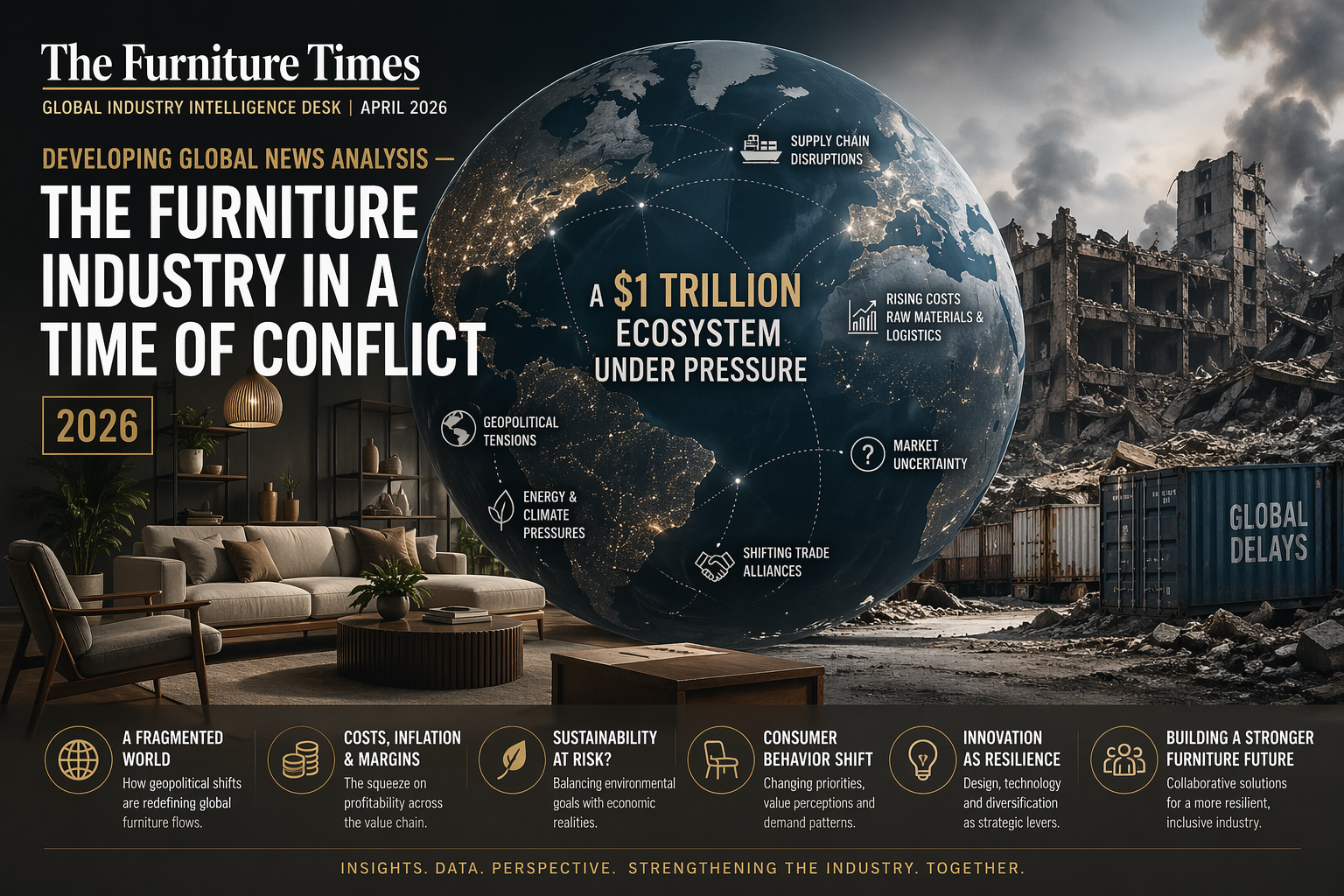
A $1 Trillion Ecosystem Under Pressure
The global furniture industry—often misunderstood as a simple retail category—is in reality a deep, interconnected $800B–$1T+ ecosystem spanning raw materials, manufacturing, logistics, retail, real estate, and digital commerce.
- The market is valued at ~$833 billion in 2026, moving toward $1 trillion+ by 2030
- Long-term projections suggest $1.3 trillion potential by 2033
This means one thing clearly:
The furniture industry is not just a market — it is global infrastructure for living, working, and commerce.
But in 2026, this ecosystem is being tested like never before.
GLOBAL CONFLICT ZONES RESHAPING THE INDUSTRY
1. Middle East Tensions — Iran, USA, Israel
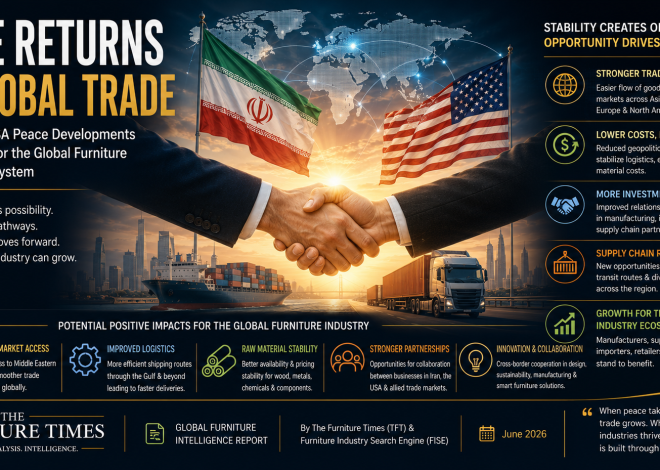
The escalating geopolitical tensions involving Iran, the USA, and Israel are directly impacting one of the most critical arteries of global trade:
Strait of Hormuz Risk
- A major share of global oil and shipping routes passes through this region
- Any disruption increases:
- Fuel costs
- Freight rates
- Insurance premiums
Impact on Furniture Industry:
- Higher container shipping costs
- Increased raw material pricing (wood processing, chemicals, foam, metals)
- Delays in Middle East project furniture supply chains (hotels, mega projects, real estate)
The Middle East, a high-growth region for hospitality and luxury interiors, is now facing uncertainty-driven procurement slowdowns.
2. Russia–Ukraine War — Europe’s Structural Disruption
The ongoing war between Russia and Ukraine continues to reshape the European furniture landscape:
Raw Material Shock:
- Russia and Eastern Europe are major suppliers of:
- Timber
- Birch plywood
- Energy inputs
Energy Crisis:
- Rising energy costs across Europe increase:
- Manufacturing costs
- Factory shutdown risks
Industry Impact:
- European manufacturers are losing cost competitiveness
- Shift toward Asia (Vietnam, Malaysia, China) for production
- Demand volatility in EU markets due to economic uncertainty
Europe is transitioning from a production hub to a design & consumption hub.
3. Red Sea & Global Shipping Disruptions
Conflicts and instability across key maritime routes (including spillover tensions in nearby regions) are affecting:
- Suez Canal traffic
- Red Sea shipping lanes
Supply Chain Consequences:
- Longer shipping routes (Africa rerouting)
- 20–40% increase in delivery timelines
- Surge in freight costs
Furniture—being bulky and logistics-heavy—is among the most exposed industries to shipping disruptions.
4. Asia-Pacific — The Silent Winner (and Pressure Point)
While conflicts disrupt other regions, the Asia-Pacific region dominates nearly half of global furniture production and consumption
Opportunity:
- Manufacturing shifts to:
- Vietnam
- Malaysia
- Indonesia
- India
Risk:
- Overdependence on Asia creates:
- Supply concentration risk
- Price volatility
- Trade imbalance pressures
Asia is becoming the “factory of the global furniture ecosystem”, but also its biggest vulnerability.
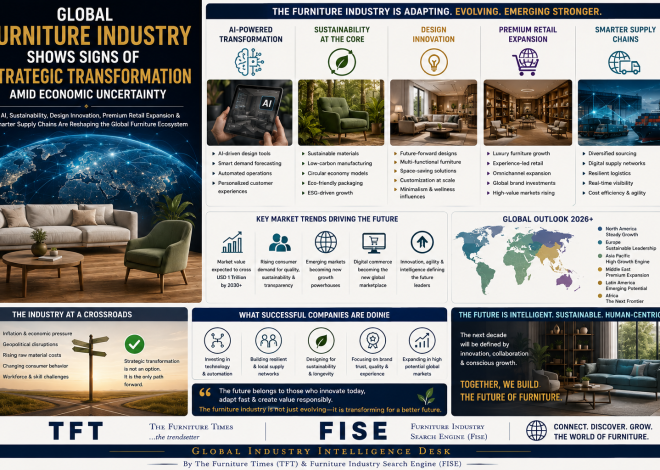
THE FURNITURE INDUSTRY IS NOT RETAIL — IT IS AN ECOSYSTEM
Today’s crisis reveals a deeper truth:
The furniture industry connects:
- Forestry & raw materials
- Manufacturing & industrial clusters
- Global logistics & shipping
- Real estate & infrastructure
- Hospitality & tourism
- Retail, e-commerce & digital platforms
Growth drivers like real estate expansion, urbanization, and commercial development continue to fuel demand globally
But conflict exposes a critical weakness: The ecosystem is fragmented, not synchronized
CURRENT MARKET REALITY (2026)
What is happening now:
- Rising costs across the entire value chain
- Delayed project completions (hotels, offices, housing)
- Reduced consumer spending in uncertain economies
- Overstocking in some regions, shortages in others
What is still growing:
- E-commerce furniture sales
- Modular and affordable furniture
- Emerging markets (Middle East, Southeast Asia, Africa)
- Contract furniture (hospitality, commercial projects)
The industry is not collapsing — it is restructuring under pressure.
STRATEGIC SHIFT: FROM MARKET TO SYSTEM THINKING
This moment defines a major transformation:
Old Model:
- Isolated manufacturers
- Local distributors
- Fragmented supply chains
New Reality:
- Integrated global ecosystems
- Data-driven sourcing & distribution
- Multi-country manufacturing strategies
- Digital-first visibility (search, listings, platforms)
THE BIG INSIGHT (2026)
The global conflicts are not just disruptions — they are revealing the true nature of the industry:
The furniture industry is not a $1 trillion market.
It is a $1 trillion interconnected system — and it lacks a central operating structure.
WHAT COMES NEXT (2026–2030 OUTLOOK)
1. Supply Chain Reconfiguration
- Multi-country sourcing (China + Vietnam + India + Malaysia)
- Nearshoring strategies (Europe, USA)
2. Cost Volatility Becomes Permanent
- Fuel, logistics, and raw material prices remain unstable
3. Rise of Digital Infrastructure
- Search engines
- Industry platforms
- Data ecosystems
4. Industry Consolidation
- Larger players gain advantage
- SMEs struggle without visibility
FINAL WORD — GLOBAL INDUSTRY ALERT
The ongoing conflicts across:
- Middle East (Iran–USA–Israel)
- Eastern Europe (Russia–Ukraine)
- Global shipping corridors
…are not isolated geopolitical events.
They are directly rewriting the future of the global furniture industry.
Conclusion
The furniture industry stands at a defining moment:
- It is growing toward $1 trillion+ scale
- It is deeply dependent on global stability
- It is structurally fragmented
And in times of conflict:
Fragmented systems break. Integrated ecosystems survive.