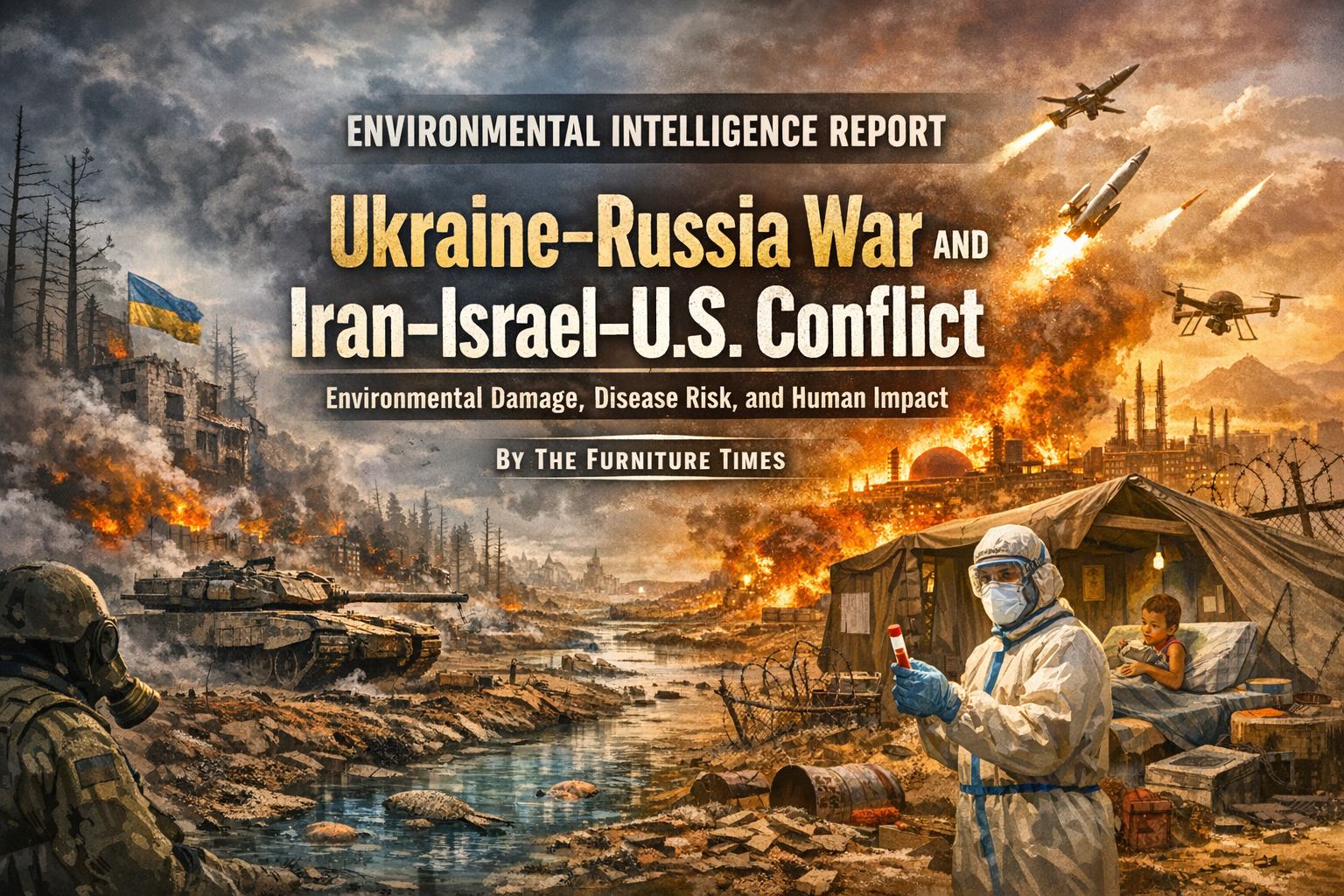
Environmental Intelligence Report
Ukraine–Russia War and Iran–Israel–U.S. Conflict: Environmental Damage, Disease Risk, and Human Impact
Modern war damages more than cities and armies. It contaminates air, water, soil, food systems, and public health infrastructure. In Ukraine, the World Health Organization says the war has caused widespread damage to energy, water, and health-care systems, while UN and Ukrainian government sources say the conflict has generated over 10 million tons of rubble and waste and environmental damage exceeding UAH 6 trillion.
In the Middle East, the current Iran–Israel–U.S. conflict is producing a different but equally serious pattern of environmental harm: oil fires, petrochemical strikes, shipping disruption, and risks to desalination and water infrastructure. UNEP warned in March 2026 that burning oil and related smoke in Iran contain hazardous compounds that pose serious long-term risks to both human and environmental health, and AP reported that threats to desalination facilities could trigger a humanitarian water crisis across parts of the Gulf.
1. Air pollution is one of the fastest environmental harms
War rapidly degrades air quality through burning fuel depots, industrial explosions, vehicle fires, and damage to power and petrochemical infrastructure. UNEP says smoke from burning oil in the Middle East includes hazardous compounds and particulates that people are directly inhaling, including children. WHO also notes that air pollution is already a major public-health killer in Europe even outside wartime conditions, which helps explain why conflict-related spikes are so dangerous.
In Ukraine, repeated attacks on energy and industrial infrastructure worsen the same problem. WHO’s 2025 Ukraine summer risk assessment says the war has damaged energy, water, and health systems, increasing vulnerability during heat and other seasonal stresses. UN and UNEP recovery work in Ukraine has focused in part on environmental restoration precisely because conflict-related damage is so broad and persistent.
2. Water systems are a major environmental and human-security flashpoint
Water damage is one of the most dangerous pathways from war to disease. WHO and UNICEF have emphasized the need to secure safe drinking water for Ukrainians, while humanitarian planning documents estimate that millions of people in Ukraine need water, sanitation, and hygiene services because infrastructure has been damaged or constrained by the war. WHO’s emergency appeal for Ukraine also warns that attacks on infrastructure can disrupt water treatment and distribution, increasing infection risks.
In the Iran–Israel–U.S. conflict, water risk is tied not only to pollution but also to desalination. AP reported that attacks or threats involving desalination and energy facilities in the Gulf could leave heavily desalination-dependent states facing acute shortages. Because these systems are tightly linked to power infrastructure, war damage can quickly become a water-supply emergency.
3. Soil, waste, and ecosystem damage last long after fighting
The environmental burden of war is often measured in debris, contamination, and damaged ecosystems that persist for years. UN analysis on Ukraine says the war has produced over 10 million tons of rubble and waste, along with agricultural soil disturbances and explosive contamination risks. Ukraine’s government has estimated environmental damage from Russia’s aggression at more than UAH 6 trillion.
These effects are not only local. Damaged farmland, contaminated soils, and destroyed wetlands weaken biodiversity, food production, and water retention. UNEP’s work on Ukraine recovery and environmental assessment reflects how post-war reconstruction now includes ecological restoration, not just rebuilding roads and buildings.
4. War can worsen disease risk even without a direct outbreak headline
The clearest health link is not that war automatically creates a specific epidemic, but that it raises the probability of respiratory illness, waterborne disease, and infection by destroying the systems that normally prevent them. WHO’s Ukraine appeal explicitly ties damaged water infrastructure to higher infection risk, and humanitarian planning for Ukraine shows that millions need WASH support.
In practical terms, disease risk rises through four channels: polluted air, unsafe water, crowded displacement settings, and weakened health systems. WHO’s Ukraine risk assessment describes exactly this kind of compounded vulnerability, where conflict damage interacts with heat, seasonal pressures, and fragile public services.
5. The Middle East war also has a global climate and pollution effect
The Iran–Israel–U.S. war is not only a regional environmental issue. Reuters reported that the conflict has triggered what the International Energy Agency called the largest-ever disruption to the global oil market, with major impacts on oil and LNG flows. In response, countries have been falling back on dirtier fuels. The Guardian reported that parts of Asia have ramped up coal use to cover energy shortfalls caused by the war, worsening air pollution and climate impacts.
This creates a second-order environmental effect: war damages the environment directly, then also pushes countries toward more polluting energy choices. The World Economic Forum summarized UN concern that the Middle East conflict should accelerate, not delay, the shift to renewables because fossil-fuel instability is now both a security and climate problem.
6. Human lives are hit through displacement, health stress, and economic fallout
Environmental damage from war translates quickly into human suffering. In Ukraine, destroyed water, energy, and health infrastructure raise health risks and reduce resilience. In the Middle East, threats to water systems, oil infrastructure, and shipping raise the danger of shortages, higher living costs, and disrupted essential services.
The global spillover matters too. Reuters reports that the IMF has warned the Iran war is dimming the outlook for many economies, with poorer countries particularly vulnerable because of rising food and fertilizer costs. That means war-driven environmental and energy shocks can amplify malnutrition, poverty, and public-health stress far beyond the conflict zone itself.
7. Regional vs global impact
The Ukraine–Russia war has had especially severe regional effects on land, water, waste, and infrastructure inside Ukraine, with long-term consequences for ecosystems and public health. The Iran–Israel–U.S. conflict, while also causing direct local environmental damage, currently stands out for its global spillovers through oil, LNG, desalination risk, and shipping disruption.
A useful way to distinguish them is this: Ukraine shows how prolonged land war degrades national ecosystems over time; the Middle East conflict shows how attacks on energy and petrochemical systems can create fast-moving cross-border environmental and economic shocks. Both are severe, but their transmission patterns differ. This is an inference based on WHO, UNEP, IMF, and AP reporting.
Final assessment
The biggest environmental lesson from both wars is that conflict damage does not end when missiles stop. It persists in polluted air, unsafe water, contaminated land, climate backsliding, and weakened health systems. Ukraine shows the cumulative ecological burden of prolonged war. The Iran–Israel–U.S. conflict shows how quickly environmental damage can become a global energy, water, and public-health problem.
The most defensible conclusion from current evidence is this: war is now an environmental-security crisis as much as a military one. Governments and industries that treat environmental recovery, water protection, and public-health resilience as secondary issues will pay a much larger long-term price.