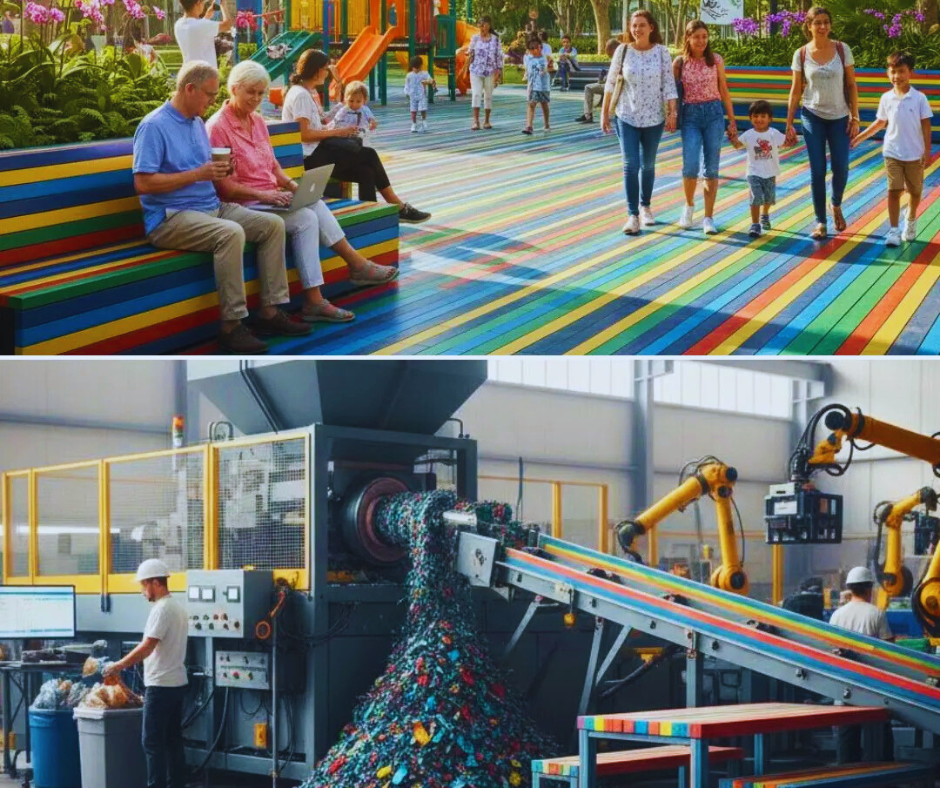
Singapore Turns Ocean-Bound Plastic into Durable Public Furniture — Making Circular Economy Visible
By The Furniture Times – Sustainability & Circular Economy Desk
SINGAPORE — In a pioneering environmental initiative, Singapore is transforming ocean-bound plastic waste into durable public furniture such as benches, decking and urban fixtures, bringing the principles of the circular economy into everyday public life. The programme, part of Singapore’s broader National Action Strategy on Marine Litter, merges environmental stewardship with public engagement, turning once discarded plastic into functional assets that citizens can interact with and appreciate.
The project involves collecting plastic waste from local waterways and coastal areas, sorting and cleaning it, and processing it into raw materials used for public urban furniture. By converting plastic that might otherwise end up polluting marine and coastal ecosystems into long-lasting benches and decking, Singapore aims to both reduce environmental pollution and demonstrate practical applications of recycled materials in urban environments.
Making Sustainability Tangible in Public Spaces
Officials associated with the programme say the initiative’s core objective is to make the often invisible issue of plastic pollution visible and tangible to citizens. Rather than relegating plastic recycling to behind-the-scenes processing facilities, Singapore’s strategy places recycled products directly in parks, pedestrian areas and public vistas — giving residents and visitors a firsthand experience of how waste can be transformed into useful infrastructure.
“We wanted to make an invisible problem visible,” said a representative from the National Environment Agency, underscoring that seeing and using items created from recycled ocean plastic helps cultivate public awareness and environmental responsibility.
Integration With National Strategy on Marine Litter
The furniture initiative forms part of Singapore’s National Action Strategy on Marine Litter, launched to address the dual challenge of land- and sea-based plastic waste. The strategy outlines a multi-pronged approach to tackling pollution, including behavioural change campaigns, policy interventions, and practical solutions for resource recovery and reuse.
Research indicates a significant proportion of plastic debris along Singapore’s shorelines originates from offshore sources, highlighting that marine plastic pollution is not solely a local issue but also a regional and global challenge.
In addition to recycling programmes, Singapore has implemented measures such as return-and-deposit schemes for beverage containers and regulatory actions aimed at reducing single-use plastic consumption, all of which support the broader sustainability agenda.
Community Engagement & Behavioural Impact
A notable element of Singapore’s approach is the emphasis on community engagement. Public furniture made from repurposed ocean plastic invites everyday interaction — residents sit on recycled benches, walk on decking crafted from waste, and encounter sustainability in a direct and relatable way. Experts say this strategy not only brings environmental issues into citizens’ daily lives but also encourages deeper understanding and long-term behavioural change.
Local environmental groups highlight that visible recycling solutions can foster a sense of ownership and responsibility, making abstract concepts like the circular economy more concrete for individuals.
Beyond Recycling: A Shift in Urban Design
The initiative also opens doors for collaboration between designers, engineers, artists, and sustainability advocates. By incorporating recycled materials into urban infrastructure, Singapore positions environmental innovation not just as a backend process but as an integral part of urban design and planning.
Experts believe such projects can inspire further innovation in material science, sustainable design applications and public policy frameworks aimed at mitigating plastic pollution more broadly.
Conclusion
Singapore’s transformation of ocean-bound plastic into durable public furniture exemplifies how circular economy principles can be made tangible and participatory. By showcasing the lifecycle of plastic — from waste to useful, visible products — the city-state is advancing sustainability literacy and encouraging civic engagement in environmental solutions.
This initiative underscores that tackling plastic pollution requires not only systemic policy action but also community involvement and public experience — transforming waste into shared infrastructure that educates, engages, and empowers citizens.

Related Posts

Massive Blaze Guts Furniture Shops in Bachupally, Hyderabad — No Casualties Reported

Global Furniture Industry Roundup — Current Trends, Challenges, and Market Momentum (March 2026)