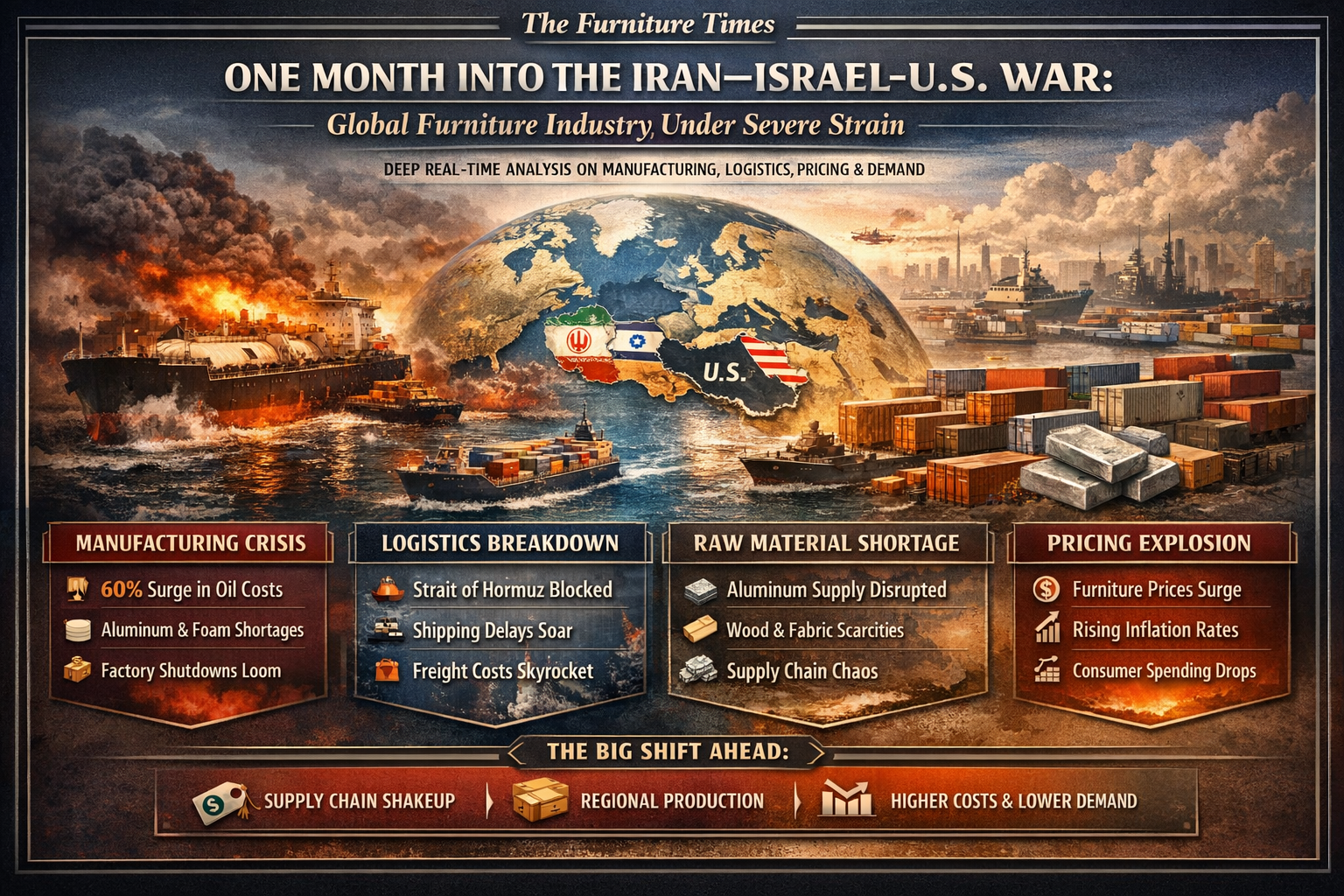
One Month Into the Iran–Israel–U.S. War: Global Furniture Industry Under Severe Strain
Deep Real-Time Analysis of the Worst Impact on Manufacturing, Logistics, Pricing, and Demand
One month into the Iran–Israel–U.S. war, the global furniture industry is no longer dealing with a distant geopolitical story. It is dealing with a direct business shock. What began as a regional military escalation has turned into an industry-wide stress test, hitting the furniture sector through the channels it depends on most: energy, shipping, materials, freight economics, and consumer confidence. The International Monetary Fund has warned that the war is dimming the outlook for many economies, while the Strait of Hormuz disruption has become a major global energy shock.
The furniture industry is especially exposed because it is one of the world’s most logistics-heavy consumer sectors. It depends on bulky shipments, long-distance sourcing, stable freight routes, affordable fuel, chemical inputs, metals, foams, packaging, and predictable consumer spending. When conflict disrupts oil flows, maritime routes, and sentiment all at once, furniture feels the damage faster than many categories. Brent crude has surged above $110, in some reports nearing $117, as the war intensified and the closure of the Strait of Hormuz amplified fears of a wider supply crisis.
The biggest shock: logistics first, demand second
The first and worst impact has been on logistics. Furniture is not a light, fast-moving product. It is container-intensive, cost-sensitive, and timing-dependent. When the Hormuz corridor is disrupted, the problem is not just oil prices. It is insurance, rerouting, shipping capacity, delivery schedules, and planning confidence. AP reports that the war is choking a large share of Middle East energy flows, especially affecting Asia, while Reuters says the current disruption has become severe enough for the IMF and the IEA to treat it as a major global economic event.
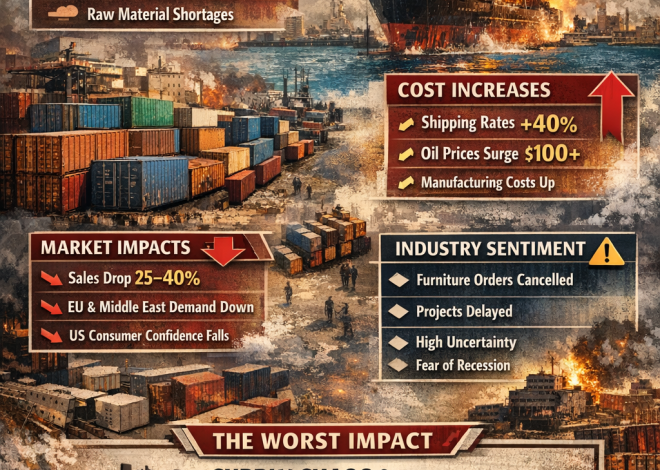
For furniture manufacturers, that translates into four immediate problems. Freight gets more expensive. Fuel-linked surcharges climb. Lead times become less reliable. Buyers become more hesitant to commit. In other words, the industry is being squeezed from both sides: cost inflation on one end, weaker confidence on the other.
Oil is now the industry’s hidden enemy
The war’s most damaging transmission mechanism into furniture is oil. Rising oil prices are not just an energy story. They feed directly into ocean freight, trucking, warehousing, petrochemical inputs, plastics, synthetic fabrics, foam, adhesives, coatings, and even retail operating costs. Reuters reports that the war is already disrupting recovery for many economies, while other coverage shows aluminium prices and fuel costs rising sharply alongside oil.
This matters because furniture companies typically do not have the pricing power of luxury energy producers or software companies. Many sit in the uncomfortable middle: too exposed to input inflation to absorb it easily, but too dependent on price-sensitive consumers to pass it through fully. That is why the current war is not just reducing efficiency. It is attacking margins.
The worst impact on the industry: supply chaos and production disruption
The worst impact so far is not a single store closure or a one-off delay. It is the growing risk of supply chaos spreading into production planning itself. Once shipping becomes unstable and input costs spike, factories begin to slow, reprioritize, or delay. China’s March factory data showed resilience, but AP noted that analysts are already warning a prolonged war could hurt industrial production and exports, especially if maritime routes remain constrained and higher inflation weakens demand.
That is the real danger for the furniture sector: not only expensive goods movement, but a chain reaction in which factories cannot plan confidently, buyers postpone orders, retailers reduce inventory risk, and suppliers hold back. When that happens, the industry moves from disruption into paralysis.
Value retail is holding better than premium
On the demand side, the war is creating a second major effect: households are becoming more defensive. Higher fuel prices, food inflation, and broader macro fear are reducing discretionary spending. In the U.S., gasoline has risen above $4 a gallon, a sharp jump from just before the war began, increasing pressure on household budgets.
That shift has major implications for furniture. Consumers are not stopping all purchases, but they are becoming more selective. Value retail is likely to hold up better than premium discretionary segments. This is consistent with recent market commentary around affordable furniture retail, where lower-price operators appear more resilient during the current shock. That means the post-war furniture market, at least in the near term, is likely to reward affordability, practical assortments, and fast decision-making more than aspirational lifestyle merchandising.
Asia faces the sharpest operational exposure
Asia may bear the heaviest operational burden because it remains the core production base for global furniture while also being highly exposed to Middle East energy routes. AP reports that oil-thirsty Asian nations are already scrambling for alternative crude sources as the conflict strains supply.
For the furniture industry, this means Asia faces a double risk: higher energy input costs and weaker export visibility. Countries and companies that rely on long shipping schedules and thin operating margins are especially vulnerable. Even if goods can still move, the economics of moving them are deteriorating.
Europe and North America are feeling the inflation side
Europe and North America are seeing more of the inflation and demand effect. Rising fuel costs, elevated materials prices, and broader inflation expectations are weighing on consumer confidence and business planning. The IMF has explicitly warned that the conflict is likely to slow growth and raise prices, with poorer and more energy-import-dependent economies especially vulnerable.
In practical furniture terms, that means delayed renovation cycles, slower order decisions, more price comparison, and higher sensitivity to freight-heavy products. Large, bulky, imported furniture will face more resistance than categories with local stock, faster fulfillment, or strong value positioning.
What the industry is learning in real time
The real-time lesson from the first month of war is stark: the furniture industry is far more exposed to geopolitical disruption than many executives may have assumed. It is not only a design and retail business. It is a freight, energy, and systems business. Companies that thought of logistics as a backend function are now being forced to treat it as strategy.
The businesses likely to come out stronger will be the ones that do five things quickly: diversify sourcing, shorten supply chains where possible, improve inventory discipline, protect value positioning, and invest in better market intelligence. The crisis is revealing that resilience, not just product, is becoming the new competitive advantage.
Final insight
One month into the conflict, the global furniture industry is not facing a normal downturn. It is facing a structural shock. The worst impact so far is the combination of energy disruption, freight instability, input inflation, and demand hesitation all arriving at once. That is what makes this moment so dangerous.
In peaceful times, furniture competes on design, comfort, and price. In wartime conditions, it competes on movement, resilience, and control.
Q: How is the Iran–Israel–U.S. war affecting the furniture industry?
A: The war is impacting the furniture industry through rising oil prices, disrupted shipping routes like the Strait of Hormuz, increased logistics costs, and declining consumer demand, creating both supply chain instability and margin pressure.
“Wars don’t just destroy markets — they redistribute power. The furniture industry is being reset.” Dr. Bilal Ahmad Bhat