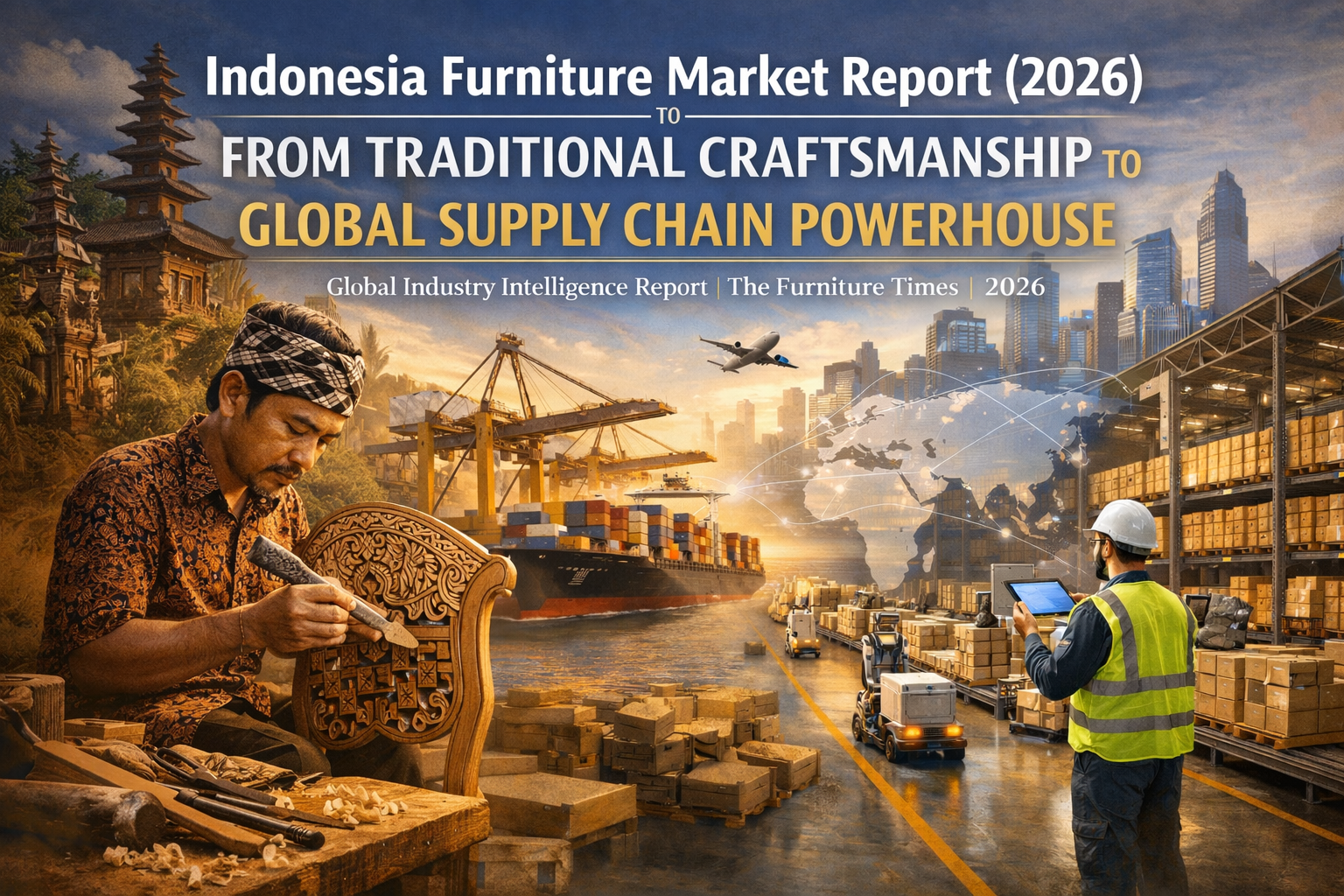
Indonesia Furniture Market Report (2026)
From Traditional Craftsmanship to Global Supply Chain Powerhouse
Global Industry Intelligence Report | The Furniture Times | 2026
1. EXECUTIVE SUMMARY
Indonesia stands as one of the most strategically important furniture markets in Southeast Asia, combining:
- Abundant natural resources (timber, rattan, bamboo)
- A strong export-oriented manufacturing base
- Growing domestic consumption driven by urbanization
As of 2025–2026:
- Market size: ~USD 9.1 billion (2025)
- Forecast: USD 15.2 billion by 2032–2034
- CAGR: ~5.8%–8.7% (2026–2034)
Indonesia is transitioning from a low-cost exporter to a design-led, value-added manufacturing hub.
2. MARKET SIZE & STRUCTURE
2.1 Market Evolution
| Year | Market Size |
| 2024 | ~$8.6 Billion |
| 2025 | ~$9.1 Billion |
| 2030 | ~$11.0 Billion |
| 2032–2034 | ~$15.2 Billion |
Key Insight:
Indonesia is a mid-scale but high-growth market, positioned between:
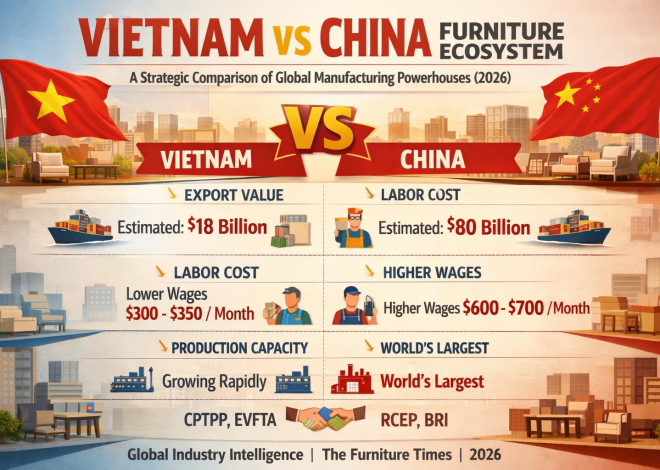
- Vietnam (export-driven efficiency)
- China (scale dominance)
2.2 Segment Breakdown
By Product:
- Residential furniture (largest segment)
- Office furniture (growing with hybrid work)
- Hospitality furniture (tourism-driven)
- Outdoor furniture (strong niche strength)
- Custom / handcrafted furniture (premium export segment)
By Material:
- Wood (dominant – teak, mahogany)
- Rattan (global leadership)
- Metal & plastic (growing industrial segment)
Wooden furniture accounts for ~68% of exports
3. EXPORT POWER & GLOBAL POSITIONING
3.1 Export Strength
Indonesia is a top global exporter of furniture, with:
- Export target: $6–7 billion+ annually
- Key markets:
- 🇺🇸 United States (largest – ~55%)
- 🇪🇺 Europe
- 🇯🇵 Japan
- 🇦🇺 Australia
Strategic Advantage:
Indonesia dominates in:
- Handcrafted wood furniture
- Rattan furniture (global leader)
- Outdoor & hospitality furniture
3.2 Role in Global Supply Chain
Indonesia is increasingly seen as:
✔ Alternative to China
✔ Complement to Vietnam
✔ Premium sourcing destination for handcrafted products
4. KEY INDUSTRY DRIVERS
4.1 Urbanization & Middle-Class Growth
- Rising disposable income is boosting home furnishing demand
- Strong residential development pipeline
Government housing programs support demand expansion
4.2 E-Commerce & Digital Retail
- Furniture e-commerce revenue: $4.4 billion (2025)
- Expected growth: 10–15% annually
Impact:
- Expands reach to Tier-2 and Tier-3 cities
- Enables D2C furniture brands
4.3 Tourism & Hospitality Expansion
Indonesia’s tourism (Bali, Lombok, Jakarta, etc.) drives:
- Resort furniture demand
- Outdoor furniture demand
- Premium hospitality projects
4.4 Government Support
- Timber legality system (SVLK certification)
- Export incentives
- Downstream wood processing policies
5. KEY MARKET TRENDS (2026–2030)
5.1 Sustainable & Eco-Friendly Furniture
- FSC-certified wood demand rising
- Recycled materials gaining traction
5.2 Customization & OEM/ODM Growth
- Buyers demand tailored designs
- Strong opportunity for contract manufacturing
5.3 Rise of Minimalist & Modern Designs
- Influenced by global trends
- Strong demand in urban markets
5.4 Smart Furniture & Functional Design
- Growth in:
- Home office furniture
- Multi-functional furniture
6. DOMESTIC MARKET ANALYSIS
6.1 Home Furniture Segment
- Valuation: ~$9.6 billion (2025)
- Growth driven by:
- Urban housing demand
- Lifestyle upgrades
6.2 Office Furniture Segment
- Growth supported by:
- Hybrid work trends
- SME expansion
6.3 Hospitality Furniture Segment
- Key cities:
- Bali
- Jakarta
- Surabaya
7. COMPETITIVE LANDSCAPE
7.1 Key Players
- Local manufacturers (Jepara-based clusters)
- Export-oriented SMEs
- International brands (e.g., IKEA Indonesia)
7.2 Industry Structure
- Highly fragmented
- Strong SME ecosystem
- Regional production clusters:
- Jepara (wood carving hub)
- Cirebon (rattan furniture)
- Surabaya (industrial furniture)
8. VALUE CHAIN ANALYSIS
Upstream:
- Timber, rattan, raw materials
Midstream:
- Manufacturing & craftsmanship
Downstream:
- Exporters
- Retail chains
- E-commerce platforms
9. CHALLENGES & RISKS
9.1 Raw Material Price Volatility
- Timber costs fluctuate
- Supply chain disruptions
9.2 Global Competition
- Vietnam (cost efficiency)
- China (scale & automation)
9.3 Fragmentation
- Lack of consolidation
- Limited global branding
9.4 Compliance & Regulations
- Export certifications (SVLK, sustainability)
10. OPPORTUNITIES & FUTURE OUTLOOK
10.1 Export Expansion
- Potential to reach:
$10B+ export economy
10.2 Digital Transformation
- E-commerce + AI-driven discovery
- Platforms like:
- Industry search engines (FISE-type systems)
- Global B2B marketplaces
10.3 Premium Branding Opportunity
Indonesia can move toward:
✔ “Made in Indonesia” luxury positioning
✔ High-value craftsmanship branding
11. STRATEGIC POSITIONING (GLOBAL COMPARISON)
| Factor | Indonesia | Vietnam | China |
| Strength | Craftsmanship | Efficiency | Scale |
| Cost | Medium | Low | Medium |
| Design | High | Medium | High |
| Export Focus | Strong | Very Strong | Very Strong |
| Automation | Low–Medium | Medium | High |
12. FUTURE FORECAST (2030–2035)
Indonesia is expected to become:
Top 5 Global Furniture Exporter
Global Leader in Sustainable Furniture
Premium Craft + Design Hub
13. CONCLUSION
Indonesia’s furniture industry is at a critical transformation stage:
From:
Raw material + low-cost production
To:
Design-driven + global brand ecosystem
FINAL INSIGHT (TFT INTELLIGENCE)
Indonesia is not just a furniture manufacturing country.
It is becoming a global furniture identity.
If supported by:
- Digital infrastructure (FISE-type platforms)
- Branding strategy
- Supply chain integration
Then Indonesia can:
Compete with Vietnam in exports
Challenge China in premium segments
Lead the world in sustainable furniture