Global Furniture Industry Hit by Geopolitical Shock
One Month After Iran–Israel–USA Conflict, Supply Chains Face Severe Disruption
Global Industry Analysis | The Furniture Times | April 2026
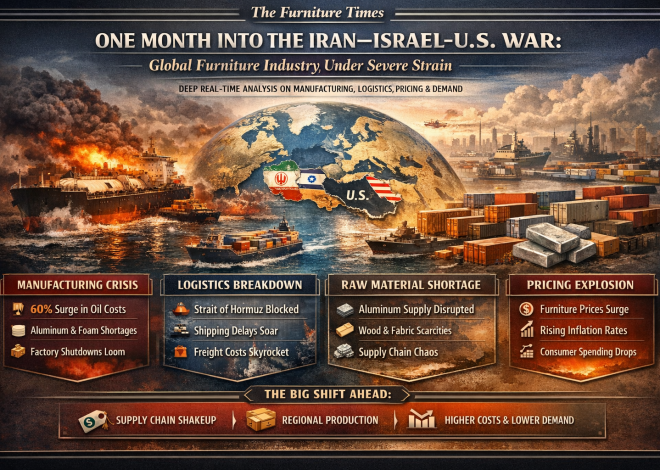
One month into escalating tensions involving Iran, Israel, and the United States, the global furniture industry is experiencing one of its most severe operational shocks in recent years.
While the conflict is geopolitical in nature, its ripple effects have rapidly extended into global trade, logistics, manufacturing, and consumer demand—placing the furniture sector under intense pressure.
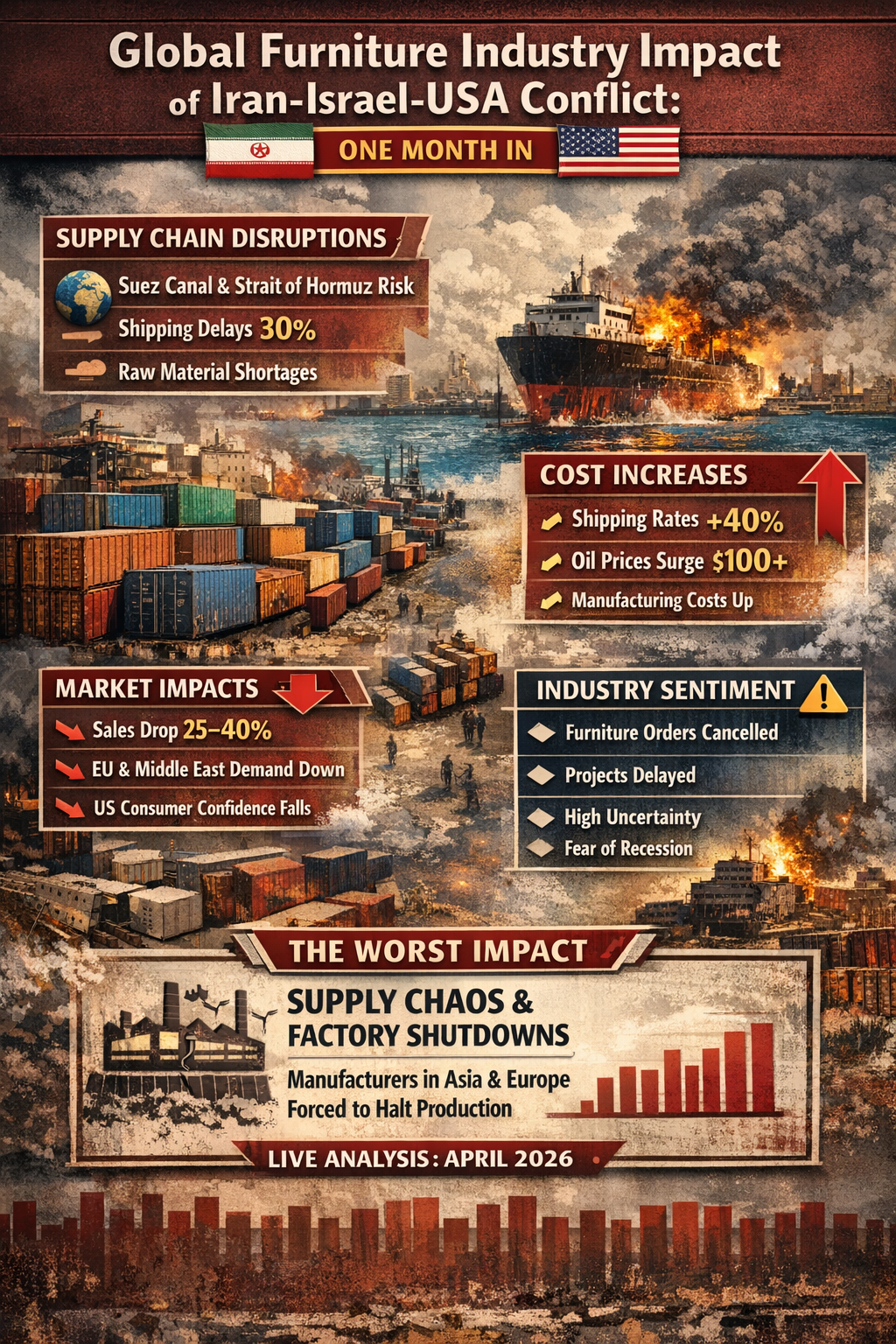
1. The Immediate Shock: Supply Chain Disruption
The most critical impact has been on global shipping routes, particularly:
- Strait of Hormuz
- Suez Canal-linked trade corridors
What’s Happening:
- shipping delays increasing significantly
- container movement slowing across key routes
- insurance costs for cargo rising sharply
Impact on Furniture Industry:
👉 Furniture is a bulk, high-volume product
👉 Any delay = major disruption
Result:
- delayed exports from Asia
- disrupted supply to Europe & US
- backlog in global logistics
2. Cost Explosion Across the Value Chain
Within just one month, the industry has seen:
Rising Costs:
- shipping costs increasing sharply
- oil prices surging (impacting freight)
- raw material prices fluctuating
Why This Matters:
Furniture operates on:
tight margins + high logistics dependency
Result:
- manufacturers forced to increase prices
- retailers facing reduced margins
- consumers delaying purchases
3. Manufacturing Under Pressure
The disruption is now moving upstream into production.
Key Issues:
- raw material delays
- production planning uncertainty
- export scheduling breakdown
Worst Case Scenario Emerging:
Some factories in Asia and Europe are:
- slowing production
- delaying orders
- temporarily halting operations
This is not just a logistics issue anymore —
it is becoming a production crisis
4. Demand Shock: The Silent Impact
While supply is affected, demand is also weakening.
Market Impact:
- decline in consumer confidence
- reduced discretionary spending
- project delays (hospitality, commercial spaces)
Regions Affected:
- Europe → demand slowdown
- Middle East → project uncertainty
- United States → cautious consumer behavior
Furniture is a non-essential purchase category
It reacts quickly to economic fear
5. Industry Sentiment: Uncertainty Rising
Across the industry:
- orders being postponed
- contracts under review
- buyers becoming risk-averse
What Businesses Are Experiencing:
“Wait and watch” strategy
delayed procurement decisions
cautious inventory planning
👉 Uncertainty is now the biggest risk.
6. The Worst Impact: Supply Chaos & Production Breakdown
After one month, the most severe outcome is clear:
The Biggest Threat:
Supply Chain Chaos + Factory Disruptions
What This Means:
- broken supply timelines
- unpredictable delivery schedules
- increasing cancellations
This creates a domino effect:
Factory → Logistics → Retail → Consumer
Entire ecosystem destabilized.
7. Structural Weakness Exposed
This crisis has revealed a major truth:
The furniture industry is:
- highly fragmented
- logistics-dependent
- lacking centralized control
There is no unified system to:
- track supply globally
- manage disruptions
- coordinate response
Insight:
This is not just a crisis
It is an exposure of structural weakness
8. What Happens Next? (Real-Time Outlook)
If tensions continue:
Short-Term (1–3 Months):
- continued delays
- rising costs
- reduced demand
Mid-Term (3–6 Months):
- supply shortages
- price inflation
- industry consolidation
Long-Term Impact:
- shift toward regional manufacturing
- increased logistics investment
- rise of digital platforms (FISE-type systems)
FINAL INSIGHT
The Iran–Israel–USA conflict is not just a geopolitical event—
It is a stress test for the global furniture industry
KEY TAKEAWAY:
The companies that survive will be those that:
- control logistics
- adapt supply chains
- leverage data and platforms
“In times of global conflict, the furniture industry is not tested by design or price — but by its ability to move.”