
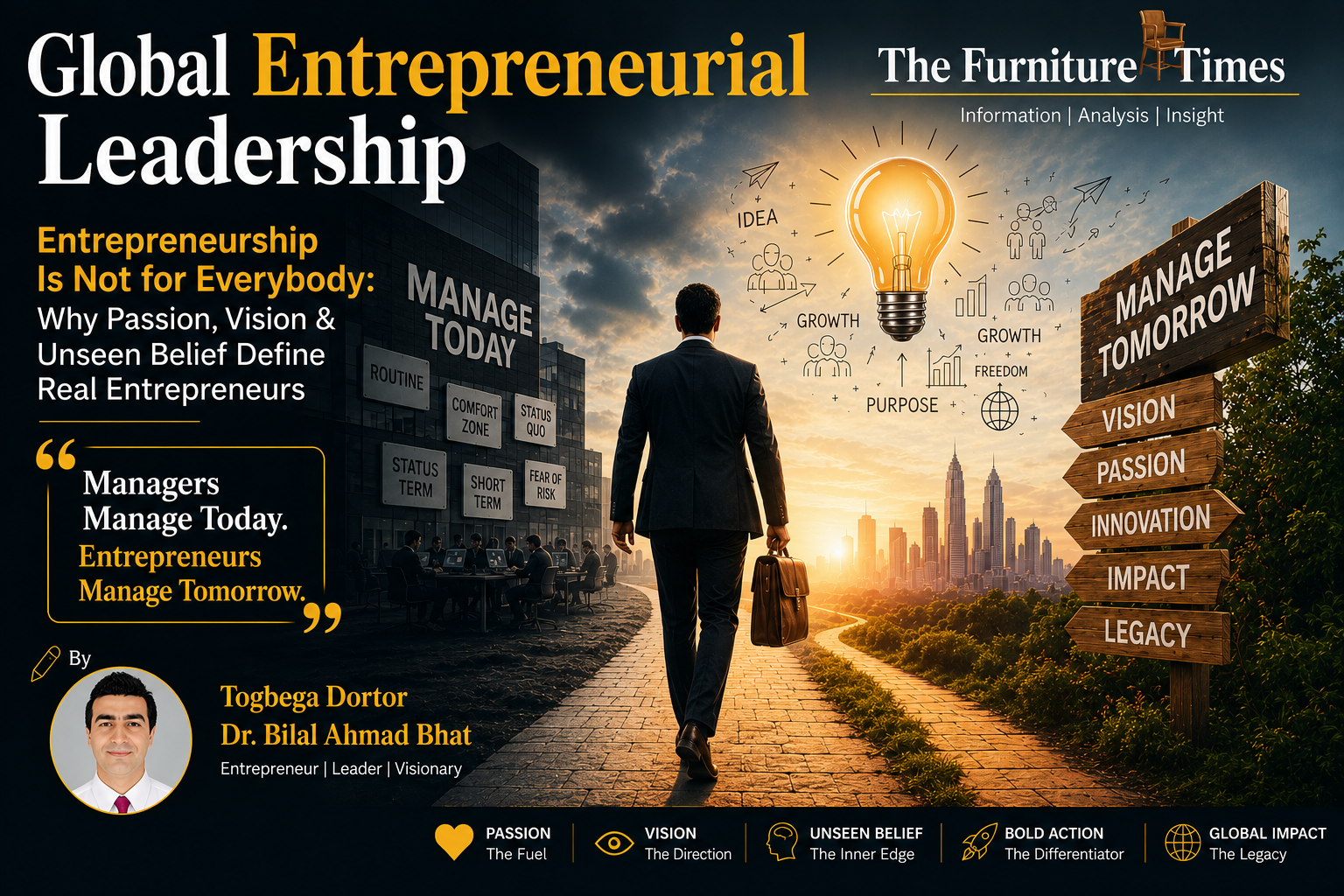
Global Entrepreneurial Leadership
Entrepreneurship Is Not for Everybody: Why Passion, Vision & Unseen Belief Define Real Entrepreneurs
“Managers Manage Today. Entrepreneurs Manage Tomorrow.”
Global Entrepreneurial Leadership | The Furniture Times | By Togbega Dortor Dr. Bilal Ahmad Bhat
In a world where entrepreneurship is often glamorized through social media headlines, luxury lifestyles, and overnight success stories, the truth about entrepreneurship is becoming increasingly misunderstood.
Many people today want the title of “entrepreneur.”
Very few are truly willing to live the reality of entrepreneurship.
According to Togbega Dortor Dr. Bilal Ahmad Bhat, entrepreneurship is not a trend, a shortcut to wealth, or a motivational slogan.
“Entrepreneurship is not for everybody.
It is for those who carry vision, passion, sacrifice, and the courage to believe in something unseen.”
For Dr. Bilal Ahmad Bhat, entrepreneurship is not simply about starting businesses. It is about transforming oneself continuously while carrying uncertainty, pressure, responsibility, and long-term thinking.
The Great Misunderstanding About Entrepreneurship
Modern society often celebrates entrepreneurship as if it is an easy pathway to freedom and financial success. Social media platforms are filled with images of luxury, startups, and rapid growth stories.
But behind every real entrepreneurial journey lies:
- years of struggle
- uncertainty
- failures
- learning
- reinvention
- emotional resilience
Dr. Bilal believes one of the biggest misconceptions is the idea of overnight success.
“Entrepreneurship is not for those who want overnight success.
It is for those who are ready to build patiently when nobody believes in them.”
He explains that many people admire entrepreneurs from a distance, but few truly understand the emotional and psychological demands of building something from nothing.
“Managers Manage Today. Entrepreneurs Manage Tomorrow.”
One of Dr. Bilal Ahmad Bhat’s most powerful philosophies is:
“Managers manage today. Entrepreneurs manage tomorrow.”
This statement reflects the fundamental difference between operational thinking and visionary thinking.
Managers focus on:
- maintaining systems
- controlling operations
- achieving current objectives
Entrepreneurs, however, focus on:
- creating future systems
- identifying unseen opportunities
- building new ecosystems
- imagining possibilities before the world sees them
According to Dr. Bilal, entrepreneurs live mentally in the future long before others arrive there.
“The entrepreneur sees tomorrow before tomorrow exists.”
Why Many Talented People Never Become Entrepreneurs
Dr. Bilal Ahmad Bhat openly shares a difficult truth many people avoid discussing.
“I have witnessed hundreds of talented and smart people in my life.
Many are intelligent. Many are skilled.
But they still cannot become entrepreneurs.”
Why?
Because talent alone is not enough.
Entrepreneurship requires:
- risk tolerance
- emotional endurance
- obsession with learning
- discipline without supervision
- self-belief during uncertainty
Dr. Bilal explains that many individuals can perform exceptionally inside structured systems, but entrepreneurship requires building systems where none exist.
“You can impress people.
But you cannot change them unless they decide to change themselves.”
He believes entrepreneurship is deeply connected to mindset and inner identity.
Entrepreneurs Must Believe in the Unseen
Perhaps the most powerful characteristic of entrepreneurs is their ability to believe in things before they become visible.
Dr. Bilal describes entrepreneurship as a journey of unseen belief.
“You have to believe in the unseen.
If you truly believe, nobody can stop you from becoming an entrepreneur.”
This belief often appears irrational to others:
- building businesses without guarantees
- pursuing ideas before validation
- continuing despite rejection
- seeing opportunities inside chaos
Yet this invisible conviction becomes the driving force behind entrepreneurial persistence.
Are Entrepreneurs Born or Made?
This debate has existed for decades.
Some believe entrepreneurs are created entirely through education and experience. Others believe entrepreneurship is a natural trait.
Dr. Bilal offers a balanced but honest perspective:
“Many people say entrepreneurs are made.
But the truth is—they are born, then made.”
He explains that entrepreneurship often begins with:
- natural curiosity
- independent thinking
- unusual ambition
- discomfort with limitation
- desire to create
But natural traits alone are not enough.
The entrepreneurial journey then “makes” the individual through:
- failures
- learning
- adaptation
- pressure
- survival
- constant skill acquisition
“Entrepreneurship is a process of becoming.”
The Reality of Constant Learning
One of the strongest themes in Dr. Bilal Ahmad Bhat’s philosophy is continuous learning.
According to him, entrepreneurs never stop evolving.
“Every day you acquire a new set of skills.”
He explains that entrepreneurship demands multidimensional growth:
- communication
- negotiation
- leadership
- finance
- psychology
- sales
- systems thinking
- crisis management
- branding
- technology
- emotional intelligence
Unlike traditional career paths where responsibilities may remain specialized, entrepreneurs are forced to grow across multiple disciplines simultaneously.
This is why entrepreneurship becomes one of the most demanding forms of self-development.
“I Am an Accidental Entrepreneur”
Dr. Bilal Ahmad Bhat often describes himself as:
“An accidental entrepreneur.”
He explains that entrepreneurship was not originally a carefully planned identity. Instead, it evolved gradually through experience, struggle, responsibility, and vision.
But at some point, he consciously understood the deeper meaning of entrepreneurship.
“When I realized it, I started working on real entrepreneurship.”
For him, real entrepreneurship is not simply owning businesses.
It is:
- building systems
- solving problems
- creating ecosystems
- empowering industries
- thinking beyond personal gain
This realization transformed his entrepreneurial journey into something larger than business itself.
Entrepreneurship Is Emotional Endurance
Most people see:
- products
- companies
- profits
- public success
But they do not see:
- sleepless nights
- uncertainty
- rejection
- sacrifices
- emotional pressure
- fear of failure
Dr. Bilal believes entrepreneurship is one of the greatest emotional endurance tests a person can experience.
“Entrepreneurs continue even when results are invisible.”
This ability to continue despite uncertainty separates entrepreneurs from observers.
The Difference Between Employees and Entrepreneurs
Dr. Bilal makes an important distinction.
Employees work inside systems.
Entrepreneurs build systems.
Neither role is inferior, but they require completely different mental frameworks.
According to him:
- many excellent employees may never become entrepreneurs
- many excellent entrepreneurs may never fit traditional employment structures
Because entrepreneurship requires:
- self-direction
- ownership mentality
- long-term thinking
- extreme accountability
“It is very hard to make an employee an entrepreneur, or a manager an entrepreneur. The chances are slim.”
Not because employees lack intelligence, but because entrepreneurship requires an entirely different psychological operating system.
The Future Belongs to Builders
As industries transform globally through AI, automation, digital infrastructure, and connected ecosystems, entrepreneurship is becoming even more complex.
The future will reward individuals who:
- adapt quickly
- learn continuously
- build systems
- create value
- solve meaningful problems
Dr. Bilal believes the next generation of entrepreneurs must think beyond small personal success.
They must think about:
- industries
- ecosystems
- global impact
- long-term transformation
Final Thought
Entrepreneurship is not a shortcut.
It is not a motivational trend.
It is not a social media identity.
It is a lifelong process of:
- learning
- believing
- adapting
- surviving
- building
- evolving
And above all, entrepreneurship belongs to those who continue believing even when the world cannot yet see what they see.
“Managers manage today.
Entrepreneurs manage tomorrow.”
— Togbega Dortor Dr. Bilal Ahmad Bhat
