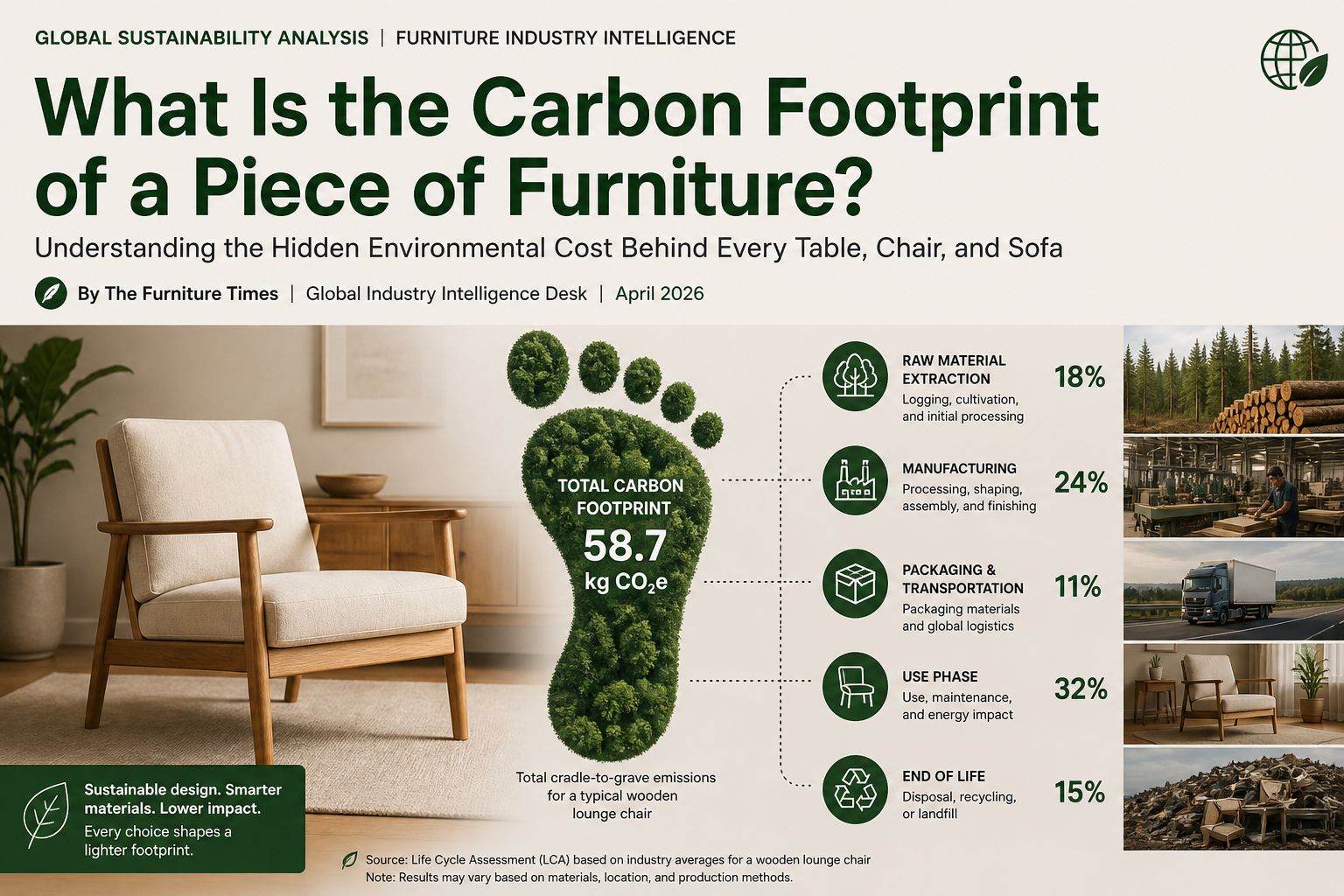
What Is the Carbon Footprint of a Piece of Furniture?
Global Sustainability Analysis | Furniture Industry Intelligence
Understanding the Hidden Environmental Cost Behind Every Table, Chair, and Sofa
By The Furniture Times | Global Industry Intelligence Desk | April 2026
Introduction: The Invisible Impact of Everyday Furniture
Every piece of furniture—whether a sofa, chair, table, or bed—carries an environmental cost that most buyers never see:
Its carbon footprint
As the global furniture industry crosses the $1 trillion mark, sustainability is no longer a trend—it is a necessity. Understanding the carbon footprint of furniture is now critical for:
- Manufacturers
- Retailers
- Designers
- Governments
- Consumers
Because the real question is no longer:
“How much does this furniture cost?”
But rather:
“What is the environmental cost of this furniture?”
What Is a Carbon Footprint?
The carbon footprint of a product refers to the total greenhouse gas (GHG) emissions generated throughout its lifecycle, measured in CO₂ equivalent (CO₂e).
For furniture, this includes emissions from:
- Raw material extraction
- Manufacturing and processing
- Transportation and logistics
- Usage and maintenance
- End-of-life disposal or recycling
The Lifecycle of Furniture: Where Emissions Come From
1. Raw Materials: The Largest Contributor
The biggest share of a furniture’s carbon footprint often comes from materials.
Wood-Based Furniture
- Logging, processing, drying, and transport
- If sustainably sourced, wood can store carbon
- If not, it contributes to deforestation
Metal Furniture
- High-energy production (steel, aluminum)
- Significant emissions during smelting
Plastic Furniture
- Derived from fossil fuels
- High carbon intensity unless recycled
Upholstered Furniture
- Foam, fabric, and adhesives increase emissions
- Complex multi-material structures
In many cases, materials account for 40–70% of total emissions.
2. Manufacturing: Energy & Industrial Processes
Furniture production involves:
- Cutting, shaping, assembling
- Finishing, polishing, coating
- Use of machinery and electricity
Factories powered by fossil fuels generate higher emissions, while renewable energy reduces the footprint significantly.
3. Transportation: The Global Supply Chain Impact
Furniture often travels across continents:
- Raw materials from one country
- Manufacturing in another
- Distribution to global markets
Shipping, trucking, and logistics contribute:
10–30% of total emissions
Flat-pack furniture reduces transport emissions, while bulky items increase them.
4. Usage Phase: Maintenance & Longevity
Furniture generally has low emissions during use—but:
- Cleaning chemicals
- Replacement cycles
- Wear and tear
impact the overall lifecycle.
The longer a product lasts, the lower its annual carbon footprint.
5. End-of-Life: Waste vs Circular Economy
At the end of its life, furniture can:
- Be reused
- Be recycled
- End up in landfills
Landfills generate methane (a potent greenhouse gas), while recycling reduces total lifecycle emissions.
How Much Carbon Does Furniture Produce?
The carbon footprint varies widely depending on product type.
Estimated Carbon Footprints:
- Wooden chair → 10–30 kg CO₂e
- Office desk → 50–150 kg CO₂e
- Sofa (upholstered) → 200–500 kg CO₂e
- Bed with mattress → 100–300 kg CO₂e
- Steel furniture → higher due to energy-intensive production
Upholstered and multi-material furniture tend to have the highest footprints.
The Hidden Problem: Complexity & Lack of Transparency
Here is the critical issue:
Most furniture buyers have no visibility into carbon impact.
Challenges include:
- No standard labeling system
- Limited product transparency
- Complex global supply chains
- Lack of data from manufacturers
This creates a carbon awareness gap in the industry.
TFT Deep Analysis: The Industry Is Entering the Carbon Economy
The furniture industry is evolving across three sustainability stages:
Stage 1: Awareness
Consumers begin asking sustainability questions
Stage 2: Certification
Adoption of standards like FSC, eco-labels
Stage 3: Carbon Intelligence (Next Phase)
Focus on:
- Measurable carbon footprints
- Lifecycle analysis
- Data-driven sustainability decisions
Why Carbon Footprint Matters Now
1. Regulatory Pressure
Governments are introducing:
- Carbon reporting requirements
- ESG standards
- Sustainability compliance
2. Consumer Demand
Buyers increasingly prefer:
- Eco-friendly products
- Transparent sourcing
- Sustainable brands
3. Business Competitiveness
Companies that reduce carbon footprint gain:
- Export advantages
- Brand value
- Investor confidence
How the Industry Can Reduce Carbon Footprint
1. Sustainable Materials
- FSC-certified wood
- Recycled materials
- Bio-based alternatives
2. Energy-Efficient Manufacturing
- Renewable energy use
- Efficient production systems
- Reduced waste
3. Smart Logistics
- Local sourcing
- Optimized shipping
- Flat-pack design
4. Longer Product Lifespan
- Durable construction
- Repairable design
- Modular systems
5. Circular Economy Models
- Recycling programs
- Buy-back systems
- Refurbishment
Role of FISE: Enabling Carbon Transparency
One of the biggest gaps in the industry is lack of structured carbon data visibility.
Furniture Industry Search Engine (FISE) can play a critical role by:
- Displaying sustainability indicators
- Showing certifications (e.g., FSC)
- Enabling carbon footprint comparison
- Highlighting eco-friendly suppliers
- Creating sustainability-based filters
Example Use Case
A buyer searching for:
“Sustainable office furniture with low carbon footprint”
Today:
- Limited visibility
- No comparison tools
With FISE:
- Verified suppliers
- Sustainability filters
- Faster, smarter decisions
Key Takeaways
1. Every Furniture Product Has a Carbon Footprint
From raw materials to disposal
2. Materials Drive Most Emissions
Especially metal, plastic, and upholstery
3. Longevity Reduces Impact
Long-lasting furniture = lower footprint
4. Transparency Is Still Missing
Buyers lack clear data
5. The Industry Must Move Toward Carbon Intelligence
Data-driven sustainability is the future
Conclusion: The Future Is Measured
The furniture industry is entering a new era.
It is no longer enough to design beautiful, functional products.
The next generation of furniture must be:
- Sustainable
- Transparent
- Measurable
Final Thought
Every piece of furniture tells a story.
In the future, that story will include its carbon footprint.
And the winners in the global furniture ecosystem will be those who can answer:
Not just “What do you sell?”
But “What impact does it create?”

Related Posts
Global Furniture Industry Shows Signs of Strategic Transformation Amid Economic Uncertainty
Why Core Values Will Become the New Competitive Advantage in the Furniture Industry