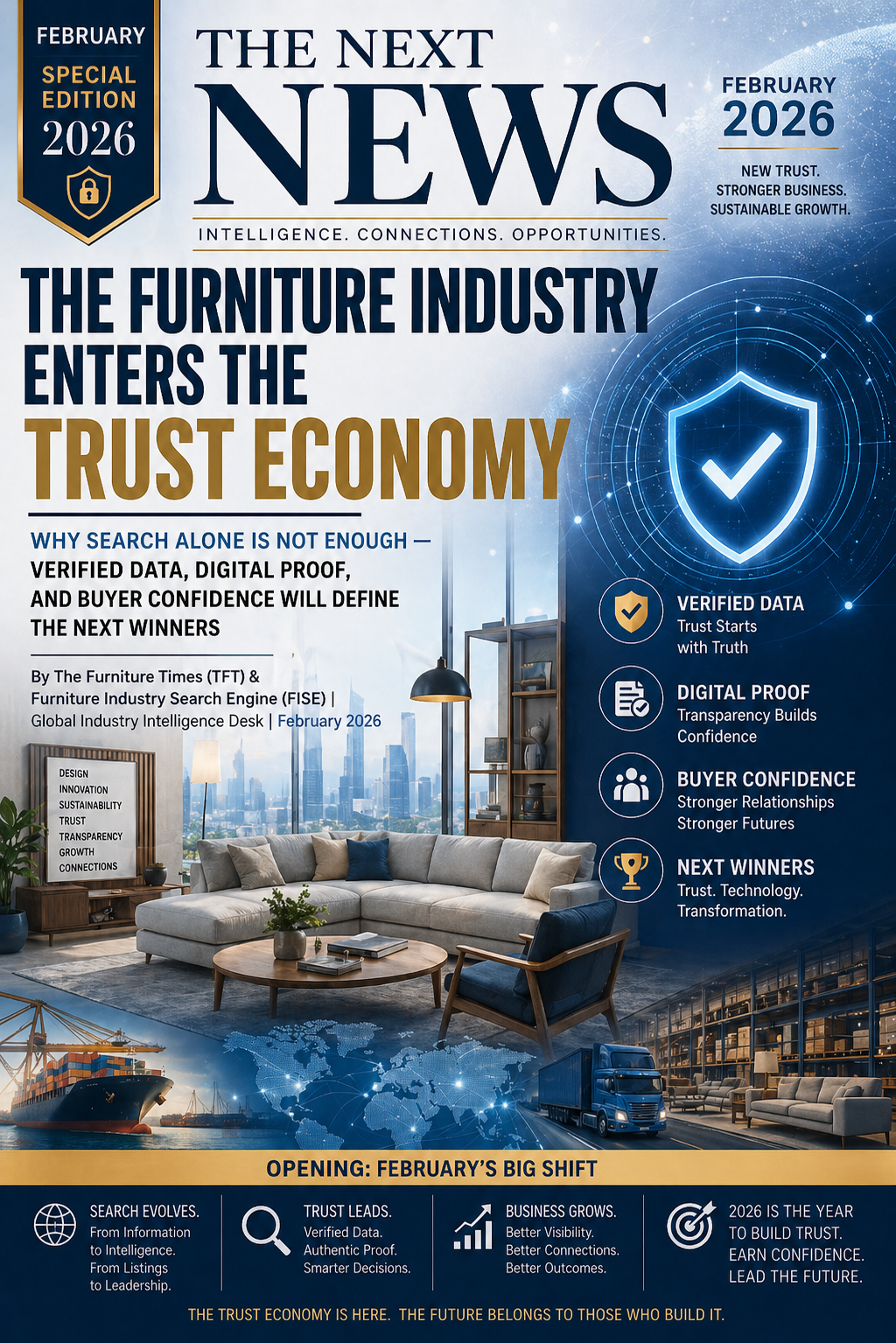
The Next News: The Furniture Industry Enters the Trust Economy
February Special Edition 2026
Why Search Alone Is Not Enough — Verified Data, Digital Proof, and Buyer Confidence Will Define the Next Winners
By The Furniture Times (TFT) & Furniture Industry Search Engine (FISE) | Global Industry Intelligence Desk | February 2026
Opening: February’s Big Shift
The January story was clear: the global furniture industry is entering the Visibility Economy.
The February story goes deeper:
Visibility without trust is not enough.
A furniture business may be found online, but if buyers cannot verify its credibility, product capability, location, experience, certifications, or delivery strength, that visibility does not convert into business.
The global furniture industry is still growing, with long-term forecasts showing continued expansion through 2035, but 2026 remains a high-pressure year because of tariffs, uneven demand, sustainability rules, and rising costs.
The February 2026 Health Check
1. Demand Is Active, but Buyers Are Cautious
The industry is not dead. Buyers still exist. Projects still exist. Retail demand still exists. But decision-making is slower because buyers are comparing more, negotiating harder, and avoiding risky suppliers.
Furniture manufacturers began 2026 with flat new orders and declining shipments, showing that demand is present but weak and uneven.
2. E-Commerce Is Growing, but Trust Is the Missing Layer
Online furniture commerce continues to grow faster than many traditional channels. One 2026 report values the e-commerce furniture market at USD 39.75 billion in 2026, projected to reach USD 51 billion by 2030.
But online growth creates a new challenge: buyers need better proof before they buy. Photos, websites, and social media posts are no longer enough.
3. Tariffs Are Forcing Supplier Re-Evaluation
Tariffs are pushing retailers and importers to review sourcing, pricing, and supplier relationships. Retailers selling furniture and other imported goods have already discussed tariff-related price increases and supply chain adjustments.
This means buyers are searching for alternative suppliers — but they need verified data before switching.
4. Global Giants Are Rebuilding Market Strategy
IKEA’s India expansion shows that major players are investing in markets with long-term growth potential, local sourcing, and online-first expansion. Meanwhile, IKEA’s China store changes show how even global furniture leaders are adapting to consumer shifts, smaller formats, and digital channels.
The lesson is clear: even the biggest companies are redesigning their visibility, retail, and trust strategy.
The February Bottom Line
The furniture industry’s next challenge is not only:
Can buyers find you?
It is:
Can buyers trust you fast enough to choose you?
That is the new bottom line.
The Industry’s Trust Problems
1. Supplier Information Is Incomplete
Many furniture businesses do not clearly show:
Product categories.
Factory capability.
Export markets.
Project history.
Certifications.
Contact details.
Delivery regions.
Business registration.
Real images and videos.
This slows down buyer confidence.
2. Generic Search Does Not Verify Industry Credibility
A buyer may find 50 suppliers through search, but still not know who is serious, active, experienced, export-ready, or project-capable.
3. Trade Fairs Are Powerful but Not Enough
Trade fairs create relationships, but they happen at fixed times and places. The industry needs a permanent digital trust layer that works every day.
4. SMEs Are Most Affected
Small and medium furniture businesses often have good products but weak digital proof. They lose opportunities not because they lack capability, but because buyers cannot verify them quickly.
Deep Analysis: The Furniture Industry Is Moving from Search to Verified Discovery
The future of furniture discovery has three stages:
Stage 1: Search
Can the business be found?
Stage 2: Trust
Can the business be verified?
Stage 3: Conversion
Can the buyer contact, compare, and decide quickly?
Most of the furniture industry is stuck at Stage 1.
FISE must move the industry into Stage 2 and Stage 3.
How FISE Solves the February Problem
1. Verified Business Profiles
FISE should create structured company profiles with:
Company name.
Country and city.
Business category.
Product specialization.
Website.
WhatsApp/email.
Factory/showroom status.
Export markets.
Years in business.
Project experience.
Certifications.
Photos and catalogue links.
2. FISE Trust Score
FISE should introduce a simple trust score based on profile completeness and verification.
Suggested trust levels:
Basic Listed — company appears in FISE.
Profile Complete — full product and contact details added.
Contact Verified — email/phone/WhatsApp verified.
Business Verified — registration or website checked.
Export Ready — export markets, capacity, and compliance shown.
Project Ready — portfolio and commercial project experience listed.
3. Category-Based Trust Pages
Instead of only listing companies, FISE should create high-intent pages:
Verified outdoor furniture suppliers in Malaysia.
Verified hotel furniture manufacturers in Vietnam.
Verified office furniture suppliers in China.
Verified kitchen cabinet manufacturers in India.
Verified furniture exporters in Turkey.
Verified luxury furniture brands in Italy.
4. Buyer Inquiry System
FISE should allow buyers to send structured inquiries:
Product needed.
Quantity.
Country.
Budget range.
Delivery timeline.
Project type.
Certification requirements.
This converts FISE from a search platform into a lead-generation engine.
5. AI Supplier Matching
The next phase should allow buyers to type a business need and receive matched suppliers.
Example:
“I need 500 outdoor dining chairs for a hotel project in Dubai.”
FISE should suggest relevant suppliers by category, region, verification level, and contact readiness.
Recommendations for February 2026
For FISE
Launch the Verified Discovery Roadmap:
Month 1: Build 10,000 priority listings.
Month 2: Add profile completion scoring.
Month 3: Launch verified badges.
Month 4: Launch buyer inquiry forms.
Month 5: Launch AI supplier matching.
Month 6: Publish the FISE Global Furniture Trust Index.
For TFT
Publish a monthly editorial series:
“The Trust Economy of Furniture”
Suggested articles:
Why Buyers Do Not Trust Unknown Furniture Suppliers.
The Hidden Cost of Incomplete Business Profiles.
How Verified Discovery Can Transform Furniture Exports.
Why SMEs Need Digital Proof More Than Ever.
The Future of Furniture Search: From Listings to Intelligence.
For Furniture Businesses
Every company should prepare a digital trust kit:
Company profile.
Product catalogue.
Factory or showroom photos.
Export capability.
Client/project references.
Certifications.
Clear contact details.
Delivery and production information.
Founder or leadership background.
Website and social links.
For Buyers
Do not depend only on random search. Use structured supplier discovery, compare verified profiles, and request proof before placing orders.
TFT Editorial View
February 2026 marks the rise of the Furniture Trust Economy.
In the past, companies won because they could manufacture.
Then they won because they could be found.
Now they will win because they can be trusted quickly.
The next competitive advantage is not only visibility.
It is verified visibility.
The Final Bottom Line
The global furniture ecosystem does not only need more listings.
It needs clean data, verified profiles, searchable categories, buyer confidence, and faster decision-making.
That is the role FISE can own.
TFT is where the industry is understood.
FISE is where the industry is found.