
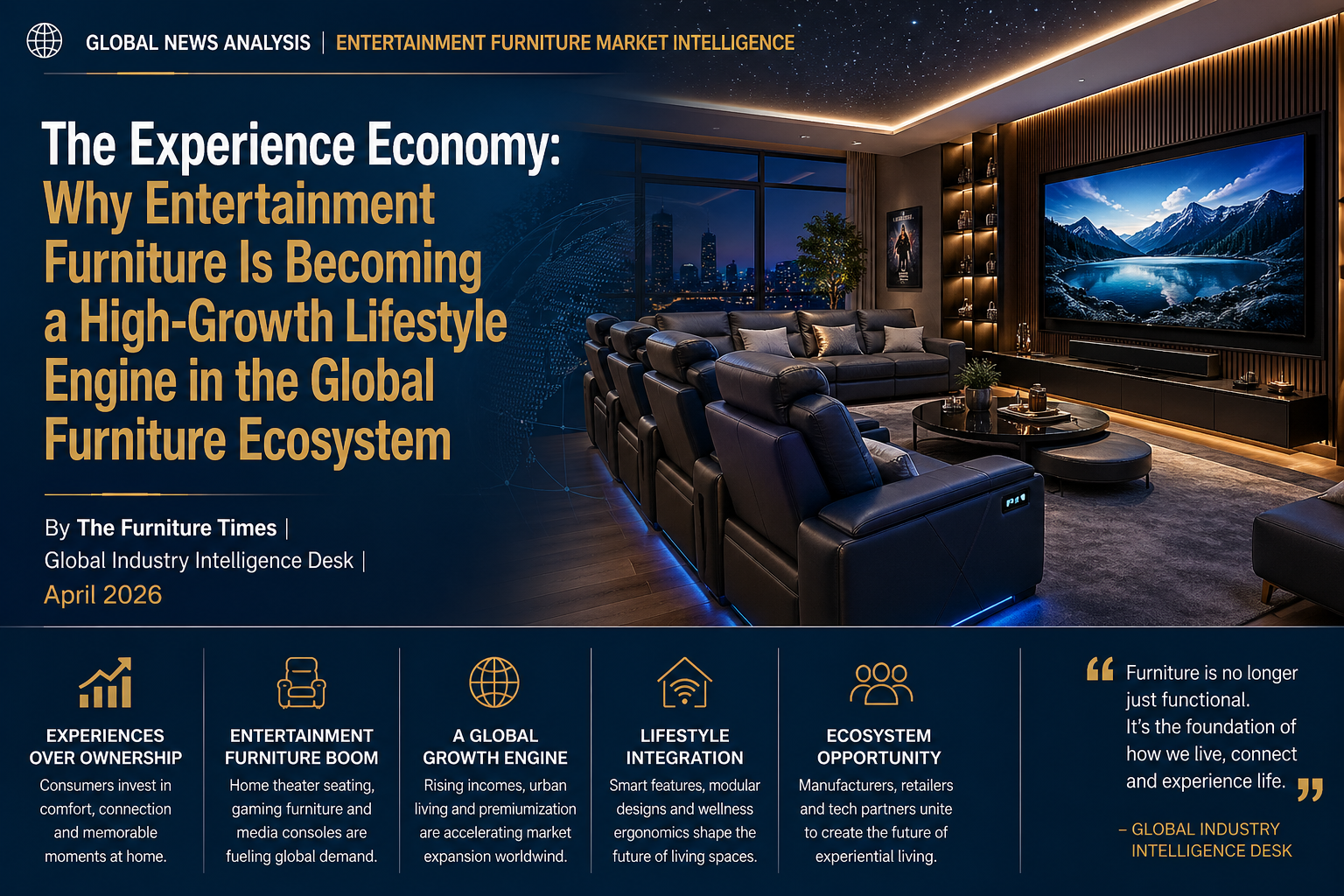
The Experience Economy: Why Entertainment Furniture Is Becoming a High-Growth Lifestyle Engine in the Global Furniture Ecosystem
Global News Analysis | Entertainment Furniture Market Intelligence
By The Furniture Times | Global Industry Intelligence Desk | April 2026
Introduction: Furniture for the Digital Lifestyle
The global furniture industry is undergoing a lifestyle transformation—and at the center of it is a fast-evolving category:
Entertainment furniture
From TV units and media consoles to gaming setups, home theatre seating, and smart storage systems, entertainment furniture is no longer just functional—it is becoming a core part of how people experience content, relax, and interact with technology.
Market Snapshot: A Fast-Growing Lifestyle Segment
The global entertainment furniture market is expanding steadily:
- Estimated at ~$23–24 billion in 2024–2025
- Expected to reach ~$35 billion by 2030
- Growing at ~6.5% CAGR
Long-term projections suggest the market could reach ~$44–48 billion by 2034–2035, reinforcing its strong growth trajectory
The Big Picture: Why Entertainment Furniture Is Rising
1. The Explosion of Digital Entertainment
The global entertainment and media industry is projected to reach $3.5 trillion by 2029, driven by streaming, gaming, and digital platforms
This massive growth directly impacts furniture demand:
- More screen time → more living room focus
- More gaming → specialized setups
- More streaming → home theatre environments
Furniture is becoming part of the entertainment infrastructure.
2. The Rise of the “Home Experience Economy”
Homes are no longer just living spaces—they are:
- Cinemas
- Gaming hubs
- Social spaces
- Work + entertainment hybrids
This drives demand for:
- TV consoles and media walls
- Recliner seating and lounge sofas
- Gaming desks and ergonomic chairs
- Storage for devices and accessories
3. Gaming Culture Driving New Demand
Gaming is one of the fastest-growing entertainment segments globally.
This creates demand for:
- Gaming chairs
- Adjustable desks
- Multi-screen setups
- Cable management furniture
Furniture is now designed specifically for performance, comfort, and long usage hours.
4. Smart Homes & Technology Integration
Entertainment furniture is evolving into:
- Smart storage systems
- Integrated lighting units
- Cable and device management hubs
- Voice-enabled furniture setups
This is transforming furniture into a technology-support platform.
5. Urban Living & Space Optimization
With smaller living spaces:
- Furniture must be multi-functional
- Storage must be integrated
- Design must be compact
Entertainment furniture is adapting to:
Space efficiency + aesthetics + functionality
Market Structure: Where Growth Is Happening
Product Categories
Entertainment furniture includes:
- TV stands and media consoles
- Entertainment centers
- Home theatre seating
- Gaming furniture
- Wall-mounted units
- Storage systems
Media cabinets alone represent a major sub-market, valued at ~$11.5 billion in 2026, expected to reach ~$17 billion by 2033
End-User Segments
- Residential → largest segment
- Commercial (gaming lounges, co-working spaces, entertainment zones) → growing rapidly
Regional Insights
- North America & Europe → high-value markets
- Asia-Pacific → fastest growth (urbanization + digital adoption)
The Hidden Challenges
Despite strong growth, the entertainment furniture market faces critical issues:
1. Rapid Technology Change
Furniture must adapt to:
- New screen sizes
- New devices
- New formats
This creates constant redesign pressure.
2. High Competition
Thousands of manufacturers compete globally with:
- Similar products
- Limited differentiation
- Price pressure
3. Short Product Cycles
Unlike traditional furniture:
- Trends change quickly
- Designs become outdated faster
- Consumer preferences evolve rapidly
4. Fragmented Discovery
Here is the deeper issue:
Buyers want solutions—but discovery is still unstructured.
- Suppliers are scattered
- Categories are unclear
- Comparisons are difficult
The Real Problem: The Entertainment Search Gap
The entertainment furniture segment highlights a core industry weakness:
High demand + high innovation ≠ efficient discovery
This leads to:
- Lost sales opportunities
- Slow sourcing decisions
- Weak global visibility for suppliers
- Inefficient buyer journeys
TFT Deep Analysis: The Industry Is Entering the Experience Economy
Entertainment furniture is evolving through three phases:
Phase 1: Functional Storage
TV units and cabinets
Phase 2: Lifestyle Design
Aesthetic and interior-focused solutions
Phase 3: Experience & Intelligence (Next Phase)
Driven by:
- Smart furniture
- Gaming integration
- AI-driven personalization
- Data-led design
Strategic Solutions: What the Industry Must Do
1. Build Category-Based Visibility
Suppliers must clearly define:
- TV console manufacturers
- Home theatre furniture suppliers
- Gaming furniture brands
- Media storage system providers
2. Move Toward Experience-Based Selling
The future is not just products—but:
- Complete entertainment setups
- Living room design solutions
- Gaming environment systems
3. Integrate Technology & Design
Winning products will combine:
- Smart features
- Cable management
- Lighting integration
- Ergonomic comfort
4. Strengthen Digital Discovery
This is the biggest gap.
The industry needs:
- Structured supplier databases
- Category-based search
- Verified profiles
- Global visibility systems
Role of FISE: The Missing Infrastructure
The entertainment furniture market clearly shows:
There is no global search engine for structured furniture discovery.
Furniture Industry Search Engine (FISE) can solve this by enabling:
- Global entertainment furniture supplier listings
- Category-based search (TV units, gaming, home theatre)
- Country-level discovery
- Verified supplier profiles
- AI-powered buyer-supplier matching
Example Use Case
A retailer searching for:
“Modern TV console manufacturers with smart storage features in Southeast Asia”
Today:
- Scattered sourcing
- Limited comparison
With FISE:
- Structured discovery
- Verified suppliers
- Faster decision-making
Key Takeaways (April 2026)
1. Entertainment Furniture Is a High-Growth Segment
Driven by digital lifestyle and home entertainment
2. The Experience Economy Is Driving Demand
Homes are becoming entertainment hubs
3. Gaming & Technology Are Major Drivers
New product categories are emerging
4. Innovation Cycles Are Faster
Design and technology evolve quickly
5. Discovery Remains Weak
Search and supplier visibility are fragmented
Conclusion: Furniture for the Digital Generation
Entertainment furniture is no longer optional—it is becoming a core lifestyle category.
It connects:
- Technology
- Design
- Comfort
- Digital behavior
- Consumer experience
But to unlock its full potential, the industry must evolve from:
Product-driven → Experience-driven → Intelligence-driven
Final Thought
The future of furniture is not just about living.
It is about experiencing.
And the next phase will be defined by:
Search + Trust + Technology + Experience + Intelligence
