
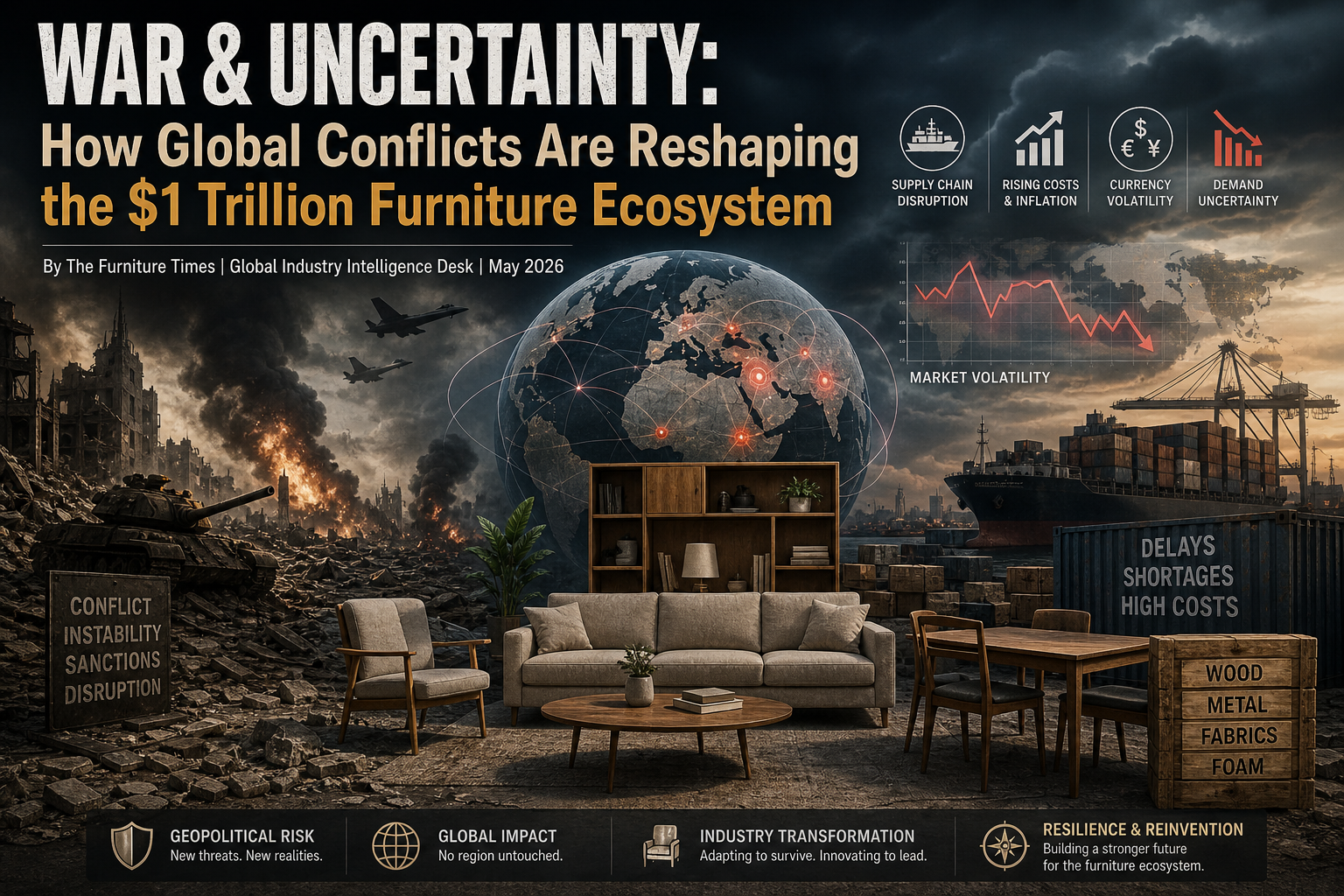
War & Uncertainty: How Global Conflicts Are Reshaping the $1 Trillion Furniture Ecosystem
Global Crisis Analysis | Furniture Industry Intelligence
By The Furniture Times | Global Industry Intelligence Desk | May 2026
Introduction: When War Reaches the Supply Chain
The world is witnessing multiple geopolitical tensions and armed conflicts across regions—from Eastern Europe to the Middle East and beyond. While these conflicts dominate headlines in terms of politics and security, their economic ripple effects are deeply transforming global industries.
One of the most impacted—yet least discussed—is:
The global furniture industry ecosystem
From raw materials to manufacturing, logistics, retail, and final consumption, war is reshaping how furniture is produced, priced, moved, and sold.
The Big Picture: A Fragile Global Ecosystem
The global furniture industry operates through:
Cross-border supply chains
Multi-country manufacturing
Global logistics networks
Export-import dependencies
War disrupts all four simultaneously.
The furniture industry is not local anymore—it is deeply global.
And global conflict creates global consequences.
Impact Layer 1: Raw Materials Shock
1. Wood, Metal, Foam & Fabric Disruptions
War zones and geopolitical tensions affect:
Timber exports
Steel and aluminum production
Chemical supply chains (used in foam, adhesives, coatings)
Textile and fabric sourcing
Result:
Raw material shortages
Price volatility
Increased production costs
Impact Layer 2: Supply Chain Breakdown
2. Logistics Disruption & Shipping Instability
Conflicts affect:
Shipping routes
Ports and transit corridors
Fuel prices
Insurance costs
Key Effects:
Delayed shipments
Higher freight costs
Reduced reliability
A sofa produced in Asia and shipped to Europe or the U.S. now faces higher risk, longer timelines, and increased cost.
Impact Layer 3: Manufacturing Pressure
3. Factory Slowdowns & Relocation
Manufacturers are facing:
Labour shortages (migration, instability)
Energy cost increases
Unpredictable supply of materials
Strategic Response:
Diversifying production locations
Moving factories to safer regions
Increasing automation
Impact Layer 4: Sellers (Manufacturers & Exporters)
4. Margin Compression & Market Uncertainty
Furniture sellers are facing:
Rising production costs
Uncertain delivery timelines
Currency fluctuations
Reduced international demand in affected regions
Result:
Lower profit margins
Delayed contracts
Increased business risk
Impact Layer 5: Buyers (Retailers, Developers, Projects)
5. Procurement Complexity
Buyers—including:
Retailers
Hospitality groups
Real estate developers
Government projects
are struggling with:
Supplier reliability
Price instability
Longer procurement cycles
Result:
Project delays
Budget overruns
Limited supplier options
Impact Layer 6: Consumers
6. Rising Prices & Changing Behavior
War impacts consumers through:
Inflation
Reduced disposable income
Economic uncertainty
Behavioral Shift:
Delayed furniture purchases
Preference for budget or essential items
Increased demand for durable products
The consumer mindset shifts from “lifestyle upgrade” to “financial caution.”
The Hidden Impact: Demand vs Confidence Gap
Here is the deeper issue:
Demand does not disappear—but confidence does.
Even when people need furniture:
They delay decisions
They reduce spending
They avoid large purchases
This creates a slowdown without collapse—a dangerous phase for businesses.
TFT Deep Analysis: The Industry Is Entering the Resilience Economy
The furniture industry is evolving through three crisis-driven phases:
Phase 1: Disruption
Supply chain breakdown and cost shocks
Phase 2: Adjustment
Relocation, cost control, supplier diversification
Phase 3: Resilience Economy (Next Phase)
Focus on:
Flexible supply chains
Multi-region sourcing
Faster decision-making
Data-driven procurement
The Real Problem: Visibility & Decision Delay
In times of war, one issue becomes critical:
Speed of decision-making
But the industry faces:
Fragmented supplier data
Lack of real-time visibility
Slow sourcing processes
This leads to:
Missed opportunities
Increased costs
Delayed recovery
Strategic Solutions: What the Industry Must Do Now
1. Diversify Supply Chains
Move from:
Single-region dependency → Multi-region sourcing
2. Strengthen Supplier Networks
Build relationships across:
Asia
Middle East
Europe
Emerging markets
3. Focus on Cost Efficiency
Optimize:
Materials
Logistics
Production processes
4. Accelerate Decision-Making
Businesses must:
Reduce sourcing time
Improve supplier comparison
Use data-driven tools
5. Build Digital Visibility Infrastructure
This is the most critical shift.
The industry needs:
Structured supplier databases
Verified business profiles
Category-based global search
Real-time discovery systems
Role of FISE: A Crisis-Era Infrastructure
In times of uncertainty, visibility becomes survival.
Furniture Industry Search Engine (FISE) can act as a critical infrastructure by enabling:
Global supplier discovery
Category-based sourcing
Verified supplier networks
Faster procurement decisions
Reduced dependency on limited supply chains
Example Use Case
A buyer searching for:
“Alternative furniture suppliers due to disrupted supply chain”
Today:
Slow and uncertain process
With FISE:
Immediate access to global suppliers
Faster comparison
Reduced risk
Key Takeaways (May 2026)
1. War Is Reshaping the Furniture Ecosystem
From materials to markets
2. Costs Are Rising Across the Value Chain
Raw materials, logistics, and production
3. Supply Chains Are Becoming Unstable
Reliability is now a major risk
4. Buyers & Consumers Are Becoming Cautious
Delayed decisions and reduced spending
5. Speed & Visibility Are Now Competitive Advantages
The faster you find solutions, the stronger you survive
Conclusion: From Crisis to Transformation
War creates disruption—but it also accelerates change.
The furniture industry is being forced to:
Rethink supply chains
Rethink sourcing
Rethink visibility
Final Thought
In times of war, industries don’t just survive—they evolve.
The global furniture ecosystem will not collapse.
It will transform.
And the winners will be those who adapt fastest by embracing:
Search + Speed + Diversification + Intelligence + Visibility
