
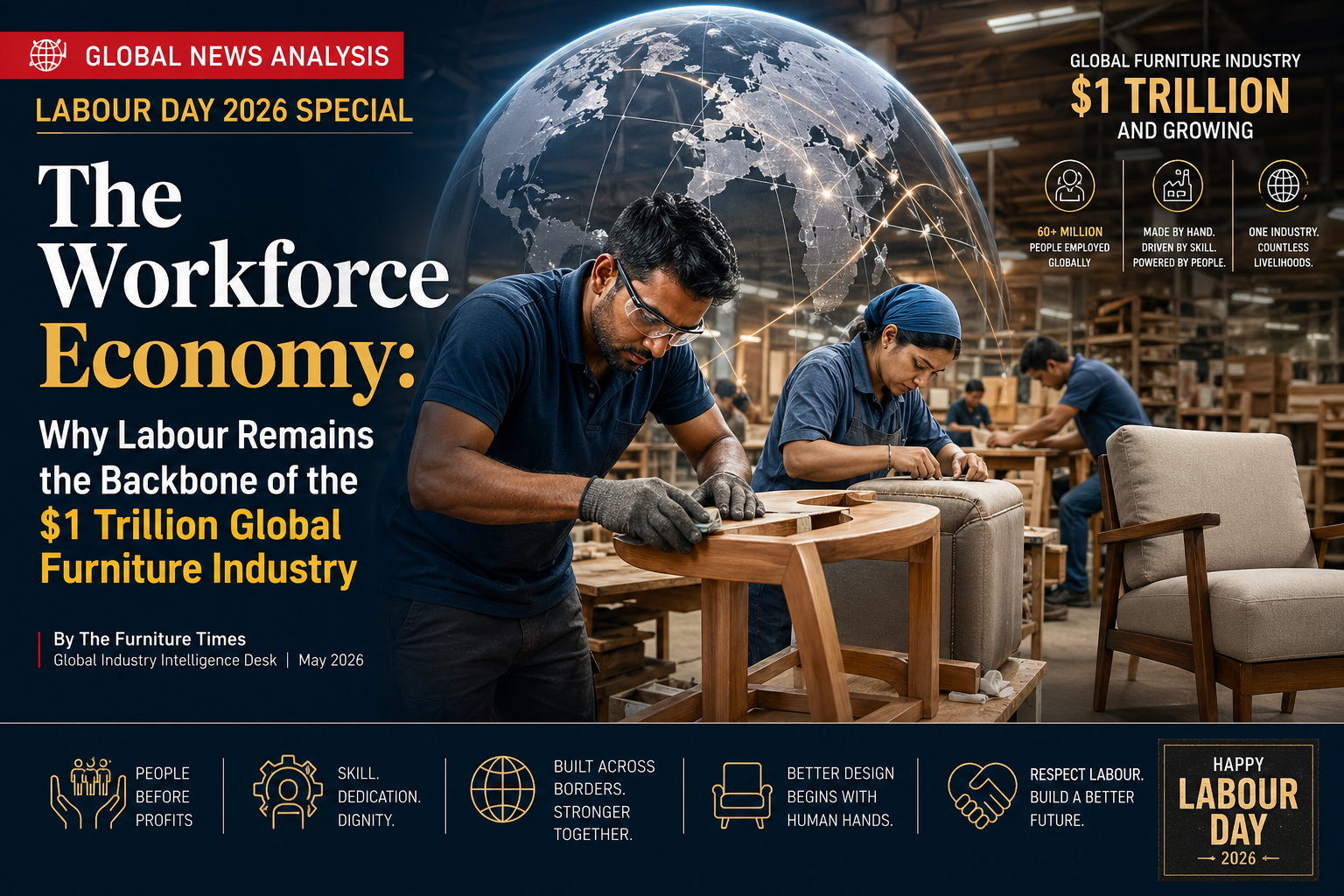
The Workforce Economy: Why Labour Remains the Backbone of the $1 Trillion Global Furniture Industry
Global News Analysis | Labour Day 2026 Special
By The Furniture Times | Global Industry Intelligence Desk | May 2026
Introduction: A Day That Defines the Industry
On Labour Day 2026, the world pauses to recognize the people who power every economy:
Workers — the builders, makers, operators, and creators of value.
In the global furniture industry, labour is not just a factor of production.
It is the foundation of craftsmanship, manufacturing, logistics, installation, and innovation.
From a carpenter in a small workshop to a technician in a smart factory, from upholstery specialists to logistics handlers—labour defines the industry.
The Reality: A $1 Trillion Industry Built on Human Skill
The global furniture ecosystem—valued at over $1 trillion—is one of the most labour-intensive industries in the world.
It depends on:
- Skilled carpenters
- Upholstery experts
- Machine operators
- Designers and engineers
- Logistics and supply chain workers
- Installers and project teams
Unlike many industries, furniture is still deeply connected to human craftsmanship.
The Labour Shift: What Is Changing in 2026
1. Skill Gap Is Expanding Globally
One of the biggest challenges today:
There are not enough skilled workers.
Across regions:
- Traditional craftsmanship is declining
- Younger generations are moving away from manual trades
- Training systems are not keeping pace
This creates:
- Production delays
- Quality inconsistencies
- Rising labour costs
2. Automation vs Craftsmanship
The industry is moving toward:
- CNC machines
- Robotics
- Smart manufacturing
But here is the truth:
Furniture cannot be fully automated.
- Upholstery still needs human touch
- Finishing still requires craftsmanship
- Custom furniture depends on skilled labour
The future is not automation alone.
It is human + machine collaboration.
3. Labour Costs Are Reshaping Global Supply Chains
Rising wages in traditional manufacturing hubs are forcing companies to:
- Relocate production
- Diversify sourcing
- Invest in automation
Countries in Southeast Asia, South Asia, and Africa are becoming new manufacturing centers.
4. Informal Workforce Still Dominates
A large portion of the global furniture workforce operates in:
- Small workshops
- Home-based production
- Unorganized sectors
These workers often face:
- Low visibility
- Limited income stability
- Lack of global access
5. The Human Impact: Invisible Talent
Across the world:
- A carpenter in a village
- A craftsman creating handmade furniture
- A small workshop producing high-quality work
These individuals often remain:
Invisible to the global market
This is one of the biggest structural gaps in the industry.
The Labour Problem: Visibility, Access, and Opportunity
Here is the deeper issue:
The world has skilled labour—but the world cannot find it easily.
Workers and small businesses struggle to:
- Showcase their skills
- Reach global buyers
- Build stable income streams
At the same time, buyers struggle to:
- Find reliable skilled suppliers
- Access niche craftsmanship
- Discover local expertise globally
TFT Deep Analysis: The Industry Is Entering the Workforce Economy
The furniture industry is evolving across three labour phases:
Phase 1: Manual Craft Economy
Local production, limited scale
Phase 2: Industrial Production Economy
Factories, mass production
Phase 3: Workforce Intelligence Economy (Next Phase)
Driven by:
- Global labour visibility
- Skill-based discovery
- Digital inclusion
- Platform-based access
The Opportunity: Empowering the Global Workforce
Labour Day 2026 highlights a powerful opportunity:
To connect skilled workers with global demand
This includes:
- Carpenters
- Upholsterers
- Artisans
- Interior craftsmen
- Installation experts
- Small manufacturers
Role of FISE: Giving Visibility to the Workforce
One of the biggest gaps in the furniture industry is:
Lack of structured visibility for skilled labour
Furniture Industry Search Engine (FISE) can transform this by enabling:
- Global listing of skilled workers and small businesses
- Category-based skill discovery
- Location-based search
- Direct buyer-supplier connections
- Inclusion of informal and rural artisans
Example Use Case
A buyer searching for:
“Custom handcrafted wooden furniture maker”
Today:
- Limited discovery
- Localized access
With FISE:
- Global search
- Verified profiles
- Direct connection to skilled labour
Strategic Recommendations
1. Recognize Labour as Core Infrastructure
Labour is not a cost—it is a value driver
2. Invest in Skill Development
Training programs must evolve with modern needs
3. Digitize Workforce Visibility
Workers must be discoverable globally
4. Empower Small & Informal Workers
Bring them into the global ecosystem
5. Build Human-Centric Industry Systems
Technology must support—not replace—labour
Key Takeaways (Labour Day 2026)
1. Labour Is the Backbone of the Furniture Industry
Without skilled workers, production stops
2. Skill Gaps Are Growing
Training and talent shortages are increasing
3. Automation Cannot Replace Craftsmanship
Human skill remains essential
4. Millions of Workers Remain Invisible
Lack of visibility limits growth
5. The Future Is Workforce Intelligence
Connecting skills with demand globally
Conclusion: A Day of Recognition—and Action
Labour Day is not just about celebration.
It is about reflection.
The global furniture industry must ask:
- Are workers visible?
- Are skills valued?
- Are opportunities accessible?
Final Thought
Behind every piece of furniture is a human story.
A craftsman. A worker. A creator.
On Labour Day 2026, the industry must recognize:
If labour is invisible, the industry cannot grow fully.
The future of the furniture ecosystem will be defined by:
Search + Skill + Inclusion + Opportunity + Intelligence
