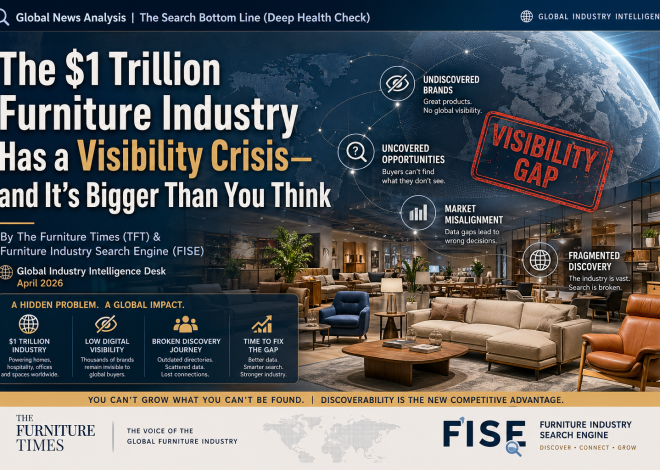
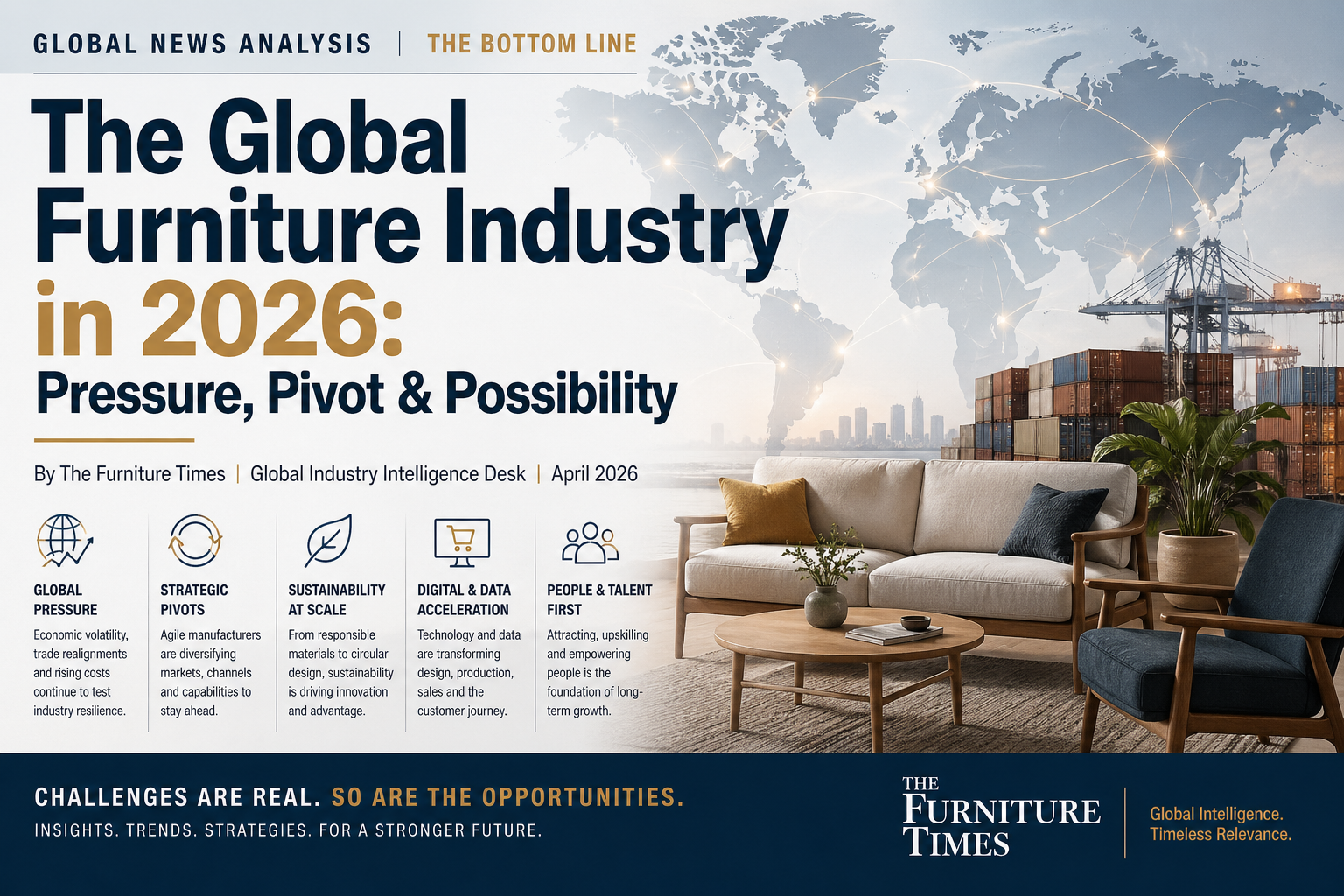
Global News Analysis | The Bottom Line
The Global Furniture Industry in 2026: Pressure, Pivot & Possibility
By The Furniture Times | Global Industry Intelligence Desk | April 2026
Introduction: The Bottom Line Is No Longer Simple
For decades, the furniture industry operated on a straightforward bottom line:
Produce → Ship → Sell → Profit
In 2026, that model broke.
Today, the bottom line of the global furniture ecosystem is being redefined by a complex mix of economic pressure, geopolitical shifts, digital disruption, and changing consumer behavior.
This is no longer just an industry—it is a highly interconnected, high-risk, high-opportunity global system.
The Real Bottom Line: Margin Under Pressure
Across the world, furniture companies are facing one common reality:
Margins are shrinking
Driven by:
- Rising raw material costs (wood, foam, metals, fabrics)
- Increased labor and compliance costs
- Higher logistics and shipping expenses
- Tariffs and trade restrictions
- Discount-driven retail competition
Even companies reporting stable revenue are seeing profit compression.
Revenue is not the problem. Profitability is.
Demand Reality: Slowing, Shifting, Splitting
The demand story is no longer uniform.
1. Slowing Demand in Mature Markets
- The U.S. and Europe are seeing reduced furniture purchases
- Housing market slowdowns are impacting sales
- Consumers delaying big-ticket spending
2. Growth in Emerging Markets
- Southeast Asia, the Middle East, and Africa show long-term demand growth
- Urbanization and population expansion are driving need
3. Market Polarization
- Budget segment growing due to affordability pressure
- Premium segment growing due to lifestyle demand
- Mid-market is getting squeezed globally
Supply Chain Reset: The End of “Global Only”
The industry is moving away from pure globalization.
New Model:
- China + 1 strategy
- Rise of Vietnam, India, Indonesia, Malaysia
- Nearshoring to the U.S., Mexico, Eastern Europe
Why?
- Tariffs
- Risk diversification
- Faster delivery requirements
The bottom line is now influenced by where you produce, not just what you produce.
The Retail Reality: Survival Mode
Furniture retailers are facing one of their toughest cycles:
- Reduced footfall in physical stores
- High inventory costs
- Online competition intensifying
- Price sensitivity is increasing
Many retailers are:
- Closing underperforming outlets
- Moving to omnichannel models
- Offering financing and discounts to stimulate demand
Retail is no longer a sales channel—it is a battlefield.
The Digital Bottom Line: Visibility = Revenue
A new truth is emerging:
If your business is not visible, your business is not viable.
Digital transformation is no longer optional:
- SEO, AEO, GEO visibility
- Online catalogs and marketplaces
- Direct-to-consumer channels
- Social commerce and content-driven sales
Companies investing in digital discovery are:
- Gaining market share
- Reducing dependency on intermediaries
- Building stronger brand equity
The Consumer Shift: From Ownership to Value
Today’s customer is:
- More price-conscious
- More research-driven
- Less impulsive
- More focused on value
Key Behavioral changes:
- Delayed purchases
- Preference for modular, flexible furniture
- Increased interest in sustainability
- Growth of second-hand and rental furniture markets
The emotional impulse to buy has been replaced by rational evaluation.
The Global Risk Layer
The furniture industry is now directly impacted by:
- Trade wars and tariffs
- Regional conflicts
- Currency fluctuations
- Inflation cycles
- Environmental regulations
This means:
The bottom line is no longer controlled internally—it is influenced globally.
Winners vs Losers: The New Divide
Winners:
- Digitally visible brands
- Premium, design-led companies
- Efficient, automated manufacturers
- Diversified exporters
- Strong brand storytellers
Losers:
- Invisible businesses
- Overdependent exporters
- Low-margin manufacturers
- Traditional retailers without digital presence
- Companies slow to adapt
TFT Global Insight: The New Bottom Line Formula
The bottom line of the furniture industry in 2026 can be defined as:
Profit = Visibility + Speed + Adaptability + Positioning – Cost Pressure
This is the new equation.
Not just:
- Production efficiency
- Distribution scale
But:
- How fast you move
- How well you are seen
- How clearly you are positioned
The Strategic Shift: From Product to Platform
The industry is evolving from:
Product-driven → Platform-driven
Meaning:
- Businesses must integrate into ecosystems
- Data and networks matter more than inventory
- Connections drive growth
This is where the future lies:
- Industry platforms
- Search engines
- Data intelligence systems
The Bottom Line for 2026
The global furniture industry is not collapsing.
It is transforming.
But the bottom line is clear:
- Growth is harder
- Margins are tighter
- Competition is sharper
- Decisions matter more
Conclusion: A Defining Moment
The furniture industry is standing at a critical crossroads.
Those who:
- Adapt quickly
- Invest in visibility
- Build strong brands
- Understand global dynamics
Will not only survive—they will lead.
Those who don’t:
Will struggle to remain relevant.
Final Thought
The bottom line is no longer just profit.
It is survival, strategy, and positioning in a rapidly changing global ecosystem.