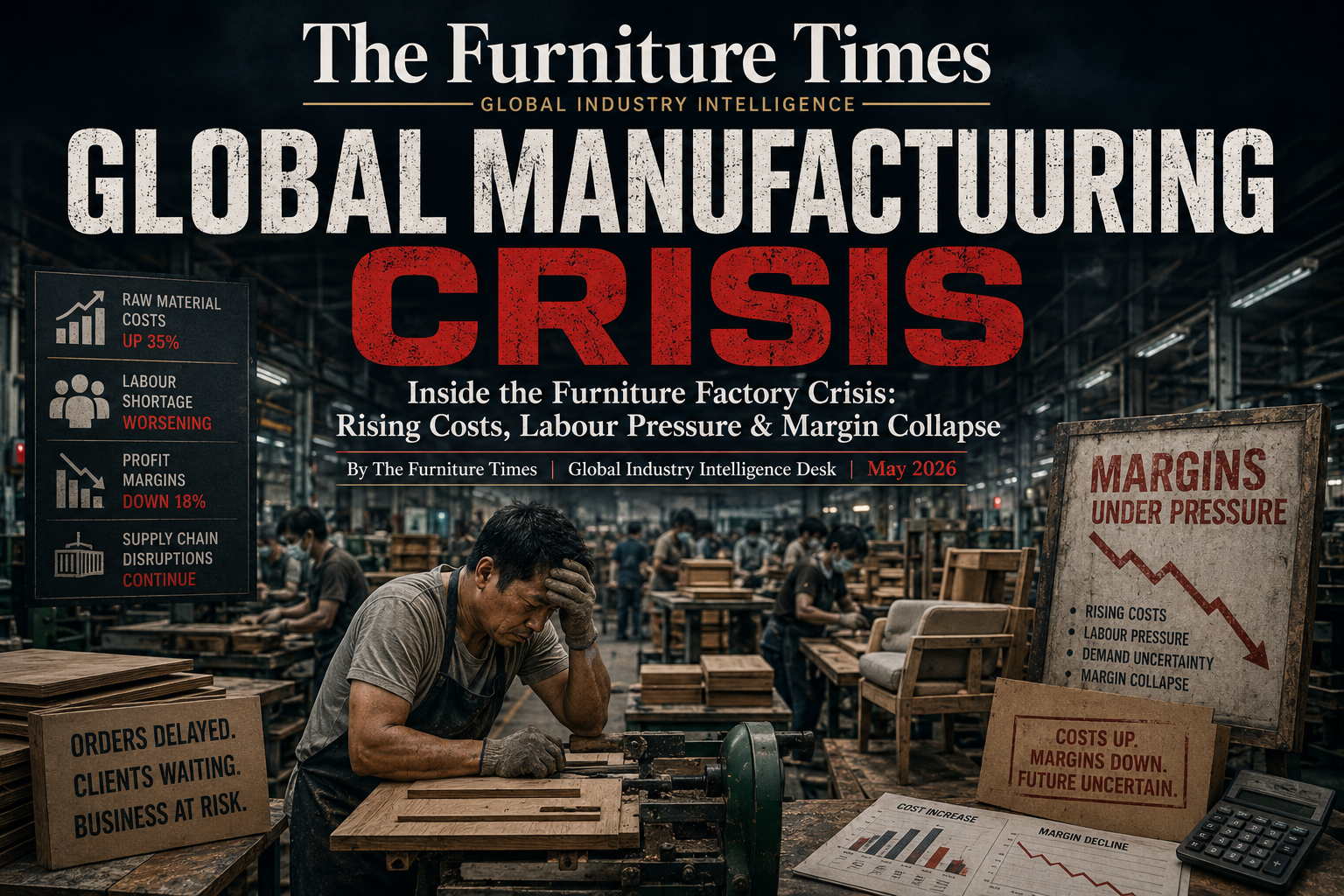
Inside the Furniture Factory Crisis: Rising Costs, Labour Pressure & Margin Collapse
Global Manufacturing Crisis | The Furniture Times
By The Furniture Times | Global Industry Intelligence Desk | May 2026
Behind every sofa, wardrobe, dining table, office workstation, hotel project, and custom interior system lies a factory fighting to survive a rapidly changing global economy.
The furniture industry may still appear active on the surface.
Factories are operating.
Containers are moving.
Products are still reaching showrooms.
But inside manufacturing floors across the world, a deeper crisis is unfolding.
Furniture factories are facing growing pressure from:
- rising energy costs
- labor shortages
- shrinking profit margins
- automation disruption
- supply-chain instability
- increasing operational complexity
For many businesses, survival itself has become a strategic challenge.
The modern furniture factory is no longer only battling competitors.
It is battling cost pressure from every direction.
The Global Factory Environment Has Changed
The traditional manufacturing model that powered the furniture industry for decades is under strain.
For years, many factories relied on:
- affordable labor
- predictable logistics
- stable energy pricing
- low operational volatility
That stability is disappearing.
What Factories Are Facing Today
Manufacturers globally are dealing with:
- expensive electricity
- fuel volatility
- rising wages
- worker shortages
- material uncertainty
- slower buyer payments
- pricing pressure from retailers
At the same time, customers still expect:
- fast delivery
- competitive pricing
- high quality
- customization
This is creating a dangerous imbalance. Costs are rising faster than margins.
1. Energy Costs Are Reshaping Manufacturing Economics
Furniture manufacturing depends heavily on energy.
Factories require power for:
- CNC machinery
- cutting systems
- compressors
- finishing lines
- drying systems
- warehouse operations
- logistics movement
Why Energy Matters So Much
Even small increases in electricity or fuel prices can dramatically affect:
- production costs
- delivery expenses
- machinery operation
- profitability
The Pressure Is Global
Factories in:
- Asia
- Europe
- the Middle East
- Africa
are all experiencing varying levels of energy uncertainty.
The Hidden Impact
Higher energy costs affect:
- factory pricing
- production scheduling
- investment decisions
- hiring capacity
Energy has become one of the most important cost variables in modern furniture manufacturing.
2. Worker Shortages Are Becoming a Structural Problem
The furniture industry is highly dependent on skilled labor.
Factories require:
- carpenters
- upholsterers
- polishers
- machine operators
- installers
- warehouse staff
- technical specialists
But Global Labour Pressure Is Rising
Many factories now struggle to:
- recruit workers
- retain skilled labor
- train new talent
- replace aging workforce segments
Why This Is Happening
Several trends are colliding:
Younger generations are avoiding factory work
Migration patterns are changing
Living costs are increasing
Technical skills are becoming harder to replace
SMEs Are Hit Hardest
Large factories may absorb labor shortages through:
- automation
- better salaries
- larger recruitment networks
Smaller factories often cannot.
The industry is not only facing a labour shortage. It is facing a skills continuity crisis.
3. Automation Pressure Is Accelerating
Automation is rapidly entering furniture manufacturing.
Factories are increasingly adopting:
- CNC systems
- robotic handling
- automated cutting
- smart warehouse systems
- AI-assisted production planning
Why Automation Is Growing
Manufacturers are trying to solve:
- labour shortages
- operational inefficiency
- rising wages
- quality consistency
The Big Manufacturing Divide
The industry is splitting into two groups:
Factories investing in automation
Factories struggling to modernize
This Creates Pressure on SMEs
Smaller businesses often face:
- limited capital
- slower technology adoption
- lower production efficiency
At the same time, they must compete against:
- larger automated factories
- faster production systems
- AI-driven manufacturing operations
Automation is no longer optional for many manufacturers. It is becoming a survival requirement.
4. Shrinking Margins Are Squeezing the Entire Industry
One of the biggest hidden problems in the furniture industry is margin collapse.
Factories are being squeezed from multiple directions simultaneously.
Rising Costs Include:
- wood
- foam
- steel
- fabric
- hardware
- freight
- electricity
- wages
But Buyers Still Demand Competitive Pricing
Retailers and buyers continue pushing for:
- lower costs
- faster delivery
- customization
- promotional pricing
This creates enormous pressure on manufacturers.
The Dangerous Result
Many factories are:
- operating on thinner margins
- delaying expansion
- reducing hiring
- cutting operational costs
Some factories are producing more… while earning less.
5. SME Survival Is Becoming a Major Industry Issue
The global furniture industry is built largely on SMEs.
These smaller businesses are critical because they:
- employ local workers
- preserve craftsmanship
- support regional economies
- supply larger export chains
But SMEs Face the Greatest Pressure
They often lack:
- large cash reserves
- financing access
- automation budgets
- diversified buyers
- strong digital visibility
The Risk
Without adaptation, many SMEs may struggle to survive:
- prolonged economic pressure
- rising operational costs
- digital transformation
- automation competition
The furniture ecosystem risks losing thousands of skilled small manufacturers if support systems do not improve.
6. The Factory of the Future Is Changing
The next-generation furniture factory may look very different.
Future factories are likely to focus on:
- automation
- smart production
- AI-assisted planning
- energy efficiency
- real-time monitoring
- integrated communication systems
Competitive Advantage Is Shifting
In the past:
- scale mattered most
Now:
- adaptability
- visibility
- efficiency
- digital infrastructure
- responsiveness
matter increasingly more.
7. Digital Visibility Is Becoming Critical for Factories
Many factories still depend heavily on:
- agents
- referrals
- exhibitions
- traditional networks
But buyers increasingly search digitally.
Factories that are:
- searchable
- visible
- verified
- responsive
gain stronger competitive positioning. The modern factory must now compete operationally and digitally at the same time.
TFT Deep Industry Insight
The furniture factory crisis is not a short-term problem.
It represents a structural transformation of global manufacturing.
The industry is moving from:
- labor-heavy systems
toward:
- intelligent production ecosystems
The Future Winners May Be Factories That Can Combine:
- manufacturing capability
- automation
- digital visibility
- communication infrastructure
- supply-chain flexibility
- operational resilience
Strategic Recommendations
For Manufacturers
Invest gradually in automation, efficiency, and digital infrastructure.
For SMEs
Focus on specialization, visibility, and connected ecosystems.
For Governments & Industry Bodies
Support workforce training, manufacturing modernization, and SME digital transformation.
For Industry Platforms
Factories increasingly require:
- discovery infrastructure
- communication systems
- lead generation
- supply-chain intelligence
Final Thought
The global furniture manufacturing sector is entering one of the most difficult transitions in its history.
Factories are no longer competing only on production.
They are competing on:
- resilience
- intelligence
- speed
- visibility
- operational efficiency
The factories that survive the next decade may not simply be the largest.
They may be the most adaptive.

Related Posts
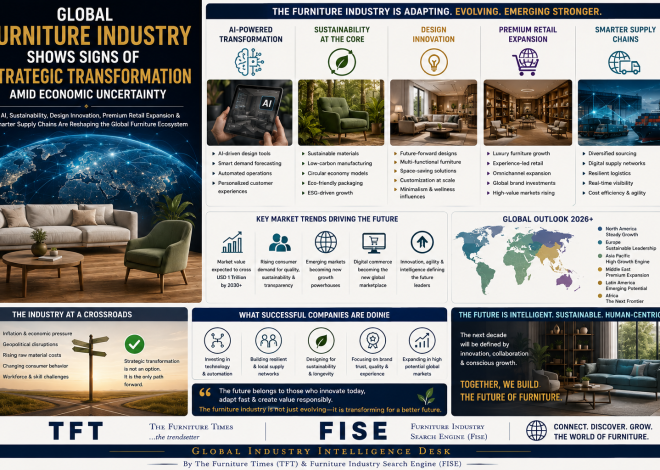
Global Furniture Industry Shows Signs of Strategic Transformation Amid Economic Uncertainty
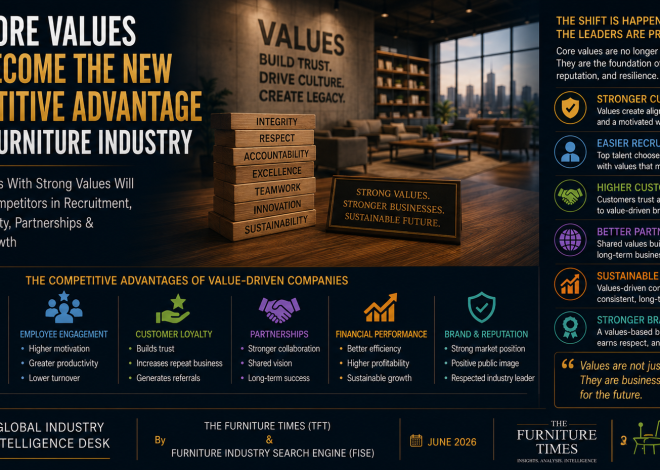
Why Core Values Will Become the New Competitive Advantage in the Furniture Industry