
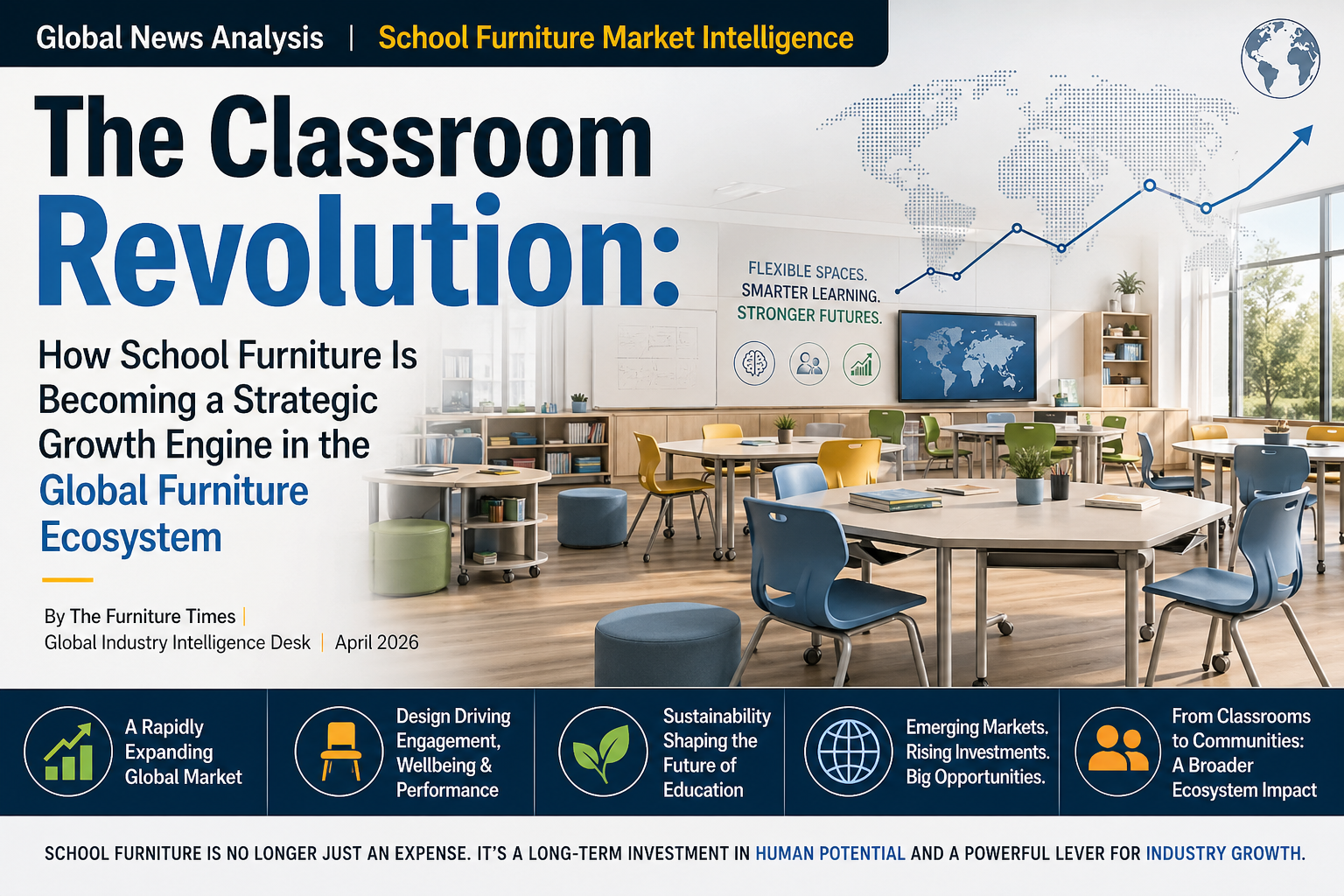
The Classroom Revolution: How School Furniture Is Becoming a Strategic Growth Engine in the Global Furniture Ecosystem
Global News Analysis | School Furniture Market Intelligence
The Classroom Revolution: How School Furniture Is Becoming a Strategic Growth Engine in the Global Furniture Ecosystem
By The Furniture Times | Global Industry Intelligence Desk | April 2026
Introduction: A Quiet but Powerful Segment
The global furniture industry often focuses on residential, office, or hospitality segments. But one of the most stable, long-term, and structurally important sectors is now gaining serious attention:
School furniture.
Driven by rising student populations, government investments, and evolving learning environments, this segment is becoming a strategic pillar of the global furniture ecosystem.
Market Snapshot: Strong, Stable Growth
The global school furniture market is showing steady expansion:
- Estimated at ~$5–7 billion in 2026
- Projected to reach $8–10+ billion by 2034
- Growing at a ~5–7% CAGR globally
This makes it a mid-sized but highly resilient segment—less volatile than residential furniture and more predictable due to institutional demand.
What Is Driving the Market
1. Global Expansion of Education Infrastructure
The biggest driver is simple:
- More schools
- More students
- More classrooms
Governments worldwide are investing heavily in education systems, especially in emerging markets, creating long-term demand for desks, chairs, storage, and lab furniture
2. Shift Toward Ergonomic Learning Environments
Modern education is no longer about static classrooms.
Schools now demand:
- Ergonomic chairs to prevent posture issues
- Adjustable desks
- Collaborative seating layouts
Comfort and health are becoming core procurement criteria, not optional features
3. Rise of Modular & Flexible Classrooms
Education systems are evolving toward:
- Group-based learning
- Flexible layouts
- Multi-use spaces
This is driving demand for:
- Modular furniture
- Lightweight, movable desks
- Stackable seating
4. Technology Integration in Classrooms
A major transformation is happening:
- Digital learning tools
- Tablets and laptops in classrooms
- Smart boards and connected systems
This creates demand for:
- Charging-enabled desks
- Tech-integrated furniture
- Storage solutions for devices
5. Growth in Emerging Markets
Regions like:
- Asia-Pacific
- Middle East
- Africa
Are seeing rapid growth due to:
- Urbanization
- Population growth
- Government education programs
Asia-Pacific alone is becoming a major growth engine for school furniture demand
Market Structure: Where the Opportunities Are
Product Segmentation
- Seating (chairs) → largest segment (~48% share)
- Desks & tables → core demand driver
- Storage & lab furniture → fastest-growing segments
Material Trends
- Wood remains dominant (~40%+ share)
- Plastic and polymers are growing fastest
- Metal remains key for durability
The Hidden Challenges
Despite stable growth, the industry faces serious structural issues:
1. Procurement Complexity
School furniture is often purchased through:
- Government tenders
- Institutional contracts
- Bulk procurement
This makes entry difficult for smaller suppliers.
2. Price Pressure vs Quality Demand
Schools want:
- Durable furniture
- Ergonomic design
- Affordable pricing
Balancing cost and quality are a major challenge.
3. Fragmented Global Supply Base
There is no unified global system for:
- School furniture suppliers
- Category-based sourcing
- Verified vendor selection
4. Digital Discovery Gap
Even in 2026:
- Buyers struggle to find suppliers globally
- Suppliers struggle to reach institutional buyers
- Product categories are not well structured online
The Real Problem: The Search Bottom Line in School Furniture
Here is the deeper issue:
Demand exists. Supply exists. But discovery is inefficient.
Schools, governments, and institutions often:
- Spend months sourcing suppliers
- Lack standardized comparison tools
- Face risks in supplier verification
This creates:
- Delayed projects
- Increased procurement costs
- Limited supplier competition
TFT Deep Analysis: From Institutional Demand to Intelligence Economy
The school furniture segment is evolving across three phases:
Phase 1: Infrastructure Growth
Driven by education expansion
Phase 2: Ergonomic & Design Shift
Driven by student well-being
Phase 3: Intelligence & Discovery (Next Phase)
Driven by data, search, and faster decision-making
Strategic Solutions: What the Industry Must Do
1. Build Category-Based Global Visibility
Suppliers must clearly position themselves:
- School desk manufacturers
- Classroom seating suppliers
- Laboratory furniture providers
- Educational storage system suppliers
Without clear categorization → lost opportunities
2. Focus on Institutional Readiness
Businesses must present:
- Project capability
- Bulk production capacity
- Certifications
- Compliance standards
This is critical for government and institutional buyers.
3. Invest in Ergonomic & Smart Design
Future demand will focus on:
- Adjustable furniture
- Tech-integrated desks
- Student health-focused designs
4. Strengthen Digital Procurement Systems
The industry needs:
- Structured supplier databases
- Verified vendor profiles
- Category-based search systems
- Global procurement intelligence
Role of FISE: The Missing Infrastructure
The school furniture segment highlights a major gap:
There is no dedicated global search system for educational furniture sourcing.
Furniture Industry Search Engine (FISE) can solve this by enabling:
- Global school furniture supplier listings
- Category-based search (desks, chairs, lab furniture)
- Country-level supplier discovery
- Verified supplier profiles
- AI-powered procurement matching
Example Use Case
A government agency searching for:
“School desk manufacturers for 50,000 students in Southeast Asia”
Today:
- Complex sourcing process
- Limited transparency
With FISE:
- Structured supplier discovery
- Verified profiles
- Faster procurement decisions
Key Takeaways (April 2026)
1. School Furniture Is a Stable Growth Segment
Driven by long-term institutional demand
2. Education Investment Is the Core Driver
Governments and institutions fuel the market
3. Ergonomics & Technology Are Redefining Design
Comfort and connectivity are key
4. Procurement Is Still Inefficient
Discovery and supplier matching remain weak
5. Intelligence Will Define the Future
Data, search, and speed will shape the next phase
Conclusion: Stability Meets Transformation
The school furniture market may not be the most glamorous segment—but it is one of the most important.
It represents:
- Long-term demand
- Government-backed growth
- Consistent procurement cycles
But to unlock its full potential, the industry must evolve from:
Supply-driven → Intelligence-driven
Final Thought
The classroom is changing.
And so is the furniture that supports it.
The future of school furniture will not be defined only by desks and chairs.
It will be defined by:
Search + Trust + Intelligence
