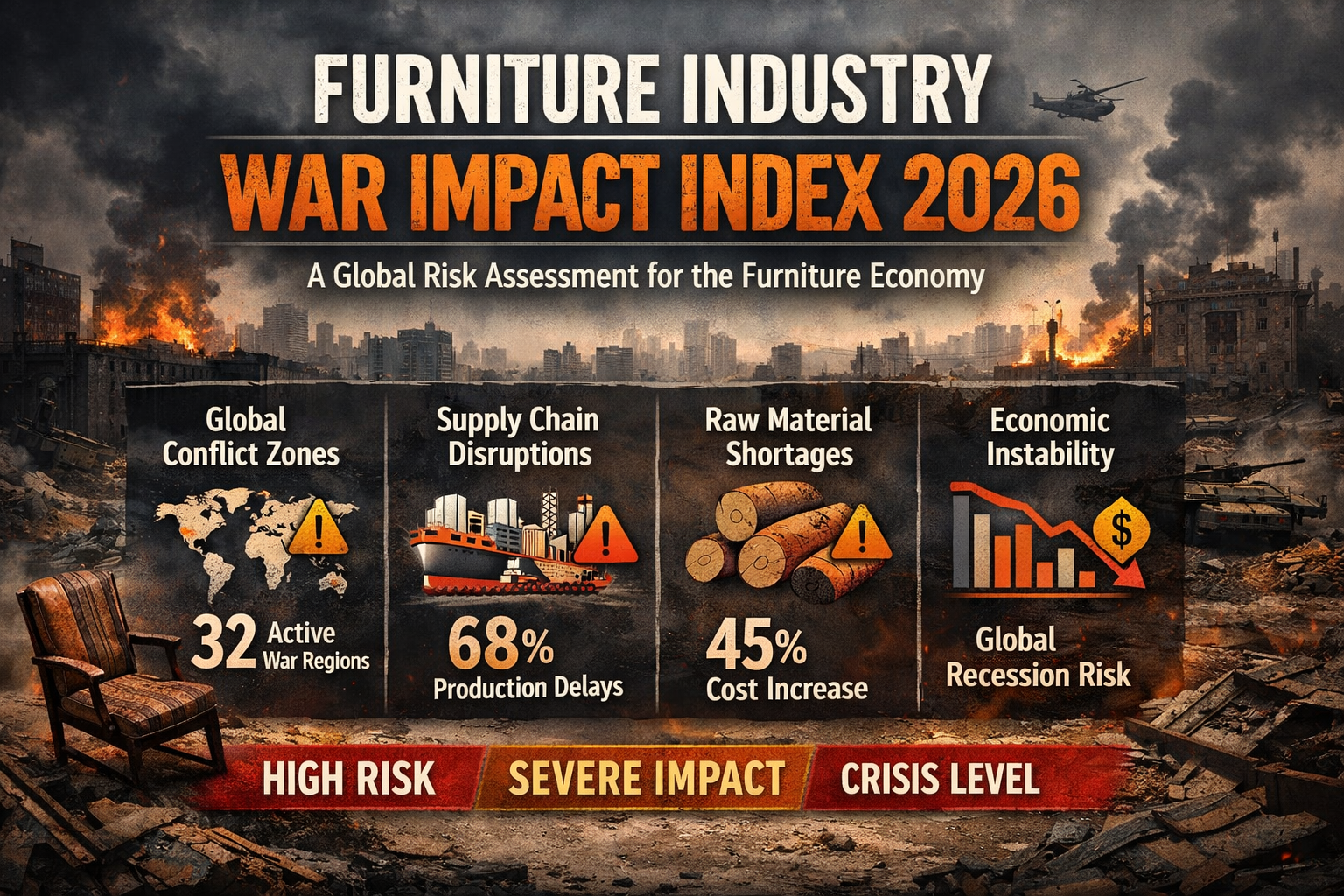
Furniture Industry War Impact Index 2026
A Global Risk Assessment for the Furniture Economy
Published by: The Furniture Times Research Desk
Executive Summary
The Furniture Industry War Impact Index 2026 is the first global analytical framework designed to measure how geopolitical conflicts influence the furniture economy.
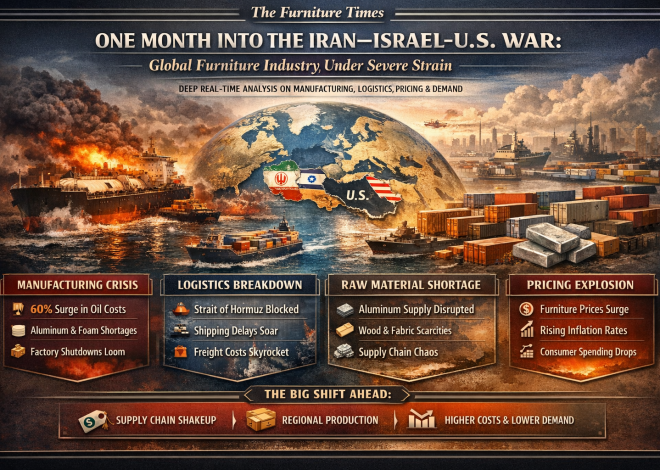
The current escalation involving the United States, Israel, and Iran has triggered serious concerns across global markets. While much attention has focused on energy and financial systems, the furniture sector—one of the largest consumer manufacturing industries in the world—faces a cascade of indirect risks.
Furniture manufacturing depends heavily on energy, logistics networks, housing markets, and consumer spending, making it highly sensitive to global instability.
The War Impact Index 2026 evaluates how these geopolitical developments may reshape the furniture industry across supply chains, production, trade, and retail markets.
Global Furniture Industry Exposure
The furniture industry is deeply integrated into the global economy:
Key Characteristics
• Highly international supply chains
• Energy-intensive manufacturing processes
• Heavy dependence on global logistics
• Strong correlation with housing and real estate markets
• Consumer discretionary spending driven demand
Because of these structural factors, geopolitical conflict can rapidly transmit shocks across the entire furniture ecosystem.
The War Impact Index Framework
The Furniture Industry War Impact Index (FIWII) measures risk across five key pillars.
1. Energy Dependency Risk
Furniture manufacturing requires significant energy for:
- timber processing
- kiln drying
- metal fabrication
- upholstery and foam production
Rising oil and gas prices directly increase production costs.
Risk Level 2026: HIGH
2. Logistics and Trade Disruption Risk
Global furniture supply chains depend on stable maritime and freight routes connecting Asia, Europe, and North America.
Conflict in the Middle East raises risks for:
- shipping insurance costs
- freight rates
- container availability
- shipping delays
Risk Level 2026: HIGH
3. Raw Material Volatility
Furniture production relies on materials tied to global commodity markets:
• steel
• aluminum
• petrochemical foams
• plastics
• coatings and adhesives
Geopolitical instability often triggers sudden commodity price spikes.
Risk Level 2026: MODERATE–HIGH
4. Consumer Demand Shock
Furniture purchases are highly sensitive to economic confidence.
Global conflict may lead to:
- inflation
- rising interest rates
- reduced consumer spending
- slower housing activity
Risk Level 2026: MODERATE
5. Construction and Real Estate Slowdown
Furniture demand is strongly linked to construction activity.
A prolonged conflict could delay:
- housing developments
- hospitality projects
- commercial real estate expansion
Risk Level 2026: MODERATE–HIGH
Global War Impact Score (2026)
| Risk Category | Score (1-10) |
| Energy Cost Exposure | 9 |
| Logistics Disruption | 8 |
| Raw Material Volatility | 7 |
| Consumer Demand Risk | 6 |
| Construction Slowdown | 7 |
Overall War Impact Score: 7.4 / 10 (High Risk)
Regional Risk Assessment
Asia-Pacific
Major manufacturing hub.
Risks include:
- export disruptions
- freight cost spikes
- supply chain delays
Impact Level: HIGH
Europe
Strong dependence on energy imports and international trade.
Impact Level: HIGH
North America
More resilient due to domestic markets but exposed to logistics costs.
Impact Level: MODERATE
Middle East
Direct geopolitical exposure.
Impact Level: VERY HIGH
Latin America
Opportunities may emerge for near-shoring production.
Impact Level: MODERATE
Potential Winners and Losers
Potential Winners
• regional manufacturers
• near-shore production hubs
• domestic furniture brands
Potential Losers
• export-dependent manufacturers
• energy-intensive factories
• long-distance logistics networks
Strategic Industry Shifts
The War Impact Index suggests several long-term structural changes.
Supply Chain Regionalization
Manufacturers may increasingly shift toward regional production clusters.
Material Innovation
Companies could accelerate adoption of:
- recycled materials
- low-energy manufacturing processes
- alternative foam technologies
Digital Supply Chain Monitoring
Advanced analytics and risk management tools may become essential.
The Furniture Times Perspective
For The Furniture Times, the Furniture Industry War Impact Index 2026 represents a new approach to understanding global risk in the furniture economy.
The industry has historically been viewed as a lifestyle and consumer goods sector. However, its deep connections to energy, logistics, construction, and global trade make it highly vulnerable to geopolitical disruption.
As conflicts reshape global markets, the furniture sector must adapt to a new reality where geopolitics becomes a central factor in business strategy.
The Furniture Industry War Impact Index aims to provide manufacturers, retailers, and investors with a strategic tool to anticipate risks and navigate an increasingly uncertain global landscape.